MISSION
VISION
OUR VALUES
To advance interdisciplinary research into the Mongol–Yuan maritime expeditions of 1281 and their historical, environmental, and cultural dimensions.
We bring together scholars from history, archaeology, environmental science, maritime studies, and related fields to examine evidence and deepen our understanding of the past.
To create an international platform where scholars and researchers can examine history through evidence, collaboration, and open scholarly inquiry.
Heavenly Wind 750 connects researchers across countries and disciplines to explore a shared chapter of Eurasian and East Asian history.
Evidence · Collaboration · Discovery
We distinguish documented evidence from interpretation, hypothesis, and historical memory. We encourage interdisciplinary research, open scholarly dialogue, and the examination of historical questions from multiple perspectives.
HEAVENLY WIND 750™ | TENGERIIN SALKHI 750™
2027–2031 INTERNATIONAL CONFERENCE & RESEARCH SERIES
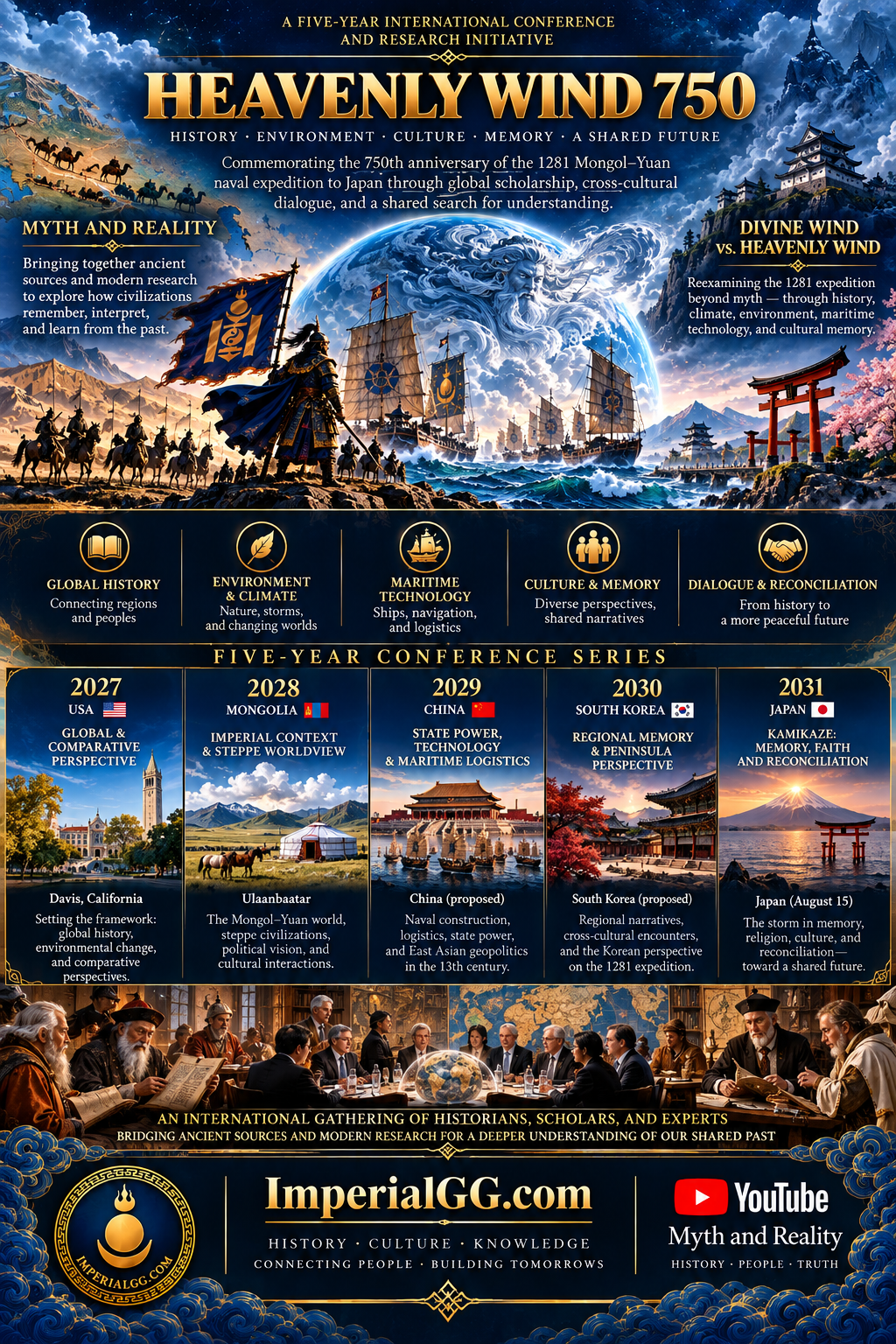
Heavenly Wind 750™ is a five-year international conference and research series examining the Mongol maritime expeditions of 1281 through history, archaeology, environmental studies, maritime research, and cultural memory. Beginning in the United States in 2027, the series will continue through Mongolia, China, South Korea, and Japan, culminating in 2031.
2027–2031 | United States · Mongolia · China · South Korea · Japan
HEAVENLY WIND 750: INTERNATIONAL CONFERENCE SERIES ANNOUNCED
By Altanbagana Baatar | DBA Candidate| Independent Historian
ImperialGG Historical Research Seriers
19 August 2026
RETHINKING THE MONGOL–YUAN MARITIME EXPEDITIONS OF 1281 THROUGH HISTORY, EVIDENCE, ENVIRONMENT
INTRODUCTION
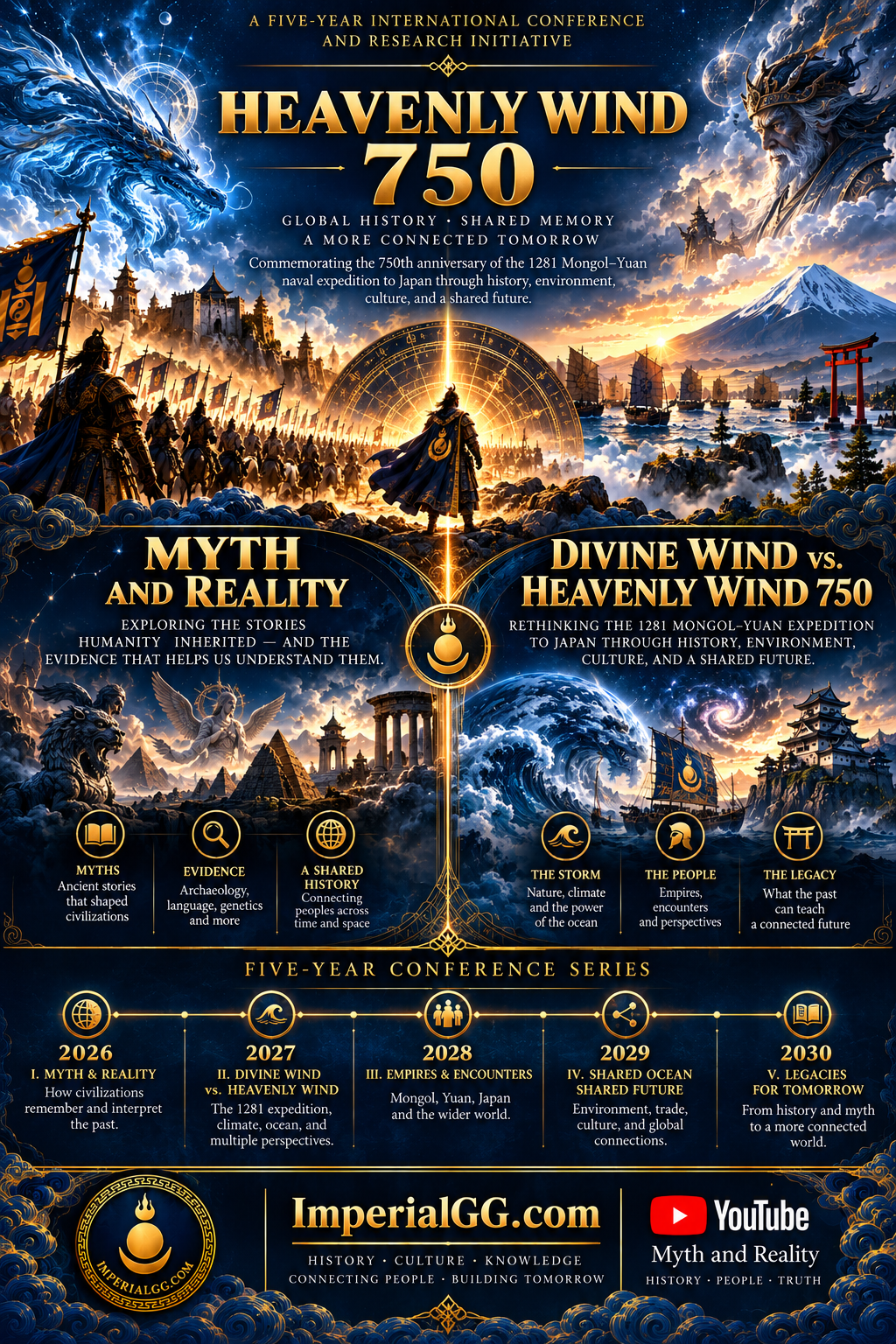
ImperialGG is pleased to announce Heavenly Wind 750™, a five-year international interdisciplinary conference and research initiative marking the 750th anniversary of the Mongol–Yuan maritime expedition of 1281 and examining the historical, environmental, military, political, technological, and cultural dimensions of the events associated with it.
Beginning in the United States in 2027 and continuing through Mongolia, China, South Korea, and Japan, the initiative is designed as a cumulative international research program rather than a sequence of independent commemorative conferences.
The series will bring together historians, archaeologists, maritime archaeologists, environmental and climate researchers, oceanographers, scholars of military and technological history, political historians, specialists in religion and cultural memory, philosophers, geographers, and researchers across the humanities and related disciplines.
Its central proposition is straightforward but consequential: the events of 1281 should be examined not only through the narratives and historical memories that developed around them, but also through the widest possible body of evidence available for understanding their causes, circumstances, and consequences.
The concept of Heavenly Wind therefore provides a methodological bridge between historical memory and evidence-based historical inquiry.
WHY 1281 MATTERS
The Mongol–Yuan expedition of 1281 represents one of the most complex encounters between imperial power, military organization, maritime technology, logistics, environmental conditions, and cultural memory in medieval East Asia. The campaign connected the Yuan imperial world, the Korean Peninsula, China, Japan, and the wider maritime environment of East Asia. Its scale required the mobilization of people, ships, supplies, military resources, administrative structures, and technological capabilities across a vast geographical area.
Yet the historical significance of 1281 extends beyond the military campaign itself. The events subsequently became deeply embedded in Japanese historical and cultural memory and became associated with the concept of kamikaze, commonly translated as “divine wind.” This tradition remains an important subject of historical and cultural study. At the same time, the existence of a powerful historical memory does not eliminate the need to investigate the underlying historical circumstances.
What happened in 1281?
What political decisions produced the expedition?
How were the forces mobilized and supplied?
What maritime technologies and logistical systems made the campaign possible?
What environmental and oceanic conditions affected the expedition?
What role did extreme weather play?
What evidence survives in archaeological and maritime contexts?
And how did later generations transform the memory and meaning of these events? These questions cannot be adequately answered by a single discipline.
FROM “DIVINE WIND” TO HEAVENLY WIND
The distinction between Divine Wind and Heavenly Wind is central to the intellectual concept of the initiative. Divine Wind refers to the historical and cultural tradition through which the Japanese term kamikaze became associated with the survival of Japan during the Mongol invasions. Heavenly Wind, by contrast, is used here as the name of a scholarly research framework.
The purpose is not to reject the kamikaze tradition, nor to substitute one predetermined explanation for another. Rather, the objective is to examine the historical event from multiple evidentiary perspectives and to distinguish between what can be documented, what can be reasonably interpreted, what remains hypothetical, and what belongs to later historical memory.
This distinction is essential to the study of complex historical events. Historical memory itself is evidence—but it is evidence of a particular kind. It can reveal how societies understood events, how religious and political meanings developed, how collective memory was transmitted, and how historical narratives changed across generations. At the same time, historical memory must be examined alongside written sources, archaeology, environmental records, technological evidence, and other forms of material evidence.
Thus, Heavenly Wind 750™ does not seek to replace myth with another myth. It seeks to place memory within a broader framework of historical investigation.
BEYOND A SINGLE HISTORICAL NARRATIVE
The initiative is founded upon the principle that no single national or disciplinary narrative can fully explain an event of the scale and complexity of the 1281 expedition.
Historical sources provide accounts of political decisions, military movements, individuals, and events. Archaeology provides material evidence. Maritime archaeology provides access to the physical remains of ships, weapons, cargo, and maritime activity. Environmental science can investigate past climatic and ecological conditions. Oceanography can contribute to the study of currents, storms, coastal environments, and maritime processes. Military history can examine strategy, organization, logistics, and mobilization. Technological history can investigate shipbuilding and military technologies.
Each field answers different questions. The purpose of interdisciplinary research is therefore not simply to place different disciplines next to one another, but to determine where their evidence can be meaningfully integrated. Where evidence agrees, confidence may increase. Where evidence conflicts, the disagreement itself becomes a subject of research. Where evidence is insufficient, the appropriate conclusion may be uncertainty rather than speculation. This approach is fundamental to the intellectual framework of Heavenly Wind 750™.
THE MONGOL–YUAN WORLD OF 1281
The expedition should also be understood within the wider political and economic structure of the Mongol–Yuan world. The Mongol imperial system connected territories across Inner Asia, China, Central Asia, the Middle East, and Eastern Europe, while the Yuan state developed within the eastern part of this wider imperial formation. The 1281 expedition therefore raises questions extending beyond the battlefield.
How did imperial decision-making operate?
How were military resources mobilized?
How were ships constructed and supplied?
How were troops and matériel transported?
What role did the Korean Peninsula play?
How did continental political power interact with maritime environments?
What technological and administrative systems were necessary for a large-scale overseas campaign?
And how did environmental conditions interact with human decisions?
By placing these questions within the same analytical framework, the expedition can be examined as an interconnected system involving empire, politics, military organization, technology, maritime logistics, geography, environment, and culture.
ENVIRONMENT AND THE HISTORICAL QUESTION
One of the principal research directions of Heavenly Wind 750™ is the relationship between environment and historical action. Environmental conditions should not be treated merely as background to historical events. Weather, climate, oceanic conditions, coastal geography, and extreme environmental events can influence military campaigns, transportation, food supplies, communications, and strategic decision-making. However, environmental explanations must themselves be evidence-based.
The question is not simply whether a storm occurred. Researchers must investigate what evidence exists concerning the timing, geographical distribution, intensity, environmental conditions, and consequences of relevant weather events, while distinguishing established findings from hypotheses.
This creates opportunities for collaboration among historians, climatologists, paleoclimatologists, oceanographers, archaeologists, geographers, and other specialists. The objective is not environmental determinism, but a more complete understanding of the interaction between human decisions and environmental conditions.
ARCHAEOLOGY AND MARITIME EVIDENCE
Written sources represent only one category of evidence available to researchers. The archaeological record provides another. The remains associated with the Mongol–Yuan expeditions—including ship remains, weapons, ceramics, anchors, construction materials, and other archaeological materials—can contribute to questions concerning shipbuilding, military organization, logistics, trade, technology, and maritime operations.
Maritime archaeology is particularly important because the sea itself preserves evidence that may not appear in written records. Material evidence can confirm aspects of historical narratives, complicate them, or reveal areas in which the surviving written record is incomplete. For this reason, Heavenly Wind 750™ will encourage dialogue between textual historians and researchers working with archaeological, environmental, and technological evidence.
The objective is not to assume that one type of evidence is automatically superior to another, but to understand what each form of evidence can and cannot establish.
THE INTELLECTUAL AND METHODOLOGICAL FOUNDATION
The inaugural 2027 conference in the United States will establish the intellectual and methodological foundation for the subsequent four-year program. Rather than treating the five conferences as independent commemorative events, Heavenly Wind 750™ is conceived as a coherent, cumulative research framework in which each conference builds upon the questions, methodological principles, and scholarly findings developed during the preceding stages.
The 2027 conference will therefore seek to establish common principles for the critical examination of historical narratives through the systematic integration of: primary historical sources, archaeology, maritime archaeology, environmental and climatic evidence, technological analysis, historical geography, military history, oceanography, and comparative interdisciplinary research.
The framework will also establish standards for distinguishing documented evidence from interpretation, hypothesis, and later historical memory. In doing so, it will provide a common scholarly basis through which conferences in Mongolia, China, South Korea, and Japan can pursue distinct regional and thematic questions while remaining part of a single cumulative research program.
Accordingly, the 2027 conference is conceived not merely as the first event of the series, but as the intellectual foundation upon which the subsequent four years of research, discussion, collaboration, and publication will be developed. The resulting framework will be reviewed, refined, and formally adopted by participating scholars at the inaugural conference and will serve as the guiding methodological reference for the remainder of the Heavenly Wind 750™ program.
THE FIVE-YEAR RESEARCH PROGRAM
2027 — UNITED STATES
GLOBAL & COMPARATIVE PERSPECTIVE
October 21-23, 2027
The inaugural conference will establish the global and comparative framework for the five-year program. Its principal purpose will be to define the major historical questions, identify relevant evidence, establish methodological principles, and create a common research framework for the subsequent conferences. The United States conference therefore represents the starting point of the cumulative research program.
2028 — MONGOLIA
IMPERIAL CONTEXT & STEPPE WORLDVIEW
November 26, 2028 — Ulaanbaatar
The second conference will examine the imperial and steppe context of the late thirteenth century. Particular attention will be given to the political structure of the Mongol Empire, imperial decision-making, steppe political traditions, military organization, economic networks, and the broader historical environment from which the Yuan maritime campaigns emerged.
2029 — CHINA
STATE POWER, TECHNOLOGY & MARITIME LOGISTICS
November 26, 2029
The third conference will examine the Yuan state and the technological and administrative systems required to organize a major maritime military campaign. Research may address shipbuilding, naval technology, military logistics, state organization, transportation, resource mobilization, and the relationship between political authority and maritime operations.
2030 — SOUTH KOREA
REGIONAL MEMORY & PENINSULA PERSPECTIVE
November 26, 2030
The fourth conference will examine the Korean Peninsula’s position within the political, military, and maritime environment of medieval East Asia. It will also consider the development and transmission of historical memory across political boundaries and generations, with particular attention to the ways in which regional communities interpreted their roles in the Mongol–Yuan maritime campaigns.
2031 — JAPAN
KAMIKAZE: MEMORY, FAITH & RECONCILIATION
August 15, 2031
The concluding conference will take place in Japan during the 750th-anniversary program. The final stage will examine the historical memory of the Mongol expeditions, the cultural and religious meanings associated with kamikaze, and the ways in which historical memory has shaped later interpretations of the events.
The conference will bring the five-year research program back to the geographical setting in which the legacy of the 1281 expedition became particularly enduring, while opening questions concerning memory, historical interpretation, dialogue, and reconciliation.
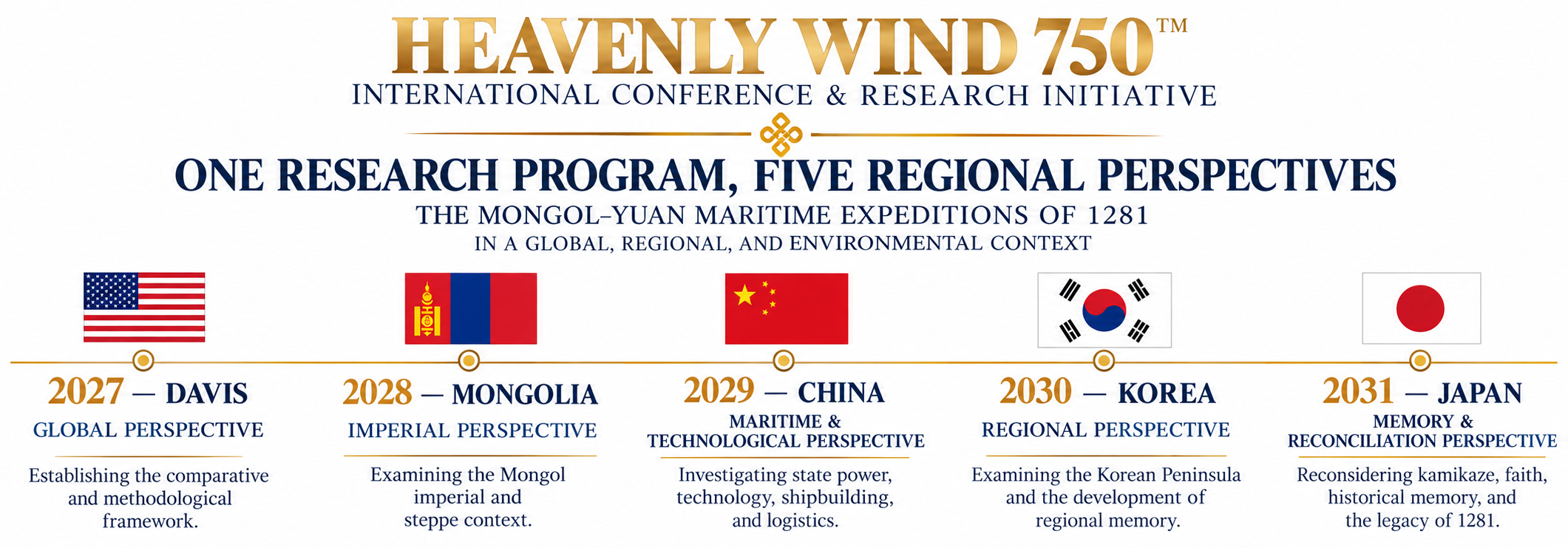
ONE RESEARCH PROGRAM, FIVE REGIONAL PERSPECTIVES
The five conferences are not intended to produce five unrelated interpretations of 1281. Each conference addresses a different geographical and thematic dimension of the same historical problem.
2027 — GLOBAL
Establishing the comparative and methodological framework.
2028 — IMPERIAL
Examining the Mongol imperial and steppe context.
2029 — MARITIME & TECHNOLOGICAL
Investigating state power, technology, shipbuilding, and logistics.
2030 — REGIONAL
Examining the Korean Peninsula and the development of regional memory.
2031 — MEMORY & RECONCILIATION
Reconsidering kamikaze, faith, historical memory, and the legacy of 1281 in Japan. Together, these stages constitute a single cumulative research trajectory.
AN INTERNATIONAL INTERDISCIPLINARY PLATFORM
Heavenly Wind 750™ is intended to extend beyond the conference itself.
The initiative will provide opportunities for collaboration among:
- Universities and research institutions
- Museums, libraries, and archives
- Historians and archaeologists
- Maritime archaeologists
- Environmental and climate researchers
- Oceanographers and geographers
- Military and technology historians
- Scholars of religion and cultural memory
- Digital humanities researchers
- Cultural institutions
- International academic networks
- Documentary and educational media producers
Research emerging from the program may contribute to academic articles, edited volumes, maps and atlases, digital archives, documentaries, podcasts, educational materials, and other forms of public scholarship.
The intention is to create a research ecosystem in which scholarly findings can circulate between academic institutions, cultural organizations, researchers, students, and the wider public.
HISTORY, EVIDENCE, AND MEMORY
The intellectual foundation of Heavenly Wind 750™ rests upon an important distinction. Historical memory is not the same thing as historical evidence. But historical memory is itself a historical phenomenon.
A society’s memory of an event can reveal its values, beliefs, fears, political experiences, religious interpretations, and changing understanding of the past. Such memory therefore deserves serious study even when particular elements of the remembered narrative cannot be independently established. The task of historical research is consequently not to dismiss memory, but to place it within an appropriate evidentiary framework.
This produces a methodological sequence:
MEMORY → SOURCES → MATERIAL EVIDENCE → COMPARATIVE ANALYSIS → HISTORICAL INTERPRETATION
The purpose of this process is not to force certainty where evidence does not permit it. It is to establish what can be demonstrated, what can be reasonably inferred, what remains contested, and what requires further investigation.
FROM 1281 TO THE FUTURE
The 750th anniversary provides an opportunity to revisit one of the major maritime episodes of medieval East Asian history through a genuinely international research framework. The central question is not simply why the Mongol–Yuan expedition failed.
The deeper questions concern how imperial decisions, military organization, maritime technology, logistics, geography, environmental conditions, human choices, and historical memory interacted to produce the events that followed.
Seven and a half centuries later, the historical record remains sufficiently rich to permit new questions, while sufficiently incomplete to require continued investigation. That combination—substantial evidence together with unresolved questions—is precisely what makes 1281 a productive subject for interdisciplinary historical research.
CONCLUSION
Heavenly Wind 750™ is conceived not simply as a commemorative conference series, but as a five-year international scholarly platform dedicated to the systematic study of the Mongol–Yuan maritime expedition of 1281 and its wider historical consequences.
Its central methodological principle is a movement:
from inherited narrative toward evidence,
from isolated interpretation toward interdisciplinary analysis,
and from commemoration toward sustained historical research.
The initiative does not seek to establish a predetermined conclusion concerning the events of 1281. Instead, it seeks to create the intellectual conditions under which scholars from different countries and disciplines can examine the available evidence, challenge assumptions, identify uncertainty, and develop more comprehensive historical interpretations.
The five-year program beginning in 2027 will therefore function as a cumulative research process in which each conference contributes to the next, culminating in the 750th-anniversary gathering in Japan in 2031. The ultimate purpose is not simply to remember what happened 750 years ago.
It is to understand how we know what happened, what remains uncertain, how historical memory was formed, and what new evidence and scholarship can still reveal.
HEAVENLY WIND 750™| International Conference & Research Series | Five Countries. Five Perspectives. One Cumulative Research Program.
ABOUT HEAVENLY WIND 750™
AN INTERNATIONAL CONFERENCE AND RESEARCH INITIATIVE
Heavenly Wind 750™ is a five-year international interdisciplinary conference and research initiative examining the Mongol–Yuan maritime expedition of 1281 and its historical, environmental, technological, political, and cultural dimensions.
The initiative was developed around the 750th anniversary of the events of 1281, bringing together scholars and researchers from different countries and disciplines to examine the historical evidence surrounding one of the most complex episodes in medieval East Asian history.
Rather than promoting a single national interpretation, Heavenly Wind 750 seeks to create an international scholarly framework in which different forms of evidence can be examined together.
Its research interests include history, archaeology, maritime archaeology, environmental and climate studies, military and technological history, political history, religion, cultural memory, philosophy, and digital humanities.
A central question of the initiative is how historical events become historical memory.
The term “kamikaze,” or “divine wind,” became deeply associated with the Japanese memory of the Mongol invasions. Heavenly Wind 750 does not seek simply to replace this tradition with another explanation. Instead, it asks how contemporary evidence, archaeological discoveries, environmental research, historical sources, and later cultural memory can be brought into critical dialogue.
FROM MEMORY TO EVIDENCE
The project follows a simple intellectual principle:
HISTORY — What happened?
EVIDENCE — What can we establish?
MEMORY — How was it remembered?
INTERPRETATION — How should it be understood?
By distinguishing these dimensions, Heavenly Wind 750 aims to encourage historical inquiry that recognizes both the value of cultural memory and the necessity of critical evidence.
FIVE YEARS — FIVE PERSPECTIVES
The initiative is planned as a five-year international journey beginning in the United States in 2027 and continuing through Mongolia, China, South Korea, and Japan, with each conference addressing a distinct geographical and intellectual perspective.
The series will ultimately bring together historical research, international academic dialogue, cultural memory, and interdisciplinary investigation surrounding the events of 1281.
A SHARED RESEARCH PLATFORM
Heavenly Wind 750 is intended to extend beyond individual conferences. Research generated through the initiative may contribute to academic publications, archaeological and environmental research, maps and atlases, digital archives, documentaries, educational resources, and other forms of public scholarship.
The broader purpose is not simply to commemorate an event 750 years ago, but to examine how evidence becomes knowledge, how knowledge becomes dialogue, and how historical understanding can contribute to communication across cultures and generations.
HEAVENLY WIND 750™
International Conference Series
Remembering History. Researching Truth. Building Future.