
MONGOLIAN & EURASIAN HISTORICAL RESEARCH
Evidence. Sources. Historical Truth.
Researching the history, cultures, and historical geography of the Eurasian Steppe through primary sources, scholarly research, and documented evidence.
How the Secret History of the Mongols Survived
From a Restricted Court Chronicle to a Rediscovered Mongolian Classic
Abstract
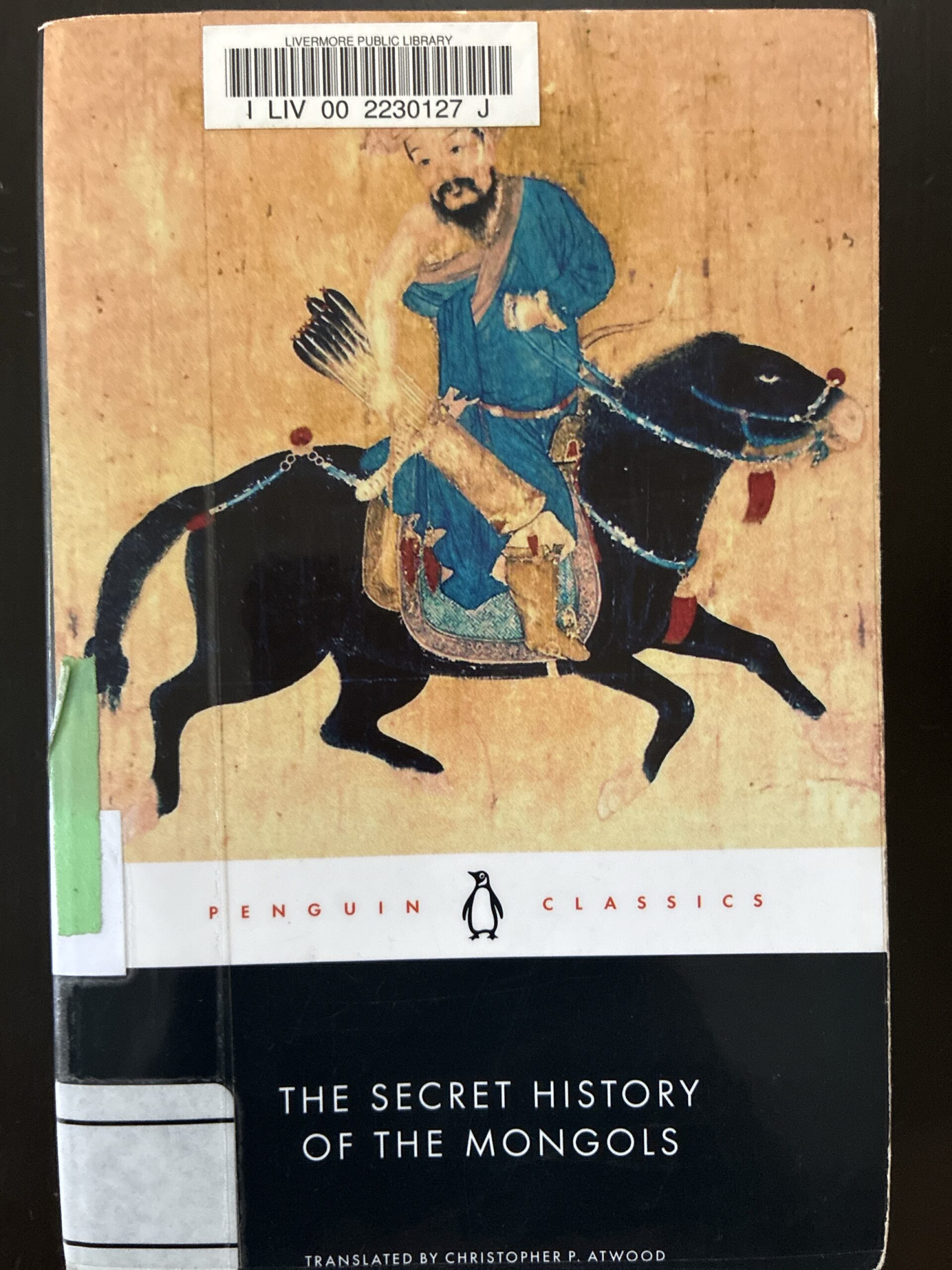
The Secret History of the Mongols is one of the most important surviving sources for the history of Chinggis Khan and the formation of the Mongol Empire. Yet the text that survives today is not the original thirteenth-century Mongolian manuscript. The original Mongolian written version has not been found. Instead, the work survived through a remarkable transmission in which Mongolian was transcribed phonetically with Chinese characters, accompanied by Chinese glosses and a Chinese translation.
This unusual form of preservation ultimately made it possible for modern scholars to reconstruct substantial portions of a Mongolian text whose original manuscript had disappeared. The history of this transmission also raises an important question concerning the word secret: evidence from the Yuan period indicates that the work belonged to a restricted sphere of dynastic and court knowledge and was not simply an ordinary historical book available for unrestricted copying. Centuries later, the text re-entered scholarly circulation through Chinese manuscript traditions and was brought to the attention of European scholarship, most importantly through the work of the Russian scholar Palladius Kafarov.
1. The Original Mongolian Text
The Secret History of the Mongols was composed in the thirteenth century in Mongolian. Its surviving text preserves an extraordinary account of the origins of the Mongol royal lineage, the childhood and rise of Temüjin, the establishment of the Mongol Empire, and the reign of Ögedei.
The original manuscript, however, has not survived.
This distinction is fundamental. Modern editions of the Secret History are therefore not simply transcriptions of an extant Mongolian manuscript from the time of Chinggis Khan. They are reconstructions based principally upon later Chinese-transmitted materials, supplemented by other Mongolian and non-Mongolian sources.
The exact date of composition has also been debated. The traditional interpretation associates its completion with the ratification of the text at the great assembly held after Chinggis Khan’s death, while scholars have proposed different dates, including 1228/29 and 1240. The famous closing statement refers to the work being completed when the assembly was held at Köde’e Aral, but the precise chronological interpretation remains a matter of scholarly discussion.
2. Why Was It Called “Secret”?
The word secret should not be interpreted too simply as meaning that the entire book was physically hidden from everyone.
There is, however, important evidence that the work belonged to a restricted sphere of Mongol dynastic knowledge.
A Yuan historical tradition records a discussion concerning the use of the Secret History in compiling official history and indicates that the work was not something to be freely transmitted to outsiders. This evidence is important because it places the text within the political culture of the Mongol imperial court rather than treating it merely as an ordinary literary work.
Thus, the term “secret” may be understood in connection with restricted dynastic knowledge—genealogy, royal memory, political decisions, military events, internal disputes, and information concerning the ruling house.
This does not justify the stronger claim that every copy of the book was subject to an absolute prohibition against copying. The surviving evidence supports a more precise conclusion: the text occupied a restricted position within the political and historical knowledge of the Mongol court.
3. The Original Mongolian Manuscript Disappeared
After the fall of the Yuan dynasty in 1368, the political circumstances surrounding Mongolian court records changed dramatically.
The Mongol imperial archives and literary materials did not all follow a single path. Some disappeared, some remained within Mongol traditions, and some entered the institutions of the Ming state.
The Secret History survived in a particularly unusual form.
Rather than preserving the original Mongolian script manuscript, the Ming transmission preserved the sounds of Mongolian through Chinese characters.
This was to become the key to the text’s survival.
4. The Extraordinary Chinese Version
A modern reader might assume that the Chinese characters in the Secret History represent Chinese translations.
That is only partly true.
The Ming version contains several distinct layers of information.
First: phonetic transcription
Mongolian words were represented through Chinese characters chosen primarily for their sound, rather than for their ordinary semantic meaning.
Thus:
Chinese character ≠ Chinese meaning
Instead:
Chinese character → Mongolian sound
The characters therefore functioned almost like a phonetic notation system.
This is one of the reasons why a Chinese reader could recognize the characters but could not simply read the resulting text as ordinary Chinese.
5. The Three-Layer Structure
The transmitted text is particularly valuable because it preserves three complementary levels.
1. Mongolian phonetic transcription
The Mongolian text was represented through Chinese characters according to their approximate pronunciation.
This preserves information about Mongolian phonology that would otherwise have disappeared with the original manuscript.
2. Chinese interlinear explanation
Chinese explanations were placed alongside or beneath the phonetic transcription, providing the meaning of individual Mongolian words or grammatical units.
This gives researchers another piece of evidence:
sound + grammatical function + meaning
3. Continuous Chinese translation
The text was also translated into continuous Chinese prose so that a Chinese reader could understand the narrative.
Consequently, the transmitted work effectively provided:
Mongolian pronunciation → Chinese phonetic representation → Chinese lexical explanation → Chinese translation
This structure is extraordinarily important for modern scholarship. The Chinese translation provides the general meaning, while the phonetic transcription preserves evidence for the Mongolian original.
Modern digital editions of the Secret History continue to distinguish these different textual layers.
6. Why a Chinese Reader Could Not Simply Read the Mongolian Text
This point is frequently misunderstood.
It is not accurate to say that Chinese scholars could not “read the characters.”
They could read the characters.
The problem was that the characters were being used for a different purpose.
In ordinary Chinese writing:
character → Chinese word/meaning
In the phonetic transcription of the Secret History:
character → Mongolian sound
A Chinese reader who pronounced the characters according to Chinese linguistic values would therefore produce something very different from the original Mongolian.
To recover the text, one had to know Mongolian.
In effect, the Chinese characters functioned as a kind of phonetic encoding of Mongolian.
This is precisely why the transmission became so valuable to later Mongolists.
7. The Paradox of Preservation
Here lies one of the great paradoxes in the history of the Secret History.
The original Mongolian manuscript disappeared.
Yet the Mongolian language of that manuscript was not completely lost.
Its phonetic shadow survived inside Chinese characters.
The meaning survived through the Chinese translation.
The combination allowed later scholars to work backward:
Chinese phonetic transcription
↓
Mongolian pronunciation
↓
Mongolian vocabulary and morphology
↓
reconstructed Mongolian text
The very form that makes the medieval text difficult to read also helped preserve it.
8. How Was It Rediscovered?
The Secret History did not suddenly emerge from nowhere in the nineteenth century.
Its Chinese-transmitted tradition had survived for centuries.
Chinese scholars continued to copy, study, and preserve versions of the work. Among the important later witnesses was the version associated with Gu Guangqi (顧廣圻), whose 1805 recension became particularly important for subsequent scholarship.
The crucial nineteenth-century development was therefore not the sudden creation or discovery of the text itself, but its entry into modern international scholarship.
9. Palladius Kafarov and the European Rediscovery
One of the central figures in this story was the Russian Orientalist Palladius Kafarov (1817–1878).
Kafarov spent many years in Beijing and had access to Chinese scholarly materials.
In 1866, he published a Russian translation based on the Chinese tradition of the Secret History. His work introduced the text to a much wider European scholarly audience and became a major turning point in the modern study of the Mongol chronicle.
It is therefore more accurate to say:
Kafarov did not “discover” the original Mongolian manuscript.
Rather:
He brought the Chinese-transmitted Secret History into the international scholarly world and made it available to European Mongolists.
This distinction is historically important.
10. The Problem That Faced Nineteenth-Century Scholars
Kafarov and later scholars encountered a remarkable situation.
They possessed:
- Chinese characters representing Mongolian sounds;
- Chinese explanations;
- Chinese translations;
but not the original Mongolian manuscript.
Consequently, reconstructing the original language required a completely different methodology.
Scholars had to compare:
Chinese phonetic transcription
with
Chinese translation
and then with
known Mongolian vocabulary, grammar, and other medieval sources.
The process was essentially a philological reconstruction of a lost manuscript.
Later scholars such as Erich Haenisch, Francis W. Cleaves, Paul Pelliot, Sergei Kozin, and Igor de Rachewiltz substantially advanced this work.
11. Another Key: The Altan Tobči
The reconstruction of the Secret History was later strengthened by another Mongolian historical work: Lubsangdanzan’s Altan Tobči.
Although it was compiled centuries after the Secret History, it preserves a substantial portion of the narrative tradition found in the earlier work.
This provided scholars with something extremely valuable:
a Mongolian-language witness to passages otherwise preserved through the Chinese transcription tradition.
The Altan Tobči therefore became an important comparative source for reconstructing the lost Mongolian wording.
The reconstruction of the Secret History consequently rests not upon one surviving manuscript, but upon multiple textual witnesses from different periods and linguistic traditions.
12. A Text That Survived by Crossing Languages
The history of the Secret History can therefore be represented as a chain:
13th-century Mongolian court tradition
↓
Mongolian written text
↓
restricted dynastic transmission
↓
Ming-era Chinese phonetic transcription
↓
Chinese lexical explanations
↓
Chinese translation
↓
later Chinese manuscript tradition
↓
Kafarov, 1866
↓
European Mongolian studies
↓
modern philological reconstruction
This is why the history of the Secret History is almost as remarkable as the history contained within it.
13. The Historical Paradox
The Secret History of the Mongols was created as a record of the Mongol imperial world.
Its original manuscript disappeared.
Its Mongolian script tradition was interrupted.
Yet the text survived because another civilization preserved it in a radically different written form.
The Chinese characters that prevented a Chinese reader from simply reading the text as Chinese ultimately became the very mechanism through which scholars could reconstruct the lost Mongolian language.
In this sense, the transmission of the Secret History is a historical paradox:
The Mongolian original was lost, but its sounds survived in Chinese characters; its meaning survived in Chinese translation; and centuries later, these two layers allowed scholars to reconstruct the voice of the lost Mongolian manuscript.
That is why the Secret History of the Mongols is not merely a historical chronicle.
It is also one of the most extraordinary examples of textual survival across languages, political regimes, and writing systems in medieval Eurasia.
Selected scholarly references
- William Hung, “The Transmission of the Book Known as the Secret History of the Mongols,” Harvard Journal of Asiatic Studies.
- Francis W. Cleaves, The Secret History of the Mongols.
- Igor de Rachewiltz, The Secret History of the Mongols: A Mongolian Epic Chronicle of the Thirteenth Century.
- Christopher P. Atwood, The Secret History of the Mongols: A Mongolian Epic Chronicle of the Thirteenth Century.
- Erich Haenisch, critical studies and editions of the Secret History.
- Sergei Kozin, Sokrovennoe skazanie.
- Palladius Kafarov, nineteenth-century Russian translation and studies of the Chinese-transmitted text.