
KUBLAI KHAN’S INVASIONS OF VIETNAM (1285–1288)
By Altanbagana Baatar
DBA Candidate| Founder & Organizer
Heavenly Wind 750 International Conference
Heavenlywind750.com | Imperilagg.com
17 November 2026
YUAN IMPERIAL EXPANSION, TRẦN RESISTANCE, AND THE BATTLE OF BẠCH ĐẰNG
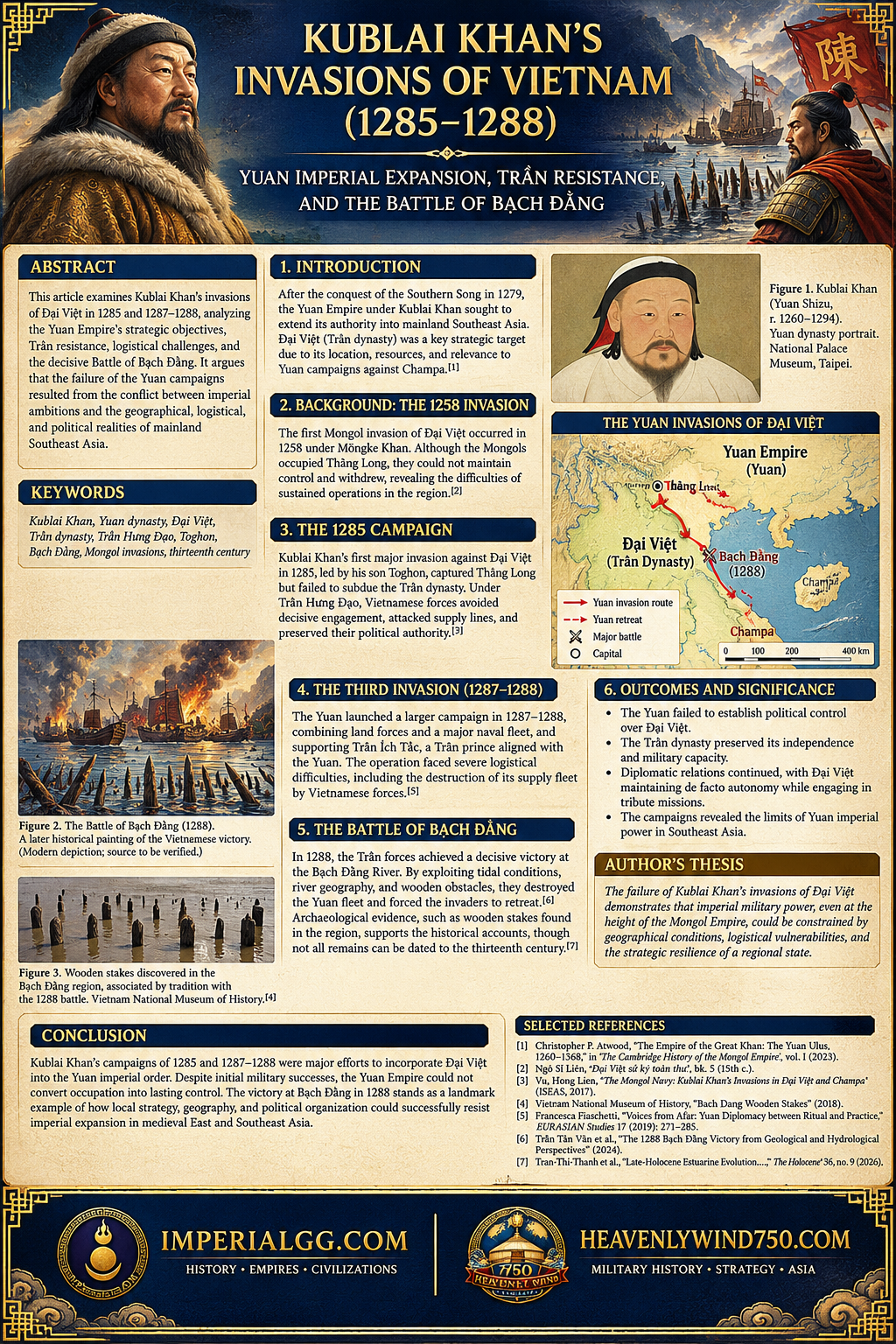
An Historical Study of Mongol Imperial Strategy, Southeast Asian Political Resistance, Naval Logistics, and Riverine Warfare in the Late Thirteenth Century
ABSTRACT
During the second half of the thirteenth century, the Yuan dynasty, established by Kublai Khan, pursued an expansive foreign policy across East and Southeast Asia. Following the conquest of the Southern Song dynasty in 1279, the Yuan Empire increasingly focused its attention on the political and strategic environment of mainland Southeast Asia. Đại Việt, Champa, and the maritime trade networks connecting the South China Sea with the Indian Ocean became important elements in this regional policy.
Within this context, Kublai Khan sought to secure political submission and logistical cooperation from the Trần dynasty of Đại Việt. Yuan demands included military access, provisions, diplomatic recognition, and cooperation with imperial campaigns in the region. The Trần court, however, resisted these demands, seeking to preserve its political autonomy while navigating the diplomatic expectations of the Yuan imperial court. This confrontation culminated in two major Yuan military campaigns against Đại Việt in 1285 and 1287–1288.
This article examines these campaigns not simply as confrontations between Mongol military power and Vietnamese resistance, but as complex historical processes shaped by imperial administration, regional political rivalries, geographical conditions, riverine transportation, naval logistics, and local military organization. Particular attention is given to the Battle of Bạch Đằng in 1288, which marked the decisive conclusion of the Yuan invasion. The battle is examined in relation to the strategic use of river geography, tidal conditions, naval mobility, and the logistical vulnerabilities of an expeditionary army operating far from its principal supply bases.
The article argues that the failure of the Yuan campaigns cannot be explained solely by military defeat or environmental difficulties. Rather, it reflected the limitations of an imperial strategy that struggled to reconcile centralized political demands with the geographical, logistical, and political realities of mainland Southeast Asia.
Keywords: Kublai Khan, Yuan dynasty, Đại Việt, Trần dynasty, Trần Hưng Đạo, Toghon, Champa, Bạch Đằng, Mongol invasions, thirteenth century.
1. INTRODUCTION: YUAN IMPERIAL POLICY IN SOUTHEAST ASIA
During Kublai Khan’s reign, the Mongol Empire underwent a significant political and administrative transformation. Following the establishment of the Yuan dynasty and the conquest of the Southern Song in 1279, the imperial government extended its strategic attention toward the southern regions of East and Southeast Asia. The incorporation of southern China brought the Yuan court into closer contact with maritime trade networks, coastal political powers, and the kingdoms of mainland Southeast Asia.
Within this emerging geopolitical environment, Đại Việt, ruled by the Trần dynasty, occupied an important strategic position. Its territory lay along the southern frontier of the Yuan Empire and provided access to routes connecting southern China with Champa and other Southeast Asian states. The kingdom’s geographical position therefore had implications beyond bilateral relations between the Yuan court and the Trần monarchy.
The Yuan campaigns against Champa created an additional source of tension. Military operations against Champa required access to transportation routes, provisions, and logistical facilities in the surrounding region. Đại Việt’s cooperation was consequently important to the Yuan military strategy. The Trần government, however, had its own political and security interests and was unwilling to allow its territory to become an unrestricted operational corridor for foreign forces.
The resulting confrontation involved more than a disagreement over diplomatic protocol. It reflected a fundamental difference between the Yuan imperial conception of political supremacy and the Trần dynasty’s determination to preserve its domestic authority.
The Yuan court sought to incorporate neighboring states into an imperial diplomatic hierarchy in which submission to the emperor was expressed through tribute, envoys, and recognition of imperial authority. The Trần rulers, by contrast, could employ diplomatic forms to manage relations with the Yuan Empire while maintaining their own institutions, military forces, and domestic political legitimacy.
This distinction is essential for understanding the conflicts of 1285 and 1287–1288. They were not merely attempts to conquer territory; they were military efforts to enforce an imperial political relationship that the Trần dynasty was unwilling to accept on the terms demanded by Kublai Khan.
2. THE FIRST MONGOL INVASION OF 1258: THE HISTORICAL BACKGROUND BEFORE KUBLAI’S CAMPAIGNS
The Mongol military presence in Đại Việt began before Kublai Khan’s establishment of the Yuan dynasty. In 1258, during the reign of Möngke Khan, Mongol forces invaded Đại Việt and occupied its capital, Thăng Long. Nevertheless, the occupation did not develop into permanent political control. The Trần dynasty preserved its capacity to resist, and the Mongol forces eventually withdrew.
The campaign of 1258 must be distinguished from the later invasions of 1285 and 1287–1288. The first campaign belonged to the imperial military policy of Möngke Khan, whereas the later operations were conducted under Kublai Khan and the Yuan dynasty. Treating these campaigns as a single uninterrupted military operation would obscure their different political contexts and strategic objectives.
Nevertheless, the earlier invasion established an important historical precedent. It demonstrated the difficulties of maintaining a foreign military presence in the Red River region, where river systems, humid conditions, transportation constraints, and local resistance could undermine the advantages of a powerful expeditionary army.
The experience of 1258 therefore provides essential background for understanding the later Yuan campaigns. It also demonstrates that the military challenges faced by Mongol forces in Đại Việt were not simply the result of the Trần dynasty’s resistance in the 1280s. They were connected to the broader difficulties of conducting sustained military operations in the geographical and political environment of mainland Southeast Asia.
3. THE CAMPAIGN OF 1285: THE YUAN INVASION AND TRẦN RESISTANCE
One of the most significant military confrontations between the Yuan Empire and Đại Việt occurred in 1285. Although the immediate diplomatic tensions concerned the Trần court’s refusal to comply with Yuan demands, the underlying conflict involved broader strategic questions.
Kublai Khan expected the Trần rulers to cooperate with Yuan military operations in the region, particularly those directed against Champa. Such cooperation would have required access to territory, transportation routes, and logistical resources. For the Trần dynasty, however, allowing a foreign army to move freely through its territory could have undermined its political independence and created a permanent military threat.
In preparation for the campaign, Kublai Khan appointed his son Toghon to lead the Yuan forces operating in the southern region. The invasion developed into a major military operation involving Mongol forces, troops recruited from different parts of the Yuan Empire, and supporting naval and transportation units.
Figure 1. The 1285 Yuan invasion of Đại Việt. A historical representation of the military confrontation between the Yuan forces and the Trần dynasty. The original artwork and its provenance should be verified before publication.
The Yuan forces advanced into Đại Việt and occupied Thăng Long. However, the capture of the capital did not result in the destruction of the Trần political system. The royal court and military leadership withdrew from the capital while maintaining the capacity to reorganize their forces and continue resistance.
This distinction between occupying a capital and controlling an entire kingdom is central to understanding the campaign. The Yuan army could capture major urban centers and important transportation routes, but it could not automatically eliminate the Trần dynasty’s political legitimacy, regional military networks, or capacity to mobilize resistance.
Trần Hưng Đạo, also known as Trần Quốc Tuấn, became one of the principal military leaders of the resistance. His role was not limited to defending the capital. The broader strategy involved maintaining military organization, exploiting the vulnerabilities of the invading army, and preventing Yuan forces from establishing stable control over the surrounding countryside.
The Trần forces employed a strategy that combined military withdrawal, local mobilization, attacks against vulnerable positions, and pressure on enemy supply routes. Rather than relying exclusively on direct confrontation with the larger Yuan army, they sought to prolong the campaign and make the maintenance of the invading force increasingly difficult.
The Yuan invasion therefore faced a strategic problem: territorial occupation did not guarantee political submission. The Trần dynasty retained sufficient military and administrative organization to continue the conflict even after the capital had fallen.
The campaign ultimately failed to achieve its principal political objective. The Trần monarchy survived, and the Yuan forces withdrew. Nevertheless, Kublai Khan did not abandon his southern policy. The failure of the 1285 campaign became one of the factors leading to the preparation of another major invasion.
It is important to approach military figures and troop estimates cautiously. Medieval Chinese and Vietnamese sources do not always use identical categories for soldiers, auxiliary forces, and naval personnel. Their numerical accounts should therefore be compared rather than combined into a single supposedly definitive total.
4. THE THIRD INVASION, 1287–1288: THE YUAN EMPIRE’S LARGE-SCALE MILITARY OPERATION
Following the failure of the 1285 campaign, Kublai Khan continued his efforts to bring Đại Việt into the Yuan imperial political system. One aspect of this policy involved Trần Ích Tắc, a member of the Trần royal family who had aligned himself with the Yuan. His political position offered the Yuan court a potential alternative to the reigning Trần leadership.
The Yuan government subsequently prepared another major military expedition. The campaign began in late 1287 and continued into 1288. Unlike an operation based exclusively on land forces, the invasion relied on coordination between the army advancing overland and naval forces operating through coastal and riverine routes.
The military objective was not simply to occupy Thăng Long again. The broader intention was to defeat the Trần government, establish a politically compliant administration, and secure the Yuan Empire’s strategic position in the region.
Figure 2. Yuan naval operations during the late thirteenth century. A general historical illustration of Yuan-era naval warfare. This image should not be presented as a verified depiction of the actual fleet involved in the 1287–1288 campaign.
The expedition faced substantial logistical challenges. An army operating far from its principal bases required a continuous supply of food, weapons, transport animals, and other necessities. The movement of these resources depended on the availability of secure transportation corridors and reliable communication between the land forces and the fleet.
The geographical conditions of Đại Việt complicated these requirements. The Red River delta contained numerous waterways, marshes, and areas of dense vegetation. River currents and tidal changes influenced navigation, while seasonal weather conditions affected transportation and the movement of military supplies.
The Trần leadership recognized the importance of these logistical vulnerabilities. Rather than treating the Yuan army as a single force that could be defeated through one direct engagement, the Vietnamese strategy focused on weakening its capacity to remain in the country.
The Yuan expeditionary force was therefore confronted by two interconnected problems: the difficulty of controlling the political territory of Đại Việt and the difficulty of maintaining an army in that territory over an extended period.
The Yuan command structure included Toghon as a principal military leader, while naval operations involved other commanders and officers. The precise hierarchy and responsibilities of individual commanders should be reconstructed through comparison of the Yuan and Vietnamese historical accounts rather than assumed from later summaries.
5. THE DESTRUCTION OF THE SUPPLY FLEET AND THE LOGISTICAL CRISIS
One of the most important developments during the 1287–1288 campaign was the disruption of the Yuan supply system. The military operation depended heavily on the transportation of provisions and other essential materials by water.
The loss or disruption of supply vessels could affect an expeditionary army far beyond the immediate value of the ships themselves. It could reduce the availability of food, restrict operational mobility, weaken communications, and force commanders to reconsider the continuation of the campaign.
For an army operating deep inside hostile territory, the security of its supply network was inseparable from its ability to maintain military pressure. Even a force capable of winning individual engagements could become vulnerable if its supply lines were disrupted.
The Trần forces exploited this strategic weakness by targeting the movement of Yuan supplies and using their knowledge of local waterways. As the logistical situation deteriorated, the Yuan army faced increasing difficulties in sustaining its presence in Đại Việt.
The occupation of Thăng Long could not compensate for the loss of a reliable supply system. The Trần leadership remained active, local resistance continued, and the Yuan forces were unable to convert their initial territorial advances into lasting political control.
This relationship between military operations and logistical capacity is essential to understanding the final stages of the campaign. The Yuan forces were not defeated simply because they lacked numerical strength. Their ability to use that strength effectively was constrained by the operational environment and the vulnerability of their supply network.
6. THE BATTLE OF BẠCH ĐẰNG IN 1288: RIVER GEOGRAPHY AS A MILITARY STRATEGY
The Battle of Bạch Đằng in 1288 marked the decisive conclusion of the Yuan invasion of Đại Việt. The Bạch Đằng River system occupied an important position in the network of waterways connecting the northern Vietnamese coast with inland river routes.
Its geographical characteristics were particularly significant for naval warfare. Tidal fluctuations, changing river channels, narrow passages, marshland, and variations in water depth could affect the movement of large vessels. For an invading fleet unfamiliar with the local environment, these conditions created substantial navigational risks.
Trần Hưng Đạo is traditionally credited with organizing the Vietnamese strategy that exploited these geographical characteristics. Vietnamese historical accounts describe the use of wooden stakes placed in the riverbed to obstruct enemy vessels, in combination with knowledge of the tidal cycle and the timing of naval movements.
Figure 3. The Battle of Bạch Đằng, 1288. A historical representation of the Vietnamese naval strategy associated with Trần Hưng Đạo. The specific artwork and its institutional provenance should be verified before publication.
Archaeological discoveries have played an important role in discussions of the battle. In 1976, wooden stakes were discovered in the Chanh River area of Quảng Ninh Province. The Vietnam National Museum of History has associated these remains with the historical Battle of Bạch Đằng.
Museum descriptions report that some of the stakes measured approximately 1.5 to 3 meters in length. Their positioning and arrangement have been interpreted in connection with the obstruction of enemy vessels. Some stakes were reportedly placed vertically, while others were inclined toward the river channel.
Figure 4. Archaeological wooden stakes associated with the Bạch Đằng River system. The precise location, excavation context, and dating of each archaeological assemblage must be identified before individual remains are attributed to the battle of 1288.
However, archaeological evidence must be evaluated carefully. It would be methodologically incorrect to assume that every wooden stake discovered in the Bạch Đằng region belongs to the thirteenth-century battle.
A 2026 geoarchaeological study published in The Holocene examined wooden-pile sites in the Bạch Đằng estuary. Radiocarbon analysis of eight samples from certain sites, including Cao Quy and Dam Thuong, indicated dates of approximately 2515–2301 calibrated years before present, corresponding broadly to 566–352 BCE. The researchers associated these structures with settlement activity during the later Đông Sơn period rather than the thirteenth-century battle.
These findings do not disprove the historical Battle of Bạch Đằng. Instead, they demonstrate that archaeological structures found within the same broader river system may belong to different historical periods. The stakes associated with the 1288 battle must therefore be distinguished from earlier archaeological features through precise examination of their location, stratigraphy, dating, and excavation records.
The distinction is particularly important because historical narratives and archaeological evidence answer different questions. Written sources describe military events and their political significance, while archaeological investigations establish the physical presence, construction methods, and chronological context of material remains. A reliable reconstruction requires both forms of evidence to be evaluated independently before they are brought together.
The geographical environment of Bạch Đằng also deserves closer examination. Research into the area’s geological, geomorphological, and hydrological conditions has considered tidal variation, sedimentation, historical river channels, and changes in coastal landscapes. Some studies have discussed substantial tidal fluctuations in the region, but the river system has undergone significant natural and human-induced changes over more than seven centuries. Present-day geography cannot therefore be treated as an exact representation of the landscape in 1288.
The significance of the battle should consequently not be reduced to a simple account in which the tide receded and Yuan vessels struck hidden stakes. Its outcome involved the coordinated use of geographical knowledge, naval positioning, timing, the restriction of enemy movement, and the broader logistical difficulties already confronting the Yuan expedition.
Bạch Đằng demonstrated how local knowledge of a riverine environment could become a decisive military resource against a larger expeditionary fleet.
7. WHY DID THE YUAN INVASIONS FAIL?
The failure of Kublai Khan’s campaigns against Đại Việt cannot be explained exclusively by climate, disease, or geographical difficulties. These factors were important, but they must be considered alongside the political objectives of the Yuan court, the military organization of the Trần dynasty, and the logistical structure of the invading forces.
First, the political objectives of the Yuan Empire conflicted with the interests of the Trần monarchy. Kublai Khan expected the rulers of Đại Việt to recognize Yuan supremacy and cooperate with imperial military operations. The Trần leadership, however, sought to preserve its own political institutions and military authority. The conflict was therefore rooted in incompatible political expectations.
Second, the military advantages of the Yuan forces were not equally effective in every geographical environment. The broad plains of northern China and the grasslands of Inner Asia offered conditions different from those of the Red River delta. The riverine landscape, marshes, dense vegetation, humid climate, and seasonal changes in water levels complicated the movement of troops and supplies.
Third, the Trần resistance was supported by more than the royal court and its principal commanders. Regional military organization, local knowledge, administrative networks, and the ability to mobilize forces outside the capital helped sustain resistance even when major urban centers were occupied.
Fourth, the Yuan military operation depended on maritime and riverine transportation. The disruption of the supply fleet weakened the ability of the land forces to maintain their positions and continue offensive operations. The effectiveness of the Yuan army therefore depended on the security of a logistical network that could not be protected throughout the campaign.
These factors interacted rather than operating independently. Political resistance prevented the Yuan forces from establishing stable authority, geographical conditions complicated military operations, and logistical disruption weakened the expedition’s capacity to continue.
The failure of the Yuan invasions should therefore be understood as the outcome of a strategic mismatch between imperial military objectives and the political, geographical, and logistical realities of Đại Việt.
8. AFTER THE WAR: MILITARY VICTORY AND DIPLOMATIC RELATIONS
The conclusion of the 1288 campaign did not bring an immediate end to relations between the Yuan Empire and Đại Việt. The Trần dynasty preserved its political independence, but diplomatic relations continued.
This distinction is important for understanding the nature of medieval East Asian international relations. Military submission, diplomatic recognition, tribute, and the recognition of an emperor’s supremacy were not necessarily identical concepts.
The Yuan court interpreted diplomatic participation within an imperial framework in which neighboring rulers were expected to acknowledge the authority of the Yuan emperor. The Trần government, however, could use diplomatic practices to manage relations with the powerful northern empire without surrendering its domestic political institutions.
The Trần rulers could therefore maintain a distinction between diplomatic accommodation and actual political subordination. Tribute missions and formal recognition did not necessarily mean that the Yuan government exercised direct administrative control over Đại Việt.
This relationship illustrates the limits of imperial power in a region where political authority was negotiated through both military force and diplomatic practice.
The military outcome of 1288 was consequently significant, but it did not eliminate the diplomatic relationship between the two states. Instead, it created a political environment in which the Trần dynasty retained its autonomy while continuing to manage relations with the Yuan court.
9. CONCLUSION: THE STRATEGIC LIMITS OF KUBLAI KHAN’S SOUTHERN EXPANSION
Kublai Khan’s invasions of Đại Việt in 1285 and 1287–1288 represent an important episode in the military and political history of the Mongol Empire. They demonstrate the challenges of extending imperial authority into a region characterized by complex river systems, maritime transportation networks, established local political institutions, and organized military resistance.
The Yuan Empire possessed considerable military resources and the ability to mobilize forces from different parts of its territories. Nevertheless, these advantages did not guarantee political control over Đại Việt. The Trần dynasty preserved its government, maintained military resistance, and prevented the Yuan campaigns from achieving their principal objective.
The failure of the invasions cannot be reduced to a simple narrative of military defeat. It reflected the difficulty of translating military superiority into durable political authority. The occupation of a capital did not guarantee the submission of a kingdom, and the movement of a large army into hostile territory did not guarantee the security of its supply system.
The Battle of Bạch Đằng in 1288 represents the clearest expression of these limitations. The Vietnamese forces used their understanding of the river environment and the vulnerabilities of the Yuan naval operation to defeat the invading fleet. Archaeological research has added important evidence to the discussion, although the dating and identification of individual wooden structures must remain subject to careful scientific examination.
Ultimately, the campaigns reveal a central limitation of Kublai Khan’s southern expansion: imperial military resources could not automatically overcome the political organization, geographical knowledge, and strategic resistance of established Southeast Asian states.
The history of these invasions should therefore be examined as a multidimensional encounter between imperial expansion and regional political autonomy, rather than as an isolated episode of military confrontation.
AUTHOR’S THESIS
The failure of Kublai Khan’s invasions of Đại Việt cannot be adequately explained through military strength or battlefield outcomes alone. The Yuan Empire’s imperial strategy encountered a combination of geographical constraints, logistical vulnerabilities, riverine conditions, and organized political resistance. The Trần dynasty successfully defended its political autonomy by combining military organization, knowledge of the local environment, strategic withdrawal, and diplomatic flexibility.
The Battle of Bạch Đằng in 1288 was the decisive military expression of this broader conflict. It demonstrated that the resources of a large imperial army and navy could be constrained by the geographical environment and the strategic capabilities of a smaller regional state. The campaigns therefore illustrate the limits of imperial expansion when military superiority cannot be converted into sustainable political authority.
REFERENCES AND BIBLIOGRAPHY
I. Primary Historical Sources
Yuan shi 元史. The official dynastic history of the Yuan dynasty. Relevant sections concerning Đại Việt, foreign relations, and the biographies of military commanders should be consulted in the original Chinese text. Exact juan, edition, and page references should be verified against the edition used.
Ngô Sĩ Liên. Đại Việt sử ký toàn thư 大越史記全書. A major Vietnamese historical compilation completed in the fifteenth century. The sections concerning the Trần dynasty and the Mongol-Yuan invasions are particularly relevant.
Lê Tắc 黎崱. An Nam chí lược 安南志略. A historical account of Đại Việt compiled around the late thirteenth and early fourteenth centuries. Its relationship to the Yuan political environment should be considered when evaluating its descriptions.
II. Modern Scholarly Studies
Vu, Hong Lien. The Mongol Navy: Kublai Khan’s Invasions in Đại Việt and Champa. Nalanda-Sriwijaya Centre Working Paper No. 25. Singapore: ISEAS – Yusof Ishak Institute, 2017.
Fiaschetti, Francesca. “Voices from Afar: Yuan Diplomacy between Ritual and Practice.” EURASIAN Studies 17 (2019): 271–285.
Atwood, Christopher P. “The Empire of the Great Khan: The Yuan Ulus, 1260–1368.” In The Cambridge History of the Mongol Empire, vol. I. Cambridge University Press, 2023.
Trần Tân Văn, Đỗ Thị Yến Ngọc, Hoàng Xuân Đức, and Cao Thị Hương. “Some Understandings and Interpretations of the 1288 Bạch Đằng Victory from the Geological-Geomorphological and Meteorological-Hydrological Perspectives.” 2024.
Tran-Thi-Thanh, Nhan, et al. “Late-Holocene Estuarine Evolution Influencing Archeological Wooden-Pile Sites, Bach Dang Estuary, Northern Vietnam.” The Holocene 36, no. 9 (2026). DOI: 10.1177/09596836261450824.
III. Archaeological and Museum Sources
Vietnam National Museum of History. “Bach Dang Wooden Stakes.” 2018.
Kimura, Jun. “Archaeological Survey and Excavation at Dong Ma Ngua, Vietnam 2010.” Institute of Nautical Archaeology, 2010.