
WEAPONS AND MILITARY EQUIPMENT OF THE MONGOL SOLDIERS IN THE YUAN EXPEDITIONS AGAINST JAPAN (1274 AND 1281)
By Altanbagana Baatar
DBA Candidate| Founder & Organizer
Heavenly Wind 750 International Conference
Heavenlywind750.com | Imperilagg.com
05 November 2026
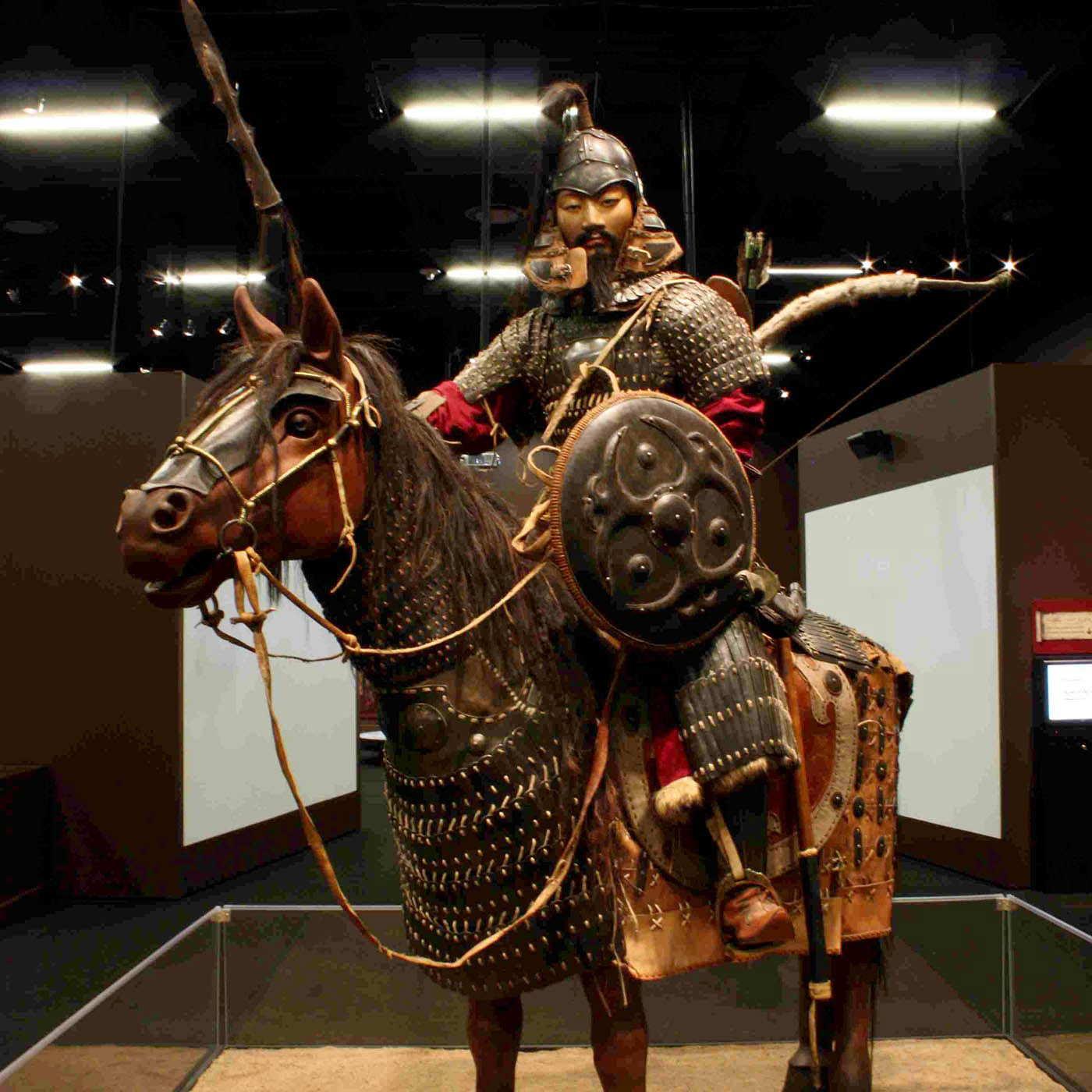
An Evidence-Based Study of Weapon Construction, Materials, Tactical Functions, and Military Adaptation
The Yuan expeditions against Japan in 1274 and 1281 provide an important historical opportunity to examine the weapons and military equipment of Mongol soldiers operating beyond the familiar environment of the Eurasian steppe.
Mongol military effectiveness was closely associated with mounted archery, composite bows, protective armour, and mobile cavalry tactics. However, the Japanese expeditions presented a different operational environment. Soldiers had to cross the sea, conduct amphibious landings, fight on unfamiliar terrain, and participate in coordinated engagements involving infantry and naval forces.
This study examines the weapons and equipment associated with Mongol military traditions and evaluates their relevance to the Japanese campaigns. It focuses on composite bows, arrows, quivers, swords and sabres, spears, lamellar armour, helmets, horse equipment, and the logistical requirements of military operations. It also examines the evidence for gunpowder weapons and explosive projectiles, while distinguishing the technology of the multinational Yuan expedition from equipment that can specifically be attributed to Mongol soldiers.
The principal visual source is the late-thirteenth-century Japanese illustrated handscroll Mōko Shūrai Ekotoba (蒙古襲来絵詞). Written accounts, archaeological evidence from the Takashima underwater site, and museum research are used to evaluate the material culture of the campaigns.
The study distinguishes direct campaign evidence, comparative evidence from broader Mongol military history, and modern reconstructions. This distinction is essential because the surviving archaeological and visual record does not always identify the ethnicity or military unit of the individual who used a particular object.
AUTHOR’S THESIS
The Mongol soldier participating in the invasions of Japan should be understood as a member of a highly developed military tradition built around mobility, mounted archery, protective equipment, and adaptable close-combat weapons.
The campaigns of 1274 and 1281 demonstrate the challenges of transferring this military system into a maritime theatre. The composite bow remained central to Mongol military identity, but the operational environment required soldiers to adapt their methods of fighting to shipboard conditions, landing operations, and unfamiliar terrain.
The historical evidence does not justify attributing every weapon found in the Yuan invasion fleet to Mongol soldiers. The expedition included Mongol, Chinese, and Goryeo personnel, whose equipment and military responsibilities were not necessarily identical.
The central argument of this study is therefore that Mongol military equipment must be reconstructed through a combination of direct historical evidence and carefully controlled comparison with the broader military traditions of the Mongol Empire.
1. HISTORICAL CONTEXT: THE TWO EXPEDITIONS AGAINST JAPAN
The Yuan-led invasions of Japan took place in 1274 and 1281 under the authority of Kublai Khan.
The first expedition reached the Japanese islands in October 1274. Yuan and Goryeo forces attacked Tsushima, Iki, and the northern coast of Kyushu. The operation involved naval transport, landing forces, archers, and other military units.
The second expedition took place in 1281. It was substantially larger and involved forces assembled from different parts of the Yuan Empire. The Northern Route Army departed from the Korean Peninsula, while another major force was organized in southern China.
These campaigns should not be treated as exclusively Mongol military operations. The Yuan expedition was a multinational imperial undertaking. Goryeo provided ships, sailors, troops, and logistical support, while Chinese personnel and military specialists also participated.
Primary historical background:
The distinction between the Mongol contingent and the wider Yuan army is essential throughout this article.
2. THE COMPOSITE BOW: THE CENTRAL WEAPON OF MONGOL WARFARE
Historical classification: Strong evidence for broader Mongol military use; campaign-specific specimens remain limited.
The composite bow was the defining weapon of Mongol mounted warfare. Its construction combined different materials to produce a compact but powerful weapon suitable for mounted archery.
2.1 Construction and materials
A traditional Inner Asian composite bow could incorporate:
Wood: The structural core of the bow.
Horn: Usually applied to the belly, where the material resisted compression.
Animal sinew: Applied to the back, where it resisted tension.
Animal glue: Used to bind the different layers.
Protective coverings: Materials such as bark or other coverings could help protect the bow against environmental conditions.
The combination of these materials allowed the bow to store substantial energy. Its recurved construction provided considerable power relative to its length.
The exact materials and construction methods varied across regions and periods. It would therefore be inaccurate to assume that every Mongol bow used precisely the same combination of materials.
2.2 Military function
The composite bow was particularly suited to mounted warfare. A trained archer could shoot while riding, attack from different directions, and maintain distance from an opponent.
Mongol military tactics relied on the combination of archery, mobility, coordination, and the ability to reposition rapidly.
In Japan, these advantages were affected by the conditions of the campaign. The soldiers had to operate from ships and conduct landings in a landscape that did not provide the same freedom of movement as the open steppe.
The bow nevertheless remained a central weapon of Mongol military identity.
2.3 Historical evidence
The Royal Armouries identifies the composite bow as one of the central elements of Mongol military equipment. Its research also explains the importance of lamellar armour and mounted archery in the broader Mongol military system.
Recommended visual source:
Royal Armouries — Arms and Armour of the Mongol Empire
The museum’s article includes manuscript illustrations of Mongol archers and descriptions of their weapons.
3. ARROWS AND QUIVERS: AMMUNITION AND TACTICAL USE
Historical classification: Strong evidence for Mongol archery; exact arrow types used by each contingent require individual verification.
Arrows were an essential component of the Mongol military system. Their construction and design determined how effectively a bow could be used against different targets.
3.1 Construction
A typical medieval arrow consisted of:
A wooden shaft.
An iron or steel arrowhead.
Feather fletching for flight stability.
A nock at the rear for attachment to the bowstring.
Arrowheads varied in shape and function. Narrower heads were suitable for penetration, while broader cutting forms were intended to inflict wounds on less heavily protected opponents.
The presence of different arrowhead forms in medieval archaeological collections does not, by itself, establish which particular type was used in Japan by Mongol soldiers.
3.2 Tactical function
Archery could be used to:
Disrupt enemy formations.
Attack opponents before close combat.
Force defenders to seek cover.
Support advancing infantry or cavalry.
Create opportunities for coordinated attacks.
Quivers provided a means of carrying and organizing ammunition. Their design and placement depended on whether a soldier fought primarily on horseback or on foot.
3.3 Poisoned arrows
Poisoned arrows are mentioned in historical accounts associated with the Mongol invasions.
The National Archives of Japan preserves a historical summary that refers to short arrows coated with poison in accounts of the invasion.
However, this evidence should be treated carefully. The account does not establish that every Mongol soldier carried poisoned arrows or that all such arrows belonged exclusively to the Mongol contingent.
Source:
National Archives of Japan — Historical records of the invasions
4. SWORDS AND SABRES: CLOSE-COMBAT WEAPONS
Historical classification: Strong comparative evidence for Mongol military use.
Although the composite bow was central to Mongol warfare, swords and sabres provided essential alternatives when combat moved to close range.
4.1 Construction
The swords associated with the broader Mongol military tradition included single-edged blades, often slightly curved.
Their construction involved:
An iron or steel blade.
A handle suitable for one-handed use.
A guard or grip designed to provide control.
A scabbard for carrying the weapon.
The precise form varied across the Mongol Empire and changed through contact with other military cultures.
4.2 Tactical function
A curved single-edged blade was particularly suitable for a mounted soldier. It allowed a cutting movement while riding past an opponent.
A sword also served as a secondary weapon when an archer could no longer maintain distance or when the bow could not be used effectively.
The Japanese campaign environment created situations in which close-combat weapons would have been particularly useful, including landing operations and fighting around ships.
4.3 Historical evidence
John of Plano Carpini’s thirteenth-century account describes Mongol swords as slightly curved and sharp on one side.
The Royal Armouries discusses this evidence and explains the relationship between sword design and mounted warfare.
Source:
Royal Armouries — Arms and Armour of the Mongol Empire
5. SPEARS AND POLEARMS: WEAPONS FOR FORMATION COMBAT
Historical classification: Established in broader Mongol military practice; campaign-specific ethnic attribution is not always possible.
Spears and other long-shafted weapons were widely used in medieval warfare, including among Mongol forces.
5.1 Construction
A typical spear consisted of a wooden shaft and a metal head, generally made from iron or steel.
The head could be narrow and pointed for thrusting or designed with broader edges for cutting.
5.2 Tactical function
Spears offered several advantages:
Greater reach than a sword.
The ability to attack approaching opponents.
Use in defensive formations.
Effectiveness against cavalry.
Practical application in close engagements.
The Japanese invasion scrolls depict Yuan soldiers using a variety of long weapons.
However, not every figure in the scroll can be identified as ethnically Mongol. Some formations included Korean and Chinese soldiers.
The Royal Armouries discusses the role of spears and glaives in the Mongol campaigns in Japan, particularly in the context of infantry fighting.
Source:
Royal Armouries — Arms and Armour of the Mongol Empire
6. LAMELLAR ARMOUR: THE PROTECTIVE SYSTEM OF THE MONGOL WARRIOR
Historical classification: Strong evidence for Mongol military use.
Lamellar armour was one of the most characteristic forms of protection used by Mongol warriors.
6.1 Construction and materials
Lamellar armour was constructed from numerous small plates connected by leather cords or other bindings.
The plates could be made from:
Iron.
Steel.
Hardened leather.
Each plate was pierced with holes and attached to neighbouring plates. The overlapping arrangement produced a flexible protective surface.
The plates were assembled into larger sections that could cover the torso and, depending on the design, the shoulders and other parts of the body.
6.2 Tactical function
Lamellar armour offered protection against:
Cutting weapons.
Some forms of projectile impact.
Fragments and other battlefield hazards.
Its construction allowed movement while maintaining a protective surface.
The armour was particularly suitable for cavalry because it combined protection with a degree of flexibility.
6.3 Historical testimony
John of Plano Carpini described the construction of Mongol armour in the thirteenth century. His account explains how narrow metal plates were pierced, overlapped, and attached to straps using leather thongs.
This is one of the most valuable written descriptions of Mongol armour from the period.
The Royal Armouries reproduces and discusses this description in its study of Mongol military equipment.
Visual source:
Royal Armouries — Mongol lamellar armour and manuscript illustrations
7. HELMETS AND HEAD PROTECTION
Historical classification: Strong evidence for broader Mongol military use.
Helmets were an important part of the protective equipment of Mongol warriors.
7.1 Construction
Mongol helmets could be made from iron, steel, or hardened leather.
Some designs used several metal sections assembled into a rounded or conical shape. Others incorporated overlapping lamellar plates.
A neck guard could be attached to protect the rear and sides of the head.
7.2 Tactical function
Helmets helped reduce injuries from:
Arrows.
Sword strikes.
Other weapons used in close combat.
Falling debris.
The exact design depended on the period, the soldier’s status, and the military equipment available.
7.3 Historical evidence
Carpini’s account describes metal helmets and protective equipment worn by Mongol warriors.
The Royal Armouries also discusses helmet construction and the use of attached neck guards.
Source:
Royal Armouries — Mongol helmets and armour
8. HORSE EQUIPMENT AND THE IMPORTANCE OF MOBILITY
Historical classification: Strong evidence for the broader Mongol cavalry system; the use of particular horse-armour types in the Japanese expeditions is less certain.
The horse was fundamental to Mongol military organization.
A cavalry soldier depended on more than weapons. Saddles, bridles, reins, stirrups, and other equipment supported control, stability, and the ability to use a bow while riding.
8.1 Horse protection
Some heavily equipped Mongol cavalry used protective coverings made from leather or metal plates.
These forms of protection varied in extent and construction. It is not appropriate to assume that every Mongol cavalry horse was fully armoured.
8.2 Military function
The horse provided:
Rapid movement across open terrain.
Mobility during reconnaissance.
The ability to reposition archers.
Support for pursuit and withdrawal.
Transportation of military supplies.
8.3 The Japanese campaign problem
The maritime expeditions created a significant logistical challenge.
Horses had to be transported by sea, unloaded, and prepared for operations on unfamiliar terrain. The availability of suitable landing areas and the conditions of the battlefield affected the use of cavalry.
This meant that the Mongol military system could not operate in Japan exactly as it did on the open steppe.
The distinction between a soldier’s normal cavalry equipment and the equipment actually deployed during a specific landing operation is important.
Source:
Royal Armouries — Kamikaze: The Mongol Invasions of Japan
9. AXES, DAGGERS, AND PERSONAL FIELD EQUIPMENT
Historical classification: Comparative evidence from Mongol military accounts; individual use in the Japanese campaigns is not always documented.
Mongol warriors carried equipment for practical military and everyday purposes.
9.1 Daggers and knives
Small blades could be used as secondary weapons and for everyday tasks such as cutting food, rope, leather, or other materials.
9.2 Axes
Axes could serve as weapons or tools.
A small axe could be useful for cutting wood, maintaining camp equipment, and other practical tasks. Larger axes could be used in combat.
9.3 Field equipment
Comparative accounts of Mongol military equipment describe items such as:
Leather belts.
Quivers.
Bow cases.
Knives.
Boots made from leather or felt.
Containers for food and drink.
Equipment for maintaining weapons.
The presence of these objects in general descriptions of Mongol military life does not establish that every soldier carried all of them during the Japanese expeditions.
10. GUNPOWDER WEAPONS AND EXPLOSIVE PROJECTILES
Historical classification: Evidence for use within the Yuan expedition; specific attribution to Mongol soldiers remains uncertain.
One of the most significant technological aspects of the invasions was the use of explosive projectiles.
Japanese historical accounts describe devices commonly referred to as tetsuhau.
10.1 Construction
Archaeological discoveries associated with the invasions include ceramic or earthenware explosive containers.
These devices could contain gunpowder-based explosive mixtures.
The surviving archaeological evidence allows researchers to examine their physical construction, but the precise composition and method of use must be evaluated object by object.
10.2 Tactical function
Explosive devices could produce:
A loud blast.
Smoke.
Flying fragments.
Psychological shock.
Disruption among enemy troops.
Their purpose was not identical to that of a conventional arrow or spear.
10.3 Were they Mongol weapons?
This question requires particular caution.
The Yuan expedition was multinational. The use of gunpowder technology by the Yuan army does not establish that the devices were manufactured or operated exclusively by Mongol soldiers.
Chinese military specialists and other personnel within the Yuan forces may have been involved.
Therefore, this article treats explosive projectiles as part of the military technology of the Yuan expedition, not as weapons that can automatically be classified as exclusively Mongol.
10.4 The problem of the illustrated explosion scene
The Mōko Shūrai Ekotoba contains an important visual tradition associated with the invasions. However, the handscroll was copied and restored, and some images were significantly altered during the Edo period.
The image of an explosion should therefore not be used without discussing the scroll’s history and the possibility of later modification.
Sources:
National Archives of Japan — Illustrated records of the invasions
Giuseppina Aurora Testa — Mōko Shūrai Ekotoba: A Case Study of Encounter with the Other in Japan
11. THE MŌKO SHŪRAI EKOTOBA: A VISUAL SOURCE FOR THE INVASIONS
The Mōko Shūrai Ekotoba (蒙古襲来絵詞), commonly translated as the Illustrated Handscroll of the Mongol Invasions, is one of the most important visual sources for the campaigns of 1274 and 1281.
The scroll is associated with Takezaki Suenaga, a Japanese warrior who participated in the fighting and sought to preserve a record of his military service.
It provides valuable visual material for studying:
Bows and arrows.
Armour and helmets.
Swords and other close-combat weapons.
Military clothing.
Horses and mounted combat.
The appearance of Yuan soldiers.
The interaction between Japanese defenders and invading forces.
11.1 Historical limitations
The scroll is not a neutral military inventory.
It was created from the perspective of a Japanese warrior and must be interpreted in its historical and political context.
It was also copied and restored, with some images significantly altered during the Edo period.
Consequently, researchers must distinguish between:
The late-thirteenth-century visual tradition.
Later copies and restorations.
Images whose original appearance cannot be securely established.
The scroll is useful evidence, but it cannot independently establish the precise ethnic identity of every soldier or the ownership of every weapon.
Primary visual source:
Mōko Shūrai Ekotoba — Wikimedia Commons image record

Academic research:
Testa, Giuseppina Aurora. “Mōko Shūrai Ekotoba: A Case Study of Encounter with the Other in Japan.”
Conlan, Thomas D. “Myth, Memory, and the Scrolls of the Mongol Invasions of Japan.”
12. ARCHAEOLOGICAL EVIDENCE FROM TAKASHIMA
The underwater archaeological site at Takashima, Nagasaki Prefecture, is one of the most important locations for studying the 1281 invasion.
The site has produced material associated with the Yuan fleet, including ship-related remains, weapons, ceramics, and other objects.
12.1 Why Takashima matters
Unlike later literary narratives, underwater archaeological evidence provides physical material that can be studied through archaeological methods.
It can help researchers investigate:
The construction and organization of the fleet.
The transportation of military equipment.
The material culture of the expedition.
The types of objects carried aboard ships.
The conditions under which the fleet was lost.
12.2 The attribution problem
The archaeological remains are associated with a multinational Yuan expedition.
An arrowhead, ceramic object, or piece of equipment recovered from the site cannot automatically be classified as Mongol.
Such attribution requires additional evidence, including archaeological context, manufacturing characteristics, comparative material, and historical documentation.
This limitation is particularly important when reconstructing the equipment of the Mongol contingent.
Archaeological sources:
13. COMPARISON OF THE 1274 AND 1281 EXPEDITIONS
The two invasions shared important military characteristics, but they took place under different operational conditions.
| Military element | 1274 expedition | 1281 expedition |
|---|---|---|
| Composite bows | Central to Mongol archery traditions | Continued importance |
| Arrows and quivers | Essential ammunition | Continued use |
| Swords and sabres | Secondary close-combat weapons | Continued use |
| Spears and polearms | Relevant to landing and infantry engagements | Relevant to larger-scale engagements |
| Lamellar armour | Established Mongol protective equipment | Continued use |
| Helmets | Part of Mongol protective equipment | Continued use |
| Horse equipment | Limited by maritime transport and landing conditions | Same logistical challenge |
| Explosive projectiles | Described in historical accounts | Associated with the broader Yuan military system |
| Naval logistics | Essential to the first landing operation | Essential to the larger second expedition |
This comparison identifies military functions and the broader historical context. It does not establish that every individual weapon has been independently documented for every Mongol unit in both campaigns.
14. CONCLUSION
The Mongol soldiers who participated in the Yuan expeditions against Japan belonged to a military tradition shaped by centuries of warfare across the Eurasian steppe.
The composite bow was central to this tradition. It was supported by arrows, quivers, swords, sabres, spears, protective armour, helmets, and specialized riding equipment.
The Japanese campaigns demonstrate the challenges of adapting a mobile military system to maritime operations and unfamiliar battlefields.
The visual record of the Mōko Shūrai Ekotoba, the written accounts of Mongol military equipment, and the archaeological evidence from Takashima provide complementary perspectives. None of these sources should be used in isolation.
The most important distinction is between the weapons of Mongol soldiers and the wider military technology of the Yuan Empire. The expedition included Mongol, Chinese, and Goryeo personnel, and the presence of an object in the invasion fleet does not automatically establish its use by an ethnic Mongol soldier.
A historically responsible reconstruction must therefore identify what is directly documented, what is supported by comparative evidence, and what remains uncertain.
The Mongol military system was not defined by a single weapon. It was a coordinated combination of mobility, archery, protective equipment, close-combat weapons, and logistical organization. The invasions of Japan provide an important case study of how this system encountered the demands of maritime warfare.
The study of Mongol military equipment is ultimately a study of technology, mobility, adaptation, and the material foundations of imperial warfare.
REFERENCES AND FURTHER READING
Primary and institutional sources
National Archives of Japan. “Japan and Mongolia: Our History through Archival Records.”
https://www.archives.go.jp/about/activity/international/jp_mn50/english/ch01.htmlMōko Shūrai Ekotoba (蒙古襲来絵詞). Illustrated handscroll associated with Takezaki Suenaga.
https://commons.wikimedia.org/wiki/File:M%C5%8Dko_Sh%C5%ABrai_Ekotoba.jpgTakashima Underwater Archaeological Survey Report.
https://sitereports.nabunken.go.jp/files/attach/29/29996/21714_1_%E9%B7%B9%E5%B3%B6%E6%B5%B7%E5%BA%95%E9%81%BA%E8%B7%A1.pdf
Museum and academic research
Royal Armouries. “Arms and Armour of the Mongol Empire.”
https://royalarmouries.org/objects-and-stories/stories/the-mongols/arms-and-armour-of-the-mongol-empireRoyal Armouries. “Kamikaze: The Mongol Invasions of Japan.”
https://royalarmouries.org/objects-and-stories/stories/the-mongols/kamikaze-the-mongol-invasions-of-japanTesta, Giuseppina Aurora. “Mōko Shūrai Ekotoba: A Case Study of Encounter with the Other in Japan.” Eikón / Imago.
https://doi.org/10.5209/eiko.73275Conlan, Thomas D. “Myth, Memory, and the Scrolls of the Mongol Invasions of Japan.”
https://tconlan.scholar.princeton.edu/sites/g/files/toruqf3991/files/tconlan/files/conlan_myth_memory_.pdf“The Evolution of Warfare and Weapons in Japan, 792–1392.” Histories.
https://www.mdpi.com/2409-9252/4/1/2Japan Society for the Promotion of Science. “Underwater Archaeological Research on the Mongol Invasions.”
https://www.jsps.go.jp/file/storage/grants/english/e-grants/kakenhi_essay/data/no53_ikeda_e.pdf
IMPERIALGG.COM
HEAVENLY WIND 750 INTERNATIONAL CONFERENCE
From Historical Narratives to Evidence-Based Inquiry.