
YUAN DYNASTY REWARDS AFTER THE 1274 EXPEDITION TO JAPAN
By Altanbagana Baatar
DBA Candidate| Founder & Organizer
Heavenly Wind 750 International Conference
Heavenlywind750.com | Imperilagg.com
04 November 2026
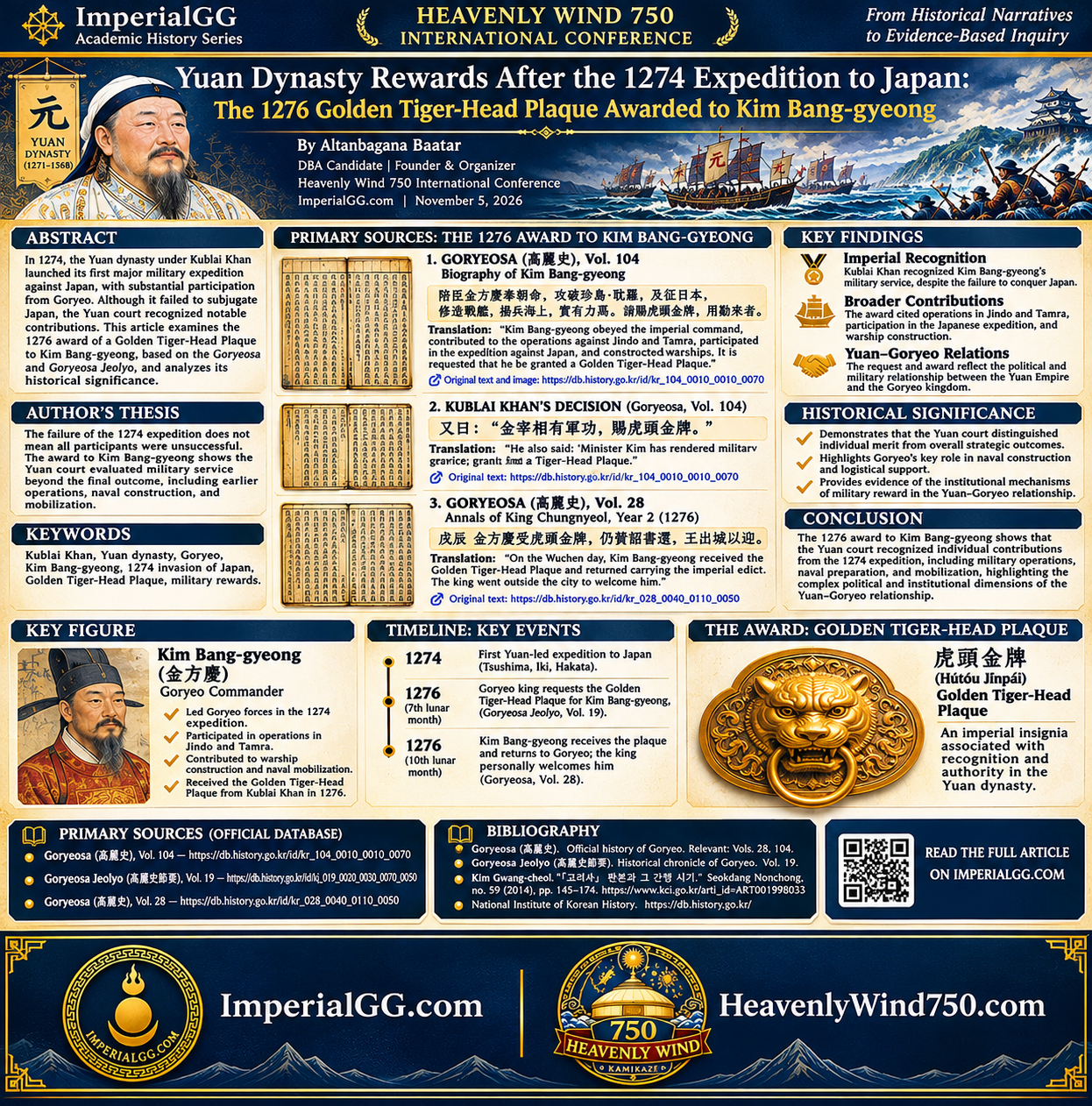
THE 1276 GOLDEN TIGER-HEAD PLAQUE AWARDED TO KIM BANG-GYEONG
ABSTRACT
In 1274, the Yuan dynasty under Kublai Khan launched its first major military expedition against Japan, with substantial military and naval participation from the Goryeo kingdom. Although the expedition failed to achieve its strategic objective of subjugating Japan, the question of how the Yuan court evaluated and rewarded its military participants remains important to understanding the political and military relationship between the Yuan Empire and Goryeo.
A particularly significant case is the award of a golden tiger-head plaque (虎頭金牌) to the Goryeo commander Kim Bang-gyeong in 1276. Drawing primarily on the Goryeosa (高麗史) and Goryeosa Jeolyo (高麗史節要), this article examines the original historical records documenting the request for the award, Kublai Khan’s decision, and the subsequent presentation of the plaque.
The evidence demonstrates that the Yuan court recognized Kim Bang-gyeong’s military contributions despite the unsuccessful strategic outcome of the 1274 expedition. However, the award should not be attributed exclusively to the Japanese campaign: the historical record explicitly includes his earlier military operations in Jindo and Tamra, as well as his contribution to the construction and preparation of warships.
Keywords: Kublai Khan, Yuan dynasty, Goryeo, Kim Bang-gyeong, 1274 Mongol-led invasion of Japan, Golden Tiger-Head Plaque, military rewards.
AUTHOR’S THESIS
The failure of the 1274 Yuan-led expedition to achieve its strategic objective does not mean that all participating commanders and military personnel were considered unsuccessful or without merit.
The award of the Golden Tiger-Head Plaque to Kim Bang-gyeong in 1276 provides important evidence that the Yuan court evaluated military service beyond the final outcome of a campaign. His contributions were recognized in connection with several military operations, naval preparations, and the mobilization of forces.
This case also demonstrates the importance of distinguishing between the strategic outcome of a military expedition and the individual recognition of military service. The two were not necessarily treated as identical matters by the Yuan imperial administration.
I. THE 1274 EXPEDITION: MILITARY OBJECTIVES AND OUTCOME
In 1274, Kublai Khan’s Yuan dynasty launched a major military expedition against Japan after diplomatic efforts to establish Yuan authority over the Japanese court had failed.
The expedition involved Yuan forces and troops from Goryeo. Goryeo’s contribution extended beyond the provision of soldiers. Its role included shipbuilding, naval preparations, transportation, and logistical support.
The expeditionary force advanced through Tsushima and Iki before reaching the Hakata Bay region, where it encountered Japanese defensive forces.
The campaign did not achieve its objective of conquering Japan. The invading forces withdrew, and the expedition ended without establishing Yuan political control over the Japanese islands.
It is important, however, not to conflate the circumstances of the 1274 withdrawal with the catastrophic storm associated with the second invasion in 1281. The military and environmental circumstances of the two expeditions must be examined separately.
II. PRIMARY SOURCE I: GORYEOSA — THE BIOGRAPHY OF KIM BANG-GYEONG
<AsyncImage query=”Goryeosa 高麗史 historical book original woodblock printed page Korean historical text” aspectRatio=”5:4″ width=”100%” maxHeight={260} fit=”contain”/>
Source: Goryeosa (高麗史), Volume 104, Biographies, Volume 17, Biography of Kim Bang-gyeong.
Event: 1276.
Original text and manuscript image: National Institute of Korean History — Goryeo History Database
The historical record states:
陪臣金方慶奉朝命,攻破珍島·耽羅,及征日本,修造戰艦,揚兵海上,實有力焉。請賜虎頭金牌,用勸來者。
Translation:
“His subordinate official, Kim Bang-gyeong, obeyed the imperial command and contributed to the operations against Jindo and Tamra. During the expedition against Japan, he also repaired and constructed warships and helped mobilize military forces at sea, making a substantial contribution. It is therefore requested that he be granted a Golden Tiger-Head Plaque as an encouragement to those who follow.”
This passage is particularly important because it identifies the basis for the award request.
The text does not attribute Kim Bang-gyeong’s merit exclusively to the Japanese expedition. It explicitly includes his earlier military operations in Jindo and Tamra, together with his role in naval construction and military mobilization.
The passage therefore provides evidence of how Goryeo’s royal court presented his military service to the Yuan imperial government.
Source image and transcription: Open the official historical database link above and select the original-image viewer (원문이미지) where available. The original text should be compared with the digital transcription.
III. PRIMARY SOURCE II: KUBLAI KHAN’S DECISION
The Goryeosa records the Yuan emperor’s response to the request.
Original Chinese text:
又曰:“金宰相有軍功,賜虎頭金牌。”
Translation:
“He also said: ‘Minister Kim has rendered military service; grant him a Golden Tiger-Head Plaque.'”
This is the central passage in the present study.
It records not merely a request for recognition, but Kublai Khan’s decision to grant the award.
The expression 虎頭金牌, or Golden Tiger-Head Plaque, refers to an imperial insignia associated with recognition and authority. Its precise administrative privileges should not be inferred from this sentence alone; those require additional evidence from Yuan institutional records.
Nevertheless, the wording clearly identifies the award as an imperial recognition of military service.
Primary source: Goryeosa, Volume 104 — Biography of Kim Bang-gyeong.
IV. PRIMARY SOURCE III: GORYEOSA JEOLYO — THE REQUEST IN 1276
<AsyncImage query=”Goryeosa Jeolyo 高麗史節要 ancient Korean history book original printed page” aspectRatio=”5:4″ width=”100%” maxHeight={260} fit=”contain”/>
Source: Goryeosa Jeolyo (高麗史節要), Volume 19.
Reign: King Chungnyeol, Year 2.
Date: Seventh lunar month, 1276.
Original text and manuscript image: National Institute of Korean History — Historical Records Database
The record begins:
遣中贊金方慶直史館文璉如元,賀聖節。王上書中書省曰……
Translation:
“The chief councillor Kim Bang-gyeong and Mun Ryeon of the Royal Historiographical Office were dispatched to Yuan to offer congratulations on the imperial birthday. The king sent a letter to the Central Secretariat, stating…”
The following passage contains the request for the Golden Tiger-Head Plaque and the explanation of Kim Bang-gyeong’s military contributions.
This entry establishes the diplomatic process through which Goryeo’s king formally requested imperial recognition for Kim Bang-gyeong.
It is important to distinguish this event from the actual presentation of the award. The request was made in the seventh lunar month of 1276; the subsequent record documents the receipt of the plaque.
V. THE PRESENTATION OF THE AWARD: OCTOBER 1276
Source: Goryeosa (高麗史), Volume 28, Annals of King Chungnyeol, Year 2.
Original Chinese text:
戊辰 金方慶受虎頭金牌,仍賫詔書還,王出城以迎。
Translation:
“On the Wuchen day, Kim Bang-gyeong received the Golden Tiger-Head Plaque and returned carrying the imperial edict. The king went outside the city to welcome him.”
This entry provides an important confirmation that the award was actually received.
It also records the Goryeo king’s personal reception of Kim Bang-gyeong upon his return. The ceremony indicates the political significance attached to the imperial recognition.
The distinction between the two records is essential:
The seventh lunar month of 1276 documents the request for the award.
The tenth lunar month of 1276 documents Kim Bang-gyeong’s receipt of the plaque.
These were separate stages of the process and should not be treated as a single event.
Primary source: Goryeosa, Volume 28 — Annals of King Chungnyeol.
VI. THE HISTORICAL SIGNIFICANCE OF KIM BANG-GYEONG’S AWARD
The award can be examined from three related perspectives.
1. Recognition of military service
Kublai Khan explicitly recognized Kim Bang-gyeong’s military merit. The decision demonstrates that the Yuan court could distinguish between the overall strategic outcome of an expedition and the contributions of individual commanders.
The failure to conquer Japan did not automatically erase the military service performed by every participant.
2. Naval construction and logistical contribution
The original record specifically mentions the construction and repair of warships, as well as the mobilization of forces at sea.
This is significant because it demonstrates that Goryeo’s role in the expedition was not limited to supplying ground troops. Naval capacity and logistical preparation were essential components of the military operation.
3. Yuan–Goryeo political relations
The request for the award was transmitted by the Goryeo king to the Yuan court.
This process illustrates the political relationship between the two states and the role of Goryeo’s military elite within the Yuan imperial system.
Kim Bang-gyeong’s recognition was therefore both a military distinction and an event reflecting the political relationship between the Yuan emperor and the Goryeo royal court.
VII. THE OTHER COMMANDERS: QUESTIONS REQUIRING FURTHER VERIFICATION
The 1274 expedition involved several important commanders, including:
Xindu (忻都): Senior Yuan commander associated with the expedition.
Hong Tagu (洪茶丘): Yuan military commander of Goryeo ancestry.
Liu Fuheng (劉復亨): Yuan commander who participated in the expedition.
Secondary accounts contain different claims about their promotions, rewards, injuries, and subsequent appointments.
However, these claims must be separated chronologically. A promotion before the 1274 expedition cannot automatically be described as a reward for the campaign. Similarly, a reward recorded in connection with the 1281 expedition cannot automatically be attributed to service in 1274.
Further examination of the relevant biographies and annals in the Yuan Shi (元史) is necessary before making definitive claims about their individual post-campaign rewards or punishments.
This article therefore does not present unverified claims about their personal rewards as established facts.
VIII. THE JAPANESE SIDE: THE PROBLEM OF SAMURAI REWARDS
The aftermath of the 1274 invasion also created a different problem for the Kamakura shogunate.
Japanese warriors who participated in the defense expected recognition and material rewards for their service. In the conventional reward system, land and property obtained through conquest could be distributed to military retainers.
However, the defense of Japan did not produce newly conquered territories that could be redistributed.
The Kamakura government nevertheless conducted investigations into military service and provided rewards. The problem was not that no rewards were granted, but that the government faced difficulties in satisfying the expectations of all participating warriors.
This comparison reveals two different institutional approaches to military recognition:
The Yuan imperial court could issue imperial insignia and formal distinctions.
The Kamakura government faced the practical challenge of rewarding warriors in a defensive war that generated no new conquered territory.
The financial and political consequences of this problem deserve further study, particularly in relation to the later decline of the Kamakura shogunate.
CONCLUSION
The 1276 award of the Golden Tiger-Head Plaque to Kim Bang-gyeong provides one of the clearest documented examples of Yuan imperial recognition connected with the 1274 expedition to Japan.
The primary records establish four important points:
The Goryeo king formally requested imperial recognition for Kim Bang-gyeong.
The request cited his military operations in Jindo and Tamra, his participation in the Japanese expedition, and his contribution to warship construction and naval mobilization.
Kublai Khan approved the award, explicitly recognizing Kim Bang-gyeong’s military service.
Kim Bang-gyeong received the plaque in 1276 and returned to Goryeo, where the king personally welcomed him.
The evidence demonstrates that the unsuccessful strategic outcome of the 1274 expedition did not prevent the Yuan court from recognizing individual military contributions.
Kim Bang-gyeong’s case also highlights the importance of Goryeo’s naval and logistical role in the Yuan military campaign against Japan.
Rather than viewing the 1274 expedition solely through the question of victory or defeat, its aftermath should also be examined through the political, military, and institutional mechanisms by which the participating states evaluated service and distributed recognition.
PRIMARY SOURCES
1. Goryeosa (高麗史), Volume 104 — Biography of Kim Bang-gyeong.
Records the request for the Golden Tiger-Head Plaque and Kublai Khan’s decision.
National Institute of Korean History — Original text and image viewer
2. Goryeosa Jeolyo (高麗史節要), Volume 19 — King Chungnyeol, Year 2.
Records the 1276 request submitted by the Goryeo court.
National Institute of Korean History — Original text and image viewer
3. Goryeosa (高麗史), Volume 28 — King Chungnyeol, Year 2.
Records Kim Bang-gyeong’s receipt of the Golden Tiger-Head Plaque in the tenth lunar month of 1276.
National Institute of Korean History — Original text
BIBLIOGRAPHY
Goryeosa (高麗史). Official history of Goryeo, compiled during the fifteenth century. Relevant sections: Volumes 28 and 104.
Goryeosa Jeolyo (高麗史節要). Historical chronicle of Goryeo. Relevant section: Volume 19.
Kim Gwang-cheol. “『고려사』 판본과 그 간행 시기” [The Printed Books of Goryeosa and Their Publication Date]. Seokdang Nonchong, no. 59 (2014), pp. 145–174. KCI bibliographic record.
National Institute of Korean History. Korean History Database. Official historical records database.
IMPERIALGG.COM
HEAVENLY WIND 750 INTERNATIONAL CONFERENCE
From historical narratives to evidence-based inquiry.