
JAPAN ON THE EVE OF THE MONGOL INVASION OF 1274
By Altanbagana Baatar
DBA Candidate| Founder & Organizer
Heavenly Wind 750 International Conference
Heavenlywind750.com | Imperilagg.com
08 November 2026
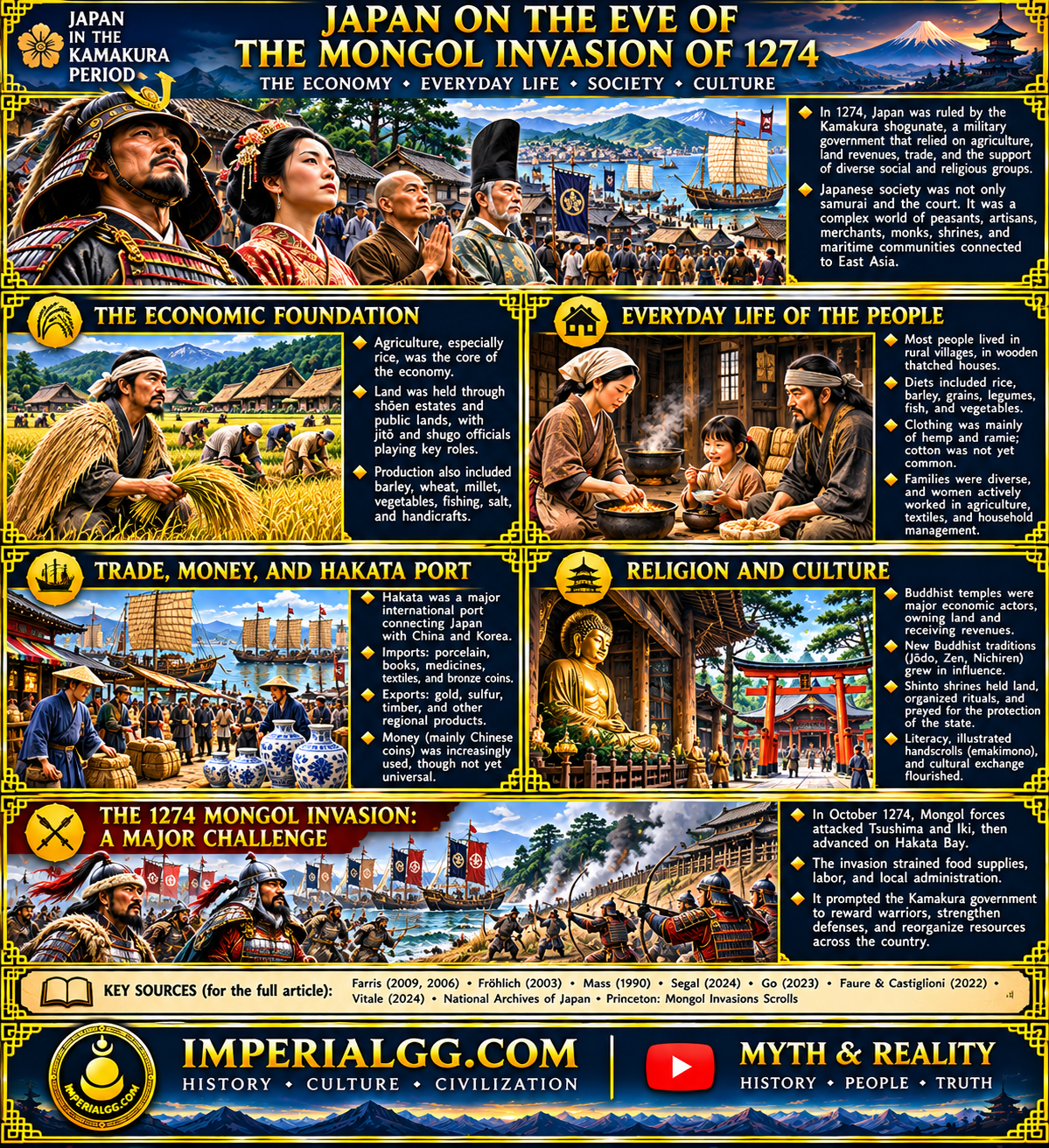
THE ECONOMY, EVERYDAY LIFE, SOCIAL STRUCTURE, AND CULTURE OF THIRTEENTH-CENTURY JAPAN
A Historical Study of Landholding, Agriculture, Trade, Settlements, Family Life, Religion, and Material Culture during the Kamakura Period
ABSTRACT
When the forces of the Mongol Empire’s Yuan dynasty invaded the Japanese islands in 1274, Japan was governed under the military rule of the Kamakura shogunate. Japanese society, however, was by no means confined to the world of samurai warriors and the aristocratic court. Its economic foundations rested on agriculture, a complex system of overlapping landholding rights, rural production, fishing, handicrafts, domestic markets, and maritime trade networks connecting Japan with East Asia. At the same time, economic and political authority was distributed among the imperial court, aristocratic families, major Buddhist monasteries, Shinto shrines, the Kamakura bakufu, and local officials and warrior families, including jitō and shugo.
This article examines Japanese society before the Mongol invasion of 1274 as an interconnected economic, social, and cultural system. Its principal subjects include landholding and peasant labor relations; rice cultivation and other agricultural production; irrigation infrastructure; food consumption, famine, and demographic vulnerability; housing and clothing; family organization; women’s economic participation; dependent labor; handicrafts; monetary circulation; international trade through Hakata Port; and the socioeconomic functions of Buddhist and Shinto institutions. Particular attention is given to the geographical and social characteristics of northern Kyushu, Chikuzen Province, Hakata, Tsushima, and Iki, as well as the effects of the Mongol invasion on the inhabitants of these regions.
The study draws on William Wayne Farris’s research into the population, economy, and family history of medieval Japan; Judith Fröhlich’s study of land administration at the Ito estate in northern Kyushu; Ethan Isaac Segal’s research on money, trade, and markets in medieval Japan; recent scholarship on the changing role of Hakata Port during the thirteenth century; and diplomatic and invasion-related records preserved by the National Archives of Japan.
The central argument is that the invasion of 1274 should not be understood merely as a military confrontation between two armies. It was also a major social and administrative challenge that affected agricultural production, local governance, commercial networks, religious institutions, and the stability of everyday life.
Keywords: Kamakura period, Mongol invasion of 1274, Japanese economic history, shōen, jitō, peasants, Hakata Port, northern Kyushu, trade, money, Buddhism, Shinto, material culture, social history.
I. THE HISTORICAL PROBLEM AND ITS CONTEXT
When the forces of the Mongol Empire’s Yuan dynasty invaded the Japanese islands in 1274, the Kamakura bakufu, or military government, had become the principal political power in Japan. However, the establishment of Kamakura military rule did not mean that the imperial court, the aristocracy of Kyoto, or the major Buddhist institutions of Nara and Kyoto had lost their economic power. Although Minamoto no Yoritomo had established a military government in the late twelfth century, he did not abolish the existing system of landholding and taxation and replace it with a completely centralized economic structure. Instead, the Kamakura government consolidated its authority by working alongside existing institutions and regulating the distribution of estate revenues, administrative rights, and military obligations.
Consequently, understanding Japanese society in 1274 requires moving beyond the general description of Japan as a “samurai state” and examining the actual structure of its economy. Most of the population lived in rural communities and engaged in agriculture, fishing, forestry, handicrafts, and other forms of labor. The products generated by these communities did not merely sustain household consumption; they also provided revenue for aristocrats, monasteries, shrines, local authorities, and warrior families. Peasant labor, rights to cultivate land, harvest yields, and the condition of irrigation facilities were therefore directly connected to the economic capacity of the military government.
William Wayne Farris’s chapter “Economy and Society in an Age of Want, 1180–1280,” in Japan to 1600: A Social and Economic History, examines precisely this historical period, bringing together political developments, economic conditions, population, agriculture, trade, social classes, family organization, and gender relations. His research indicates that although major political changes took place between 1180 and 1280, the fundamental economic structure was not transformed all at once. Rather, gradual changes occurred within older institutions. This interpretation is important because it prevents us from portraying Japan in 1274 as an economy that had already become fully commercialized or undergone rapid modernization.
Source: William Wayne Farris, “Economy and Society in an Age of Want, 1180–1280,” in Japan to 1600: A Social and Economic History, pp. 107–135. Academic chapter.
II. LANDHOLDING AND THE ECONOMIC SYSTEM OF THE KAMAKURA PERIOD
2.1. Shōen Estates and Public Lands
One of the central features of Japan’s thirteenth-century economy was its system of landholding rights. Land was broadly administered through two major categories: privately controlled estates known as shōen (荘園), and lands administered through provincial government institutions, commonly referred to as kokugaryō (国衙領). These categories should not, however, be equated directly with the modern distinction between private property and state-owned land. Multiple rights could coexist over the same territory, including the rights to collect revenue, exercise administrative authority, levy taxes, cultivate fields, and provide protection.
Income from shōen estates supported the imperial household, aristocratic families, Buddhist monasteries, and Shinto shrines. Although these institutions did not necessarily manage agricultural production directly, they held rights to receive taxes, harvests, and other revenues from the estates. The actual administration of the land, organization of production, and collection of dues could be carried out by local officials and estate managers. Under this arrangement, agricultural households could find themselves responsible for obligations to more than one authority.
Jeffrey P. Mass’s chapter “Medieval Shōen,” published in The Cambridge History of Japan, examines the relationship between shōen and kokugaryō, the overlapping rights exercised over land, and the changing relationships among estate proprietors, local administrators, and warrior families. This scholarship is important for correcting the assumption that the Kamakura government directly administered all Japanese territory through a single centralized system.
Source: Jeffrey P. Mass, “Medieval Shōen,” in The Cambridge History of Japan, pp. 89–127. Cambridge University Press.
2.2. Jitō, Shugo, and the Growth of Local Authority
Under the Kamakura government, two categories of local officials played important roles in land administration: the jitō (地頭), estate stewards responsible for particular estates, and the shugo (守護), provincial military and policing officials. The jitō participated in the administration of estates and matters involving their revenues and taxation, while the shugo exercised military supervision and law-enforcement responsibilities at the provincial level. Their actual powers varied according to regional circumstances, the legal status of individual estates, and their relationships with the central government.
During the thirteenth century, the authority of local managers and warrior families tended to increase in some regions as the influence of aristocratic and religious institutions over their estates weakened. This development can be examined through the history of the Ito estate in Chikuzen Province in northern Kyushu. Judith Fröhlich’s research investigates how the estate’s administrative structure changed between 1131 and 1336, how the revenue rights of central religious and aristocratic institutions evolved, and how the social and economic position of local land managers grew during the thirteenth century.
The particular importance of this research lies in its demonstration that changes following the Mongol invasions cannot be explained solely in terms of military defense. It also reveals how rural society in regions distant from the political center was changing under the growing influence of local warrior administrators. The history of the Ito estate is therefore an important case study for understanding northern Kyushu before the invasion of 1274.
Source: Judith Fröhlich, “Land Administration in Medieval Japan: Ito no shō in Chikuzen Province, 1131–1336,” History, vol. 88, 2003, pp. 3–16. Wiley Online Library — article abstract and bibliographic information.
III. AGRICULTURE AND THE LIVES OF PEASANTS
3.1. Rice and the Structure of Agricultural Production
Agriculture formed the principal foundation of Japan’s economy in 1274. Rice occupied a particularly important position in taxation, estate revenues, and the measurement of wealth. However, this does not mean that everyone consumed rice exclusively in their daily lives. Actual agricultural production varied according to regional soil conditions, climate, water availability, and the location of cultivated land. In addition to rice, barley, wheat, millet, buckwheat, legumes, and vegetables were important components of agricultural production.
Agricultural output depended on seasonal labor, the organization of irrigation, the availability of household workers, and the quality of the soil. Rice cultivation required several stages of work, including maintaining water levels in paddy fields, transplanting seedlings, removing weeds, and harvesting the crop. Consequently, access to water sources, irrigation channels, streams, and reservoirs had a direct influence on agricultural productivity.
Farris’s research indicates that Japanese agriculture underwent certain technical changes between 1150 and 1280, although these innovations had not been fully adopted in every region by 1280. In other words, thirteenth-century Japanese agriculture was not characterized by a sudden technological revolution. Rather, gradual changes took place within an established system of production. Without recognizing this distinction, it is easy to make the historical mistake of projecting later agricultural productivity, harvest levels, and village organization directly back into 1274.
Source: Farris, “Economy and Society in an Age of Want, 1180–1280.” Academic chapter DOI.
3.2. Irrigation, Forests, and the Use of Natural Resources
Agricultural production depended on more than cultivated fields alone. Water sources, forests, mountain slopes, pastureland, and other surrounding spaces formed an integral part of rural economies. Forests supplied fuel, construction timber, and wood for tools, while water from the mountains supported irrigation. Rights to use forests and control water sources were therefore important issues in local economic life.
Farris’s research discusses evidence concerning a large reservoir near Hōryūji in 1275, as well as a dispute in 1294 involving mountain forests and water flows at the Ito estate. These examples demonstrate the importance of water, forests, and agricultural land in the late thirteenth century. However, evidence from 1275 or 1294 should not be treated as proof that identical facilities existed throughout Japan before 1274. It is more appropriate to use such records as comparative evidence for understanding the economic issues and competition surrounding natural resources during this period.
Source: Farris, Japan to 1600, “Economy and Society in an Age of Want, 1180–1280.” DOI.
3.3. Double Cropping and Actual Agricultural Yields
The practice of obtaining two harvests from the same field in a single year existed in some regions of thirteenth-century Japan, but there is no basis for assuming that it was a universal practice throughout the country. Farris cites an example from the Ki Valley in which approximately 13 percent of the rice paddies were double-cropped in 1275. This figure demonstrates that double cropping was already practiced in certain regions, but it does not establish that the method had been adopted across all Japanese agricultural land.
This evidence shows that agricultural innovation was regionally specific and depended on water resources and available labor. Increases in agricultural yields were also connected to population growth, marketable surpluses, and tax revenues. It is therefore essential to avoid projecting the agricultural developments of later periods directly onto the Japanese economy of 1274.
Source: Farris, “Economy and Society in an Age of Want, 1180–1280”.
IV. FOOD CONSUMPTION, FOOD SECURITY, AND FAMINE
Food consumption in thirteenth-century Japan was not identical to the familiar image of traditional Japanese cuisine today. The everyday diet of peasant households included rice and rice porridge, barley, millet, wheat, buckwheat, legumes, and vegetables. Rice was an important economic and social measure of wealth, but it is not possible to conclude that every poor household consumed white rice every day. Household diets depended on the crops produced by the family, the amount remaining after taxes and rents had been paid, seasonal food reserves, and access to local markets.
Food security depended not only on agricultural productivity but also on environmental conditions, weather, disease, transportation, and local administrative arrangements. Crop failures caused by excessive rainfall, drought, cold weather, or other adverse conditions could reduce household food reserves and, in some circumstances, lead to famine. Farris’s work examines major famines in Japan during the twelfth and thirteenth centuries and explains their effects on population, family stability, and the availability of labor.
In this context, the economic consequences of the invasion of 1274 cannot be assessed simply by counting the destruction caused on the battlefield. Military mobilization, transportation, food supplies, horses, and weapons preparation could place additional pressure on local production and household labor. Nevertheless, it would be inaccurate to claim that every village exposed to the invasion experienced the same degree of destruction. The scale of damage varied according to geographical location, military movements, defensive arrangements, and population displacement.
Sources: William Wayne Farris, Japan’s Medieval Population: Famine, Fertility, and Warfare in a Transformative Age. University of Hawai‘i Press — book information. See also Farris’s study of the economy between 1180 and 1280: academic chapter.
V. FISHING, SALT PRODUCTION, AND MARITIME RESOURCES
The economy of northern Kyushu cannot be understood through agriculture alone. The geographical position of Hakata Bay and the surrounding coastline and islands provided favorable conditions for fishing, the consumption and exchange of marine products, transportation, and port-related services. Marine resources were an important source of food for coastal communities and could also form part of exchange networks with other regions. However, the available evidence does not permit us to establish precise figures for the scale of thirteenth-century fishing production or the consumption levels of every household in the region. It would therefore be inappropriate to portray fishing practices as identical throughout Japan.
Salt was an important product for food preservation, cooking, and domestic use. Salt production using seawater required coastal labor, fuel, and methods for processing and transporting water. This activity was not separate from the agricultural economy. Rather, it formed part of a broader system of food preservation, household consumption, and commercial exchange.
Archaeological discoveries, research on coastal settlements, and records relating to port trade are essential for understanding the maritime economy of northern Kyushu. However, when reconstructing salt-production techniques and fishing equipment used during this period, contemporary archaeological evidence and records should take precedence over descriptions from much later periods.
General research source: Farris, Japan to 1600, “Economy and Society in an Age of Want, 1180–1280.” DOI.
VI. HOUSING, CLOTHING, AND THE MATERIAL CULTURE OF HOUSEHOLDS
6.1. Rural Housing
The homes of ordinary Japanese peasants in the thirteenth century differed considerably from aristocratic residences, the compounds of wealthy samurai, and large religious buildings. The size and construction of a house depended on the household’s economic resources, the availability of local building materials, the climate, and geographical conditions. Farris’s research describes some peasant dwellings of the period as relatively small structures with thatched roofs and earthen floors. This description, however, should not be generalized to every peasant household or region of Japan. Housing conditions differed between agricultural districts, mountain settlements, coastal villages, and commercial centers.
The interior of a household had to accommodate cooking, heating, food storage, and the tools and equipment required for daily work. Building techniques, hearths, and cooking facilities varied by region. There is evidence for the use of kamado (竈), or cooking stoves, in western Japan during the Kamakura period. Nevertheless, the appearance of a traditional Japanese house in later centuries should not be treated as a direct representation of the homes of thirteenth-century peasants.
Source: Farris, Japan’s Medieval Population, sections concerning rural housing and everyday life. Book information.
6.2. Clothing and Textile Use
Clothing among ordinary households was made using plant-based fibers, including materials derived from hemp and ramie. The quality, color, design, and quantity of clothing depended on household wealth, social position, and the productive resources available in each region. The garments worn by aristocrats and high-ranking warriors were often made from more expensive materials and involved more elaborate craftsmanship and decoration than the clothing of ordinary peasants. Clothing therefore reflected wider social distinctions.
It would be anachronistic to describe cotton fabric, which became widely used in Japan during later periods, as a standard material in the clothing of ordinary people in 1274. Farris’s research notes evidence of cotton cultivation in Chikuzen Province from 1429. This illustrates why the history of thirteenth-century clothing must be reconstructed without projecting the material culture of later centuries backward into the Kamakura period.
Source: Farris, Japan’s Medieval Population. University of Hawai‘i Press.
6.3. Household Objects and Handicrafts
Agricultural households used a wide range of everyday objects, including farming tools, wooden and ceramic vessels, cooking equipment, food-storage containers, textiles, woven products, and other domestic items. Some of these objects could be produced or repaired within the household, while others were obtained from local craftspeople or through market exchange. Household economies therefore depended not only on agricultural harvests but also on the labor of family members, handicraft production, and local systems of exchange.
Archaeological evidence is particularly important for studying this subject. Written records rarely describe the everyday possessions of poorer households in detail. Ceramic vessels, hearths, tools, and building remains therefore provide essential evidence for reconstructing material culture. Finds from excavations around Hakata, particularly Chinese porcelain and other imported objects, are especially valuable for research into thirteenth-century trade and consumption.
VII. FAMILY, WOMEN, CHILDREN, AND DEPENDENT LABOR
The organization of families in thirteenth-century Japan should not be equated directly with the patriarchal household model that became more prominent in later periods. Farris’s research examines the possibility that kinship relationships among ordinary people during the early and middle Kamakura period could involve both maternal and paternal lines, rather than being organized exclusively through the father’s lineage. Marriage, residence patterns, and inheritance varied according to social position and regional circumstances. Some households followed patterns in which a wife resided with or near her family, while others established separate residences. Historical evidence also indicates the existence of divorce, remarriage, and unstable family relationships.
It would be misleading to reduce women’s economic participation to domestic responsibilities alone. Women took part in agriculture, food processing, textile production, the management of household resources, and the maintenance of kinship networks. Their legal position, opportunities to own property, and inheritance rights nevertheless varied according to social class, family circumstances, and region. It is therefore not possible to assume that all women experienced identical conditions.
Medieval Japanese society also included groups of dependent laborers, such as those referred to as genin (下人). Their social and economic freedom could be more restricted than that of independent peasant households. Their family lives, working conditions, and possibilities of being transferred or sold depended on the specific nature of their status and the relationships governing their labor. This demonstrates why medieval Japanese society cannot be divided simply into two categories, “samurai and peasants.” It included landholders, administrators, farmers, craftspeople, merchants, servants, dependent laborers, monks, and many other social groups.
Sources: William Wayne Farris, “Economy and Society in an Age of Want, 1180–1280.” Academic DOI. See also “The Medieval Peasant,” in The Cambridge History of Japan, on the effects of the shōen system on peasant life. Cambridge University Press.
VIII. TRADE, THE USE OF MONEY, AND THE TRANSFORMATION OF MARKETS
The Japanese economy of the thirteenth century was not based exclusively on household production for subsistence. Agricultural products, handicrafts, marine goods, and imported commodities circulated through local and regional markets. However, the expansion of trade should not be interpreted as evidence that Japanese society had already become a fully monetized economy. Many households continued to fulfill their taxes, rents, and other obligations through agricultural produce and goods. The use of money varied according to region, social position, and access to commercial networks.
Ethan Isaac Segal’s 2024 study, “Money, Trade, and Markets in Medieval Japan, 1150–1580,” examines the gradual growth of money, markets, and commerce in medieval Japan. According to Segal’s account, improvements in agriculture, tools, irrigation facilities, and fertilizer use contributed to the conditions that supported population growth and the production of marketable surpluses, particularly from the later thirteenth century onward. Imported Chinese coins became increasingly important in domestic exchange and were used in land transactions and other forms of payment.
It is important, however, to recognize that many of these developments became more pronounced in the late thirteenth and fourteenth centuries. Markets and monetary exchange were already present in 1274, but they had not reached the same scale or level of organization as in later periods. Rather than describing the economy of 1274 simply as a “monetary economy,” it is more accurate to understand it as a transitional system in which payments in goods, monetary transactions, and estate revenues existed alongside one another.
Source: Ethan Isaac Segal, “Money, Trade, and Markets in Medieval Japan, 1150–1580,” Oxford Research Encyclopedia of Asian History, 2024. Oxford Academic — article abstract and DOI.
IX. HAKATA PORT AND MARITIME TRADE IN EAST ASIA
9.1. Hakata Was More Than a Military Position
Hakata was one of the most important maritime commercial centers in thirteenth-century Japan. Its geographical position in northern Kyushu connected Japan with the Korean Peninsula and the Chinese coast, making it a significant hub for merchants, Buddhist monks, maritime transport operators, and commercial intermediaries. Hakata, therefore, was not merely a strategically important coastline that became a target during the Mongol invasions. It was also a major center of Japan’s external economic relations.
Archaeological finds from Hakata, particularly Chinese ceramics and porcelain, provide important evidence of the scale of maritime trade during this period. However, the port’s economic importance cannot be measured solely by the quantity of imported goods. The unloading of cargo, transshipment to domestic vessels, distribution to inland markets, and commercial brokerage were all activities that shaped Hakata’s position within the wider trading system.
9.2. How Did Hakata’s Commercial Role Change during the Thirteenth Century?
Go Eun-mi’s 2023 article, “Changes in the Role of the Hakata Trade Port in the 13th Century,” is an important study of the changing commercial functions of Hakata. The author argues that during the thirteenth century, the organization of trade was influenced not only by Chinese merchants living in Hakata but increasingly by powerful Japanese families and local groups. This change did not mean that Hakata lost its importance as a port. Buddhist monks traveling from Kyoto and Kamakura to China continued to reach Hakata before arranging maritime passage.
One of the study’s important conclusions is that although Hakata remained a major port of entry and departure for overseas vessels during the thirteenth century, its role in distributing and processing imported goods within Japan changed from earlier periods. Its function as a transshipment point, where cargo from overseas vessels could be transferred to domestic transport ships, appears to have become increasingly significant. This suggests that Hakata’s economic history should not be described simply in terms of growth or decline. It is more accurately understood through the changing functions of the port within regional and international commercial networks.
Source: Go Eun-mi, “Changes in the Role of the Hakata Trade Port in the 13th Century,” Sarim, no. 83 (2023), pp. 335–358. Korean Citation Index — article record, abstract, and DOI.
9.3. Commercial Relations among China, Korea, and Japan
Japan’s maritime trade during the thirteenth century did not exist independently of the political relationships of the period. Merchants, Buddhist monks, transport intermediaries, and commodities moved between Japan, Song China, and the Goryeo kingdom on the Korean Peninsula. Even when official diplomatic relations were interrupted or restricted, commercial activity and religious travel did not necessarily cease altogether. Segal’s research identifies gold, sulfur, and timber among the products exported from Japan, while porcelain, books, medicines, textiles, and bronze coins were among the goods imported from China.
These exchanges did more than supply luxury goods to elite consumers. They also influenced monetary circulation, the transmission of religious texts, handicraft styles, and patterns of consumption. Nevertheless, imported goods were not equally accessible to every social group. Chinese porcelain and luxury objects were likely to be more closely associated with commercial centers, aristocratic households, religious institutions, and wealthier consumers than with ordinary peasant families.
Source: Segal, “Money, Trade, and Markets in Medieval Japan, 1150–1580.” Oxford Academic.
X. RELIGION, TEMPLES, SHRINES, AND SOCIAL CULTURE
10.1. The Economic Role of Buddhist Institutions
Buddhist institutions in thirteenth-century Japan should not be understood merely as places of worship and religious instruction. Major monasteries owned land, received estate revenues, maintained administrative and documentary activities, supported education and the copying of religious texts, and participated in local social relationships. They were therefore important economic actors and took part in the ownership, revenue, and administration of shōen estates.
The Kamakura period also witnessed the growing influence of several Buddhist traditions. The development of Jōdo, Zen, and Nichiren traditions contributed to a diverse religious environment and expanded the reach of Buddhist practices among different sections of society. However, the influence of these traditions was not uniform across all regions or social classes. The institutional power of major monasteries, the religious activities of local temples, and the household practices of ordinary people were distinct aspects of religious life.
The research collection “Aspects of Medieval Japanese Religion,” by Bernard R. Faure and Andrea Castiglioni, examines medieval Japanese religious life without reducing it to the history of a single school or tradition. It emphasizes the diverse and often interconnected nature of Buddhist and other religious practices, beliefs, and rituals. This approach is useful for understanding the religious culture of Japan before 1274.
Source: Bernard R. Faure and Andrea Castiglioni, “Aspects of Medieval Japanese Religion,” Religions, vol. 13, no. 10 (2022), article 894. MDPI — open-access article.
10.2. Shinto Shrines and Rituals for the Protection of the State
Shinto shrines also played important roles in landholding, revenue, ritual traditions, and local social relationships. Religious institutions in Hakata, Dazaifu, Tsushima, and Iki were not concerned exclusively with local worship. They could also participate in rituals associated with the protection and security of the country.
During the Mongol invasions, Buddhist and Shinto institutions organized prayers and rituals for the protection of Japan. Such activities are recorded in later religious and historical narratives. One example is the Hachiman gudōkun (八幡愚童訓), a text with a strong religious dimension. These sources are valuable for studying how people interpreted the invasions through religious beliefs, but they should not be treated as direct confirmation of every military detail. Their narratives often connect historical events with divine protection and the power of religious institutions.
Source: National Archives of Japan — “Japan and Mongolia: Our History through Archival Records”.
10.3. Shinkoku: The Idea of Japan as a Land Protected by the Gods
Following the Mongol invasions, the idea of Japan as a land protected by the gods, expressed through the concept of shinkoku (神国), became increasingly important in Japanese historical memory. However, it would be inaccurate to assume that all Japanese people in 1274 understood or accepted this idea in the same way. Religious belief, political discourse, local traditions, and later historical writing gave the concept different meanings in different contexts.
Judith Vitale’s The Historical Writing of the Mongol Invasions in Japan examines how memories of the Mongol invasions, historical narratives, commemorative sites, and ancestral memory were used in Japanese society from the seventeenth through the nineteenth centuries. This study is particularly important for distinguishing later nationalist interpretations, the development of the “divine wind” or kamikaze narrative, and the construction of historical memory from contemporary thirteenth-century evidence.
Source: Judith Vitale, The Historical Writing of the Mongol Invasions in Japan, Harvard University Asia Center, 2024. JSTOR — book record.
XI. LITERACY, EDUCATION, ART, AND VISUAL CULTURE
Literacy in thirteenth-century Japan was not evenly distributed across all social groups. The imperial court, aristocratic families, Buddhist monasteries, administrative officials, and many warrior households used written documents, correspondence, contracts, diaries, and official orders. It would be difficult, however, to argue that every ordinary peasant household possessed literacy. The written sources that have survived therefore tend to reflect the perspectives of institutions and social groups that had the resources and administrative capacity to produce and preserve documents.
One important form of visual culture during this period was the emakimono (絵巻), or illustrated handscroll, which combined images and written text to narrate religious stories, historical events, biographies, and political developments. One of the most important visual sources relating to the Mongol invasions is the Mōko Shūrai Ekotoba (蒙古襲来絵詞). It depicts the military activities of Takezaki Suenaga, including his participation in the fighting and his efforts to have his military service and achievements recognized.
This illustrated scroll is not merely a source for military history. Its representations of horses, armor, weapons, clothing, and military organization also provide valuable evidence for studying thirteenth-century material culture. Nevertheless, the surviving version of the scroll has a later history of copying, restoration, and alteration. Individual images should therefore not automatically be treated as untouched originals from the thirteenth century.
Visual source: Princeton University — Scrolls of the Mongol Invasions of Japan.
XII. NORTHERN KYUSHU, HAKATA, TSUSHIMA, AND IKI: REGIONAL SOCIETY BEFORE THE INVASION
The political and economic life of Kyoto and Kamakura in central Japan cannot simply be equated with conditions in northern Kyushu. Northern Kyushu was distinguished by its maritime trade, routes connecting it with the Korean Peninsula and the Chinese coast, agricultural estates, coastal settlements, and the activities of local warrior families. Its economy relied on both agriculture and maritime commerce, while important political, administrative, and commercial activities were concentrated around Dazaifu and Hakata.
The history of the Ito estate in Chikuzen Province illustrates how local land administration operated and how the economic authority of central institutions changed during the thirteenth century. Research on Hakata’s commercial activities reveals the relationships among foreign vessels, domestic maritime transport, and commercial intermediaries. Tsushima and Iki, meanwhile, occupied strategic positions on the western approaches to the Japanese islands and were among the first regions directly affected by the invasion of 1274.
The digital exhibition of the National Archives of Japan presents diplomatic documents sent by Kublai Khan in 1266, records concerning the arrival of an envoy at Dazaifu in 1268, and materials relating to the invasion of Tsushima, Iki, and northern Kyushu in 1274. According to the Archives’ account, a large number of ships appeared off Tsushima on October 5, 1274, and the invasion of Iki followed on October 14. These records provide important chronological reference points for comparing the invasion with the preceding economic and social conditions of the region.
Digital primary-source collection: National Archives of Japan — Japan and Mongolia: Our History through Archival Records.
XIII. THE INVASION OF 1274 AND ITS EFFECTS ON JAPANESE SOCIETY AND THE ECONOMY
The invasion of 1274 was not limited to military engagements along the shores of Hakata Bay. Military mobilization, transportation, food supplies, weapons, horses, coastal defenses, and the transmission of information placed demands on local resources and administrative organization. Nevertheless, there is no basis for portraying the entire Japanese countryside and all its settlements as having suffered simultaneous destruction. The immediate effects of the invasion were felt most directly in northern Kyushu, Tsushima, Iki, and the area around Hakata Bay. Other regions were affected more indirectly through military mobilization, taxation, administrative changes, and preparations for defense.
Following the invasion, the Kamakura government faced the task of identifying military service, determining the achievements of warriors, distributing rewards, and improving defensive arrangements. These matters were closely connected to economic questions. Since there were no newly conquered territories available to distribute as rewards, the government had to consider compensation through existing land rights, revenue arrangements, and official positions.
Eun-mi Go’s research examines documents concerning rewards given to warriors who served during the Mongol invasions of 1274 and 1281. It demonstrates that the process of evaluating military service and distributing rewards did not end immediately after the fighting. Following the invasion of 1274, investigations into the service of warriors were completed in the twelfth month of that year, while the distribution of rewards took place no later than the third month of the following year but one. After the invasion of 1281, investigations continued from 1281 to 1286, and rewards were distributed between 1286 and 1290. Some warriors who had not received rewards subsequently requested further examination of their cases. This demonstrates how lengthy and contentious the process of recognizing military service could become.
These records make it possible to study the social consequences of the Mongol invasions beyond the question of military defense. They connect the aftermath of the invasions with the administrative capacity of the Kamakura government, the sources of income available to warriors, and the regulation of landholding rights.
Source: Eun-mi Go, “The Distribution of Rewards and Related Documents Concerning Military Service against the Mongol Invasions of Japan,” Shigaku Zasshi, vol. 121, no. 1 (2012), pp. 43–67. J-STAGE — open-access article and PDF.
XIV. HISTORICAL CONCLUSION: WHAT KIND OF SOCIETY WAS JAPAN BEFORE THE MONGOL INVASION?
Japan before the Mongol invasion of 1274 was not an economically isolated agricultural society concerned only with subsistence. Although agriculture remained the foundation of production, local markets, maritime trade, the circulation of Chinese coins, and the importation of porcelain, books, medicines, textiles, and other commodities connected the Japanese economy to wider East Asian networks. This does not mean, however, that every household participated equally in commercial activity or that monetary exchange had become universal. Many rural households continued to organize their lives around agricultural production, labor, and tax obligations.
Socially, Kamakura-period Japan was characterized by multiple layers of authority, property rights, and labor relationships. The imperial court, aristocrats, Buddhist monasteries, Shinto shrines, the Kamakura government, local warriors, and peasant communities were connected through complex arrangements involving land, revenue, and administrative authority. This system helped organize economic production, but it also created inequalities and tensions involving taxation, rents, labor obligations, local disputes, and dependent labor.
In terms of everyday life, most of the population lived in rural communities and depended on agriculture, fishing, forest resources, handicrafts, and household production. Their food, housing, clothing, and family arrangements were closely connected to social position, regional environmental conditions, and economic resources. Women’s labor, the position of dependent people, and the distribution of household property are therefore essential subjects for understanding the social structure of the period.
Culturally and religiously, Japan was a meeting point of diverse Buddhist traditions, Shinto rituals, literacy, illustrated handscrolls, the economic influence of religious institutions, and cultural exchanges transmitted through maritime trade. After the Mongol invasions, the idea that Japan had been protected by divine powers became increasingly important in historical memory. Nevertheless, this later interpretation must be distinguished from the contemporary evidence and religious beliefs of the thirteenth century.
The invasion of 1274 therefore cannot be understood as a single military event that affected every layer of Japanese society in the same way. For the commercial ports, agricultural estates, coastal settlements, and local warrior families of northern Kyushu, it represented a direct and immediate threat. For the central government, it intensified the challenges of military mobilization, the evaluation of service, the distribution of rewards, and the supervision of local authorities.
AUTHOR’S THESIS
Explaining Japan before the Mongol invasion of 1274 solely through the history of samurai warriors, the emperor, and the Kamakura government cannot adequately reveal the actual structure of Japanese society. Japan’s military capacity rested on agricultural production, village labor, maritime trade, estate revenues, the economic resources of religious institutions, and systems of local administration.
The Kamakura government established its military authority without completely abolishing the landholding institutions inherited from earlier periods. Within this framework, relationships involving rights and obligations among aristocrats, religious institutions, local warriors, and peasants formed the fundamental structure of the Japanese economy. Agricultural production did more than supply food: it supported military service, taxation, estate revenues, urban consumption, and maritime commerce.
The example of Hakata Port demonstrates that Japan was not isolated from the commercial networks of East Asia. Yet the expansion of trade did not benefit every social group equally. Many rural households remained economically vulnerable and continued to depend on harvests, labor, and obligations imposed through the landholding system. Food shortages, natural disasters, disputes over land, dependent labor, and conflicts among local authorities were among the real social challenges of the period.
The Mongol invasion of 1274 was therefore not simply a test of Japan’s military defenses. It was a historical crisis that challenged the relationships among agricultural production, trade, local administration, population and labor, religious institutions, and political authority.
The force that sustained Japan in 1274 was not merely the samurai’s sword and bow. It was an entire economic and social system that fed, equipped, transported, and organized the country’s defenses.
BIBLIOGRAPHY AND PRINCIPAL RESEARCH SOURCES
I. ECONOMY, POPULATION, AND EVERYDAY LIFE
Farris, William Wayne. “Economy and Society in an Age of Want, 1180–1280.” In Japan to 1600: A Social and Economic History, pp. 107–135. University of Hawai‘i Press, 2009.
Academic chapter DOI
Farris, William Wayne. Japan’s Medieval Population: Famine, Fertility, and Warfare in a Transformative Age. University of Hawai‘i Press, 2006.
Publisher’s book record
II. LANDHOLDING AND ESTATE ADMINISTRATION
Fröhlich, Judith. “Land Administration in Medieval Japan: Ito no shō in Chikuzen Province, 1131–1336.” History, vol. 88, 2003, pp. 3–16.
DOI: 10.1111/1468-229X.00248
Mass, Jeffrey P. “Medieval Shōen.” In The Cambridge History of Japan, pp. 89–127. Cambridge University Press, 1990.
DOI: 10.1017/CHOL9780521223546.004
“The Medieval Peasant.” In The Cambridge History of Japan.
Cambridge University Press — chapter record
III. TRADE, MONEY, AND HAKATA PORT
Segal, Ethan Isaac. “Money, Trade, and Markets in Medieval Japan, 1150–1580.” Oxford Research Encyclopedia of Asian History, 2024.
DOI: 10.1093/acrefore/9780190277727.013.560
Go, Eun-mi. “Changes in the Role of the Hakata Trade Port in the 13th Century.” Sarim, no. 83, 2023, pp. 335–358.
DOI: 10.20457/SHA.83.11
Ohtsuka, Norihiro. “The Kamakura Bakufu and the Transformation in Trade with China.” Shigaku Zasshi, vol. 121, no. 2, 2012, pp. 199–226.
DOI: 10.24471/shigaku.121.2_199
IV. RELIGION, CULTURE, AND HISTORICAL MEMORY
Faure, Bernard R., and Andrea Castiglioni. “Aspects of Medieval Japanese Religion.” Religions, vol. 13, no. 10, 2022, article 894.
DOI: 10.3390/rel13100894
Vitale, Judith. The Historical Writing of the Mongol Invasions in Japan. Harvard University Asia Center, 2024.
DOI: 10.2307/jj.29895196
V. PRIMARY RECORDS AND DIGITAL ARCHIVAL COLLECTIONS
National Archives of Japan. “Japan and Mongolia: Our History through Archival Records.”
Diplomatic documents, records of the 1274 invasion, and historical illustrations
Princeton University. Scrolls of the Mongol Invasions of Japan.
Digital research collection of the Mōko Shūrai Ekotoba