
SOUTHERN SONG CHINA AND JAPAN, 1270–1280
By Altanbagana Baatar
DBA Candidate| Founder & Organizer
Heavenly Wind 750 International Conference
Heavenlywind750.com | Imperilagg.com
09 November 2026
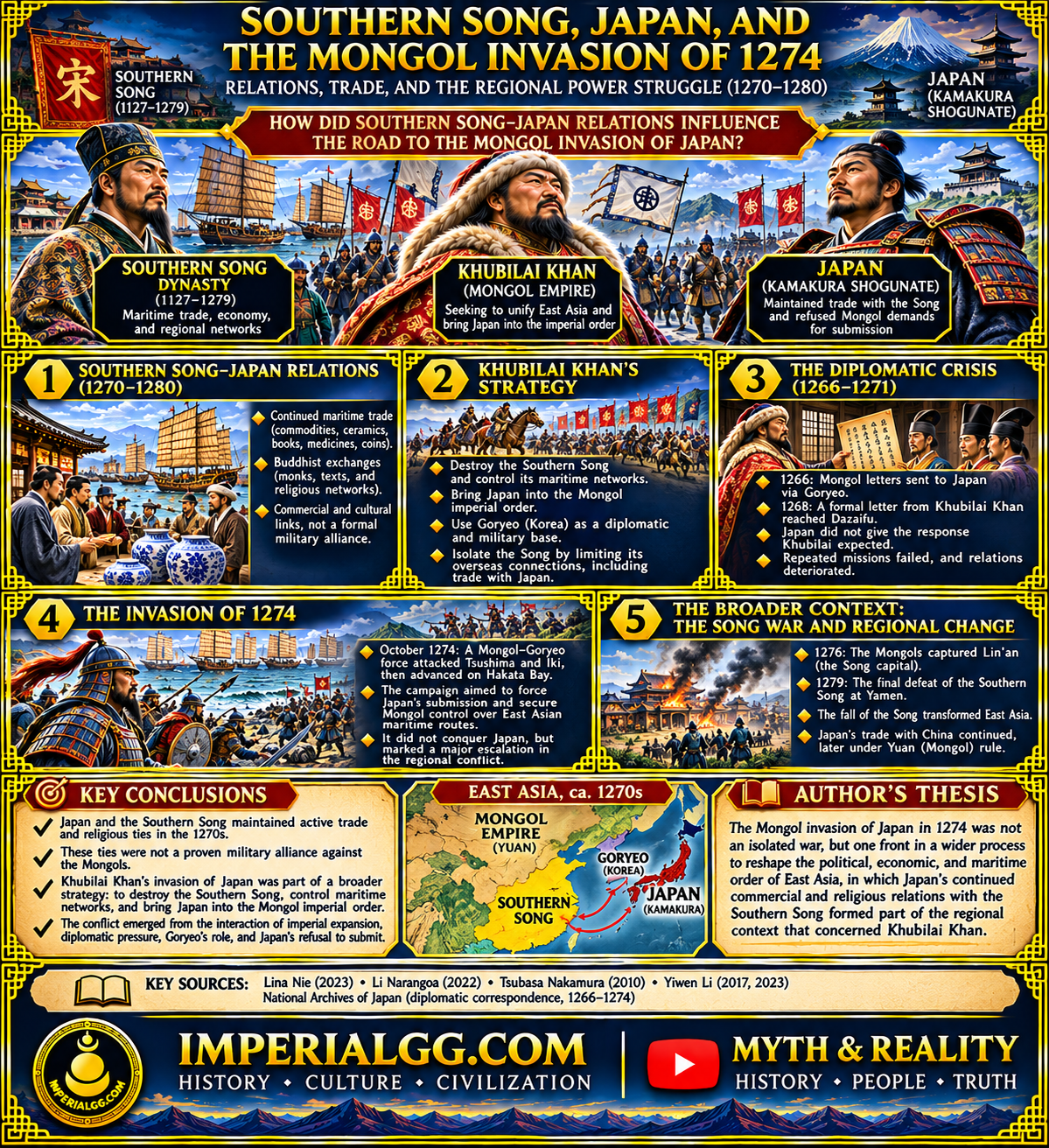
MARITIME TRADE, DIPLOMACY, AND THE GEOPOLITICAL FACTORS BEHIND THE MONGOL INVASION OF 1274
An Examination of Sino-Japanese Relations during the Final Decade of the Southern Song Dynasty and the Expansion of Mongol Power in East Asia
ABSTRACT
The decade from 1270 to 1280 was a decisive period in the political transformation of East Asia. The Mongol Empire, under Khubilai Khan, was consolidating its authority over the Korean Peninsula, continuing its military campaign against the Southern Song dynasty, and seeking to establish a new political and diplomatic order across the maritime regions of East Asia. Japan, governed by the Kamakura shogunate, maintained commercial and religious connections with Southern Song China despite the growing power of the Mongol Empire.
This article examines the relationship between Southern Song China and Japan during the final decade of the Song dynasty, with particular attention to maritime trade, Buddhist networks, diplomatic negotiations, and the strategic objectives of Khubilai Khan. It investigates how the continued commercial and religious connections between Japan and Southern Song China intersected with the Mongol effort to consolidate control over East Asian maritime routes and isolate the remaining Song resistance.
The article argues that the Mongol invasion of Japan in 1274 cannot be explained solely as an attempt to force Japan into submission. It must also be understood within the broader context of the Mongol-Song war, the incorporation of Goryeo into the Mongol imperial system, the strategic importance of maritime commerce, and the diplomatic confrontation between Khubilai Khan and the Japanese political authorities.
The evidence does not establish that Japan and Southern Song China formed a military alliance against the Mongols. Rather, it demonstrates that commercial and religious networks continued to connect the two societies while the Mongol Empire sought to extend its political influence over the same maritime world. The distinction between commercial relations, diplomatic recognition, and military cooperation is essential to understanding the origins of the conflict.
Keywords: Southern Song dynasty, Kamakura shogunate, Khubilai Khan, Mongol Empire, Japan, Goryeo, maritime trade, Buddhist networks, East Asian diplomacy, Mongol invasion of 1274.
I. THE GEOPOLITICAL BACKGROUND: EAST ASIA BETWEEN 1270 AND 1280
By the beginning of the 1270s, East Asia had entered a period of profound political transformation. The Mongol Empire had already expanded across much of Eurasia, while Khubilai Khan was consolidating his authority in China and developing the institutions that would become the Yuan dynasty. The Korean kingdom of Goryeo had been brought under Mongol influence following decades of warfare and negotiation. Meanwhile, the Southern Song dynasty continued to resist Mongol expansion from its territories south of the Yangtze River.
The Southern Song dynasty, established in 1127 after the loss of northern China to the Jurchen Jin, had developed an extensive maritime economy. Its commercial ports, shipbuilding industries, navigation, financial institutions, and overseas trading networks connected southern China with Japan, Korea, Southeast Asia, and other parts of the Indian Ocean world. These networks were not simply commercial routes. They also carried Buddhist monks, religious texts, technologies, artistic traditions, and diplomatic information.
Japan was an important participant in this maritime environment. Although relations between the Japanese imperial court, the Kamakura government, and the Chinese dynasties had changed considerably since earlier centuries, commercial and religious contacts with Song China continued. Japanese monks traveled to China for Buddhist study, while Chinese monks and religious traditions influenced the development of Buddhism in Japan.
For Khubilai Khan, the continuation of these connections had to be considered within a much larger strategic environment. The Mongol campaign against the Southern Song was not only a land war. It also involved control over rivers, coastal regions, ports, shipping, and maritime supply networks. The political integration of Korea and the expansion of Mongol naval capabilities made Japan increasingly relevant to this wider strategy.
Li Narangoa argues that the Mongol invasions of Japan were connected to Khubilai’s broader plan to isolate the Southern Song from its trade networks and undermine its ability to resist Mongol expansion. This interpretation places Japan within the wider strategic history of the Mongol-Song conflict rather than treating the invasion as an isolated confrontation between the Mongols and the Japanese.
Sources:
Li Narangoa, “The Mongol Invasions of Japan and their Legacy,” in The Mongol World (2022). Australian National University Research Repository.
Lina Nie, “Before the Storm: A Transrealm History of the Decades Leading Up to the First Mongol Invasion of Japan,” Monumenta Nipponica 78, no. 2 (2023), pp. 157–187. Sophia University — article and abstract.
II. SOUTHERN SONG AND JAPAN: THE CONTINUATION OF MARITIME RELATIONS
2.1. Japan’s commercial connections with Southern Song China
During the thirteenth century, trade between Japan and Southern Song China was sustained by maritime merchants, Buddhist monks, aristocratic patrons, and commercial intermediaries. This relationship did not necessarily depend on a formal diplomatic alliance between the two governments. Commercial activity could continue through private merchants and religious institutions even when official political relations were limited.
Japanese ships carried goods to Chinese ports, while Chinese vessels and merchants brought commodities to Japan. Among the products associated with this trade were Japanese sulfur, gold, and timber, while Chinese imports included ceramics, books, medicines, textiles, and copper coins. These exchanges contributed to the development of Japanese markets and the circulation of continental material culture.
The trade was also closely connected to religious travel. Japanese Buddhist monks visited China to study under prominent teachers and to obtain religious texts. These journeys created relationships between monasteries, merchants, and political patrons. The resulting networks made it possible for commercial activity to continue even when political circumstances changed.
Research by Tsubasa Nakamura on Japan-Song trade during the middle Kamakura period challenges the idea that foreign trade was simply controlled by a single policy of the Kamakura government. Nakamura argues that the early development of trade was driven largely by influential figures in the Kyoto aristocratic community, Japanese monks traveling to Song China, and maritime merchants. The Kamakura bakufu’s involvement became more visible later, particularly as Kamakura developed as a political and religious center and the government increasingly supported Zen Buddhist institutions.
This is important because it shows that Japan’s connections with Southern Song China were not necessarily the result of a centrally organized foreign policy. They emerged through a complex combination of commercial interests, religious networks, and aristocratic patronage.
Source: Tsubasa Nakamura, “The Development of Japan-Song Trade and the Kamakura Bakufu in the Middle Kamakura Period,” Shigaku Zasshi, vol. 119, no. 10 (2010), pp. 1693–1717. J-STAGE — open-access article and abstract.
2.2. Buddhist networks as channels of commercial exchange
Buddhism was one of the most important connections linking Japan and Southern Song China. During the Kamakura period, Japanese monks traveled to China to study Chan Buddhism, obtain religious manuscripts, and establish relationships with Chinese religious institutions. These connections were not restricted to theology. Monasteries required financial resources, building materials, imported objects, and transportation, while merchants benefited from the trust and contacts provided by religious networks.
The development of Zen institutions in Kamakura and Kyoto also created a demand for Chinese religious culture and material objects. Chinese Buddhist architecture, monastic regulations, paintings, books, and ceramics became influential in Japan.
These exchanges demonstrate that religious institutions were active participants in the maritime economy. They helped maintain channels of communication between Japan and China even when political relations were uncertain.
Yiwen Li’s research on Sino-Japanese maritime trade demonstrates that the participation of Japanese monasteries became particularly important in the period following the Mongol invasions. Although the main transformation described in that study belongs to the later thirteenth and fourteenth centuries, it also reveals the pre-existing integration of religious and commercial networks that made continued exchange possible.
Sources:
Yiwen Li, Networks of Profit and Faith: Spanning the Sea of Japan and the East China Sea, 838–1403 (2017). City University of Hong Kong research record.
Yiwen Li, “Sending Ships to China to Finance Monastery Construction,” in Networks of Faith and Profit (2023), pp. 128–163. Cambridge University Press.
III. WHY DID THE CONTINUATION OF JAPAN–SONG TRADE MATTER TO KHUBILAI KHAN?
The relationship between Japan and Southern Song China became politically significant because it existed within a region where the Mongol Empire was attempting to establish military and diplomatic supremacy.
By the 1270s, the Southern Song was the principal Chinese state still resisting Mongol conquest. Its survival depended not only on military forces but also on its economic resources, maritime transportation, port infrastructure, and commercial connections. The ability to maintain maritime trade was therefore part of the wider economic environment supporting the Song state.
Japan’s continued commercial connections with Southern Song China were relevant to this environment. Even if Japanese merchants were not acting as agents of the Song government, their voyages contributed to the circulation of commodities, money, and information across the East China Sea.
It is important to distinguish three different matters:
Commercial relations: Japanese merchants and religious institutions continued to participate in maritime trade with Song China.
Diplomatic relations: Japan did not accept Khubilai Khan’s demand to establish relations on terms that implied recognition of Mongol imperial superiority.
Military cooperation: There is no sufficient evidence that Japan and Southern Song China had formed a coordinated military alliance against the Mongol Empire.
These distinctions are essential. The continuation of trade did not automatically make Japan a military ally of the Southern Song. Nevertheless, from the perspective of Mongol imperial strategy, an independent maritime network connecting Japan with the remaining Song territories could be regarded as an obstacle to the political and economic integration of the region.
Li Narangoa’s interpretation of the invasions as part of a broader effort to isolate Southern Song China provides an important framework for examining this issue. However, the precise weight assigned to Japan’s trade in Khubilai’s decision to invade remains a question requiring careful comparison of Mongol, Korean, and Japanese primary sources.
Source: Li Narangoa, “The Mongol Invasions of Japan and their Legacy.” ANU Research Repository.
IV. KHUBILAI KHAN’S DIPLOMATIC INITIATIVES TOWARD JAPAN, 1266–1271
The diplomatic confrontation between the Mongol Empire and Japan began before the invasion itself. In 1266, Khubilai Khan sent diplomatic correspondence concerning Japan to the Goryeo court. One document instructed the Goryeo king to facilitate the journey of Mongol envoys to Japan, while another expressed the Mongol ruler’s desire to establish relations with the Japanese court.
The Goryeo mission reached Dazaifu in 1268 carrying an official letter from Khubilai Khan. The letter referred to Japan’s long-standing communications with China and questioned why Japan had not established relations with the Mongol Empire. It expressed a desire for friendly relations but also implied that force could be used if Japan rejected the proposal.
The letter was politically significant because it was not simply an invitation to exchange merchants or establish ordinary diplomatic contact. It placed Japan within the Mongol Empire’s expanding system of international relations, in which the Mongol ruler expected surrounding states to recognize his superior political position.
The Japanese authorities did not provide the response Khubilai expected. The letter was delivered through Dazaifu and forwarded to Kamakura, while the imperial court in Kyoto also received it. The Japanese political authorities chose not to send an official reply.
The National Archives of Japan preserves records concerning the arrival of the Mongol letter and the reaction of Japanese political figures. One contemporary court diary described the arrival of the document as an unexpected and extremely important event that caused widespread astonishment.
Subsequent diplomatic missions also failed to secure the desired response. This prolonged silence contributed to the deterioration of relations and increased the possibility of military confrontation.
Primary-source collection: National Archives of Japan, “Japan and Mongolia: Our History through Archival Records.” Diplomatic correspondence and historical documents.
V. THE ROLE OF GORYEO: THE KOREAN PENINSULA AS THE STRATEGIC BRIDGE
The relationship between Southern Song China and Japan cannot be fully understood without examining the position of Goryeo.
The Korean kingdom had experienced decades of conflict with the Mongols before entering a subordinate relationship with the Mongol Empire. Its political position changed significantly during the thirteenth century, and the Goryeo court became an essential intermediary in Mongol diplomatic and military activities directed toward Japan.
The geographical position of Korea made it indispensable to any Mongol expedition across the sea. The peninsula provided ports, shipbuilding resources, naval personnel, provisions, and a staging area for operations against the Japanese islands.
The Mongol Empire therefore used Goryeo not only as a diplomatic channel but also as a military and logistical partner. The 1266 correspondence instructed the Goryeo ruler to assist in sending Mongol envoys to Japan. Later, Goryeo was required to contribute troops and ships for the invasion.
This placed the Goryeo kingdom in a difficult political position. It had to fulfill obligations to the Mongol Empire while dealing with its own political, economic, and social circumstances. The invasion of Japan was therefore not simply a conflict between Mongols and Japanese. It involved several political actors whose interests and degrees of autonomy were different.
Lina Nie’s study is particularly valuable here because it examines the negotiations involving Khubilai Khan, Chinese advisers, the Goryeo king, the Kamakura shogunate, and the Japanese imperial court. It demonstrates that the crisis developed through years of diplomatic interaction rather than through a single decision made immediately before the invasion.
Source: Lina Nie, “Before the Storm,” Monumenta Nipponica 78, no. 2 (2023), pp. 157–187. Article and abstract.
VI. THE SOUTHERN SONG WAR AND THE MONGOL INVASION OF JAPAN IN 1274
By 1274, the Mongol Empire was still engaged in its campaign against the Southern Song dynasty. The invasion of Japan must therefore be situated within a period when Mongol military operations were taking place across multiple fronts.
Khubilai’s decision to attack Japan followed years of unsuccessful diplomatic efforts. The Japanese authorities had not accepted the Mongol proposal for relations, and the Mongol ruler had not obtained the political recognition he sought.
The first invasion began in October 1274. Mongol and Goryeo forces crossed the sea and attacked Tsushima and Iki before reaching northern Kyushu. The National Archives of Japan records the appearance of a large fleet before Tsushima on October 5 and the attack on Iki on October 14.
The invasion demonstrated that the Mongol Empire was prepared to use military force to achieve its political objectives in the Japanese archipelago. It also revealed the importance of Goryeo’s military and maritime resources in the Mongol strategy.
The first invasion did not result in the conquest of Japan. Nevertheless, the military confrontation transformed relations between the Mongol Empire and the Kamakura government. Japan strengthened its coastal defenses, while Khubilai continued to seek submission through further diplomatic missions.
The invasion should not be interpreted as an automatic consequence of Japan’s trade with Southern Song China. Rather, it emerged from the interaction of several factors: the Mongol campaign against the Song, the strategic position of Goryeo, Khubilai’s expectations of diplomatic submission, Japan’s refusal to respond on those terms, and the importance of maritime routes in the political economy of East Asia.
Primary source: National Archives of Japan, “Japan and Mongolia: Our History through Archival Records.” Chronology and records of the 1274 invasion.
VII. THE FALL OF THE SOUTHERN SONG, 1276–1279, AND THE CHANGING REGIONAL ORDER
The fall of the Southern Song dynasty was a decisive turning point in East Asian history. The Mongol conquest of the Song capital, Lin’an, in 1276 was followed by continued resistance among the remaining Song loyalists. The final defeat of the Southern Song occurred in 1279, after the naval battle at Yamen.
The conquest transformed the political and economic structure of East Asia. The Mongol Empire now controlled the principal territories of China and had access to the extensive shipbuilding, commercial, and maritime resources of the former Song regions.
These developments had important implications for Japan. The country was no longer connected to an independent Southern Song state in the same political environment as before. The maritime networks that had previously operated between Japan and Song China now existed within a region increasingly controlled by the Yuan dynasty.
However, the fall of the Southern Song did not mean that Sino-Japanese commerce ended. Trade continued, although its political circumstances and institutional organization changed. Japanese merchants, monks, and monasteries continued to participate in maritime exchange with China.
Yiwen Li’s research demonstrates that after the failed Mongol invasions, Sino-Japanese trade entered a new phase in which religious institutions played an increasingly important role. The continued exchange of goods, books, ceramics, and religious personnel shows that political conflict did not eliminate the commercial and cultural connections across the sea.
Sources:
Yiwen Li, Networks of Profit and Faith: Spanning the Sea of Japan and the East China Sea, 838–1403. Research record.
Yiwen Li, “Sending Ships to China to Finance Monastery Construction.” Cambridge University Press.
VIII. THE PERIOD 1270–1280: A CHRONOLOGICAL OVERVIEW
| Year | Major development | Historical significance |
|---|---|---|
| 1270–1272 | Mongol pressure on Southern Song and diplomatic efforts toward Japan continue | Japan becomes increasingly relevant to the Mongol Empire’s regional strategy |
| 1273 | Mongol-Goryeo preparations and negotiations continue | Goryeo’s role as a diplomatic and military intermediary becomes more important |
| 1274 | First Mongol invasion of Japan | Military confrontation follows years of unsuccessful diplomacy |
| 1276 | Mongol forces capture the Southern Song capital, Lin’an | The Song court loses its principal political center |
| 1279 | Final defeat of the Southern Song at Yamen | Mongol control over China is consolidated |
| 1280 | Yuan rule over the former Song territories continues to develop | Japan faces a transformed regional political and maritime environment |
This chronology shows that the invasion of Japan in 1274 occurred before the final destruction of the Southern Song in 1279. The Mongol Empire was therefore conducting its campaign against Japan while the war against the Song was still underway.
IX. HISTORICAL INTERPRETATION: WAS THE MONGOL INVASION OF JAPAN PART OF THE WAR AGAINST THE SOUTHERN SONG?
The relationship between the Mongol invasion of Japan and the war against the Southern Song requires careful interpretation.
One argument emphasizes Khubilai Khan’s desire to bring Japan into the Mongol imperial order. The diplomatic correspondence of 1266 and 1268, the repeated missions, and the Japanese refusal to establish relations on Mongol terms provide direct evidence for this political confrontation.
A second interpretation places the invasion within the wider struggle over maritime commerce and strategic routes in East Asia. The continued commercial and religious connections between Japan and Southern Song China were part of a regional network that the Mongol Empire sought to bring under its influence. Li Narangoa’s interpretation specifically emphasizes the relationship between the invasions and the Mongol strategy of isolating the Southern Song from its trade networks.
A third perspective emphasizes the importance of Goryeo. The Korean kingdom was not merely a geographical passage between the continent and Japan. It was a political actor whose military, naval, and logistical resources were essential to the Mongol expedition.
These interpretations are not necessarily mutually exclusive. The available evidence suggests that the invasion emerged from the interaction of imperial expansion, diplomatic confrontation, military planning, and the strategic importance of maritime connections.
What cannot be established from the available evidence is that Japan’s continued trade with Southern Song China constituted a formal military alliance or that the Mongol invasion was launched exclusively to punish Japan for trading with the Song. Such claims would require direct documentary evidence that has not been demonstrated here.
HISTORICAL CONCLUSION
The decade from 1270 to 1280 was one of the most consequential periods in the history of East Asia. The Mongol Empire was attempting to destroy the remaining resistance of the Southern Song, consolidate its authority over Goryeo, and establish a political order extending across the continental and maritime regions of East Asia.
Japan remained connected to Southern Song China through commercial exchange, Buddhist networks, maritime merchants, and the movement of religious and cultural knowledge. These connections were not necessarily organized as a state alliance, but they formed part of a regional economic and cultural system that existed beyond the direct political control of the Mongol Empire.
Khubilai Khan’s diplomatic initiatives toward Japan reflected his expectation that neighboring states should recognize the authority of the Mongol ruler. Japan’s refusal to respond on those terms became an important element in the deterioration of relations. The strategic position of Goryeo and the continuing war against the Southern Song further complicated the situation.
The invasion of 1274 was therefore not simply a military expedition against an isolated island country. It was part of a much wider historical process involving the transformation of East Asian diplomacy, the consolidation of Mongol power, the struggle for control of maritime routes, and the collapse of the Southern Song dynasty.
The fall of the Southern Song in 1279 did not end commercial and cultural relations between China and Japan. Instead, those relations continued under a new political order, demonstrating that the economic and religious networks of East Asia were more enduring than the military conflicts that repeatedly disrupted them.
AUTHOR’S THESIS
The Mongol invasion of Japan in 1274 should be understood within the broader geopolitical transformation of East Asia during the final decade of the Southern Song dynasty.
Japan’s continued commercial and religious relations with Southern Song China were part of a maritime network that connected the Japanese archipelago with the Chinese coast and the Korean Peninsula. These relations did not constitute proof of a formal Japanese-Song military alliance. Nevertheless, they formed part of the regional economic environment that Khubilai Khan sought to bring under Mongol political influence.
The Mongol Empire’s campaign against the Southern Song, the incorporation of Goryeo into the Mongol imperial system, Khubilai’s diplomatic demands toward Japan, and the Kamakura government’s refusal to accept those demands together created the conditions for military confrontation.
The invasion of Japan in 1274 was not an isolated war between the Mongol Empire and the Japanese archipelago. It was one front in the larger struggle to reshape the political, commercial, and maritime order of East Asia.
BIBLIOGRAPHY AND PRINCIPAL SOURCES
I. JAPAN–SONG RELATIONS AND MARITIME TRADE
Nakamura, Tsubasa. “The Development of Japan-Song Trade and the Kamakura Bakufu in the Middle Kamakura Period.” Shigaku Zasshi, vol. 119, no. 10 (2010), pp. 1693–1717.
DOI: 10.24471/shigaku.119.10_1693
J-STAGE — article abstract and PDF
Li, Yiwen. Networks of Profit and Faith: Spanning the Sea of Japan and the East China Sea, 838–1403. PhD dissertation, Yale University, 2017.
City University of Hong Kong research record
Li, Yiwen. “Sending Ships to China to Finance Monastery Construction.” In Networks of Faith and Profit: Monks, Merchants, and Exchanges between China and Japan, 839–1403 CE, pp. 128–163. Cambridge University Press, 2023.
DOI: 10.1017/9781009303132.007
II. THE DIPLOMATIC CRISIS AND THE MONGOL INVASION
Nie, Lina. “Before the Storm: A Transrealm History of the Decades Leading Up to the First Mongol Invasion of Japan.” Monumenta Nipponica, vol. 78, no. 2 (2023), pp. 157–187.
Sophia University — article and abstract
Narangoa, Li. “The Mongol Invasions of Japan and their Legacy.” In The Mongol World, 2022.
DOI: 10.4324/9781315165172-72
Australian National University Research Repository
III. PRIMARY SOURCES AND ARCHIVAL MATERIALS
National Archives of Japan. “Japan and Mongolia: Our History through Archival Records.”
Diplomatic correspondence, the 1266 and 1268 missions, and records of the 1274 and 1281 invasions
National Archives of Japan. Mokokoku Chojo and Jinshinin Kanpakuki.
Manuscript and documentary records relating to the Mongol diplomatic correspondence and its reception in Japan, described in the National Archives’ digital exhibition.
METHODOLOGICAL NOTE
This article distinguishes between commercial relations, diplomatic recognition, and military cooperation. Evidence that Japanese merchants and Buddhist institutions continued to trade with Southern Song China does not, by itself, establish the existence of a formal military alliance between the two governments.
The interpretation that the Mongol invasions were connected to Khubilai Khan’s strategy of isolating Southern Song China is supported by Li Narangoa’s research. Lina Nie’s study provides a broader diplomatic framework, examining the negotiations and actions of the Mongol, Goryeo, Japanese court, and Kamakura authorities. Nakamura’s research is used to explain the institutional and commercial structure of Japan-Song trade during the Kamakura period.
The chronology also distinguishes the first Mongol invasion in 1274 from the final defeat of the Southern Song in 1279. The fall of the Southern Song therefore occurred five years after the first invasion of Japan. Later developments in Yuan-Japanese trade are treated as evidence of the changing regional order, not as direct proof of the causes of the 1274 campaign.
The article does not claim that Japan fought as a military ally of the Southern Song. Such a conclusion would require direct primary-source evidence beyond the commercial and religious contacts established by the cited scholarship.