GORYEO UNDER THE MONGOL EMPIRE, 1230–1280
By Altanbagana Baatar
DBA Candidate| Founder & Organizer
Heavenly Wind 750 International Conference
Heavenlywind750.com | Imperilagg.com
10 November 2026
Conquest, Political Subordination, Royal Autonomy, and the Formation of a Vassal Kingdom in East Asia
ABSTRACT
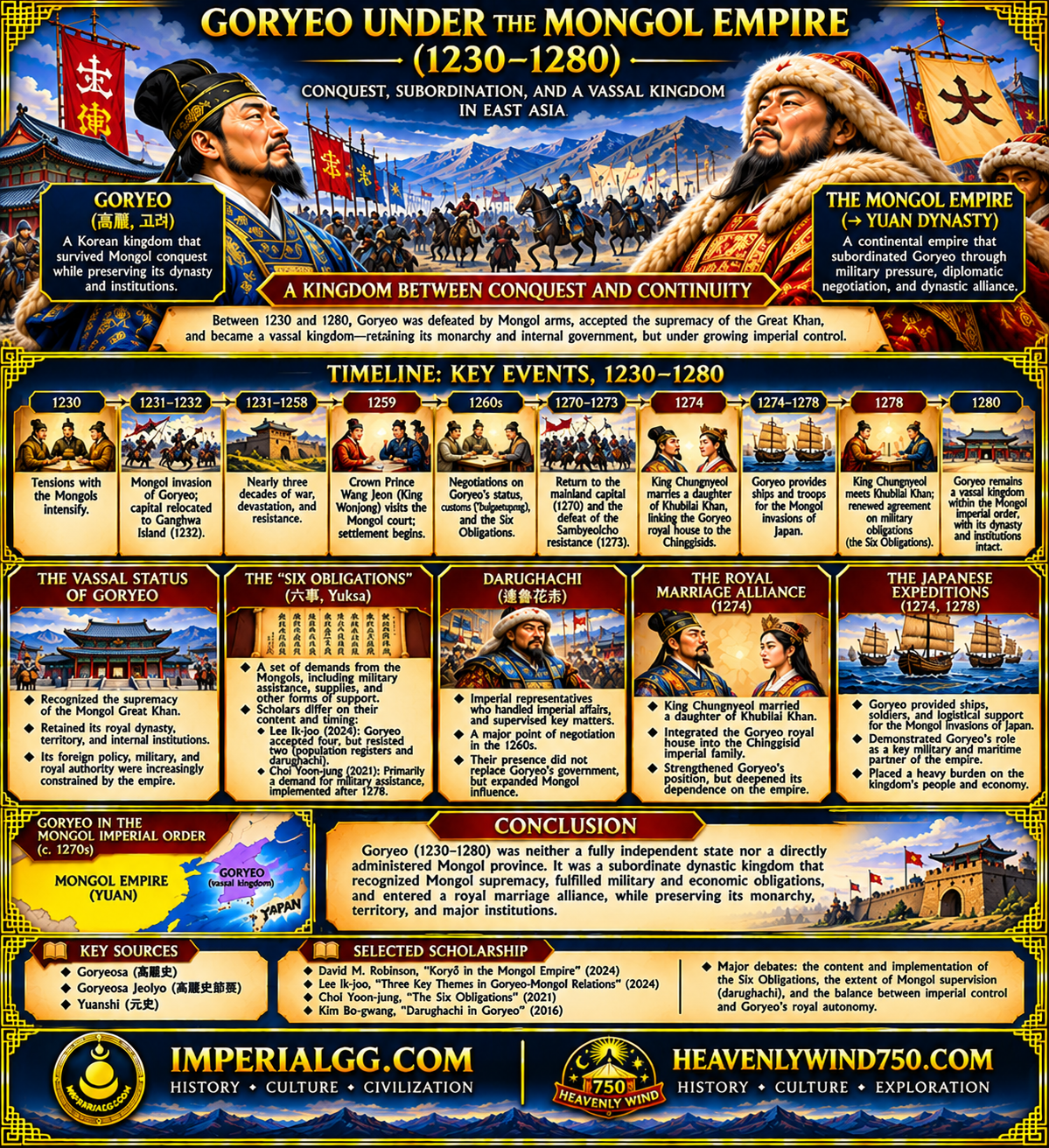
The relationship between the Kingdom of Goryeo (高麗, 고려) and the Mongol Empire between 1230 and 1280 represents one of the most complex examples of political subordination and negotiated sovereignty in medieval East Asia. Beginning with the Mongol invasion of 1231, Goryeo experienced nearly three decades of intermittent warfare, military resistance, diplomatic negotiations, and internal political conflict. The settlement of 1259 did not immediately transform Goryeo into an ordinary Mongol province. Instead, it initiated a prolonged process through which the Goryeo monarchy retained its dynastic continuity and substantial domestic institutions while acknowledging the supremacy of the Mongol Great Khan and assuming increasingly extensive military, diplomatic, and economic obligations.
This article examines the evolution of Goryeo’s political status from the beginning of the Mongol invasions to 1280. It focuses on the destruction caused by the campaigns of 1231–1259, the negotiations following King Wonjong’s accession, the meaning of the promise not to alter Goryeo’s customs, the so-called Six Obligations, the role of darughachi officials, the restoration of royal authority, the Sambyeolcho resistance, the marriage alliance with the Chinggisid imperial family, and the political significance of King Chungnyeol’s meeting with Khubilai Khan in 1278.
Drawing on the Korean historical records Goryeosa (高麗史) and Goryeosa Jeolyo (高麗史節要), the Chinese imperial history Yuanshi (元史), and modern Korean and international scholarship, this study argues that Goryeo should not be described simply as either an independent sovereign state or a directly administered Mongol province. Its status developed into a form of dynastic subordination within the Mongol imperial order, in which the Goryeo monarchy preserved important elements of its state structure while its external sovereignty, military policy, and royal authority became increasingly constrained.
Keywords: Goryeo, Mongol Empire, Yuan dynasty, vassal kingdom, tributary-investiture relationship, darughachi, Six Obligations, royal marriage alliance, Sambyeolcho, Khubilai Khan, thirteenth century.
I. INTRODUCTION: THE POLITICAL STATUS OF GORYEO IN THE MONGOL IMPERIAL ORDER
During the thirteenth century, the Korean peninsula occupied a strategically important position between the Mongol Empire, the Chinese states, and the Japanese archipelago. The Kingdom of Goryeo, established in 918 by Wang Geon, possessed a long-established monarchy, administrative institutions, aristocratic families, a written bureaucratic tradition, and a distinct political and cultural identity. By the beginning of the Mongol invasions, the kingdom had already experienced several centuries of diplomatic relations with powerful neighboring states.
The emergence of Mongol power fundamentally altered this regional political environment. The Mongol Empire, founded under Chinggis Khan and expanded by his successors, developed a system of imperial authority that extended far beyond the direct administration of conquered territories. Its political relationships included military occupation, tribute, negotiated submission, dynastic marriages, the appointment of imperial representatives, and the incorporation of local elites into imperial institutions.
Goryeo’s experience demonstrates how these different mechanisms could operate simultaneously. Although Mongol armies repeatedly invaded the peninsula between 1231 and 1259, the Goryeo royal house was not abolished. The monarchy continued, its capital eventually returned to the mainland, and its domestic institutions survived, although under conditions of growing imperial supervision.
The central historical question is therefore not simply whether Goryeo was conquered. The evidence clearly establishes that Mongol military power compelled Goryeo to accept a subordinate relationship. The more important question is how that relationship was organized, what elements of sovereignty remained, and how the obligations imposed by the Mongol Empire changed between the initial invasion and the end of the 1270s.
David M. Robinson’s chapter “Koryŏ in the Mongol Empire,” published in The Cambridge History of the Mongol Empire in 2024, provides an important framework for understanding this relationship. Robinson emphasizes that the Mongol conquest transformed Korean political, social, economic, and cultural life, while Koreans themselves became participants in the imperial system as soldiers, advisers, agricultural workers, palace attendants, and members of elite marriage networks.
Source: David M. Robinson, “Koryŏ in the Mongol Empire,” The Cambridge History of the Mongol Empire (2024).
https://doi.org/10.1017/9781316337424.017
II. 1230–1239: THE BEGINNING OF MONGOL MILITARY EXPANSION INTO GORYEO
The year 1230 provides the immediate chronological background to the Mongol invasion of Goryeo. At this time, the kingdom was governed under the military regime established after the military coup of 1170. Although the Goryeo king formally occupied the throne, real political authority had been concentrated in powerful military families, particularly the Choe regime.
This internal political structure affected the kingdom’s ability to respond to Mongol pressure. Goryeo had previously established relations with the Mongols during the campaigns against Khitan forces in the region. However, the relationship became increasingly difficult as Mongol demands for tribute, diplomatic submission, and political recognition expanded.
In the eighth lunar month of 1231, Mongol forces launched their first major invasion of Goryeo. They advanced toward the capital of Gaegyeong, demonstrating the vulnerability of the kingdom’s northern defenses. The Mongol withdrawal in early 1232 did not end the conflict. Instead, the Goryeo military government adopted a strategy of relocating the royal court to Ganghwa Island, separated from the mainland by a narrow stretch of water.
The relocation of the capital in 1232 was a strategic decision intended to exploit the Mongols’ limitations in conducting prolonged amphibious operations. The island offered natural defensive advantages and allowed the royal government to continue resisting while Mongol forces operated across the mainland.
The second Mongol invasion in 1232 caused extensive destruction. Among the cultural losses was the destruction of the first edition of the Tripitaka Koreana, a major Buddhist canonical collection. Subsequent campaigns in 1235 and later years expanded the devastation across agricultural regions, towns, monasteries, and local administrative centers.
The conflict was not a continuous occupation of the entire peninsula. Rather, it consisted of successive military campaigns, raids, sieges, negotiations, and temporary withdrawals. The Goryeo court maintained its political center on Ganghwa Island, while the mainland population experienced the consequences of repeated warfare.
The destruction of agricultural production, the displacement of communities, the loss of cultural institutions, and the disruption of regional administration weakened the kingdom’s economic and military capacity. Nevertheless, Goryeo’s resistance continued for nearly three decades.
Primary and institutional source: A History of Korea, Chapter 5, “Goryeo and the Mongol Empire,” Academy of Korean Studies.
https://contents.history.go.kr/resources/common/pdf/A%2520History%2520of%2520Korea_The%2520Understanding%2520Korea%2520Series.pdf
III. 1239–1259: PROLONGED WAR, NEGOTIATIONS, AND THE CRISIS OF THE GORYEO MONARCHY
By 1239, the Mongol and Goryeo governments had entered a period of renewed diplomatic contact. However, the fundamental disagreements remained unresolved. The Mongols demanded that Goryeo accept imperial authority, provide supplies, and comply with political requirements, while the Goryeo military government attempted to preserve its control over the kingdom and avoid the establishment of direct Mongol supervision.
The relocation to Ganghwa Island remained a central obstacle. The Mongol government repeatedly demanded that the Goryeo court return to the mainland and that the king personally appear before the Mongol ruler. These demands were not merely ceremonial. They were intended to demonstrate that Goryeo recognized the political supremacy of the Mongol sovereign.
The military regime resisted these demands for years. The Mongol campaigns of the 1240s and 1250s increasingly devastated the peninsula. By the middle of the 1250s, the Mongols had demonstrated their ability to penetrate deeply into Goryeo territory, threaten the old capital, and conduct operations against coastal positions.
The political situation changed significantly in 1258 when the Choe military regime collapsed. This development weakened the political structure that had sustained resistance from Ganghwa Island and restored greater authority to the royal house.
In 1259, Crown Prince Wang Jeon, the future King Wonjong, traveled to the Mongol court. His journey became the turning point in the relationship between the two states. The negotiations brought the prolonged military confrontation toward an end and established the basis for a new political arrangement.
However, the settlement did not immediately resolve every issue. The return of the capital to the mainland, the future authority of the Goryeo monarchy, the presence of Mongol representatives, and the obligations expected from Goryeo remained subjects of negotiation.
The year 1259 should therefore be understood as the beginning of a new political phase rather than the date on which Goryeo instantly became an ordinary Mongol province.
Source: Academy of Korean Studies, “King Wonjong,” Korean History database.
https://contents.history.go.kr/mobile/kc/view.do?code=kc_age_20&levelId=kc_n203300
IV. 1259–1268: NEGOTIATING SUBORDINATION AND PRESERVING THE GORYEO STATE
Following the settlement of 1259, Goryeo faced a fundamental political challenge: how could the monarchy maintain its dynastic and institutional continuity while accepting the supremacy of the Mongol Great Khan?
The Goryeo court sought to establish a relationship resembling the traditional East Asian tributary-investiture system. Under this arrangement, the Goryeo monarch would recognize the superior political position of the Mongol ruler, receive recognition of his royal title, and maintain the internal institutions of his kingdom.
A particularly important issue was the promise commonly discussed in Korean scholarship as bulgaetupung (不改土風), meaning the commitment not to alter Goryeo’s local customs and institutions.
The significance of this principle extended beyond cultural traditions. The preservation of Goryeo customs was closely connected to the continued existence of its territory, population, royal lineage, and governing institutions.
The negotiations also involved the so-called Six Obligations, or yuksa (六事). These obligations have been the subject of substantial debate among modern Korean historians.
Lee Ik-joo’s 2024 study, “A Reexamination of Three Key Themes in the Study of Goryeo-Mongol Relations,” examines the historical meaning of the brotherly agreement, the promise not to alter Goryeo customs, and the Six Obligations.
According to Lee’s interpretation, Goryeo sought to preserve its sovereignty and royal lineage through a tributary-investiture arrangement. The Mongols, meanwhile, demanded the king’s personal attendance at the imperial court (chinjo, 親朝) and compliance with the Six Obligations. Lee argues that Goryeo accepted four obligations but resisted two particularly sensitive demands: the submission of population registers and the establishment of darughachi officials.
The distinction is important. Population registration would have provided the Mongol authorities with greater access to information about Goryeo’s inhabitants and resources. The appointment of darughachi officials would have created a more direct channel of imperial supervision inside the kingdom.
Lee argues that by 1268 the Mongols had ceased pressing these two demands in the same manner, allowing the relationship to develop into a form of tributary-investiture subordination that Goryeo had sought to preserve.
This interpretation is not universally accepted. Other scholars have argued that the Six Obligations should be understood primarily as a demand for military assistance and that the question of their implementation remained unresolved until the late 1270s.
The debate demonstrates why the political status of Goryeo cannot be reduced to a single legal formula. The relationship was negotiated, contested, and repeatedly redefined.
Sources:
Lee Ik-joo, “A Reexamination of Three Key Themes in the Study of Goryeo-Mongol Relations: The ‘Brotherly Agreement,’ the ‘Promise Not to Alter Goryeo Customs,’ and the ‘Six Obligations,’” Korean Medieval History Studies 79 (2024), pp. 257–298.
https://doi.org/10.35863/JKMH.79.8
Choi Yoon-jung, “Reconsideration of Koryeo-Mongol Relationship, 1219–1278: Focusing on Mongol’s Request for Fulfillment of the So-called ‘Six Things (六事),’” Daegu Historical Studies 142 (2021), pp. 257–312.
https://doi.org/10.17751/DHR.142.257
V. DARUGHACHI AND THE QUESTION OF DIRECT IMPERIAL ADMINISTRATION
The position of the darughachi (達魯花赤) is central to understanding the degree of Mongol supervision over Goryeo.
Darughachi were imperial representatives used in different parts of the Mongol Empire. Their functions varied according to the political and administrative conditions of individual territories. They could supervise local affairs, monitor the implementation of imperial orders, oversee security and transport, and represent the interests of the imperial government.
The presence of darughachi in Goryeo therefore represented an important expansion of Mongol influence. However, it is necessary to distinguish between the presence of imperial representatives and the complete replacement of local government.
Goryeo retained its own administrative institutions, officials, legal traditions, and royal court. The Mongol representatives operated within a political environment in which the Goryeo monarchy continued to exist, although its authority was increasingly restricted.
The debate over whether darughachi should be established as a permanent institution was particularly significant during the negotiations of the 1260s. The demand was closely connected to the question of whether the Mongols could exercise direct administrative supervision over Goryeo’s population and resources.
Kim Bo-gwang’s research on darughachi in Goryeo emphasizes their institutional role and the ways in which their presence affected the kingdom’s experience of imperial rule.
Source: Kim Bo-gwang, “Darugachi Figures in Goryeo: Existence, Influence and Goryeo Having a ‘Taste of Being Ruled’ from Interactions with Them,” History and Reality 99 (2016), pp. 25–58.
https://www.kci.go.kr/kciportal/ci/sereArticleSearch/ciSereArtiView.kci?sereArticleSearchBean.artiId=ART002093810
VI. 1269–1273: ROYAL RESTORATION, THE SAMBYEOLCHO RESISTANCE, AND THE RETURN TO THE MAINLAND
The relationship between Goryeo and the Mongol Empire entered another period of instability in 1269.
Internal political conflict weakened King Wonjong’s position. The Mongol court intervened in the dispute, and the king’s authority was restored with Mongol support. This episode demonstrated the extent to which the Goryeo royal succession had become connected to imperial political decisions.
In 1270, the Goryeo court returned from Ganghwa Island to the mainland and re-established its capital at Gaegyeong. The return fulfilled one of the central Mongol demands dating back to the 1230s.
However, not all military forces accepted the political settlement. The Sambyeolcho (三別抄), a military organization associated with the military government, continued armed resistance against the decision to accommodate Mongol authority.
The movement established bases on Ganghwa Island, then moved to Jindo and eventually Jeju Island. It maintained resistance until its defeat in 1273 by combined Mongol and Goryeo forces.
The Sambyeolcho resistance should not be reduced to a single interpretation. It involved opposition to Mongol domination, the interests of military groups that had lost political power, the consequences of the end of the military regime, and disagreements over the future of the Goryeo state.
Its defeat eliminated a major organized military challenge to the settlement between the Goryeo monarchy and the Mongol Empire.
The events of 1270–1273 therefore strengthened the position of the restored monarchy while simultaneously demonstrating that Goryeo’s political future was increasingly determined within the framework of Mongol imperial authority.
Primary source: Goryeosa, records of King Wonjong’s reign.
https://db.history.go.kr/goryeo/
VII. 1274: THE ROYAL MARRIAGE ALLIANCE AND GORYEO’S NEW IMPERIAL POSITION
One of the most significant developments in Goryeo-Mongol relations occurred in 1274, when King Chungnyeol (忠烈王) married a daughter of Khubilai Khan.
This marriage established a direct dynastic relationship between the Goryeo royal house and the ruling Chinggisid imperial family. It was not simply a personal union between two individuals. In the political culture of the Mongol Empire, marriage alliances were important instruments for integrating regional rulers and aristocratic families into the imperial order.
The marriage strengthened Goryeo’s position within the empire while also increasing the political dependence of its royal family on the Mongol court.
The Goryeo king became an imperial son-in-law, a relationship that gave him access to the imperial family and its political networks. At the same time, the imperial connection influenced the succession, authority, and political conduct of the Goryeo monarchy.
This relationship became a defining feature of Goryeo’s subsequent history under Mongol domination. The royal family retained its dynastic identity, but its members increasingly participated in the political and social structures of the Mongol Empire.
David M. Robinson notes that the marriage alliance established in 1274 lasted for approximately a century and profoundly shaped the relationship between Goryeo and the Chinggisid imperial family.
Source: David M. Robinson, “Koryŏ in the Mongol Empire,” The Cambridge History of the Mongol Empire (2024).
https://doi.org/10.1017/9781316337424.017
VIII. GORYEO’S MILITARY AND ECONOMIC OBLIGATIONS: THE JAPANESE EXPEDITIONS
Goryeo’s strategic position became particularly important when Khubilai Khan began preparations for the invasion of Japan.
The kingdom possessed maritime experience, shipbuilding capacity, access to the Korean Strait, and a geographical position essential to military operations against the Japanese archipelago.
Goryeo was therefore required to provide ships, soldiers, labor, provisions, and logistical support for the Mongol military campaigns.
The first Mongol invasion of Japan took place in 1274. The expedition involved Mongol and Goryeo forces and relied heavily on Korean maritime resources and military personnel.
The contribution of Goryeo was not limited to supplying troops. The kingdom’s shipyards, coastal facilities, craftsmen, sailors, and agricultural production became part of the imperial military mobilization.
This demonstrates that Goryeo’s subordinate status had practical consequences for its population and economy. The kingdom’s resources could be mobilized for campaigns that served the strategic interests of the Mongol Empire, even when those campaigns were not directly connected to the defense of Goryeo itself.
The Japanese expedition also illustrates the difference between formal dynastic autonomy and effective strategic independence. Goryeo continued to possess a king and domestic institutions, but its military and foreign policy were increasingly shaped by imperial requirements.
Source: David M. Robinson, “Koryŏ in the Mongol Empire” (2024).
https://doi.org/10.1017/9781316337424.017
IX. 1278: KING CHUNGNYEOL’S MEETING WITH KHUBILAI AND THE SIX OBLIGATIONS
The year 1278 is especially important for understanding the changing relationship between Goryeo and the Mongol Empire.
Choi Yoon-jung’s 2021 study argues that the Mongol demand for the so-called Six Obligations should be understood primarily as a demand for military assistance. According to this interpretation, the Mongols had sought such assistance from Goryeo since 1231, but the Goryeo military government repeatedly resisted implementation.
The political situation changed after King Chungnyeol’s marriage alliance and his meeting with Khubilai Khan in 1278.
Choi argues that Chungnyeol agreed to provide military assistance for the planned Japanese expedition. In this interpretation, the meeting marked the beginning of Goryeo’s actual implementation of the Six Obligations.
The study further argues that the king’s willingness to cooperate with Khubilai helped secure the position of the Goryeo royal house while allowing him to remove certain Mongol military and administrative pressures from Goryeo territory.
This interpretation differs in important respects from Lee Ik-joo’s 2024 analysis, which emphasizes the earlier negotiated acceptance of four obligations and the Mongols’ eventual retreat from two particularly intrusive demands.
The disagreement is historically significant. It suggests that the Six Obligations should not be treated as a fixed and universally agreed list whose implementation can be established without examining the political context of each period.
Rather, the obligations evolved through negotiations, military requirements, internal political struggles, and changes in the relationship between the Goryeo monarchy and the Mongol court.
The meeting of 1278 therefore represents an important stage in the transformation of Goryeo from a kingdom that had negotiated the limits of Mongol interference into a more active military participant in the imperial system.
Source: Choi Yoon-jung, “Reconsideration of Koryeo-Mongol Relationship, 1219–1278,” Daegu Historical Studies 142 (2021), pp. 257–312.
https://doi.org/10.17751/DHR.142.257
X. 1280: GORYEO AT THE END OF THE FIRST HALF-CENTURY OF MONGOL DOMINATION
By 1280, Goryeo had undergone a profound political transformation.
The kingdom had survived the destruction of nearly three decades of warfare without losing its royal dynasty or being converted into an ordinary Mongol province. Its capital had returned to the mainland, the military resistance of the Sambyeolcho had been defeated, the royal house had entered the Chinggisid marriage network, and the kingdom had become deeply involved in the military and administrative structures of the Mongol Empire.
However, the preservation of the monarchy did not mean the preservation of unrestricted sovereignty.
Goryeo’s foreign policy was constrained by the imperial court. Its king was expected to maintain relations with the Great Khan, fulfill military and logistical obligations, and recognize the political hierarchy of the empire. The royal marriage alliance further connected the Goryeo dynasty to imperial decisions.
At the same time, Goryeo continued to possess a distinct political identity, administrative institutions, local elites, and a royal succession system. Its relationship with the Mongol Empire was therefore different from the direct provincial administration imposed in other conquered territories.
The year 1280 provides a useful endpoint for examining the first fifty years of this transformation. It allows us to distinguish the period of military conquest and negotiated subordination from the later stages of Goryeo’s long relationship with the Yuan dynasty.
XI. WAS GORYEO AN INDEPENDENT KINGDOM, A VASSAL STATE, OR A MONGOL PROVINCE?
The political status of Goryeo between 1230 and 1280 cannot be adequately explained by choosing only one of these categories without qualification.
1. Goryeo was not fully independent in the modern sense.
Its external relations, military commitments, royal succession, and diplomatic position were increasingly constrained by Mongol imperial authority. The kingdom could not freely determine all aspects of its foreign policy.
2. Goryeo was not simply an ordinary Mongol province.
Its royal dynasty survived, its domestic institutions continued to function, and its territory was not entirely reorganized as a directly administered imperial province. The Goryeo court retained substantial responsibility for internal government.
3. Goryeo developed into a subordinate dynastic kingdom within the Mongol imperial order.
This description best captures the combination of imperial supremacy and institutional continuity. The Goryeo monarch recognized the authority of the Mongol Great Khan, while the Goryeo royal house maintained its own throne and administrative system.
The term “vassal kingdom” can therefore be useful as a modern analytical description, provided that it is not treated as an exact equivalent of European feudal vassalage. The Mongol Empire operated through a wider and more flexible range of relationships, including tribute, military service, royal marriage, personal attendance, and the incorporation of local elites.
A further distinction is necessary between the Mongol Empire before 1271 and the Yuan dynasty established by Khubilai Khan. The political relationship developed during the period of Mongol imperial expansion and continued after the establishment of the Yuan dynasty. It should not be assumed that the later Yuan administrative framework was already fully established in 1230.
XII. CONCLUSION
Between 1230 and 1280, Goryeo experienced one of the most consequential transformations in its political history.
The Mongol invasions beginning in 1231 weakened the kingdom’s military and economic foundations and exposed the limits of the existing military regime. The collapse of the Choe government in 1258 and the negotiations of 1259 opened a new phase in which the Goryeo monarchy sought to preserve its dynasty and institutions under Mongol supremacy.
The negotiations of the 1260s were central to defining the limits of imperial intervention. The promise not to alter Goryeo customs, the question of the Six Obligations, and the dispute over darughachi and population registration demonstrate that the political relationship was negotiated rather than imposed through a single administrative settlement.
The return of the capital in 1270 and the defeat of the Sambyeolcho in 1273 consolidated the new political order. The marriage between King Chungnyeol and Khubilai Khan’s daughter in 1274 connected the Goryeo royal family directly to the Chinggisid imperial house. Goryeo’s participation in the Japanese expedition and the meeting between Chungnyeol and Khubilai in 1278 further demonstrated the kingdom’s integration into the military and political structures of the empire.
By 1280, Goryeo remained a kingdom with its own monarch, institutions, and political identity, but it no longer possessed the unrestricted external sovereignty that it had exercised before the Mongol invasions.
Its history during this period reveals the flexibility of Mongol imperial governance. The empire did not always eliminate existing monarchies or replace them with direct provincial administration. In some cases, it incorporated established royal houses into a hierarchy of political dependence, military service, and dynastic alliance.
Goryeo is one of the clearest examples of this form of imperial integration in medieval East Asia.
AUTHOR’S THESIS
The political transformation of Goryeo between 1230 and 1280 should be understood not as a simple transition from independence to annexation, but as the gradual formation of a subordinate dynastic kingdom within the Mongol imperial order.
The Mongol Empire achieved political supremacy over Goryeo without abolishing its royal dynasty or completely replacing its domestic institutions. Instead, imperial authority was exercised through military pressure, negotiated obligations, diplomatic hierarchy, administrative supervision, royal marriage, and the mobilization of Korean human and material resources.
Goryeo’s survival as a kingdom was therefore neither evidence of complete independence nor proof that Mongol domination was merely symbolic. Its monarchy retained meaningful domestic authority, but the conditions under which that authority operated had fundamentally changed.
The most important historical insight is that Goryeo’s political status was neither static nor uniform. It evolved through successive negotiations and conflicts, and the balance between imperial authority and local autonomy shifted repeatedly between 1230 and 1280.
This case also challenges the assumption that the Mongol Empire governed every conquered territory through the same administrative model. Its imperial structure was capable of incorporating existing states through different combinations of military, political, dynastic, and economic mechanisms.
Goryeo’s experience demonstrates that an established kingdom could preserve its historical identity while becoming deeply integrated into an imperial system whose supreme authority lay beyond its own borders.
PRIMARY SOURCES AND SELECTED BIBLIOGRAPHY
A. KOREAN PRIMARY SOURCES
1. Goryeosa (高麗史)
The official historical record of the Goryeo dynasty. The reigns of King Gojong, King Wonjong, and King Chungnyeol are essential for examining the Mongol invasions, negotiations, royal succession, darughachi, military obligations, and the Japanese expeditions.
Digital source:
https://db.history.go.kr/goryeo/
2. Goryeosa Jeolyo (高麗史節要)
A chronological history of Goryeo. It provides a complementary account of political and military events and should be compared with the Goryeosa.
Digital source:
https://db.history.go.kr/
B. CHINESE PRIMARY SOURCES
3. Yuanshi (元史)
The official history of the Yuan dynasty, compiled during the early Ming period. Its biographies and imperial records provide information about Goryeo rulers, Korean officials, military personnel, and the relationship between Goryeo and the Mongol imperial court.
Chinese Text Project:
https://ctext.org/wiki.pl?if=gb&res=774108
Research note: The Yuanshi was compiled after the events it describes. Its accounts should therefore be compared with contemporary Korean records rather than treated as a neutral eyewitness narrative.
C. MODERN SCHOLARSHIP
4. Robinson, David M.
“Koryŏ in the Mongol Empire.” In The Cambridge History of the Mongol Empire (2024).
https://doi.org/10.1017/9781316337424.017
5. Lee, Ik-joo (이익주).
“A Reexamination of Three Key Themes in the Study of Goryeo-Mongol Relations: The ‘Brotherly Agreement,’ the ‘Promise Not to Alter Goryeo Customs,’ and the ‘Six Obligations.’” Korean Medieval History Studies 79 (2024), pp. 257–298.
https://doi.org/10.35863/JKMH.79.8
6. Choi, Yoon-jung (최윤정).
“Reconsideration of Koryeo-Mongol Relationship, 1219–1278: Focusing on Mongol’s Request for Fulfillment of the So-called ‘Six Things (六事).’” Daegu Historical Studies 142 (2021), pp. 257–312.
https://doi.org/10.17751/DHR.142.257
7. Jung, Dong-hun.
“The Meaning of Tribute in the Early Relations (1219–1259) between Goryeo and Mongol Empire.” Korean Medieval History Studies 61 (2020), pp. 249–285.
https://doi.org/10.35863/JKMH.61.8
8. Kim, Bo-gwang.
“Darugachi Figures in Goryeo: Existence, Influence and Goryeo Having a ‘Taste of Being Ruled’ from Interactions with Them.” History and Reality 99 (2016), pp. 25–58.
https://www.kci.go.kr/kciportal/ci/sereArticleSearch/ciSereArtiView.kci?sereArticleSearchBean.artiId=ART002093810
9. Academy of Korean Studies.
A History of Korea, Chapter 5: “Goryeo and the Mongol Empire.”
https://contents.history.go.kr/resources/common/pdf/A%2520History%2520of%2520Korea_The%2520Understanding%2520Korea%2520Series.pdf