
NATIONAL PRIDE DAY OF MONGOLIA
By Altanbagana Baatar
DBA Candidate| Founder & Organizer
Heavenly Wind 750 International Conference
Heavenlywind750.com | Imperilagg.com
11 November 2026
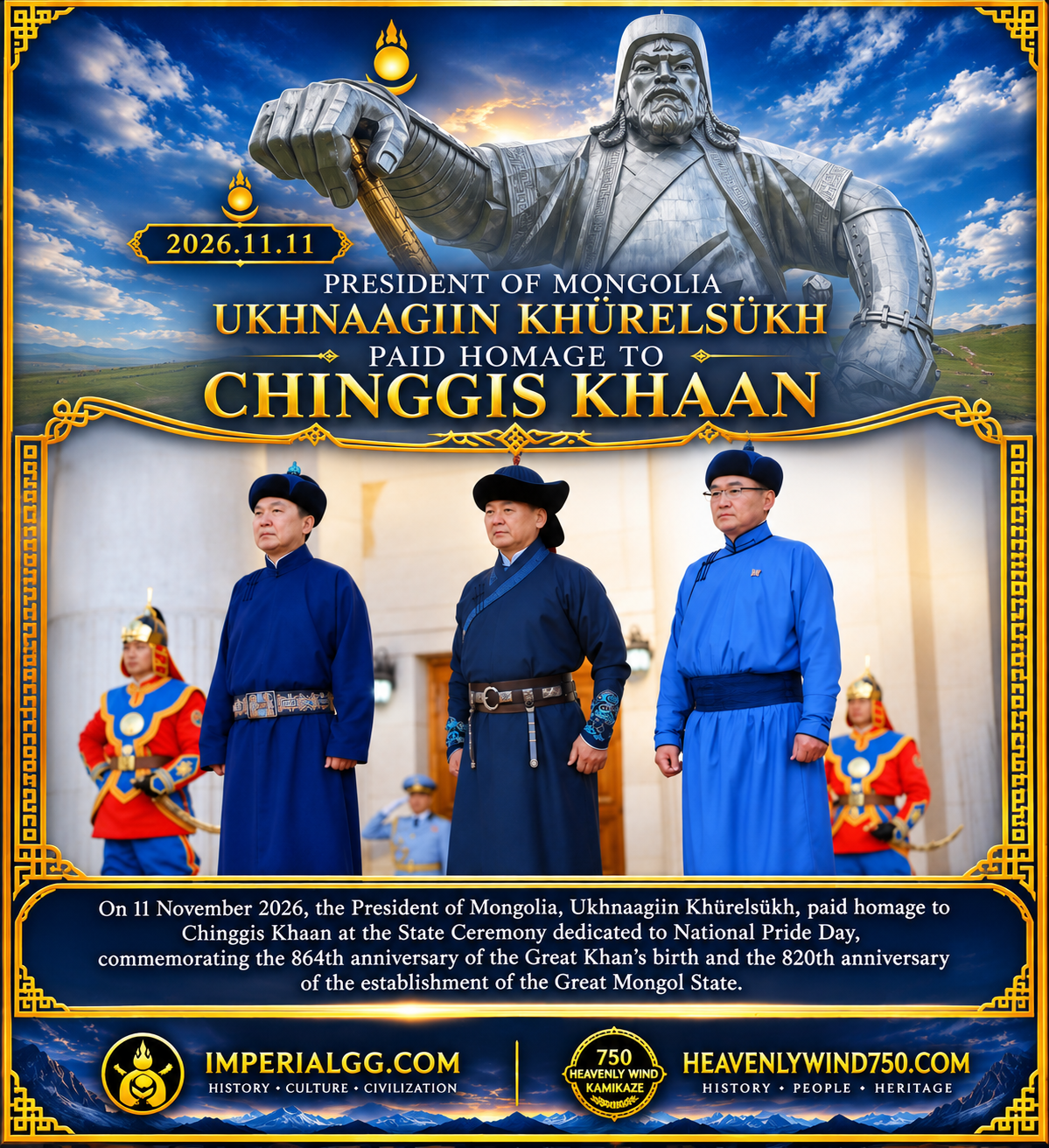
CHINGGIS KHAAN, HISTORICAL MEMORY, AND THE CONTINUITY OF MONGOLIAN STATEHOOD
ABSTRACT
National Pride Day occupies a distinctive position in the contemporary political and cultural life of Mongolia because it institutionalizes the historical memory of Chinggis Khaan as a central element of national identity and connects the achievements of the medieval Mongolian state with the historical consciousness of the modern nation. Established through Presidential Decree No. 4, issued on January 9, 2012, the observance designated the first day of the first month of winter according to the traditional lunar calendar as the officially recognized commemorative date of Chinggis Khaan’s birth and established the occasion as National Pride Day. The subsequent amendment to Mongolia’s Law on Public Holidays and Observances on November 8, 2012, formally incorporated Chinggis Khaan’s Day into the national public holiday calendar, transforming the presidential decision into a statutory component of Mongolia’s commemorative framework.
The establishment of this national observance reflects a broader historical process through which the Mongolian state has sought to preserve and institutionalize the memory of its medieval political traditions. Chinggis Khaan’s significance derives not only from the territorial expansion of the Mongol Empire but, more fundamentally, from his transformation of the political organization of the Mongolian steppe, the consolidation of previously competing political communities, the development of a centralized system of authority, and the foundation of a state whose institutions and international influence reshaped the history of Eurasia. The Great Mongol State, established in 1206, became the political foundation from which the Mongol Empire developed into the largest contiguous land empire in recorded history.
This article examines the legal establishment of National Pride Day, the historical background of the officially recognized birth anniversary, the political conditions preceding the unification of the Mongolian steppe, the foundation of the Great Mongol State, and the continuing significance of Chinggis Khaan’s legacy for Mongolian statehood and national identity. Drawing upon the Secret History of the Mongols, Chinese and Persian historical traditions, the 2012 presidential decree, Mongolian legislation, and modern international scholarship, the study places the contemporary commemoration within the broader historical development of Mongolian civilization. It argues that National Pride Day is not simply an annual celebration of a prominent historical ruler, but a state-recognized expression of the relationship between historical memory, political continuity, cultural inheritance, and national responsibility.
Keywords: National Pride Day, Chinggis Khaan, Temüjin, Great Mongol State, Mongolian statehood, national identity, historical memory, Mongolian civilization, 1206, Mongol Empire.
I. INTRODUCTION: NATIONAL PRIDE DAY AND THE HISTORICAL MEMORY OF MONGOLIA
The historical identity of a nation is formed through a complex relationship between collective experience, political institutions, cultural traditions, language, historical memory, and the interpretation of the past by successive generations. In Mongolia, the figure of Chinggis Khaan occupies an exceptional position within this historical consciousness because his rise to power transformed the political organization of the Mongolian steppe and initiated the formation of a state whose influence extended across much of Eurasia. His historical significance is therefore inseparable from the development of Mongolian statehood, the consolidation of political authority among the Mongolian groups, and the emergence of a new imperial order that connected the societies of East Asia, Central Asia, the Middle East, and Eastern Europe.
The establishment of National Pride Day in 2012 gave this historical legacy a formal place within the contemporary national calendar. By designating Chinggis Khaan’s officially recognized birth anniversary as a national commemorative occasion, the Mongolian state connected an important historical figure with the wider concept of national pride and placed the memory of the Great Mongol State within the framework of public historical recognition. The decision was significant because it moved the commemoration beyond the traditional remembrance of a historical personality and established it as an institutional expression of Mongolia’s historical identity.
The significance of this development becomes clearer when examined against the historical circumstances of the late twelfth and early thirteenth centuries. The Mongolian steppe was not politically unified before Temüjin’s rise. It contained competing tribal confederations, aristocratic lineages, military leaders, and political communities whose alliances were continually reshaped by warfare, diplomacy, marriage, economic interests, and struggles for regional influence. The establishment of the Great Mongol State in 1206 was therefore the result of a prolonged process of political consolidation rather than a single military victory. Temüjin’s achievement consisted in transforming the existing structure of political relationships and establishing a new order in which authority could extend beyond the interests of individual tribes and lineages.
The historical importance of Chinggis Khaan must consequently be understood through the relationship between his personal leadership and the institutional transformation that occurred under his rule. His conquests expanded the geographical reach of Mongolian power, but the foundation of the state preceded the greatest phase of imperial expansion and provided the political and administrative framework that made subsequent expansion possible. The distinction between the establishment of the Great Mongol State in 1206 and the later development of the Mongol Empire is essential for understanding the historical foundations of Mongolian statehood.
National Pride Day brings these different dimensions of history into a contemporary public context. Its significance is not exhausted by the ceremonial recognition of Chinggis Khaan’s birth anniversary; it also provides an occasion to examine the historical formation of the Mongolian political community, the development of its institutions, the preservation of its cultural traditions, and its contribution to world history.
II. THE PRESIDENTIAL DECREE OF JANUARY 9, 2012: THE FORMAL ESTABLISHMENT OF NATIONAL PRIDE DAY
The legal foundation of National Pride Day is Presidential Decree No. 4, issued by the President of Mongolia on January 9, 2012. The decree, titled “ЧИНГИС ХААН-ТЭМҮЖИНИЙ МЭНДЭЛСЭН ОГНООГ АЛБАН ЁСНЫ БОЛГОЖ, ЁСЧЛОХ ТУХАЙ”—translated as “On Officially Recognizing and Commemorating the Birth Date of Chinggis Khaan–Temüjin”—established the official commemorative date associated with the birth of Chinggis Khaan and directed that the occasion be celebrated throughout the country under the name National Pride Day. The presidential document was issued with reference to the constitutional authority of the President and the relevant provisions of the Law on the President of Mongolia, thereby placing the decision within the formal legal framework of the Mongolian state rather than treating it as an informal cultural initiative.
The decree specifically referred to the conclusions of a working group established to determine and officially recognize the birth date of Chinggis Khaan–Temüjin, together with a proposal submitted by the Mongolian Academy of Sciences. On this institutional basis, the decree recognized the first day of the first month of winter in the traditional lunar calendar, corresponding to the Year of the Water Horse in the third sixty-year cycle and the officially adopted year 1162, as the commemorative date. Its second provision named the occasion National Pride Day and established the requirement that it be celebrated ceremonially throughout Mongolia. The legal significance of the decree therefore lies in the combination of historical recognition, institutional consultation, and the creation of a nationwide commemorative practice.
The original text of the presidential decree is preserved in Mongolia’s official legal information system and constitutes the primary legal source for examining the establishment of the observance. Its wording is particularly important because it identifies the institutional basis of the decision and distinguishes the formal recognition of the commemorative date from the subsequent legislative action that incorporated Chinggis Khaan’s Day into the public holiday framework.
Primary legal source: Presidential Decree No. 4, January 9, 2012, On Officially Recognizing and Commemorating the Birth Date of Chinggis Khaan–Temüjin.
https://legalinfo.mn/mn/detail?lawId=9522
The decision was followed by a legislative amendment adopted by the State Great Khural on November 8, 2012, which added Chinggis Khaan’s Day to Article 4.1 of the Law on Public Holidays and Observances. The amended provision identifies the holiday as Chinggis Khaan’s birthday, corresponding to the first day of the first month of winter according to the lunar calendar. This legislative action gave the observance a statutory basis within Mongolia’s public holiday system and established its place alongside other nationally recognized holidays.
The distinction between the presidential decree and the parliamentary amendment is important for an accurate understanding of the legal process. The presidential decree of January 9 established the official commemorative date and named it National Pride Day, whereas the legislative amendment of November 8 incorporated Chinggis Khaan’s Day into the law governing public holidays. Together, these actions created the legal and institutional foundation through which the observance became an established annual national occasion.
Primary legal source: Law on Public Holidays and Observances of Mongolia, Article 4.1.8, amended November 8, 2012.
https://legalinfo.mn/mn/detail?lawId=399
III. THE HISTORICAL BASIS OF THE OFFICIALLY RECOGNIZED BIRTH ANNIVERSARY
The selection of Chinggis Khaan’s birth anniversary as the foundation of National Pride Day reflects the historical importance attributed to the emergence of Temüjin and the political transformation associated with his leadership. The Mongolian state adopted 1162 as the official year of his birth, following the conclusions and proposal referenced in the 2012 presidential decree. The date is embedded in the traditional lunar calendar and is commemorated on the first day of the first month of winter, which means that its corresponding Gregorian calendar date changes from year to year.
The historical chronology of Temüjin’s birth has been examined through several different medieval traditions. Mongolian and Chinese historical records commonly support 1162, while Persian historical accounts, particularly the tradition associated with Rashīd al-Dīn, preserve alternative chronological information. The UNESCO historical study of the Mongols and their state notes that 1162 is the date found in most Chinese and Mongolian records, whereas Rashīd al-Dīn and other Persian sources have been associated with alternative years, including 1155 and 1167. Igor de Rachewiltz, in his extensive commentary on the Secret History of the Mongols, also discusses the different chronological traditions and the adoption of 1162 as the officially recognized birth year in Mongolia.
This historical background is relevant because the official commemorative date belongs to the modern institutional history of Mongolia, while the reconstruction of Temüjin’s precise birth chronology belongs to the critical study of medieval historical sources. The presidential decree established the date that the Mongolian state recognizes for national commemoration; the historical significance of that decision is grounded in the long-standing association of Temüjin’s birth with the emergence of the political leader who subsequently unified the Mongolian steppe and founded the Great Mongol State.
The adoption of a traditional lunar date also reflects the importance of Mongolia’s historical calendar and cultural traditions in the contemporary national commemorative system. Rather than selecting an arbitrary Gregorian date, the state connected the observance with the traditional calendrical framework through which Mongolian society historically organized seasonal time, ceremonial occasions, and important cultural events. The annual movement of the Gregorian date is therefore a consequence of the decision to preserve the lunar-calendar basis of the commemoration.
Sources: Sh. Bira, “The Mongols and Their State in the Twelfth to the Thirteenth Century,” UNESCO; Igor de Rachewiltz, The Secret History of the Mongols: A Mongolian Epic Chronicle of the Thirteenth Century (2004).
https://en.unesco.org/silkroad/sites/default/files/knowledge-bank-article/vol_IVa%20silk%20road_the%20mongols%20and%20their%20state%20in%20the%20twelfth%20to%20the%20thirteenth%20century.pdf
https://altaica.ru/LIBRARY/rachewiltz/Rachewiltz_The%20Secret%20History%20of%20the%20Mongols_I-II%202004.pdf
IV. THE MONGOLIAN STEPPE BEFORE TEMÜJIN: POLITICAL FRAGMENTATION AND THE TRANSFORMATION OF NOMADIC SOCIETY
The rise of Temüjin occurred during a period of significant political and socioeconomic transformation in the Mongolian steppe. By the second half of the twelfth century, the traditional political structure based on kinship and lineage had undergone considerable change, while the growth of differentiated wealth, the concentration of livestock, and the development of broader political alliances had altered the organization of nomadic society. The Mongolian steppe was inhabited by several major political communities, including the Mongols, Kereyit, Naiman, Merkit, and Tatar, each possessing its own leadership structures, military resources, and networks of political allegiance. These groups were connected through trade, warfare, marriage, diplomacy, and shifting alliances, and their political relationships were influenced by the activities of neighboring powers, particularly the Jin dynasty in northern China.
Sh. Bira’s study of the Mongols and their state explains that the weakening of older clan structures and the emergence of larger tribal confederations were central features of this period. The development of new socioeconomic interests encouraged political consolidation, while competition among aristocratic families and military leaders produced recurrent conflict over authority and resources. The Mongolian steppe was therefore characterized by both centrifugal forces, which maintained political division, and centripetal forces, which encouraged the formation of larger political units under powerful leaders. Temüjin’s rise occurred within this historical environment, and his achievement was closely connected with his ability to exploit the political opportunities created by these transformations.
The early history of Temüjin, as preserved in the Secret History of the Mongols, illustrates the instability of this environment. Following the death of his father, Yesügei, the family lost the protection and support of many of its former followers and experienced a period of severe insecurity. Ho’elün’s role in preserving the household and raising her children is an important element of the narrative because it demonstrates the vulnerability of families whose political position depended upon the support of wider kinship and alliance networks. Temüjin’s subsequent rise was therefore not simply the continuation of an established hereditary position; it involved the reconstruction of political relationships and the gradual acquisition of personal authority.
His alliance with Toghril, the ruler of the Kereyit, and his early relationship with Jamukha demonstrate the importance of personal loyalty and political partnership in the steppe world. The anda relationship, traditionally associated with sworn brotherhood, could connect individuals across separate lineages and political communities, while the institution of the nüker allowed warriors to attach themselves to a chosen leader beyond the limitations of common descent. These relationships provided Temüjin with a means of assembling followers whose loyalty was connected to personal allegiance and shared political interests rather than exclusively to inherited tribal affiliation.
The transformation of these relationships into a wider political coalition was fundamental to Temüjin’s success. His military victories against the Merkit, Tatar, and other rivals strengthened his position, while the gradual weakening or defeat of competing leaders enabled him to extend his authority across an increasingly large part of the steppe. The resulting political consolidation was not merely the expansion of one lineage at the expense of others; it represented a fundamental reorganization of political authority in which the emerging Mongol ruler claimed a position above the older divisions among the steppe communities.
Sources: The Secret History of the Mongols; Sh. Bira, “The Mongols and Their State in the Twelfth to the Thirteenth Century,” UNESCO; Timothy May, The Mongols (2019).
https://en.unesco.org/silkroad/sites/default/files/knowledge-bank-article/vol_IVa%20silk%20road_the%20mongols%20and%20their%20state%20in%20the%20twelfth%20to%20the%20thirteenth%20century.pdf
https://doi.org/10.1017/9781641890953.002
V. TEMÜJIN’S RISE TO POWER AND THE FORMATION OF A NEW POLITICAL ORDER
The political career of Temüjin must be examined as a process extending over several decades, during which alliances were established and broken, rival leaders were defeated, and the organization of power on the steppe was gradually transformed. His early relationship with Jamukha initially provided an important political partnership, but the ambitions and interests of the two leaders eventually diverged. Their rivalry became one of the central conflicts in the political history of the late twelfth century, reflecting the wider struggle over whether authority should remain distributed among competing aristocratic and tribal groups or be consolidated under a single dominant ruler.
Temüjin’s political strategy combined military force with the deliberate construction of relationships that extended beyond traditional lineage structures. His followers included members of different tribal communities, and his growing coalition offered political opportunities to individuals whose positions had been limited within the older aristocratic order. This approach enabled him to build a network of personal loyalty that could support military operations and the establishment of a broader political system. The importance of this development lies in the fact that the emerging state was not based solely upon the hereditary authority of the Borjigin lineage; it also depended upon the incorporation of diverse groups into a new hierarchy of political and military responsibility.
The defeat of the major rival confederations, including the Kereyit and Naiman, completed the decisive stage of this consolidation. The elimination of rival political centers allowed Temüjin to extend his authority across the Mongolian steppe and establish the conditions for a new state-wide political settlement. The final unification was therefore the outcome of a prolonged process in which military victories, political alliances, and institutional reorganization operated together.
The historical importance of Temüjin’s achievement becomes especially clear when compared with the political organization that existed before his rise. Earlier confederations had depended upon the authority of individual khans and the cooperation of aristocratic families whose interests could diverge. Temüjin’s emerging political order sought to establish a more durable hierarchy in which military command, administrative responsibility, and political allegiance were organized around the central authority of the Great Khan. This transformation created the conditions for the foundation of the Great Mongol State in 1206 and for the later development of an imperial system extending far beyond Mongolia.
VI. 1206: THE FOUNDATION OF THE GREAT MONGOL STATE AND THE INSTITUTIONALIZATION OF POLITICAL AUTHORITY
The assembly convened in 1206 near the upper reaches of the Onon River marked the decisive establishment of the unified Mongolian political order. At this assembly, Temüjin was proclaimed Chinggis Khaan, and the new political structure received recognition as the supreme authority over the Mongolian groups brought together through the preceding campaigns and alliances. The event is traditionally regarded as the foundation of the Great Mongol State and represents one of the most consequential turning points in the history of Mongolia.
The importance of 1206 lies in the institutional consequences of unification. The proclamation of Chinggis Khaan did not merely confirm the personal supremacy of a victorious leader; it established the political framework through which the newly unified population could be governed and mobilized. The traditional divisions among the Mongolian groups were reorganized under a central authority, and the ruler’s power was expressed through a system of military command, administrative appointments, personal allegiance, and the distribution of responsibilities among trusted followers and members of the ruling family.
The organization of the military according to the decimal system of tens, hundreds, thousands, and ten-thousands provided a structure for mobilizing and commanding forces across a much wider political territory. The appointment of commanders and officials created a hierarchy through which the ruler could exercise authority beyond his immediate household and personal military following. The formation and reorganization of the kesikten, or imperial guard, also strengthened the political center by providing a body of loyal personnel connected directly to the ruler and the administration of the court.
The development of administrative institutions was equally important. The appointment of Sigi Qutuqu to a judicial position and the use of literate specialists, including the Uighur official Tatatungga, demonstrate the incorporation of different forms of expertise into the new political system. The Mongolian state developed through the interaction of steppe political traditions and administrative knowledge obtained from neighboring societies, showing that the emerging government was capable of adapting institutions and personnel to the requirements of an expanding state.
The legal and customary framework associated with the Yeke Jasa occupies an important place in historical discussions of Mongolian state formation. Although no complete original text of a comprehensive code survives, medieval accounts, including those of Juvayni, describe the existence of rules and regulations associated with Chinggis Khaan’s authority. The historical significance of these accounts should be assessed carefully, but they indicate that the political order of the early Mongol state was understood by later historians as involving more than military command. It included expectations concerning conduct, justice, military organization, court procedure, and the exercise of authority.
The establishment of the Great Mongol State in 1206 therefore represented a major transformation in the political history of the Mongolian steppe. It provided the institutional basis for the subsequent expansion of Mongolian power and established a political structure whose influence would extend across Eurasia. The anniversary of this event remains distinct from Chinggis Khaan’s birth anniversary, although the two are historically connected through the life and achievements of Temüjin.
Sources: The Secret History of the Mongols; Sh. Bira, “The Mongols and Their State in the Twelfth to the Thirteenth Century,” especially the section on the foundation of the Mongol state; Ruth W. Dunnell, “The Rise of Chinggis Khan and the United Empire, 1206–1260,” in The Cambridge History of the Mongol Empire (2024).
https://en.unesco.org/silkroad/sites/default/files/knowledge-bank-article/vol_IVa%20silk%20road_the%20mongols%20and%20their%20state%20in%20the%20twelfth%20to%20the%20thirteenth%20century.pdf
https://www.cambridge.org/core/books/abs/cambridge-history-of-the-mongol-empire/rise-of-chinggis-khan-and-the-united-empire-12061260/40F64848E13817221B45FB39EA4EC88E
VII. CHINGGIS KHAAN’S STATE AND THE FORMATION OF THE MONGOL EMPIRE
The foundation of the Great Mongol State created the political and administrative conditions for the expansion of Mongolian power beyond the traditional boundaries of the steppe. The subsequent campaigns against neighboring states were conducted by a government that had already consolidated its internal political authority and developed mechanisms for mobilizing military forces and resources. The distinction between state formation and imperial expansion is important because the Mongol Empire did not emerge solely as the result of conquest; its expansion depended upon the prior establishment of a political organization capable of sustaining military campaigns, incorporating conquered territories, and managing relationships with diverse societies.
The first stages of expansion included the incorporation of northern forest peoples and other nomadic communities, followed by the submission of the Uighurs and the campaigns against the Jin dynasty. The incorporation of the Uighur territories was particularly important because it brought literate administrative personnel and established commercial networks into the Mongolian political system. The empire’s later development relied upon the participation of individuals and communities from different cultural and linguistic backgrounds, whose knowledge and expertise contributed to the administration of an increasingly extensive political structure.
The campaigns against the Khwarazmian Empire between 1219 and 1224 transformed the geographical scale of Mongolian power and brought large areas of Central Asia under Mongolian control. These campaigns also demonstrated the destructive consequences of imperial warfare, including the devastation of cities, the displacement of populations, and the disruption of established political and economic systems. A historical assessment of the Mongol Empire must therefore recognize both the expansion of interregional connections and the severe human consequences of conquest.
The empire’s subsequent development under Chinggis Khaan’s successors extended the political system into northern China, Central Asia, the Middle East, and Eastern Europe. The resulting imperial network facilitated the movement of merchants, diplomats, religious figures, artisans, and military specialists across vast distances, while also imposing new political hierarchies upon conquered societies. The Mongol Empire became one of the most consequential political formations in world history because it connected regions that had previously maintained different and sometimes limited patterns of interaction.
Modern scholarship increasingly examines the Mongol Empire as a complex Eurasian system rather than as a purely military phenomenon. The Cambridge History of the Mongol Empire, edited by Michal Biran and Hodong Kim, brings together research on the political, economic, social, cultural, and regional dimensions of Mongolian imperial history. Its approach places Mongolian political traditions at the center of the analysis while examining the ways in which the empire transformed the societies incorporated into its expanding structure.
Source: Michal Biran and Hodong Kim, eds., The Cambridge History of the Mongol Empire (Cambridge University Press, 2024).
https://doi.org/10.1017/9781316337424
VIII. NATIONAL PRIDE DAY AS AN EXPRESSION OF MONGOLIAN STATEHOOD AND HISTORICAL CONTINUITY
The establishment of National Pride Day should be understood within the broader relationship between historical memory and modern statehood. Contemporary Mongolia is a sovereign constitutional state with political institutions that differ fundamentally from those of the medieval Great Mongol State. The modern Republic and the thirteenth-century empire cannot be treated as identical political structures, nor should the centuries separating them be overlooked. Nevertheless, the historical memory of the Great Mongol State remains a central component of Mongolia’s national identity because it represents a major period in which Mongolian political authority was consolidated and projected onto the wider international stage.
The continuity that National Pride Day commemorates is therefore primarily historical, cultural, and symbolic rather than an uninterrupted institutional succession. The modern Mongolian state recognizes the Great Mongol State as a foundational reference point in its historical consciousness and identifies Chinggis Khaan as a figure whose achievements transformed the political history of the Mongolian people. This recognition provides a framework through which the history of the medieval state can be studied as part of the longer development of Mongolian political identity.
The importance of this historical memory also lies in the preservation of cultural inheritance. Mongolian history is documented not only in the Secret History of the Mongols but also in Chinese dynastic histories, Persian chronicles, inscriptions, archaeological remains, manuscripts, and oral traditions. These sources preserve different perspectives on the political and cultural history of the Mongolian world, and their comparative study contributes to a more complete understanding of Mongolia’s historical experience. The preservation and scholarly examination of these records are essential responsibilities for contemporary institutions, universities, museums, archives, and research organizations.
National Pride Day provides a public occasion through which this responsibility can be communicated to society. Its educational significance is not limited to the repetition of familiar historical narratives; it also includes encouraging the study of historical sources, strengthening knowledge of the Mongolian language and script, supporting archaeological research, protecting cultural monuments, and making reliable historical scholarship accessible to younger generations. The historical legacy of Chinggis Khaan is most meaningfully preserved when it becomes a subject of sustained research and education rather than remaining only a ceremonial symbol.
IX. THE INTERNATIONAL SIGNIFICANCE OF CHINGGIS KHAAN AND MONGOLIAN CIVILIZATION
The historical significance of Chinggis Khaan extends far beyond the borders of modern Mongolia because the political system established under his leadership transformed the history of Eurasia. The Mongol Empire connected East Asia with Central Asia, the Middle East, and Europe, creating new conditions for the movement of people, goods, knowledge, and political ideas. Its military campaigns reshaped the territorial organization of numerous states, while its administrative practices and imperial networks influenced the development of later political systems.
The movement of merchants and diplomatic missions across Mongolian-controlled territories contributed to the expansion of commercial relations and the circulation of technologies, artistic practices, religious traditions, and administrative knowledge. These processes were accompanied by forced migration, military destruction, political subordination, and the redistribution of labor and resources. The historical importance of the empire therefore lies in the scale of its transformation of Eurasian societies, not in an idealized image of imperial rule.
For Mongolia, the international dimension of this history provides an opportunity to present the country’s historical heritage through scholarly research and cultural diplomacy. Chinggis Khaan is studied in universities, museums, and research institutions throughout the world, and the history of the Mongol Empire has become a major field of international historical scholarship. Mongolia’s participation in this scholarly environment enables the country to communicate its historical experience through academic publications, international conferences, archaeological cooperation, archival research, and the preservation of historical manuscripts.
The international significance of Chinggis Khaan should therefore strengthen rather than diminish the importance of Mongolian historical scholarship. The history of the Mongol Empire belongs to the wider history of humanity, but the study of its political origins, language, institutions, and cultural traditions requires the sustained participation of Mongolian scholars and research institutions. National Pride Day provides an occasion to recognize this contribution and to emphasize the importance of presenting Mongolian history through evidence-based international scholarship.
Sources: Michal Biran, “The Mongol Empire and Inter-Civilizational Exchange”; The Cambridge History of the Mongol Empire (2024); UNESCO, “The Mongols and Their State in the Twelfth to the Thirteenth Century.”
https://www.cambridge.org/core/books/abs/cambridge-world-history/mongol-empire-and-intercivilizational-exchange/4949177F984748F01EC4B1F08AEE9C7A
https://doi.org/10.1017/9781316337424
https://en.unesco.org/silkroad/sites/default/files/knowledge-bank-article/vol_IVa%20silk%20road_the%20mongols%20and%20their%20state%20in%20the%20twelfth%20to%20the%20thirteenth%20century.pdf
X. THE RESPONSIBILITY OF HISTORICAL MEMORY: FROM COMMEMORATION TO KNOWLEDGE
The establishment of National Pride Day gives contemporary Mongolia an institutional occasion to reflect on the relationship between historical achievement and national responsibility. The significance of a historical commemoration depends not only on the event or personality being remembered but also on the way the memory is transmitted through education, scholarship, cultural institutions, and public life. In this respect, the historical legacy of Chinggis Khaan requires sustained research into the political, social, economic, and cultural conditions of the thirteenth century, as well as the preservation of the historical sources through which that period can be understood.
The Secret History of the Mongols is especially important because it is both a historical narrative and a major literary monument of the Mongolian language. Its descriptions of political alliances, family relationships, military organization, leadership, and the foundation of the Mongol state provide indispensable material for the study of medieval Mongolian society. Its language and narrative structure also preserve an important part of Mongolia’s intellectual and cultural inheritance. The continued translation, publication, and scholarly interpretation of this work are therefore essential to the preservation of Mongolian historical knowledge.
The same responsibility extends to the study of Mongolian historical manuscripts, inscriptions, archaeological sites, traditional scripts, and records preserved in foreign archives. Chinese, Persian, Tibetan, and other historical traditions contain information that can complement Mongolian narratives and provide additional perspectives on the development of the Mongol Empire. Their systematic comparison allows researchers to reconstruct historical events with greater precision and to distinguish contemporary evidence from later interpretations.
National pride becomes historically meaningful when it is accompanied by this commitment to knowledge. The achievements of the past cannot be preserved through commemoration alone; they require institutions capable of protecting historical materials, scholars capable of interpreting them, and an educational system that enables future generations to understand their significance. The responsibility associated with National Pride Day therefore extends beyond the ceremonial recognition of Chinggis Khaan and concerns the continued development of Mongolia’s historical and cultural institutions.
XI. CONCLUSION
The establishment of National Pride Day through Presidential Decree No. 4 of January 9, 2012, and its subsequent incorporation into Mongolia’s Law on Public Holidays and Observances constituted an important institutional recognition of Chinggis Khaan’s place in the historical identity of the Mongolian nation. By designating the first day of the first month of winter according to the lunar calendar as the official commemorative date of his birth, the Mongolian state connected the memory of the founder of the Great Mongol State with a nationwide occasion dedicated to historical recognition and national pride.
The historical significance of this decision is rooted in the transformation of the Mongolian steppe during the late twelfth and early thirteenth centuries. Temüjin’s rise occurred in a period of political fragmentation, socioeconomic change, and competition among powerful steppe confederations. Through military campaigns, political alliances, and the reorganization of authority, he established a political coalition capable of overcoming the divisions that had characterized the region. The proclamation of Chinggis Khaan in 1206 marked the foundation of the Great Mongol State and established the institutional framework from which the Mongol Empire subsequently expanded across Eurasia.
The legacy of Chinggis Khaan is therefore inseparable from the history of Mongolian state formation and from the wider transformation of Eurasian political and cultural relationships. His achievements influenced the development of imperial institutions, international trade networks, military organization, and the movement of peoples and knowledge across vast geographical regions. The historical assessment of this legacy requires an approach that recognizes both the political and institutional achievements of the Mongol state and the destructive consequences of imperial conquest, placing the history of Mongolia within its full international and historical context.
National Pride Day provides contemporary Mongolia with an annual opportunity to recognize this historical inheritance and to strengthen public understanding of the country’s place in world history. Its lasting significance lies in the relationship between commemoration and responsibility: preserving the language, manuscripts, archaeological heritage, historical records, and cultural traditions that allow the achievements of previous generations to be studied and transmitted. The historical legacy of Chinggis Khaan is not preserved simply by remembering his name, but through the continued development of the intellectual, cultural, and institutional foundations that make historical knowledge accessible to future generations.
AUTHOR’S THESIS
National Pride Day represents the institutional recognition of Chinggis Khaan’s historical legacy as a central component of modern Mongolian national identity. The presidential decree of January 9, 2012, transformed the officially recognized birth anniversary of Chinggis Khaan into a nationwide commemorative occasion, while the subsequent amendment to public holiday legislation established its formal position within the legal framework of the Mongolian state. This decision connected the historical memory of the Great Mongol State with the contemporary understanding of Mongolian statehood and cultural continuity.
The deeper significance of the commemoration lies in the historical transformation that occurred under Chinggis Khaan’s leadership. The unification of the Mongolian steppe and the foundation of the Great Mongol State in 1206 represented a major political achievement whose consequences extended far beyond the immediate geographical boundaries of Mongolia. The institutions, military organization, political relationships, and imperial networks that developed from this foundation reshaped the history of Eurasia and established Mongolian political traditions as an important subject of world historical scholarship.
The modern Mongolian state does not reproduce the political institutions of the thirteenth-century empire, nor does the history of the contemporary Republic constitute an uninterrupted continuation of the medieval imperial administration. Its connection with the Great Mongol State is expressed through historical memory, cultural inheritance, and the recognition of a formative period in the development of Mongolian political identity. National Pride Day gives this relationship an official public expression and provides an opportunity to connect the achievements of the past with the responsibilities of the present.
The historical value of National Pride Day ultimately depends on the depth of knowledge that accompanies its commemoration. The preservation of historical manuscripts, the development of source-based scholarship, the protection of archaeological heritage, the study of Mongolian language and script, and the international presentation of Mongolian history are essential elements of this responsibility. The legacy of Chinggis Khaan should therefore be understood not only as a source of national remembrance but also as an enduring intellectual and cultural inheritance.
National Pride is the recognition of historical achievement, the preservation of cultural inheritance, and the responsibility to transmit the knowledge of the past to future generations.
PRIMARY SOURCES AND SELECTED BIBLIOGRAPHY
A. MONGOLIAN LEGAL AND INSTITUTIONAL SOURCES
1. Presidential Decree No. 4, January 9, 2012.
On Officially Recognizing and Commemorating the Birth Date of Chinggis Khaan–Temüjin.
The primary legal document establishing the official commemorative date and naming the occasion National Pride Day.
Original Mongolian text:
https://legalinfo.mn/mn/detail?lawId=9522
2. Law on Public Holidays and Observances of Mongolia.
Article 4.1.8, concerning Chinggis Khaan’s Day and the first day of the first winter month according to the lunar calendar.
Official legal text:
https://legalinfo.mn/mn/detail?lawId=399
3. Mongolian Academy of Sciences.
The scholarly proposal referenced in Presidential Decree No. 4 concerning the officially recognized birth date of Chinggis Khaan. The decree identifies the Academy’s proposal and the working-group conclusions as the institutional basis for the decision.
B. MEDIEVAL PRIMARY SOURCES
4. The Secret History of the Mongols.
The principal surviving Mongolian narrative source for the life of Temüjin, the political organization of the steppe, the formation of the Mongol ruling order, and the foundation of the Great Mongol State.
Edited and translated with extensive commentary by Igor de Rachewiltz (2004).
Digital edition:
https://altaica.ru/LIBRARY/rachewiltz/Rachewiltz_The%20Secret%20History%20of%20the%20Mongols_I-II%202004.pdf
5. Rashīd al-Dīn, Jāmiʿ al-Tawārīkh.
A major early fourteenth-century Persian historical compilation containing accounts of Chinggis Khaan, the Mongol ruling family, and the formation and expansion of the Mongol Empire.
6. Yuan Shi (元史).
The official history of the Yuan dynasty, compiled during the early Ming period. Its accounts of Chinggis Khaan and the early Mongol Empire provide an important Chinese historiographical perspective.
C. MODERN SCHOLARSHIP
7. Bira, Sh.
“The Mongols and Their State in the Twelfth to the Thirteenth Century.” UNESCO, History of Civilizations of Central Asia.
8. de Rachewiltz, Igor.
The Secret History of the Mongols: A Mongolian Epic Chronicle of the Thirteenth Century. Leiden: Brill, 2004.
9. May, Timothy.
The Mongols. Arc Humanities Press, 2019.
https://doi.org/10.1017/9781641890953.002
10. Dunnell, Ruth W.
“The Rise of Chinggis Khan and the United Empire, 1206–1260.” In The Cambridge History of the Mongol Empire, 2024.
11. Biran, Michal, and Hodong Kim, eds.
The Cambridge History of the Mongol Empire. Cambridge University Press, 2024.
https://doi.org/10.1017/9781316337424
12. Biran, Michal.
“The Mongol Empire and Inter-Civilizational Exchange.” The Cambridge World History.
13. Morgan, David O.
“Čengīz Khan.” Encyclopaedia Iranica.
https://www.iranicaonline.org/articles/cengiz-khan/
14. Myadar, Orhon.
“The Rebirth of Chinggis Khaan: State Appropriation of Chinggis Khaan in Post-Socialist Mongolia.” Nationalities Papers 45, no. 5 (2017): 840–855.
https://doi.org/10.1080/00905992.2017.1335297
METHODOLOGICAL NOTE
This study distinguishes between the modern legal establishment of National Pride Day, the historical interpretation of Chinggis Khaan’s life and political achievements, and the contemporary meaning of the commemoration for Mongolian national identity. Presidential Decree No. 4 of January 9, 2012, and the amendment to the Law on Public Holidays and Observances of November 8, 2012, constitute the principal legal evidence for the establishment of the observance. The Secret History of the Mongols, Chinese dynastic histories, and Persian historical compilations provide the medieval source base for examining the political world of Temüjin and the foundation of the Great Mongol State.
The article treats the year 1162 as the officially recognized birth year adopted by the Mongolian state and examines the historical context of that recognition through the relevant medieval and modern scholarship. It distinguishes the birth anniversary from the foundation of the Great Mongol State in 1206 and does not treat the modern Republic of Mongolia as an institutionally identical continuation of the medieval empire. The relationship between the two is examined through historical memory, cultural inheritance, and the modern state’s formal recognition of the significance of Mongolian political history.