
THE MONGOLIAN WORLD, 1264–1294
By Altanbagana Baatar
DBA Candidate| Founder & Organizer
Heavenly Wind 750 International Conference
Heavenlywind750.com | Imperilagg.com
12 November 2026
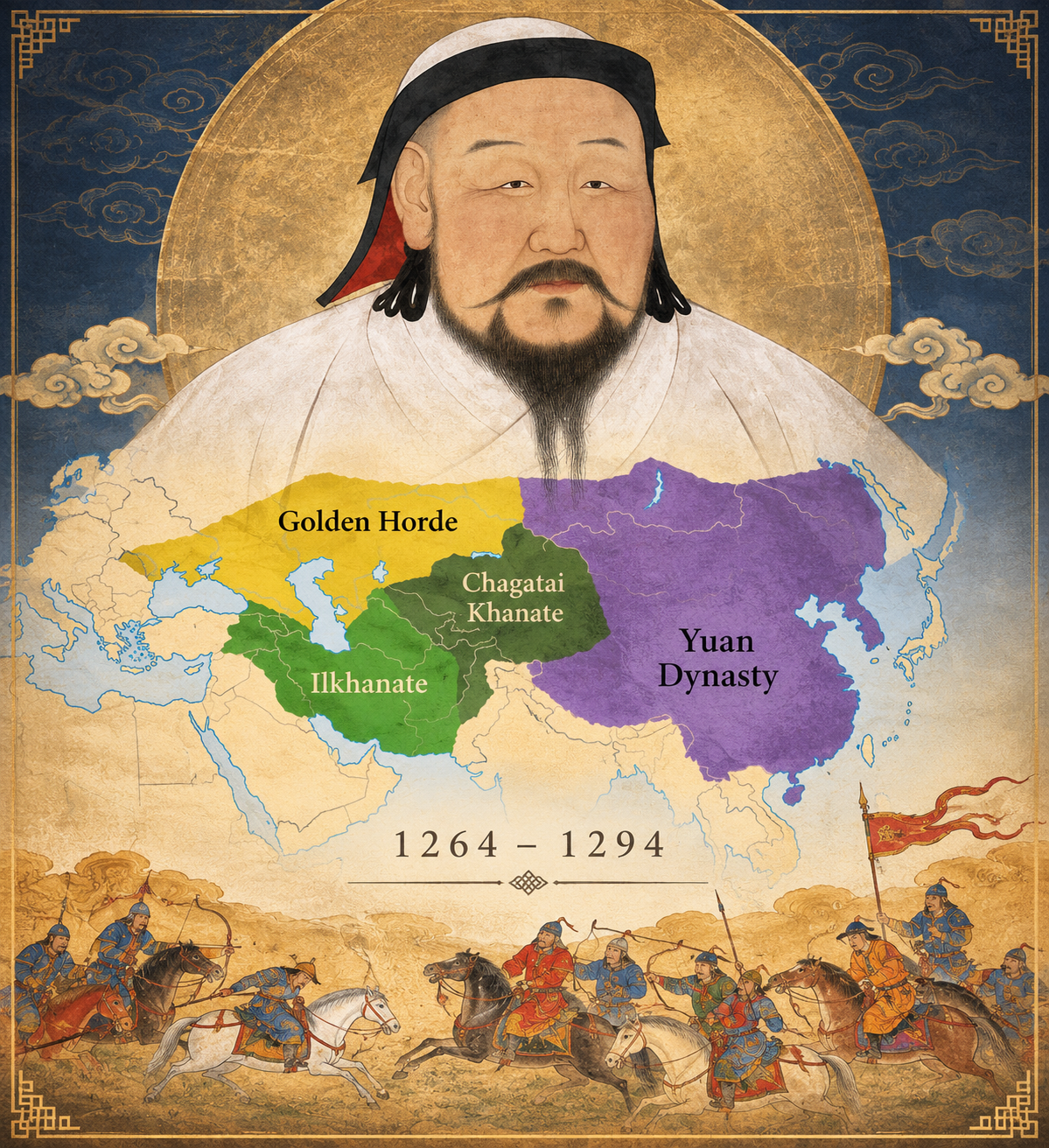
Political Relations, Social Structures, Trade Networks, Cultural Exchange, and Conflict among the Yuan, Golden Horde, Chagatai, and Ilkhanate
IMPERIALGG.COM | HISTORICAL RESEARCH ARTICLE
ABSTRACT
The period from 1264 to 1294 represents a decisive phase in the transformation of the Mongol Empire from a unified imperial structure into a network of powerful Chinggisid political centers. Following Qubilai’s victory over Ariq Böke in 1264, the Great Khan consolidated his authority in East Asia and established the Yuan dynasty in 1271. Yet his supremacy was neither universally recognized nor consistently enforced across the vast territories inherited by the descendants of Chinggis Khan. The Jochid Ulus, commonly known as the Golden Horde; the Chaghadaid Ulus in Central Asia; and the Hülegüid state in Iran and neighboring territories increasingly pursued their own political, military, and economic interests.
This article examines the relations among these four political formations between 1264 and Qubilai’s death in 1294. It investigates not only dynastic rivalries and military conflicts but also the social structures, commercial networks, administrative practices, population movements, religious policies, and cultural exchanges that connected the Mongolian world. Particular attention is given to the conflict between the Golden Horde and the Ilkhanate, Qaidu’s challenge to Qubilai in Central Asia, the diplomatic relationship between the Yuan and Ilkhanate courts, and the economic networks that continued to operate despite political fragmentation.
The central argument is that political division did not immediately dissolve the Mongol imperial system. Rather, the four major Chinggisid uluses developed as increasingly autonomous political centers while retaining important elements of a shared imperial inheritance. Their relations combined competition with cooperation, military confrontation with commercial interdependence, and regional adaptation with the continued prestige of Chinggisid legitimacy.
Keywords: Mongol Empire, Qubilai Khan, Yuan dynasty, Golden Horde, Jochid Ulus, Chaghadaid Khanate, Ilkhanate, Qaidu, Eurasian trade, Silk Roads, ortoq, diplomacy, cultural exchange.
I. INTRODUCTION: FROM IMPERIAL UNITY TO A CONNECTED MONGOLIAN WORLD
The second half of the thirteenth century was not simply a period of Mongol imperial decline. It was a period of political transformation in which the descendants of Chinggis Khan increasingly governed their territories through separate courts, military establishments, administrative systems, and regional economic structures. The Mongol Empire had expanded across an extraordinary geographical area, connecting East Asia, Central Asia, the Eurasian steppe, the Middle East, and Eastern Europe. By the 1260s, however, the political authority that had once been concentrated in the Great Khan’s court was increasingly contested.
The death of Möngke Khan in 1259 created a succession crisis between his brothers Qubilai and Ariq Böke. Their struggle was not merely a personal rivalry. It exposed disagreements over the location of imperial authority, the political role of the Mongolian homeland, the administration of conquered territories, and the relationship between the Great Khan and the regional Chinggisid princes.
Qubilai’s victory in 1264 consolidated his position, but it did not restore the political unity that had characterized the earlier empire. The Jochid rulers in the western steppe, the Hülegüid rulers in Iran, and the competing Chinggisid powers in Central Asia retained substantial autonomy. The Yuan dynasty, formally proclaimed in 1271, became the principal political center of Qubilai’s realm, but its claims to universal supremacy were not accepted equally by all branches of the imperial family.
Modern scholarship increasingly describes this period through the concept of a Mongol commonwealth or a connected system of Chinggisid uluses. Michal Biran and Hodong Kim’s The Cambridge History of the Mongol Empire provides a framework for understanding the political histories of these regions within a shared imperial history rather than as entirely unrelated successor states.[1] Christopher P. Atwood’s study of the Yuan Ulus, Marie Favereau and Roman Yu. Pochekaev’s research on the Golden Horde, Michal Biran’s work on Mongol Central Asia, and Stefan Kamola and David O. Morgan’s account of the Ilkhanate demonstrate how regional political developments remained connected through dynastic legitimacy, diplomatic relations, military competition, and economic exchange.[2]
The term ulus is important in this context. It referred to a political community and its associated people, territory, and ruling lineage. It should not automatically be understood as equivalent to a modern nation-state with fixed borders and exclusive sovereignty. The political boundaries of the Mongol uluses were often contested, and the authority of a khan could depend on military strength, dynastic recognition, alliances, and the loyalty of subordinate elites.
The years 1264–1294 therefore offer an especially valuable period for examining how the Mongolian world functioned after the weakening of centralized imperial authority. The death of Qubilai in 1294 provides a natural endpoint for this study, marking the end of his personal reign and the beginning of a new phase in Yuan politics.
II. 1264: QUBILAI’S VICTORY OVER ARIQ BÖKE AND THE POLITICAL REORDERING OF THE EMPIRE
Qubilai’s victory over Ariq Böke in 1264 was a turning point in the political history of the Mongol Empire. The conflict followed the death of Möngke Khan and reflected competing approaches to the exercise of imperial power. Qubilai increasingly based his authority in northern China, while Ariq Böke maintained his position in the Mongolian homeland and sought support among princes and military leaders who opposed Qubilai’s political direction.
The struggle demonstrated that the question of succession could no longer be settled through the traditional expectation of a single universally accepted imperial center. The Great Khan’s authority required the support of powerful members of the Chinggisid family, military commanders, and regional political elites.
Qubilai’s victory strengthened his position in East Asia, but it did not compel every Mongol ruler to recognize his supremacy. The Jochid court had its own political interests, while the Ögedeid prince Qaidu increasingly challenged Qubilai’s authority in Central Asia. The Ilkhanate, in contrast, maintained a closer relationship with Qubilai, partly because of the dynastic connection between Qubilai and Hülegü.
The political consequences of 1264 were therefore complex. The empire was not formally divided by a single act into four independent states on that date. Rather, regional autonomy and competing dynastic claims became increasingly difficult to reconcile with the ideal of one universally recognized Great Khan.
The Royal Armouries’ historical account of the Mongols emphasizes that the khanates had developed around powerful branches of the Chinggisid dynasty and that Qubilai’s victory accelerated their independent political development.[3] For a more detailed scholarly interpretation, Atwood’s chapter on the Yuan Ulus places Qubilai’s political consolidation within the longer transformation of the Mongol imperial system.[4]
III. THE YUAN DYNASTY: QUBILAI’S EAST ASIAN STATE
In 1271, Qubilai proclaimed the dynastic title Da Yuan, establishing the Yuan dynasty as the formal name of his imperial state. This decision represented a major political and ideological development. Qubilai did not abandon his Mongol identity or his claim to Chinggisid imperial legitimacy. Instead, he sought to combine the authority of the Mongol Great Khan with the political traditions and administrative institutions of China.
The Yuan court incorporated Chinese bureaucratic practices, taxation systems, provincial administration, and urban institutions while preserving Mongol military organization and the political privileges of the ruling elite. This combination created a distinctive imperial structure in which Mongol political authority operated through institutions adapted to the administration of a large sedentary population.
Dadu, present-day Beijing, became the principal capital, while Shangdu served as an important summer residence and political center. The court attracted Mongolian aristocrats, Chinese officials, Tibetan Buddhist representatives, Central Asian merchants, Muslim administrators, artisans, and foreign envoys.
The Yuan state was socially diverse. Mongols occupied privileged positions in the military and political hierarchy, while Central Asian and other foreign groups played important roles in commerce, finance, administration, and specialized services. Chinese officials, scholars, artisans, and agricultural communities remained essential to the functioning of the state.
Qubilai’s policies were not simply an attempt to become a Chinese emperor in the conventional sense. He maintained Mongol court traditions while adopting administrative methods suited to ruling China. The resulting political system was neither a direct continuation of the earlier nomadic empire nor an ordinary Chinese dynasty. It was a Mongol imperial state governing a complex East Asian society.
The conquest of the Southern Song was central to this transformation. The Song capital of Lin’an fell in 1276, and the final organized resistance ended in 1279. The conquest brought the economic resources of southern China, its commercial cities, maritime experience, shipbuilding capacity, and agricultural production under Yuan control.[5]
The resulting state possessed an enormous economic base. Agricultural taxation, urban commerce, manufacturing, maritime trade, and the circulation of goods across Eurasia all contributed to its power. Nevertheless, the costs of military expansion, frontier defense, and ambitious foreign campaigns placed continuing pressure on the imperial treasury.
Figure placement — Qubilai and the Yuan court: Insert the surviving imperial portrait of Qubilai Khan, held by the National Palace Museum, Taipei. The portrait was produced after his death, around 1294, and should not be described as a contemporary photograph or a verified likeness painted during his lifetime. See Figure 2 and source credit below.
IV. THE GOLDEN HORDE: THE JOCHID ULUS AND THE WESTERN EURASIAN STEPPE
The Golden Horde, or Jochid Ulus, emerged from the territories associated with Chinggis Khan’s eldest son Jochi and his descendants. By the 1260s, it had developed into a major political power across the western Eurasian steppe, the Volga region, the northern Black Sea area, and territories connected with the Russian principalities.
Its geographical position was exceptionally advantageous. The Jochid territories connected the Eurasian steppe with the Black Sea, the Caucasus, the Islamic world, and commercial routes leading toward Central Asia. The Golden Horde was therefore not merely a military power on the western frontier of the Mongol world. It was also an important commercial and diplomatic center.
During the period under consideration, the Golden Horde was governed by Berke, Möngke-Temür, Tuda-Möngke, and Toqta. Their reigns were marked by the development of the Jochid political system, the management of subordinate territories, relations with the Mamluk Sultanate, and continuing tensions with the Ilkhanate.
Berke’s conversion to Islam was an important development in the history of the Jochid court. It strengthened the political and cultural connections between the Golden Horde and the wider Islamic world. His relationship with the Mamluk Sultanate also became strategically significant, especially during the conflict with Hülegü and his successors.
However, the conflict between the Golden Horde and the Ilkhanate should not be reduced to a religious confrontation. Territorial claims, control of Azerbaijan and the Caucasus, access to commercial routes, military security, and the distribution of revenue were fundamental causes of the rivalry.
Marie Favereau and Roman Yu. Pochekaev emphasize the Golden Horde’s position at the intersection of Asia, the Middle East, and Europe. Their research demonstrates that the Jochid rulers maintained extensive diplomatic and commercial partnerships even while pursuing political independence from other Mongol courts.[6]
The Golden Horde’s society was also diverse. It included Mongol aristocratic families, Turkic-speaking steppe populations, military communities, merchants, urban artisans, agricultural populations, and the inhabitants of subordinate Russian principalities. Political authority remained in the hands of the Jochid dynasty and its military elites, but local administrative practices and established urban institutions continued to play important roles.
The cities of the Volga region, the Crimea, and the territories connected with Khwarazm formed important commercial centers. These networks linked the Golden Horde to the Mediterranean, the Caucasus, Central Asia, and the wider Islamic world.
V. THE ILKHANATE: MONGOL RULE IN IRAN AND THE MIDDLE EAST
The Ilkhanate was established by Hülegü, a grandson of Chinggis Khan, following the Mongol campaigns in western Asia. Its political center was located in Iran and Mesopotamia, with influence extending into Azerbaijan, parts of the Caucasus, and neighboring regions.
Between 1264 and 1294, the Ilkhanate was governed by a succession of rulers whose policies reflected the challenges of governing a predominantly sedentary society with established administrative, religious, and urban institutions.
Hülegü died in 1265, and his son Abaqa succeeded him. Abaqa’s reign, from 1265 to 1282, was characterized by military confrontation with the Mamluk Sultanate, continuing tensions with the Golden Horde, and diplomatic relations with Qubilai’s Yuan court.
Following Abaqa, Tegüder Ahmad ruled from 1282 to 1284. Arghun then became Ilkhan and ruled from 1284 to 1291. Gaykhatu succeeded him in 1291 and remained in power until 1295.
The Ilkhanate’s political structure combined Mongol military authority with Persian administrative expertise. Mongol aristocrats and commanders controlled major military and political positions, while Persian officials, scribes, financial administrators, and local elites contributed to the functioning of the state.
The Mongol rulers inherited a region with sophisticated systems of taxation, agriculture, urban commerce, irrigation, and bureaucratic administration. They could not govern this society through steppe military institutions alone. They therefore employed local administrative specialists and adapted established institutions to the needs of the new ruling dynasty.
Stefan Kamola and David O. Morgan’s study of the Ilkhanate emphasizes the importance of indigenous administrative elites and the gradual adoption of local customs in the development of Mongol rule in Iran.[7]
Religious policy also changed over time. Islam was deeply established in the societies governed by the Ilkhans, but the ruling dynasty did not adopt a single uniform religious policy throughout the period. Tegüder Ahmad’s conversion to Islam was significant, but the later formal transformation of the Ilkhanate’s ruling ideology is particularly associated with Ghazan’s conversion in 1295, after the period examined here.
The Ilkhanate therefore remained a politically Mongol state whose institutions and culture increasingly reflected the Iranian and wider Islamic environment in which it operated.
VI. THE CHAGHATAID ULUS AND Qaidu’s CENTRAL ASIAN POLITICS
Central Asia occupied a strategically important position between the Yuan territories in the east, the Golden Horde in the northwest, and the Ilkhanate in the southwest. The Chaghataid Ulus controlled or contested territories extending across parts of present-day Xinjiang, Kazakhstan, Kyrgyzstan, Uzbekistan, and neighboring regions.
Its political history during the 1260s was unstable. The Chaghataid ruling family faced internal disputes, changing alliances, and pressure from other branches of the Chinggisid dynasty.
The Ögedeid prince Qaidu became one of the most influential political figures in Central Asia. His opposition to Qubilai was based on dynastic claims, regional interests, and the desire to control important military and commercial territories. Qaidu was not simply a rebel against an established state. He represented a competing branch of the Chinggisid family seeking to preserve and expand its political position.
The conflict involved more than the personal rivalry between two princes. Central Asia contained important agricultural cities, caravan routes, military corridors, and revenue-producing territories. Control of these regions was essential to the economic and political security of the neighboring uluses.
The agreement traditionally associated with the Talas region around 1269 illustrates the attempts made by Central Asian political leaders to regulate territorial claims and economic interests. However, the exact circumstances, participants, and terms must be treated cautiously because the surviving accounts do not provide a completely uniform record.
Michal Biran’s study of the Chaghadaids and Ögedeids demonstrates that Central Asia was a politically contested region in which two competing uluses operated within a complex system of dynastic alliances and warfare.[8]
In 1282, Duwa became the Chaghadaid ruler, while Qaidu’s influence remained dominant in the wider Central Asian political system. Their cooperation strengthened the challenge to Yuan authority and shaped the military balance across the region.
The Central Asian ulus also played an important role in the movement of merchants, religious figures, officials, and artisans. Its position between East and West made it an essential link in the wider Mongol commercial system, even when warfare disrupted particular routes.
VII. THE GOLDEN HORDE–ILKHANATE CONFLICT: TERRITORY, REVENUE, AND DYNASTIC RIVALRY
The conflict between the Golden Horde and the Ilkhanate was one of the most consequential political rivalries in the Mongol world during the second half of the thirteenth century.
The origins of the conflict extended back to the reigns of Berke and Hülegü. Their disagreement involved the distribution of conquered territories, the control of Azerbaijan and the Caucasus, and the political and economic consequences of Mongol expansion into western Asia.
The Caucasus was particularly important because it connected the northern steppe with Iran, Anatolia, and the Middle East. Azerbaijan and neighboring regions contained valuable agricultural resources, urban centers, trade routes, and strategic military corridors.
Berke’s relationship with the Mamluk Sultanate strengthened the international dimension of the conflict. The Mamluks and the Golden Horde shared an interest in limiting the expansion of the Ilkhanate. Diplomatic correspondence and military cooperation therefore connected the internal disputes of the Mongol imperial family with the wider balance of power in the Middle East.
Reuven Amitai-Preiss’s Mongols and Mamluks: The Mamluk-Ilkhanid War, 1260–1281 remains an important study of this conflict. It demonstrates that the struggle involved military strategy, regional diplomacy, territorial interests, and the competing political objectives of the Mongol and Mamluk courts.[9]
The religious dimension was significant but should not be treated as the sole explanation. Berke’s Muslim identity influenced his diplomatic relationships, while the Mamluk court could present cooperation with the Golden Horde as a relationship between Muslim powers. Yet the struggle over territory and political supremacy was fundamental.
The conflict also demonstrates the limits of the idea of a unified Mongol imperial peace. The Mongol rulers could facilitate long-distance trade in some regions while fighting one another in others. Commercial networks were not automatically protected from political conflict.
VIII. YUAN–ILKHANATE RELATIONS: DIPLOMACY, ADMINISTRATION, AND THE MOVEMENT OF EXPERTS
Relations between the Yuan court and the Ilkhanate were generally closer than the relations between either of these states and the Golden Horde. Their rulers belonged to related branches of the Toluid family, and the Ilkhans maintained diplomatic connections with Qubilai.
These connections were not limited to formal recognition or the exchange of envoys. Officials, merchants, artisans, scholars, religious representatives, and technical specialists moved between the eastern and western Mongol courts.
One notable figure was Bolad Aqa, a Mongol official associated with the transmission of information and administrative knowledge between the Yuan and Ilkhanate courts. His activities illustrate how the Mongol imperial network could continue to transmit political ideas and institutional experience even after centralized authority had weakened.
Atri Hatef-Naiemi’s article, “Confronting the Foreigner: Common Policies of Rashid al-Din and Liu Bingzhong on Mongol Rule in Iran and China,” examines the relationship between the political and administrative ideas associated with the Yuan and Ilkhanate environments. It provides an important perspective on the intellectual connections between the two courts.[10]
The exchange of specialists was particularly important in fields such as astronomy, medicine, engineering, financial administration, cartography, and the production of courtly objects.
The Yuan and Ilkhanate courts did not develop identical institutions. Their societies had different demographic structures, administrative traditions, and economic resources. Nevertheless, the movement of people and knowledge created channels through which experiences from one part of the Mongol world could influence another.
IX. TRADE AND ECONOMIC EXCHANGE: THE EURASIAN NETWORK
Trade was one of the strongest forces connecting the Mongol political territories. The political division of the empire did not immediately destroy the commercial networks that had developed during the earlier period of expansion.
The Yuan territories possessed the manufacturing and agricultural resources of China. Silk, ceramics, tea, paper, metal goods, and other manufactured products circulated through domestic and international markets. Central Asian cities connected these goods with the markets of Iran, the Volga region, the Black Sea, and the Middle East.
The Golden Horde controlled important commercial routes linking the Eurasian steppe with the Black Sea and the Mediterranean. The Ilkhanate connected Iran and Mesopotamia with Central Asia, the Persian Gulf, and the wider Islamic trading world. Central Asia served as a geographical bridge between the eastern and western regions.
The Mongol postal and relay system, commonly known as the yam, supported communication, official travel, and the movement of state personnel. Its operation varied across regions and depended on political control, available resources, and the security of particular routes.
It is important not to describe the entire Mongol world as a permanently safe and unified commercial zone. Warfare, taxation, local rivalries, and the breakdown of political authority could disrupt trade. The concept of Pax Mongolica is useful when discussing the conditions that facilitated exchange, but it should not obscure the uneven and sometimes violent realities of Mongol rule.
Prajakti Kalra’s research on Mongol trade and traders emphasizes the importance of merchants and commercial partnerships in the operation of the imperial economy.[11]
One important institution was the ortoq partnership. These commercial arrangements connected merchants with the financial resources of Mongol aristocrats and other powerful patrons. Merchants could receive capital, conduct long-distance trade, and share profits according to agreed arrangements.
Enerelt Enkhbold’s study of the ortoq system examines its role in forming business partnerships within the Mongol Empire. It demonstrates that Mongol commercial activity included organized investment and financial cooperation, rather than relying exclusively on state-controlled trade.[12]
The movement of goods was accompanied by the circulation of currencies and accounting practices. The Yuan state made extensive use of paper money within its own monetary system, while silver and other forms of money continued to be important in many long-distance commercial transactions. These regional differences demonstrate that the Mongol world was economically interconnected without being a completely unified monetary market.
X. SOCIAL STRUCTURES AND POPULATION MOVEMENT
The Mongol political system brought together societies with very different economic and social structures. The steppe populations relied heavily on pastoralism, while China and Iran contained large agricultural populations, urban centers, craft industries, and established administrative elites.
The Mongol ruling elite occupied the highest levels of political and military authority. Yet the day-to-day operation of the states depended on the cooperation of local officials, merchants, agricultural communities, artisans, religious institutions, and other social groups.
Population movement was one of the defining features of the period. Artisans and specialists were transferred between regions, sometimes voluntarily and sometimes through forced relocation. Military communities were settled in strategic locations, while officials and merchants moved between courts and commercial centers.
These movements contributed to the spread of technical knowledge, artistic styles, administrative methods, and religious ideas.
In the Yuan territories, Central Asian and West Asian specialists worked alongside Chinese officials and artisans. In the Ilkhanate, Persian administrators and scholars served a Mongol ruling elite. In the Golden Horde, Turkic-speaking populations, Mongol aristocrats, merchants, and urban communities participated in a changing social structure.
The movement of people was not always beneficial to the communities involved. Forced migration, military requisition, taxation, and warfare could produce severe economic and social disruption. A balanced account of Mongol integration must therefore consider both the exchange of knowledge and the coercive mechanisms through which imperial resources were mobilized.
XI. RELIGION, CULTURAL EXCHANGE, AND INTELLECTUAL CONNECTIONS
The Mongol world was religiously diverse. Buddhism, Islam, Christianity, Daoism, Confucian traditions, and indigenous steppe religious practices all existed within the political and social environments of the four major uluses.
Qubilai’s court developed a particularly close relationship with Tibetan Buddhism. The imperial relationship with the Tibetan religious teacher Phagpa was important to the ideological and political development of the Yuan state. Yet the Yuan court did not operate as a religiously uniform society. It maintained relations with different religious communities and employed representatives of several traditions.
The Golden Horde’s relationship with Islam developed significantly under Berke and his successors. The Ilkhanate, meanwhile, governed a predominantly Muslim society while retaining a Mongol ruling dynasty with changing religious policies.
These developments should not be presented as a simple transition from Mongol traditional religion to one universal faith. Religious affiliation varied among rulers, aristocratic families, military communities, merchants, and ordinary populations.
Johan Elverskog’s study of religious exchange in the Mongol Empire examines the movement of religious ideas, institutions, and communities across the imperial space.[13] The wider cultural consequences included the circulation of texts, translation activities, artistic techniques, medical knowledge, astronomical information, and philosophical ideas.
The artistic traditions of the Mongol period also demonstrate this interaction. Yuan court painting, Persian miniature traditions, Tibetan Buddhist art, Islamic decorative forms, and Mongol courtly imagery developed through contact among different artistic environments.
The surviving illustrations in Rashid al-Din’s Jamiʿ al-Tawarikh provide particularly important visual evidence for the later representation of Mongol history in a Persianate manuscript tradition. These illustrations should be used carefully: many surviving copies were produced after the events they depict and do not constitute direct eyewitness records of every scene.
XII. 1274 AND 1281: THE JAPANESE EXPEDITIONS AND THE EAST ASIAN MARITIME FRONTIER
Qubilai’s attempts to bring Japan under Mongol authority were among the most ambitious military operations of his reign. The first major expedition took place in 1274, followed by a much larger operation in 1281.
These campaigns must be understood in the context of Yuan expansion in East Asia. The conquest of the Southern Song by 1279 brought the resources of southern China under Yuan control, including shipbuilding capacity, maritime knowledge, port infrastructure, and large populations experienced in naval commerce.
The expeditions required cooperation between Yuan military forces and the Korean kingdom of Goryeo, as well as the mobilization of ships, troops, food supplies, and logistical resources.
The 1281 campaign was especially demanding. The scale of the operation created serious problems involving transport, command, coordination, weather, and the maintenance of a large fleet. The failure of the expedition demonstrated the limitations of applying continental imperial power to a complex maritime campaign.
These campaigns were primarily Yuan-led operations. There is no sound basis for presenting the 1281 invasion of Japan as a coordinated military campaign involving the Golden Horde, the Chaghadaid Khanate, and the Ilkhanate.
The Japanese expeditions nevertheless reveal an important aspect of Qubilai’s imperial strategy: the Yuan state was not merely a continental power. It sought to extend its authority through maritime routes and to incorporate East Asian commercial and political networks into the wider Mongol imperial system.
XIII. 1281–1294: QUBILAI, QAIDU, AND THE STRUGGLE FOR CENTRAL ASIA
After the second Japanese expedition, Qubilai’s attention increasingly focused on the continuing challenge posed by Qaidu and his allies in Central Asia.
Qaidu’s influence threatened the Yuan state’s western frontier and its ability to maintain secure communications with regions beyond the Gobi and the Tarim Basin. Control of these territories was strategically important because they linked the Mongolian homeland with Central Asian trade routes.
In 1282, Duwa became the Chaghadaid ruler, while Qaidu continued to exercise substantial influence in the region. Their political cooperation created a formidable challenge to Yuan military authority.
The conflict was not simply a contest between two rulers. It involved the control of military corridors, trade routes, frontier settlements, and the political allegiance of local elites.
In 1286, Qaidu’s forces captured Beshbalik, weakening Yuan control in the western frontier region. In 1287, Nayan, a member of a collateral Chinggisid branch, rebelled against Qubilai in Manchuria. Qubilai suppressed the rebellion, but the episode revealed that opposition to his authority was not confined to Central Asia.
The conflict continued in 1288 and 1289. Qaidu’s forces advanced into Mongolian territory, and Karakorum was captured in 1289. Qubilai’s response demonstrated that he remained capable of organizing military resistance, but the continuing struggle showed that the Yuan court could not eliminate Qaidu’s political influence.
These events are essential to understanding the final years of Qubilai’s reign. The Yuan state was powerful in China, but its authority across the wider Mongol world remained contested.
XIV. 1294: THE DEATH OF QUBILAI AND THE END OF AN IMPERIAL REIGN
Qubilai died in 1294, ending a reign that had transformed the political and institutional history of East Asia. He had consolidated the Yuan dynasty, completed the conquest of the Southern Song, developed a new imperial capital, expanded the court’s administrative institutions, and maintained the claim to Great Khan supremacy.
However, the political world he left behind was not a restored unified empire. The Golden Horde continued to pursue its own regional policies. The Ilkhanate maintained its political and administrative structure in Iran. The Chaghadaid and Ögedeid powers remained active in Central Asia, with Qaidu still challenging Yuan authority.
Qubilai was succeeded by his grandson Temür Öljeitü, who became Yuan emperor in 1294. The succession did not immediately resolve the conflicts inherited from the previous reign. Instead, the new ruler faced the continuing challenge of managing the Yuan state while dealing with the political realities of the other Chinggisid uluses.
Qubilai’s death should therefore be understood as the end of a particular political era rather than the end of Mongol imperial connections. The Chinggisid rulers continued to share a dynastic inheritance, political traditions, and commercial relationships, even though their territories were governed through increasingly autonomous courts.
The later reconciliation efforts of 1303–1304 demonstrate that the idea of a wider Mongol political relationship remained meaningful beyond Qubilai’s lifetime.[14]
XV. CONCLUSION
The years 1264–1294 were a formative period in the history of the Mongol Empire. Following Qubilai’s victory over Ariq Böke, the political authority of the Great Khan became increasingly concentrated in East Asia, while the other Chinggisid branches developed their own regional centers of power.
The Yuan dynasty, the Golden Horde, the Chaghadaid Ulus, and the Ilkhanate were not simply four isolated successor states. They remained connected through dynastic legitimacy, diplomacy, military competition, commercial networks, administrative experience, and population movement.
Their political relationships were complex. The Golden Horde and Ilkhanate fought over territory and strategic resources. Qaidu challenged Qubilai’s authority in Central Asia. The Yuan and Ilkhanate maintained diplomatic connections and exchanged officials and specialists. Merchants continued to operate across regions despite the disruptions caused by warfare and political fragmentation.
The economic history of this period reveals a world in which trade routes, urban markets, pastoral economies, and commercial partnerships connected societies with very different institutions. The movement of artisans, administrators, religious figures, and merchants also contributed to cultural and intellectual exchange.
At the same time, the benefits of connectivity should not obscure the costs of imperial expansion. Forced migration, taxation, military requisition, and prolonged warfare affected many communities. The Mongol world was neither a permanently peaceful commercial system nor a uniform political structure.
Qubilai’s death in 1294 marked the end of an important imperial reign. It did not, however, erase the wider political and economic relationships that had developed across Eurasia. The history of the Mongol world during this period is best understood as the transformation of a unified imperial ideal into a connected system of competing but interdependent Chinggisid political centers.
AUTHOR’S THESIS
The historical significance of 1264–1294 lies not simply in the fragmentation of the Mongol Empire, but in the transformation of its political and institutional inheritance.
Qubilai’s Yuan state, the Golden Horde, the Chaghadaid Ulus, and the Ilkhanate developed distinct political and social systems while continuing to participate in a wider Mongol world. Their rivalries weakened the possibility of a single imperial command, but their dynastic relationships, commercial networks, diplomatic exchanges, and shared political traditions preserved important forms of interconnection.
The Mongol Empire should therefore be studied not only as a military empire that expanded and fragmented, but also as a historical system that connected different regions of Eurasia through political institutions, trade, population movement, and cultural exchange.
The period 1264–1294 represents the transition from centralized imperial authority to a connected Chinggisid political world—a world divided by competing rulers, yet still linked by a common imperial inheritance.
FOOTNOTES AND SELECTED BIBLIOGRAPHY
1. Michal Biran and Hodong Kim, eds., The Cambridge History of the Mongol Empire, 2 vols. (Cambridge: Cambridge University Press, 2023). The general introduction provides the framework for understanding the Mongol Empire’s transformation into regional Chinggisid political centers.
2. Christopher P. Atwood, “The Empire of the Great Khan: The Yuan Ulus, 1260–1368,” in The Cambridge History of the Mongol Empire (Cambridge: Cambridge University Press, 2023); Marie Favereau and Roman Yu. Pochekaev, “The Golden Horde, c. 1260–1502”; Michal Biran, “Mongol Central Asia: The Chaghadaids and the Ögödeids, 1260–1370”; Stefan Kamola and David O. Morgan, “The Ilkhanate, 1260–1335.” These studies provide the principal regional frameworks used in this article.
3. Royal Armouries, “Fall of an Empire,” historical overview of the Mongol khanates and the succession conflict between Qubilai and Ariq Böke. https://royalarmouries.org/objects-and-stories/stories/the-mongols/fall-of-an-empire
4. Atwood, “The Empire of the Great Khan: The Yuan Ulus, 1260–1368.” https://www.cambridge.org/core/books/abs/cambridge-history-of-the-mongol-empire/empire-of-the-great-khan/41EEE744E9D3545E7111DC25B77C33F2
5. Atwood, “The Empire of the Great Khan.” For the broader historical context of the Southern Song conquest and Yuan state formation, see also the National Palace Museum’s exhibition “Kublai Khan and His Era.” https://south.npm.gov.tw/english/ExhibitionsDetailE003110.aspx
6. Favereau and Pochekaev, “The Golden Horde, c. 1260–1502.” https://www.cambridge.org/core/books/abs/cambridge-history-of-the-mongol-empire/golden-horde-c-12601502/194D20494453E0AC8373BE9ADFB8B8D6
7. Kamola and Morgan, “The Ilkhanate, 1260–1335.” https://www.cambridge.org/core/books/abs/cambridge-history-of-the-mongol-empire/ilkhanate-12601335/715FFD7F108DC7868FCD785E25818EA0
8. Biran, “Mongol Central Asia: The Chaghadaids and the Ögödeids, 1260–1370.” https://www.cambridge.org/core/books/abs/cambridge-history-of-the-mongol-empire/mongol-central-asia/D4970E08F6EAD86F9BF503BDDE2692BD
9. Reuven Amitai-Preiss, Mongols and Mamluks: The Mamluk-Ilkhanid War, 1260–1281 (Cambridge: Cambridge University Press, 1995). https://doi.org/10.1017/CBO9780511563485
10. Atri Hatef-Naiemi, “Confronting the Foreigner: Common Policies of Rashid al-Din and Liu Bingzhong on Mongol Rule in Iran and China,” Journal of the Royal Asiatic Society 32, no. 3 (2022): 613–633. https://doi.org/10.1017/S1356186321000638
11. Prajakti Kalra, “Pax Mongolica: Trade and Traders in the Mongol Empire,” Oxford Research Encyclopedia of Asian History (2020). https://doi.org/10.1093/acrefore/9780190277727.013.493
12. Enerelt Enkhbold, “The Role of the Ortoq in the Mongol Empire in Forming Business Partnerships,” Central Asian Survey 38, no. 4 (2019): 531–547. https://doi.org/10.1080/02634937.2019.1652799
13. Johan Elverskog, “Religious Exchange,” in The Cambridge History of the Mongol Empire (Cambridge: Cambridge University Press, 2023). https://doi.org/10.1017/9781316337424.011
14. For the broader political context of the later Mongol reconciliation, see The Cambridge History of the Mongol Empire, Vol. I, and the relevant sections of Rashid al-Din’s Jamiʿ al-Tawarikh.
PRIMARY SOURCES FOR FURTHER VERIFICATION
Yuan Shi 元史 — the official history of the Yuan dynasty, compiled in the fourteenth century.
Rashid al-Din, Jamiʿ al-Tawarikh — an essential Persian-language history of the Mongol rulers and their dynasties.
Ata-Malik Juvayni, Tarikh-i Jahan-gushay — an important earlier Persian account of the Mongol conquests and political institutions.
Marco Polo, The Travels of Marco Polo — a European account of travel and life in the Mongol-ruled East, to be used with source criticism.
Vassaf, Tārīkh-i Waṣṣāf — an important Persian historical source for the Ilkhanate.
METHODOLOGICAL NOTE
The article distinguishes between contemporary or near-contemporary primary sources, modern scholarly interpretations, and the author’s synthesis. The primary sources listed above should be consulted in identifiable editions and translations before adding direct quotations or page-specific references. No unverified page numbers or reconstructed quotations have been supplied. Chronological and political details—particularly the 1269 Central Asian settlement, the precise sequence of Qaidu’s campaigns, and the changing status of the Chaghadaid rulers—require comparison across the Persian, Chinese, and other surviving records.
The historical maps and manuscript images accompanying the online edition should also be treated as visual evidence with their own dates and provenance. A later illustration of a thirteenth-century event is evidence of how that event was remembered or represented, not necessarily a contemporary eyewitness depiction.
Visual material and suggested placement in the web article
The following images are suitable starting points for the article’s visual layout. Their captions should remain with them when publishing.
Figure 1. The Four Major Mongol Political Territories
Place after the Introduction. Use to orient readers to the Yuan, Golden Horde, Chaghatai, and Ilkhanate regions. This is a modern historical reconstruction, not a contemporary thirteenth-century map.
Credit: World History Encyclopedia, “Four Khanates of the Mongol Empire.” Image source and description.
Figure 2. Imperial Portrait of Qubilai Khan
Place in Section III. This posthumous portrait was produced around 1294 and is associated with the Yuan imperial portrait collection.
Credit: National Palace Museum, Taipei. Museum portrait collection.
Figure 3. Mongol Cavalry in the Persian Manuscript Tradition
Place in Sections VII or XIII. Identify the manuscript’s actual date and collection before publication; later copies should not be presented as contemporary depictions of the events.
Related manuscript tradition: Rashid al-Din, Jamiʿ al-Tawarikh. For a research starting point, see Manuscript image record.
Figure 4. The Ilkhanate Court in Persian Miniature Painting
Place in Section V. Use as an illustration of the later Persianate visual tradition of Mongol court life, with the manuscript date stated accurately.
Credit: World History Encyclopedia, Ilkhanate historical illustration. Image context and historical overview.
Figure 5. The Mongol Empire in the Thirteenth Century
Place in Sections VI and IX to show the Central Asian corridors, major cities, and neighboring political regions.
Credit: UNESCO, History of Civilizations of Central Asia, Vol. IV, Map 6a. Volume and map source.