
THE LEGITIMACY OF THE GREAT KHANATE: ARIQ BÖKE, QUBILAI, AND THE MILITARY TAKEOVER OF IMPERIAL POWER, 1259–1264
By Altanbagana Baatar
DBA Candidate| Founder & Organizer
Heavenly Wind 750 International Conference
Heavenlywind750.com | Imperilagg.com
13 November 2026
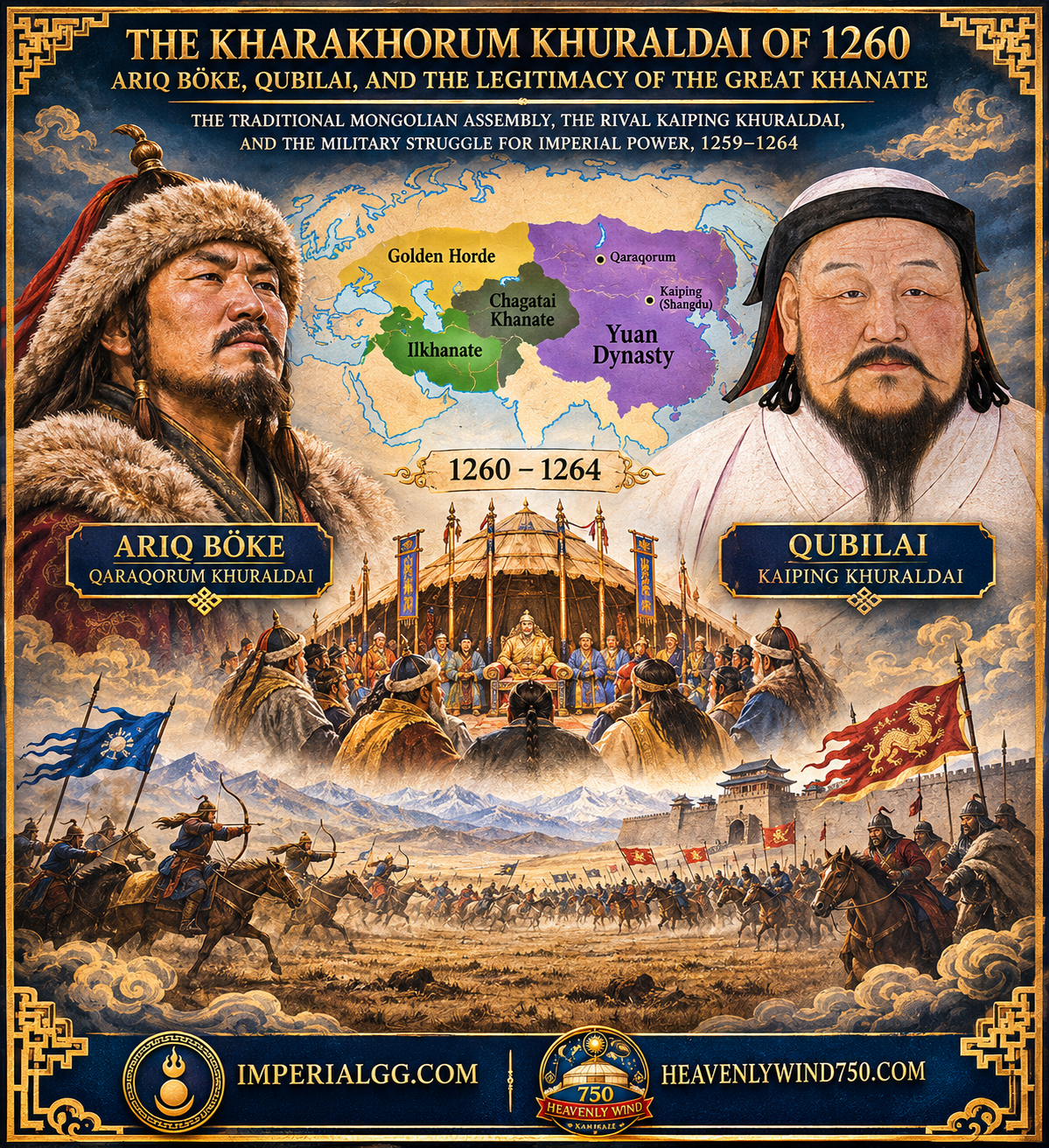
THE TRADITIONAL MONGOLIAN ASSEMBLY, THE RIVAL KAIPING KHURALDAI, AND THE MILITARY STRUGGLE FOR IMPERIAL POWER, 1259–1264
ABSTRACT
The death of Möngke Qa’an on 11 August 1259 created a succession crisis that fundamentally altered the political structure of the Mongol Empire. In 1260, two rival assemblies produced competing claims to the supreme authority of the Great Khanate. Qubilai was enthroned at Kaiping in April, while Ariq Böke subsequently secured his own enthronement at a Khuraldai near Qaraqorum, the traditional political center of the Mongol Empire.
This article examines the competing political legitimacy of these assemblies within the framework of Mongolian imperial traditions. It argues that Ariq Böke’s claim was rooted in the political institutions and established imperial center inherited from Möngke’s reign, while Qubilai’s claim emerged from a rival political center supported by a narrower coalition of Chinggisid princes, Chinese officials, regional military commanders, and the fiscal and administrative resources of northern China. The subsequent conflict was therefore not simply a personal struggle between two brothers. It was a contest over the location, institutional character, and political foundations of imperial authority.
By examining the rival Khuraldais, the military campaigns of 1260 and 1261, the blockade of Mongolia, and the defection of Alghu, this study demonstrates how Qubilai ultimately overcame Ariq Böke through the strategic mobilization of northern Chinese resources. The victory established Qubilai’s effective supremacy but did not restore the original political unity of the Mongol Empire.
Keywords: Mongol Empire; Ariq Böke; Qubilai; Khuraldai; Qaraqorum; Kaiping; Möngke Qa’an; Chinggisid legitimacy; Mongolian political traditions; Yuan dynasty.
I. THE DEATH OF MÖNGKE AND THE SUCCESSION CRISIS OF 1259
On 11 August 1259, Möngke Qa’an died during his military campaign against the Southern Song dynasty. His death left the Mongol Empire without an undisputed supreme ruler at a critical moment in its expansion. The succession question immediately became a matter of political and military urgency.
Möngke had governed an empire extending across much of Eurasia. His authority rested not only on his descent from Chinggis Khan but also on the recognition of the imperial family, the cooperation of the ruling princes, the military establishment, and the administrative structures that connected the different territories of the empire.
The two most prominent candidates from the Toluid branch were his brothers Qubilai and Ariq Böke. Qubilai was operating in the Chinese theater of war, while Ariq Böke was closely associated with Qaraqorum and the central Mongolian political establishment.
The geographical and political positions of the two princes were fundamentally different. Qubilai had developed a substantial power base in northern China and had established relationships with Chinese administrators and military commanders. Ariq Böke, by contrast, was positioned within the traditional Mongolian heartland and was supported by important elements of Möngke’s former political and military establishment.
The succession crisis therefore raised a question larger than the personal ambitions of two princes: where should the supreme authority of the Mongol Empire be established, and through which political institutions should it be recognized?
[FIGURE 1 — MAP]
The Mongol Empire in 1259, showing Qaraqorum, Kaiping, northern China, the Gansu Corridor, the Mongolian heartland, and the major western khanates.
Suggested source: A historical map of the Mongol Empire, adapted from the geographical framework in The Cambridge History of the Mongol Empire. Map prepared for ImperialGG.com.
II. THE KHURALDAI AND THE TRADITIONAL MONGOLIAN POLITICAL ORDER
The Khuraldai was a central institution of Mongolian imperial political life. It provided a formal setting in which members of the ruling lineage, princes, military leaders, and other influential figures could deliberate on matters affecting the state and the imperial succession.
The authority of a Great Khan was not based exclusively on personal military strength. Chinggisid descent was essential, but the recognition and participation of the imperial ruling establishment were also fundamental to the political legitimacy of supreme authority.
The political traditions of the Mongol Empire had developed through the practices of Chinggis Khan and his successors. The establishment of the empire in 1206, the organization of the imperial family, the distribution of territories and military responsibilities, and the selection of successive rulers created a political system in which dynastic legitimacy and collective recognition were closely connected.
This did not mean that every succession was peaceful or that the Khuraldai operated as a modern parliamentary institution. Political power, military strength, family relationships, and the balance among competing branches of the ruling lineage all influenced the outcome.
Nevertheless, the Khuraldai represented a recognized institution through which the ruling establishment could affirm a new supreme ruler.
In the crisis of 1260, the location of the assembly was especially important. Qaraqorum was not simply another city. It was the established political center of the Mongol Empire and the principal seat of imperial authority in Mongolia.
Consequently, the convening of a Khuraldai in the Qaraqorum region carried considerable political significance. It connected the succession process to the established center of the empire and to the political institutions associated with the preceding Great Khans.
III. THE QARAQORUM KHURALDAI AND ARIQ BÖKE’S CLAIM
In May–June 1260, Ariq Böke organized his own enthronement assembly near Qaraqorum. This followed Qubilai’s earlier enthronement at Kaiping.
Ariq Böke’s position was strengthened by several important political circumstances.
First, he controlled the traditional Mongolian heartland and the imperial center at Qaraqorum. Second, his political administration represented a continuation of important elements of Möngke’s ruling establishment. Third, he received support from influential members of the imperial family and from political and military figures connected with the central Mongolian administration.
Christopher P. Atwood emphasizes that Ariq Böke’s regime continued Möngke’s political personnel and policies and that Ariq Böke controlled the Mongolian heartland. Atwood also identifies the support of the western khanates and Möngke’s sons as important elements of his position.
The support associated with Ariq Böke included:
Möngke’s sons, whose dynastic position connected Ariq Böke’s claim to the immediate ruling family of the deceased Great Khan.
Qutuqtai Khatun, Möngke’s widow, whose support carried political significance within the imperial household.
Alghu, a Chaghadaid prince initially entrusted by Ariq Böke with a major political and military mission in Central Asia.
Qaidu, a descendant of Ögedei who became an important opponent of Qubilai’s political order.
Berke, ruler of the Jochid Ulus, whose conflict with Hülegü shaped the wider political alignment of the western Mongol world.
Orghina Khatun, the influential regent of the Chaghadaid territories, whose position was important in the Central Asian balance of power.
These relationships did not constitute a permanent or unanimous coalition. Political allegiance changed during the conflict, and the actions of individual princes were influenced by their own territorial and dynastic interests.
Nevertheless, Ariq Böke’s position was closely connected to the traditional imperial center and to a significant part of the political establishment inherited from Möngke.
The Qaraqorum Khuraldai therefore represented more than an alternative coronation. It was a claim to preserve the established political center and the traditional institutional foundations of the Great Khanate.
[FIGURE 2 — HISTORICAL ILLUSTRATION]
A reconstruction of the Mongolian imperial court at Qaraqorum, depicting the political setting of a Khuraldai. This should be presented as an interpretive reconstruction, not as a verified contemporary depiction of the 1260 assembly.
IV. THE KAIPING KHURALDAI: QUBILAI’S RIVAL CLAIM
Before Ariq Böke’s enthronement near Qaraqorum, Qubilai had already been declared Great Khan at Kaiping, in Inner Mongolia.
Christopher P. Atwood dates Qubilai’s enthronement to 15 April 1260. Mustafa Uyar gives 5 May 1260. The difference should be acknowledged rather than concealed. For this article, Atwood’s date is used in the main chronology, while Uyar’s alternative date is retained in the scholarly discussion.
The Kaiping assembly was politically significant, but its location was far from Qaraqorum, the established center of Mongolian imperial authority.
Qubilai’s political initiative was strongly influenced by his Chinese Confucian advisers and administrative entourage. However, his enthronement did not depend solely on those advisers. It also required the support of Chinggisid princes, particularly the princes of the left hand, who controlled territories in eastern Mongolia and Manchuria.
Atwood makes an important distinction: Qubilai received the collective support of the princes of the left hand, while his support among the princes of the right hand was limited to a few lower-status Chaghadaid and Ögedeid princes.
This distinction is central to understanding the political balance of 1260.
Qubilai did possess Chinggisid support. It would therefore be inaccurate to describe his assembly as having no dynastic legitimacy or no participation by Mongolian princes. Yet the available evidence indicates that his coalition was geographically and politically narrower than the imperial establishment associated with Ariq Böke.
Qubilai’s assembly was a rival political gathering that attempted to establish supreme authority from a different center. Its success depended on a combination of dynastic allies, Chinese administrative expertise, military commanders, and access to the economic resources of northern China.
The two assemblies thus embodied competing political orientations:
The Qaraqorum Khuraldai was associated with the traditional Mongolian imperial center and the continuation of Möngke’s political establishment.
The Kaiping Khuraldai was associated with Qubilai’s emerging power base in northern China and a new political coalition that increasingly relied on Chinese administrative and military resources.
V. QUBILAI’S CHINGGISID ALLIES AND THE CHINESE MILITARY-ADMINISTRATIVE NETWORK
Qubilai’s success cannot be explained simply by the support of Chinese officials. His political and military coalition included Chinggisid princes, Mongolian commanders, Chinese military leaders, and regional authorities.
Atwood identifies several important elements of this coalition.
The princes of the left hand, descendants of Chinggis Khan’s brothers, provided Qubilai with an important dynastic foundation. Their support was especially significant because they controlled eastern Mongolian and Manchurian territories.
Among the other princes associated with Qubilai’s side were figures from the Ögedeid and Chaghadaid branches. Their participation, however, should not be confused with unanimous support from those branches.
The military and administrative network supporting Qubilai included the following figures:
LIU HEIMA (劉黑馬)
Liu Heima was a northern Chinese military commander whose support helped Qubilai strengthen his position in the northwestern theater. His role formed part of the effort to secure regional military forces and prevent Ariq Böke from consolidating control over the western approaches to Mongolia.
WANG WEIZHENG (汪惟正)
Wang Weizheng was an Önggüt commander active in the southwestern Gansu region. His military cooperation was important in the struggle for control over the regional forces and strategic routes connecting northwestern China with the Mongolian territories.
LIAN XIXIAN (廉希憲)
Lian Xixian was an administrator appointed as pacification commissioner in the northwest. His role was primarily administrative and political rather than that of a battlefield commander. His appointment helped Qubilai consolidate civil authority in a strategically important region.
These appointments were part of a broader strategy. Qubilai sought to control the administrative structures of northwestern China, win over commanders of the Mongol armies stationed there, and prevent Ariq Böke from using the region as a reliable military and logistical base.
This combination of political administration and military organization gave Qubilai a decisive advantage.
The distinction is important: Qubilai’s victory was not the result of Chinese commanders acting independently. It emerged from a coalition in which Chinggisid princes provided dynastic support, Mongolian forces supplied military leadership, and Chinese and regional officials helped mobilize the economic and administrative resources necessary for prolonged warfare.
[FIGURE 3 — HISTORICAL PORTRAITS / ILLUSTRATIONS]
Portraits or historically grounded illustrations of Qubilai, Liu Heima, Wang Weizheng, and Lian Xixian. Where no authenticated contemporary portrait survives, use clearly identified later representations or omit the portrait rather than presenting an invented image as historical evidence.
VI. ARIQ BÖKE’S MILITARY COMMAND AND THE CAMPAIGN OF 1260
Ariq Böke’s political claim was supported by a military establishment that included commanders and forces connected to Möngke’s campaigns.
One of the most important figures was Alamdar, who organized forces in Mongolia and participated in the campaign against Qubilai’s coalition.
Another important commander was Qunduqai, who operated in the northwestern theater and joined forces with Alamdar.
Ariq Böke’s military position was strengthened by his control of the Mongolian heartland and by the forces that had been associated with the right wing of Möngke’s southern campaign.
However, the geographical distribution of these forces also created difficulties. They were spread across a wide territory, and their ability to maintain communication and supply lines depended on access to the Gansu Corridor and the northwestern frontier.
Qubilai recognized this vulnerability.
During the summer of 1260, he implemented a coordinated strategy to weaken Ariq Böke’s military position. This included taking control of administrative structures in northwestern China, winning over regional commanders, securing the support of princes, and restricting the movement of supplies into Mongolia.
The struggle therefore developed into a contest not only between armies but also between two competing systems of military logistics.
VII. THE BATTLE OF GUZANG, 27 OCTOBER 1260
The first major military defeat suffered by Ariq Böke’s forces occurred at Guzang, in the Wuwei region of present-day Gansu.
According to the Yuan Shi, Alamdar and Qunduqai brought their forces together in the northwestern region. Qubilai ordered the princes Qadan and Qabichi, together with the commander Wang Liangchen (汪良臣), to lead the campaign against them.
On 27 October 1260, Qubilai’s forces defeated the army of Alamdar and Qunduqai at Guzang. Both commanders were killed.
The defeat was strategically important. It weakened Ariq Böke’s position in the northwestern approaches and reduced his ability to coordinate the forces operating between Mongolia and the Chinese frontier.
Atwood explains that Qubilai’s strategy had included mobilizing northern Chinese commanders and regional forces, isolating Mongolian troops in the Liupan Mountains, and linking the forces in the Tangut region with troops raised by Alamdar’s side.
The battle demonstrated that Qubilai’s control of the administrative and military resources of northern China could be converted into battlefield advantage.
The defeat at Guzang did not immediately end Ariq Böke’s resistance. It did, however, make his strategic position increasingly difficult.
[FIGURE 4 — CAMPAIGN MAP]
The northwestern campaign of 1260: Qaraqorum, the Liupan Mountains, the Gansu Corridor, Guzang, and the movements of the forces associated with Ariq Böke and Qubilai.
VIII. THE SECOND CAMPAIGN AND THE BATTLE OF SHIMU’ULTU NA’UR, 27 NOVEMBER 1261
Following the defeat at Guzang, Qubilai continued his efforts to force Ariq Böke out of the Mongolian heartland.
The first campaign into Mongolia during the autumn and winter of 1260–1261 failed to bring Ariq Böke to a decisive confrontation. Ariq Böke was able to withdraw and maintain his position in the northern territories.
Qubilai then prepared a second major expedition.
The Yuan Shi records a series of military orders issued in November 1261. On 21 November, Tachar was ordered to lead an army of 10,000 troops through the Gubeikou route. Other commanders and forces were assigned to support the campaign.
The decisive engagement occurred on 27 November 1261, in the region identified in the sources as Shimu’ultu Na’ur.
The Yuan Shi records that the prince Qadan and other commanders killed an enemy general identified in the text as Qadan Qorchi and that Tachar, together with Qabichi and other commanders, divided their forces and attacked. The account describes a major defeat of Ariq Böke’s army and a pursuit of the retreating forces.
Atwood also identifies 27 November 1261 as the date of Qubilai’s victory at Shimu’ultu Na’ur.
The battle was a major setback for Ariq Böke. It forced him to withdraw again and further weakened his ability to challenge Qubilai militarily.
Nevertheless, the campaign did not immediately produce a complete political settlement. Ariq Böke retained the capacity to resist, and the conflict increasingly shifted toward the struggle for resources, supply routes, and control over Central Asian territories.
[FIGURE 5 — MILITARY CHRONOLOGY]
The campaign of 1261, showing the route through Gubeikou, the deployment of Tachar’s forces, and the battle near Shimu’ultu Na’ur on 27 November 1261.
IX. THE BLOCKADE OF MONGOLIA AND THE STRUGGLE FOR ECONOMIC RESOURCES
One of Qubilai’s most decisive strategies was the restriction of supplies entering Mongolia.
The Mongolian heartland depended on a wider network of trade, tribute, agricultural production, pastoral resources, and regional exchange. Although the steppe economy possessed its own productive foundations, the maintenance of a large military establishment required access to resources from surrounding agricultural and commercial regions.
Qubilai understood that the control of the northern Chinese economy and the routes connecting it with Mongolia could become a decisive instrument of warfare.
Atwood identifies the blockade of Mongolia as one of the central elements of Qubilai’s strategy. Qubilai sought to prevent the flow of tribute and trade into the traditional imperial heartland while consolidating control over the administrative and military structures of northwestern China.
Michael Hope’s research on Ariq Böke’s appanage further demonstrates the importance of this logistical struggle. Qubilai’s pressure forced Ariq Böke to seek resources from the territories that remained accessible to him, particularly the Chaghadaid lands.
This strategy transformed the conflict.
The decisive question was no longer only which prince possessed the stronger claim to the throne. It became increasingly important which side could maintain its armies, secure supplies, preserve political alliances, and control the routes connecting the Mongolian heartland with the surrounding regions.
Qubilai’s access to the fiscal and administrative resources of northern China gave him a substantial structural advantage.
X. ALGHU’S DEFECTION AND THE COLLAPSE OF ARIQ BÖKE’S CENTRAL ASIAN STRATEGY
One of the most consequential developments in the conflict was the change in allegiance of Alghu.
Ariq Böke had initially supported Alghu’s rise in the Chaghadaid territories and entrusted him with the task of securing Almaligh and establishing control over important Central Asian resources.
The appointment was strategically significant. Alghu was expected to provide access to revenue, soldiers, and supplies that could sustain Ariq Böke’s resistance.
However, Alghu increasingly pursued his own political interests and eventually broke with Ariq Böke.
The loss of Alghu was devastating because it deprived Ariq Böke of a potentially important source of supplies and military support. It also forced him to confront a new political and military challenge in Central Asia.
Ariq Böke was now caught between Qubilai’s pressure from the east and the struggle for control over the Chaghadaid territories in the west.
The defection of Alghu illustrates a broader characteristic of Mongolian imperial politics: dynastic relationships did not guarantee permanent political loyalty. Princes who possessed territorial power could pursue independent interests when the balance of resources and military strength changed.
Ariq Böke’s political coalition gradually weakened, while Qubilai’s control over the northern Chinese resource base became increasingly decisive.
XI. THE SURRENDER OF ARIQ BÖKE, 21 AUGUST 1264
By 1264, Ariq Böke’s position had deteriorated substantially.
The defeat of his armies, the blockade of Mongolia, the loss of important supply routes, and Alghu’s defection had weakened his ability to continue the conflict.
On 21 August 1264, Ariq Böke surrendered to Qubilai.
The surrender ended the immediate military struggle between the two brothers. It did not, however, restore the Mongol Empire to the political unity that had existed under Chinggis Khan, Ögedei, and Möngke.
Qubilai emerged as the effective supreme ruler, but the western khanates retained their own political interests and territorial authority. The recognition of Qubilai as Great Khan did not mean that he exercised direct and unquestioned control over every part of the former imperial domain.
The political consequences of the conflict continued for decades, particularly through the opposition associated with Qaidu and the continuing tensions between the Yuan court and other Chinggisid branches.
The surrender of Ariq Böke therefore marked the end of one succession war, but not the end of the political fragmentation of the Mongol Empire.
XII. THE POLITICAL MEANING OF THE TWO KHURALDAIS
The events of 1260 must be understood within the wider political traditions of the Mongol Empire.
The two rival assemblies represented competing claims to the authority of the Great Khanate.
The Qaraqorum Khuraldai was connected to the traditional Mongolian political center and the continuation of Möngke’s ruling establishment. Ariq Böke’s claim drew strength from his control of the Mongolian heartland, the support of Möngke’s sons, and relationships with important members of the wider imperial family and the western Mongol political world.
The Kaiping Khuraldai represented a rival political initiative. Qubilai possessed important Chinggisid allies, especially among the princes of the left hand, but his political coalition was more closely connected to northern China and the administrative and fiscal resources available there.
The distinction should not be reduced to a simple opposition between Mongols and Chinese. Qubilai was himself a Chinggisid prince, and his forces included Mongolian commanders and soldiers. Ariq Böke’s coalition also depended on political relationships across several regions of the empire.
The central distinction was the political foundation of their competing claims.
Ariq Böke’s claim was rooted in the established Mongolian imperial center and the political continuity of Möngke’s regime.
Qubilai’s claim was rooted in a rival assembly and a growing power base in northern China, supported by a combination of Chinggisid princes, Chinese administrators, regional military commanders, and control over economic resources.
The military outcome ultimately favored Qubilai because his coalition could mobilize greater fiscal and logistical resources over time.
The conflict therefore demonstrates how the political legitimacy of the Great Khanate and the practical capacity to exercise imperial power could become separate and competing questions.
CONCLUSION
The succession conflict of 1259–1264 was one of the most consequential turning points in the history of the Mongol Empire.
The rival Khuraldais of 1260 exposed a fundamental disagreement over the political foundations of supreme authority. The assembly near Qaraqorum represented the traditional Mongolian imperial center and the continuation of important elements of Möngke’s political establishment. The assembly at Kaiping established a competing claim supported by a different coalition of Chinggisid princes, Chinese administrators, and regional military commanders.
Ariq Böke possessed a substantial dynastic and political claim. His position was strengthened by his control of Qaraqorum and the Mongolian heartland, as well as by his relationships with members of Möngke’s ruling establishment.
Qubilai, however, transformed his rival claim into effective imperial power through the mobilization of northern Chinese resources, the recruitment of regional commanders, the control of administrative institutions, and the blockade of Mongolia.
The battles of Guzang in 1260 and Shimu’ultu Na’ur in 1261 weakened Ariq Böke’s military position. The defection of Alghu further undermined his access to Central Asian resources. His surrender on 21 August 1264 brought the immediate conflict to an end.
Qubilai’s victory demonstrated the growing importance of northern China as the economic and military foundation of the new imperial center. Yet it also revealed the limits of his authority over the wider Mongol world.
The conflict did not simply determine which brother would rule. It marked a transformation in the political geography of the Mongol Empire: from the traditional imperial center in Mongolia toward a new center of power increasingly sustained by the institutions and resources of northern China.
AUTHOR’S THESIS
The Khuraldai near Qaraqorum in 1260 represented the stronger continuity with the traditional political institutions and imperial center of the Mongol Empire. Ariq Böke’s claim was supported by important elements of Möngke’s ruling establishment and by a broad network of Chinggisid and regional political relationships.
Qubilai’s enthronement at Kaiping constituted a rival claim to the Great Khanate. Although he possessed significant Chinggisid support, particularly among the princes of the left hand, his political and military success depended increasingly on Chinese administrative structures, regional commanders, and the economic resources of northern China.
The victory of Qubilai in 1264 should therefore be understood not simply as the triumph of one legitimate claimant over another, but as the military and institutional victory of a new imperial power center over the traditional Mongolian political center.
The events of 1260–1264 reveal a decisive historical transition: the struggle over the legitimacy of the Great Khanate became inseparable from the struggle over the economic, military, and administrative foundations of imperial power.
NOTES AND REFERENCES
Christopher P. Atwood, “The Empire of the Great Khan: The Yuan Ulus, 1260–1368,” in The Cambridge History of the Mongol Empire, Vol. I, ed. Michal Biran and Hodong Kim (Cambridge: Cambridge University Press, 2023), especially pp. 109–112.
Mustafa Uyar, “Buqa Chīngsāng: Protagonist of Qubilai Khan’s Unsuccessful Coup Attempt against the Hülegüid Dynasty,” Belleten 81, no. 291 (2017): 373–386. Uyar gives 5 May 1260 for Qubilai’s enthronement; Atwood gives 15 April 1260.
Yuan Shi 元史, “Shizu benji” 世祖本紀, annals of Qubilai, for the campaign against Alamdar and Qunduqai and the battle at Guzang on 27 October 1260.
Geoff Humble, trans., “Yuanshi Annals (benji 本紀) for Shizu 世祖 (Qubilai Qa’an), Part Two (1260),” unpublished English translation of the relevant annals.
Yuan Shi 元史, “Shizu benji” 世祖本紀, 1261 entries, for the orders to Tachar and the battle at Shimu’ultu Na’ur on 27 November 1261.
Geoff Humble, trans., “Yuanshi Annals (benji 本紀) for Shizu 世祖 (Qubilai Qa’an), Part Three,” unpublished English translation.
Michael Hope, “An ulus within an ulus: the afterlife of Ariq Böke’s appanage in the Mongol Empire (1252–1336),” Bulletin of the School of Oriental and African Studies 88, no. 1 (2025): 49–69. https://doi.org/10.1017/S0041977X24000612
Rashīd al-Dīn, Jāmiʿ al-Tawārīkh, sections concerning the succession conflict between Qubilai and Ariq Böke.
ʿAṭā-Malik Juvaynī, Tārīkh-i Jahān-gushāy, for the wider political and administrative background of the Mongol Empire.
The Secret History of the Mongols, for the earlier political traditions, dynastic structure, and imperial practices of the Mongol ruling house. This source is used for institutional background, not as a direct narrative of the events of 1260–1264.
SELECTED BIBLIOGRAPHY
Atwood, Christopher P. “The Empire of the Great Khan: The Yuan Ulus, 1260–1368.” In The Cambridge History of the Mongol Empire, Vol. I. Cambridge: Cambridge University Press, 2023.
Hope, Michael. “An ulus within an ulus: the afterlife of Ariq Böke’s appanage in the Mongol Empire (1252–1336).” Bulletin of the School of Oriental and African Studies 88, no. 1 (2025): 49–69.
Juvaynī, ʿAṭā-Malik. Tārīkh-i Jahān-gushāy.
Rashīd al-Dīn. Jāmiʿ al-Tawārīkh.
Uyar, Mustafa. “Buqa Chīngsāng: Protagonist of Qubilai Khan’s Unsuccessful Coup Attempt against the Hülegüid Dynasty.” Belleten 81, no. 291 (2017): 373–386.
Yuan Shi 元史. “Shizu benji” 世祖本紀.
The Secret History of the Mongols.