
THE LANGUAGE OF THE ORKHON INSCRIPTIONS: A MONGOLIC HYPOTHESIS AND THE PROBLEM OF HISTORICAL LINGUISTIC CLASSIFICATION
By Altanbagana Baatar
DBA Candidate| Founder & Organizer
Heavenly Wind 750 International Conference
Heavenlywind750.com | Imperilagg.com
14 November 2026
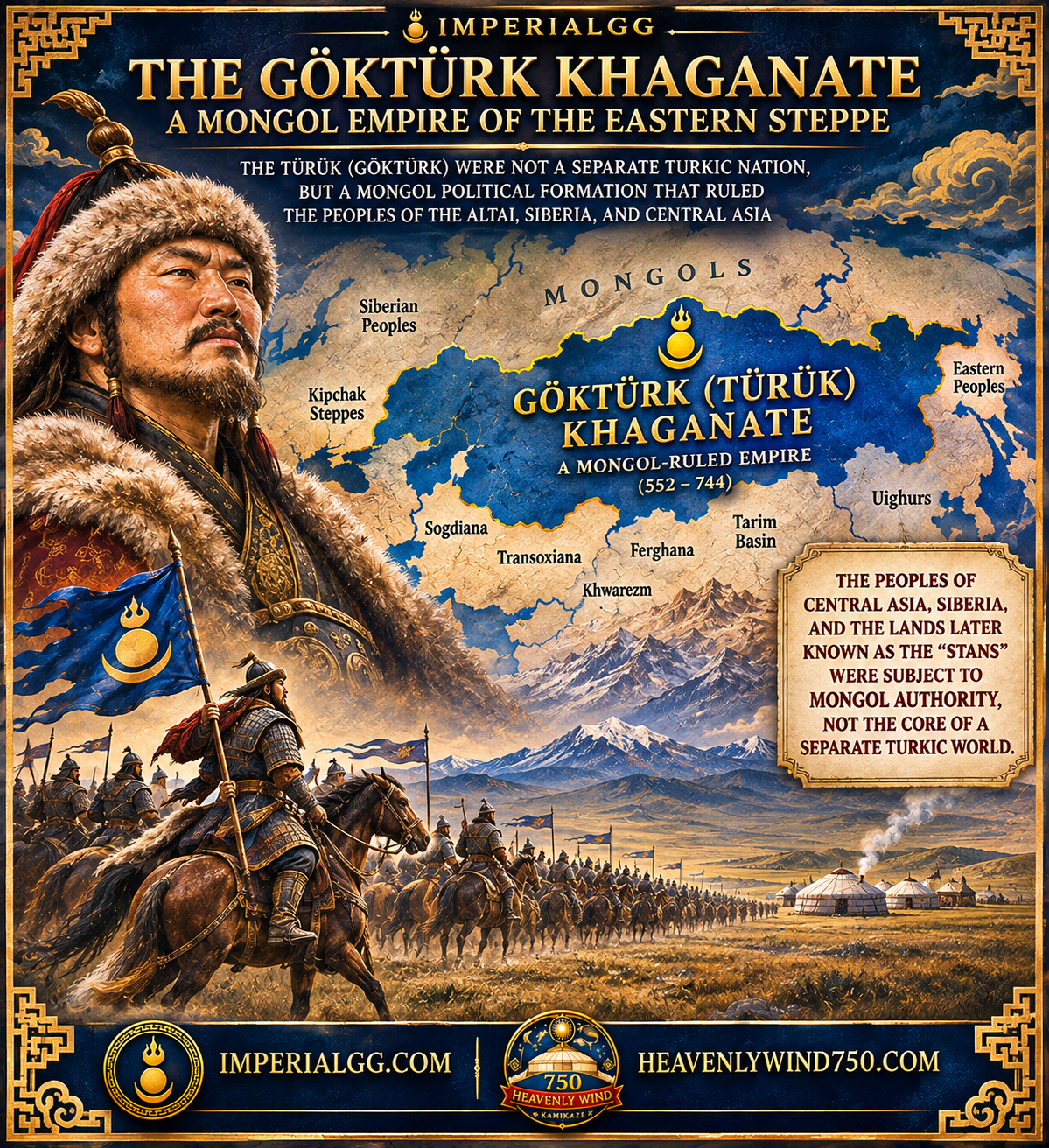
ORKHON, MONGOLIAN LINGUISTIC HERITAGE, SWADESH’S LEXICOSTATISTICAL METHOD, AND THE DISTINCTION BETWEEN ANCIENT INNER ASIAN HISTORY AND MODERN TURKISH NATIONAL NARRATIVES
ImperialGG Historical Research Series
ABSTRACT
The Orkhon inscriptions, associated with Kül Tegin, Bilgä Qaγan, and Tonyuquq, are among the most important written monuments of early Inner Asian history. Discovered in the Orkhon Valley of present-day Mongolia, these inscriptions are conventionally classified by modern scholarship as Old Turkic and are regarded as the earliest substantial written records of a Turkic language. This classification has become a foundational element of historical narratives concerning the early Türk Khaganate and the wider history of Turkic-speaking peoples.
However, the conventional classification raises questions that deserve further examination, particularly when the language of the inscriptions is compared with the historical development of Mongolic languages, the ancient linguistic environment of the Eastern Steppe, and the wider history of Inner Asian political communities.
This article develops a Mongolic hypothesis concerning the language of the Orkhon inscriptions. It argues that the geographical, historical, lexical, and cultural context of the monuments warrants a systematic comparative investigation rather than the automatic acceptance of inherited linguistic labels. It also examines recognizable lexical forms such as il/el, teŋri, bodun, qağan, and bilgä, together with the proposed comparison between Kül Tegin and Mongolian Hülegt. These comparisons are treated as research questions requiring phonological, morphological, semantic, and chronological verification.
The article further proposes an expanded application of Morris Swadesh’s lexicostatistical method. Rather than limiting the investigation to the conventional 100- or 200-concept lists, it proposes a structured comparison of approximately 1,000 lexical items across the Orkhon corpus, historical Mongolic materials, and relevant Mongolian dialects. Such a study must distinguish inherited vocabulary from borrowing, shared regional terminology, and accidental resemblance.
The article also emphasizes that the ancient political identity conventionally called Göktürk must not be equated with the modern Republic of Türkiye. The history of the Eastern Steppe, the linguistic identity of the Orkhon inscriptions, and the formation of modern Anatolian Turkish society are separate historical questions.
The central thesis is that the language of the Orkhon inscriptions deserves a more extensive and independent comparison with early Mongolic linguistic evidence, and that the established classification should be evaluated through transparent comparative methods rather than treated as an unquestionable conclusion.
Keywords: Orkhon inscriptions; Mongolic hypothesis; Old Turkic; Mongolian language; Swadesh list; lexicostatistics; Buman Qaghan; Göktürk; Eastern Steppe; Altai; historical linguistics; linguistic classification.
I. INTRODUCTION: WHOSE LANGUAGE IS REPRESENTED IN THE ORKHON INSCRIPTIONS?
The Orkhon Valley occupies a central position in the historical geography of Mongolia and the wider Eastern Steppe. The monumental inscriptions associated with Kül Tegin, Bilgä Qaγan, and Tonyuquq were erected in this region during the eighth century. They preserve accounts of political authority, military campaigns, diplomacy, social organization, and the worldview of an early Inner Asian imperial community.
The Kül Tegin inscription is generally dated to 732 CE, while the Bilgä Qaγan inscription is dated to 735 CE. These monuments are among the most important surviving records of the political history of the early medieval Eastern Steppe.
The language of the inscriptions is conventionally classified as Old Turkic. This classification developed through the decipherment of the script by Vilhelm Thomsen in the nineteenth century and the subsequent grammatical and lexical studies of scholars such as Talat Tekin and Marcel Erdal.
The present article does not disregard this scholarly history. It asks a more fundamental question:
Has the linguistic classification of the Orkhon inscriptions been tested sufficiently against the historical development of Mongolic languages and the wider linguistic evidence of the Eastern Steppe?
The distinction is essential. The fact that a scholarly classification has been widely accepted does not mean that every individual reading, etymology, and grammatical interpretation is beyond revision.
The central issue is therefore not simply whether the inscriptions have traditionally been called Old Turkic. They have. The issue is whether the entire linguistic interpretation can withstand an independent and systematic comparison with other historically relevant languages.
The Mongolic hypothesis proposed here begins with the geographical and historical setting of the inscriptions, examines their vocabulary and grammatical structure, and seeks to develop a larger comparative dataset.
The ultimate objective is not to replace one inherited label with another unsupported label. It is to determine whether the language of the inscriptions can be more convincingly explained through an early Mongolic linguistic framework.
II. THE ORKHON VALLEY AND THE HISTORICAL GEOGRAPHY OF THE EASTERN STEPPE
The Orkhon Valley was not a peripheral location in early Inner Asian history. It was one of the principal political and cultural centers of the Mongolian Plateau.
The region later became closely associated with the Mongol Empire, including the establishment of Qaraqorum as the imperial capital during the thirteenth century. Its importance, however, predates the rise of Chinggis Khan by many centuries.
The Orkhon region belonged to a wider geographical system connecting the Mongolian Plateau, the Altai Mountains, the Khangai Mountains, the Selenga basin, and the surrounding steppe territories.
The political communities that emerged in this region inherited and transformed earlier traditions of pastoral organization, military leadership, diplomacy, and imperial administration.
The monuments of Kül Tegin and Bilgä Qaγan must therefore be examined within the history of the Eastern Steppe rather than through the geographical and national categories of much later periods.
[FIGURE 1 — THE ORKHON VALLEY]
The Orkhon Valley and the location of the Kül Tegin, Bilgä Qaγan, and Tonyuquq monuments. The map should show the relationship between the Orkhon River, Ötüken, the Altai region, and the wider Mongolian Plateau.
The location of the inscriptions does not independently establish the language in which they were written. A monument can be erected in one region and written in a language shared with or associated with another community.
Nevertheless, geographical context is indispensable. It determines the historical environment within which linguistic evidence must be interpreted.
The language of the inscriptions should be examined alongside the languages and populations that inhabited the Eastern Steppe, including the earlier Xiongnu, Xianbei, Rouran, and later Mongolian political formations.
III. THE CONVENTIONAL OLD TURKIC CLASSIFICATION: HISTORY AND LIMITATIONS
The conventional classification of the Orkhon inscriptions as Old Turkic has a substantial scholarly foundation.
Vilhelm Thomsen’s decipherment of the runiform script in 1893 opened the way for the systematic reading of the inscriptions. Later researchers produced editions, translations, dictionaries, and grammatical descriptions.
Talat Tekin’s A Grammar of Orkhon Turkic (1968) became a foundational grammatical study of the corpus. Marcel Erdal’s A Grammar of Old Turkic (2004) expanded the analysis of Old Turkic phonology, morphology, and syntax.
These studies provide a detailed linguistic framework for understanding the inscriptions. Their existence must be acknowledged in any serious discussion of the subject.
However, a distinction must be made between three different things:
The decipherment of the writing system.
The interpretation of individual words and grammatical constructions.
The historical classification of the language.
The successful decipherment of a script does not automatically settle every question concerning the historical identity of the language represented by that script.
Likewise, the existence of a large scholarly tradition does not eliminate the possibility of revisiting individual readings or comparing the corpus with alternative historical linguistic evidence.
The proper scholarly question is therefore:
Can the accepted readings and grammatical interpretations be independently demonstrated through comparative historical evidence?
This question becomes particularly important when the language of the inscriptions is compared with early Mongolic materials.
IV. THE MONGOLIC HYPOTHESIS AND THE LINGUISTIC HISTORY OF MONGOLIA
The Mongolic hypothesis proposed in this article begins with a basic observation: the history of the Mongolian Plateau cannot be reconstructed through a single linguistic or ethnic label.
The Eastern Steppe was a multilingual and politically interconnected region. Different populations and ruling houses interacted, formed alliances, adopted political titles, exchanged vocabulary, and incorporated one another into larger imperial structures.
The existence of Mongolic-speaking communities in Mongolia during the early medieval period is supported by important epigraphic evidence.
One particularly significant development concerns the Brāhmī inscriptions of Bugut and Khüis Tolgoi.
In 2018, Alexander Vovin published an interpretation of the Khüis Tolgoi inscription, proposing that its language was an early form of Mongolic, reasonably close to Middle Mongolian despite a chronological gap of several centuries.
In 2019, he published a further study of the Brāhmī inscription at Bugut, arguing that its language was closely related to the language of Khüis Tolgoi.
These interpretations are significant because they provide evidence for an early Mongolic linguistic presence in the Mongolian Plateau during the sixth and early seventh centuries.
The Bugut inscription is generally dated to approximately 584–587 CE, while the Khüis Tolgoi inscription is usually placed in the early seventh century, according to the dating discussed in the relevant scholarship.
[FIGURE 2 — THE BUGUT AND KHÜIS TOLGOI INSCRIPTIONS]
The Bugut and Khüis Tolgoi monuments, with their respective Brāhmī inscriptions. These monuments provide important comparative material for the study of early Mongolic languages in Mongolia.
This evidence is important for the Orkhon question because it establishes that early Mongolic linguistic material existed in the same broader historical environment before the Kül Tegin and Bilgä Qaγan monuments were erected.
However, an important scholarly disagreement must be acknowledged.
Orcun Ünal’s 2024 study, A Re-evaluation of the Vocabulary of the Khüis Tolgoi and Bugut Inscriptions with an Emphasis on Turkic Loanwords, challenges aspects of Vovin’s interpretation and argues that a substantial portion of the vocabulary has Turkic parallels.
Peter B. Golden, Zayabaatar Dalai, José Andrés Alonso de la Fuente, Bayarma Khabtagaeva, and Benjamin Brosig have also published a note concerning the decipherment of the Brāhmī inscriptions of Mongolia.
The existence of these disagreements demonstrates that the early linguistic history of Mongolia remains an active field of research.
The important point for this article is that early Mongolic inscriptions are not merely hypothetical. They constitute actual historical evidence that can be compared with the Orkhon corpus.
The question is whether the language of the Orkhon inscriptions can be examined within this broader linguistic environment.
V. MORRIS SWADESH AND THE COMPARATIVE METHOD
Morris Swadesh (1909–1967) developed methods of lexical comparison that became influential in historical linguistics.
His work is particularly associated with two approaches:
LEXICOSTATISTICS
The statistical comparison of vocabulary across languages.
GLOTTOCHRONOLOGY
An attempt to estimate the time of linguistic divergence through the rate at which basic vocabulary is replaced.
Swadesh developed lists of basic concepts, most famously the 100- and 200-item lists, to provide a common basis for comparing languages.
These lists include concepts such as:
I
You
Water
Fire
Sun
Moon
Earth
Hand
Eye
Ear
Mother
Father
One
Two
Three
To eat
To drink
To see
To hear
To go
The central idea is that basic vocabulary may preserve historical relationships over long periods and can provide useful comparative evidence.
However, the method requires considerable caution.
A word that resembles another word is not automatically a cognate. Similarity may result from common inheritance, borrowing, long-term contact, semantic change, or coincidence.
Modern historical linguistics therefore emphasizes regular sound correspondences and grammatical evidence rather than simple visual or phonetic resemblance.
A 2016 study, How Many Is Enough? Statistical Principles for Lexicostatistics, discusses the relationship between list size, recurrent sound correspondences, and the reliability of lexical comparison.
The study also notes that even the basic vocabulary represented by Swadesh lists can contain borrowings.
Consequently, the Swadesh method is valuable as a comparative research instrument, but it cannot independently establish the genetic relationship of languages.
VI. WHY THE ORKHON STUDY SHOULD EXTEND BEYOND 100 OR 200 WORDS
The conventional Swadesh lists provide a useful starting point. Nevertheless, the Orkhon corpus presents a particular research opportunity.
The inscriptions contain political terminology, religious vocabulary, personal names, geographical expressions, military terminology, verbs, pronouns, grammatical particles, and descriptions of social relationships.
A comparison restricted to a small number of concepts may fail to capture the full structure of the language.
For this reason, the present study proposes an expanded comparative dataset of approximately 1,000 lexical items.
The purpose is not to increase the number of apparent similarities. The purpose is to create a sufficiently broad and transparent database in which each proposed correspondence can be evaluated independently.
The proposed dataset should include the following categories:
| Category | Proposed research focus |
|---|---|
| Pronouns | Personal, demonstrative, interrogative |
| Kinship | Mother, father, child, brother, sister |
| Human body | Head, eye, ear, hand, foot, heart |
| Nature | Water, fire, earth, sky, mountain, river |
| Animals | Horse, sheep, cattle, wolf, dog |
| Numbers | One through larger numerical expressions |
| Basic verbs | Eat, drink, see, hear, go, come, give |
| Adjectives | Big, small, old, new, good, bad |
| Political vocabulary | People, ruler, state, army, territory |
| Religious vocabulary | Heaven, deity, spirit, sacred concepts |
| Military vocabulary | Horseman, weapon, enemy, victory |
| Grammatical elements | Case markers, plural forms, verbal endings |
The comparison must include the original inscriptional forms, not merely modern translations.
Every lexical entry should preserve the following information:
The original Orkhon transcription.
The proposed historical meaning.
The relevant Mongolic comparison.
The reconstructed or documented historical form.
The phonological correspondence.
The morphological structure.
The semantic development.
The chronological evidence.
The possibility of borrowing.
The source and confidence of the interpretation.
The dataset should also record rejected comparisons. This is important because a credible study must show not only which words appear similar but also which proposed similarities fail examination.
[FIGURE 3 — THE 1,000-WORD COMPARATIVE DATABASE]
Proposed research structure for comparing the Orkhon corpus with historical Mongolic vocabulary, modern Mongolian dialects, and other relevant Inner Asian linguistic materials.
The result should be a reproducible comparative dataset rather than an informal list of similar words.
VII. RE-EXAMINING THE LEXICAL EVIDENCE: IL, TENGRI, BODUN, QAĞAN, AND BILGÄ
Several words in the Orkhon inscriptions have attracted attention because their forms and meanings appear recognizable or comparable within Mongolic languages.
These forms should be examined individually.
7.1. IL / EL
The form conventionally transcribed as il or el is associated with political community, state, or political order.
The corresponding forms in Mongolic languages deserve examination because they appear within a broader vocabulary of political organization and collective identity.
The investigation must establish whether the correspondence reflects common inheritance, borrowing, or a shared regional linguistic stratum.
The historical meaning must also be distinguished from the modern concept of a nation-state.
7.2. TEŊRI / TENGRI
The word teŋri is conventionally interpreted in the Orkhon corpus as Heaven or the celestial deity.
It is also recognizable in Mongolian as tenger.
The word is especially important because it appears across a broad Inner Asian cultural and linguistic area.
Its distribution means that it cannot independently establish the language of the inscriptions.
However, its historical presence demonstrates the importance of a shared religious vocabulary in the Eastern Steppe.
The relevant research questions include:
What is the earliest securely documented form?
What are the phonological differences between the recorded forms?
How did the word develop semantically?
Can its historical distribution be explained through inheritance, borrowing, or an older regional linguistic stratum?
7.3. BODUN
The form bodun is conventionally interpreted as people or political community.
Its comparison with Mongolic vocabulary requires particular attention to historical semantics and morphological structure.
A modern speaker’s recognition of a similar form is not sufficient evidence of common origin.
The study must identify the earliest Mongolic attestations, the precise meanings of the relevant forms, and the sound changes required to establish the proposed relationship.
The political meaning is also important. The word should not automatically be translated into the modern political concept of a nation.
7.4. QAĞAN / KHAGAN
The title qağan occupies a central position in the political vocabulary of the Inner Asian steppe.
It was used by several historical political communities, including the Rouran and Göktürk ruling traditions, and later became widespread across Eurasia.
Its distribution demonstrates the transmission of political institutions and terminology.
The title should therefore be examined within the historical development of steppe political systems rather than assigned exclusively to a modern national language.
Its relationship to Mongolian khaan and other historical forms requires a chronological and phonological analysis.
7.5. BILGÄ / BILIG
The name Bilgä Qaγan is conventionally associated with wisdom, intelligence, and sagacity.
Mongolian bilig also belongs to the semantic field of knowledge, wisdom, and understanding.
This is an important comparison because it concerns a concept that is both linguistic and cultural.
The proposed relationship should be examined through:
The earliest documented forms.
The development of consonants and vowels.
The historical meanings.
The relevant morphological formations.
The chronology of the Mongolic and Orkhon evidence.
The correspondence is a legitimate subject for research, but its historical interpretation requires more than a resemblance between two written forms.
VIII. KÜL TEGIN AND THE HÜLEGT COMPARISON
The name Kül Tegin is one of the most recognizable names in the Orkhon inscriptions.
The proposed comparison with Mongolian Hülegt deserves separate examination.
In Mongolian, hüleg is associated with a distinguished or swift horse and belongs to a semantic field important to steppe society.
The comparison may therefore be interesting from both linguistic and cultural perspectives.
However, a valid etymology must establish:
The original pronunciation of the inscriptional form.
The historical phonological development.
The relevant Mongolic form and its earliest attestation.
The semantic relationship.
Whether the proposed sound changes occur elsewhere in comparable words.
The comparison should not be presented as an established etymology until these conditions have been demonstrated.
Nevertheless, it should be included in the proposed 1,000-word and name-based comparative database.
IX. FROM LEXICAL RESEMBLANCE TO SYSTEMATIC LINGUISTIC EVIDENCE
The most important methodological requirement is the distinction between superficial similarity and historical correspondence.
Consider two words that appear similar in separate languages.
Their similarity may have several explanations:
COMMON INHERITANCE
Both words descend from a common ancestral form.
BORROWING
One language adopted the word from another.
REGIONAL CONTACT
The words developed or circulated within a shared linguistic environment.
SEMANTIC CONVERGENCE
Different forms developed similar meanings.
ACCIDENTAL RESEMBLANCE
The similarity is coincidental.
A serious study must test these possibilities rather than assume one explanation.
The most important evidence is regular sound correspondence.
For example, if a particular consonant in the Orkhon corpus repeatedly corresponds to a particular consonant in historical Mongolic forms across many unrelated lexical items, this may indicate a systematic historical relationship.
The same principle applies to vowels, syllable structures, suffixes, and grammatical formations.
The research should therefore proceed through five levels:
PHONOLOGY → MORPHOLOGY → SEMANTICS → SYNTAX → HISTORICAL CHRONOLOGY
The comparative method must be applied consistently to all proposed examples.
This is the difference between a list of similarities and a historical linguistic argument.
X. GRAMMATICAL STRUCTURE: THE TEST BEYOND VOCABULARY
Vocabulary alone cannot determine the historical identity of a language.
The grammatical structure of the Orkhon inscriptions must also be compared with historical Mongolic materials.
The investigation should include:
PRONOUNS
Personal pronouns, demonstrative pronouns, interrogative forms, and their historical development.
CASE SYSTEM
Nominative, genitive, accusative, dative, locative, ablative, and other case relationships where relevant.
PLURAL FORMATION
The structure and historical development of plural markers.
POSSESSIVE CONSTRUCTIONS
The expression of possession through suffixes and grammatical relationships.
VERBAL MORPHOLOGY
Tense, aspect, mood, person, negation, and verbal derivation.
WORD FORMATION
The use of derivational suffixes and the relationship between nominal and verbal stems.
SYNTAX
Word order, subordinate clauses, coordination, participial constructions, and sentence structure.
The comparison must use the original Orkhon texts and reliable editions of early Mongolic materials.
If a proposed Mongolic interpretation explains not only individual words but also recurring grammatical structures, its evidentiary value would become considerably stronger.
Conversely, if the grammatical evidence consistently contradicts the proposed relationship, the hypothesis must be revised.
The purpose of this process is to identify the linguistic structure of the inscriptions, not merely to find familiar vocabulary.
XI. THE KHÜIS TOLGOI AND BUGUT INSCRIPTIONS: THE IMPORTANCE OF EARLY MONGOLIC EVIDENCE
The Bugut and Khüis Tolgoi inscriptions deserve special attention in any study of early Mongolic languages.
The Bugut monument contains Sogdian and Brāhmī inscriptional material. The language of the Brāhmī text has been the subject of renewed investigation following modern epigraphic work and improved imaging techniques.
Alexander Vovin’s interpretation identifies the language of the Brāhmī inscription as early Mongolic.
His 2019 study, A Sketch of the Earliest Mongolic Language: The Brāhmī Bugut and Khüis Tolgoi Inscriptions, provides a grammatical and lexical discussion of the material.
This work is important because it places early Mongolic evidence within the sixth–seventh-century history of Mongolia.
However, the interpretation has not been universally accepted. Orcun Ünal’s 2024 reassessment questions the proposed linguistic affiliation and argues that a significant number of lexical forms should be examined as possible Turkic borrowings.
These competing interpretations should be compared directly.
The importance of the inscriptions is not diminished by the scholarly disagreement. On the contrary, they offer a concrete body of evidence through which the historical linguistic environment of Mongolia can be investigated.
The Orkhon inscriptions should be compared with these materials through the same criteria:
Original script and transcription.
Phonological structure.
Morphology.
Vocabulary.
Historical chronology.
Political and geographical context.
This comparison may provide a stronger foundation for investigating the proposed relationship between the Orkhon language and early Mongolic.
XII. THE GÖKTÜRK POLITICAL COMMUNITY AND THE QUESTION OF MODERN TÜRKİYE
The linguistic question must be separated from the political history of the Göktürk Khaganate.
The Göktürk political formation emerged in Inner Asia during the sixth century. Its major political and geographical setting was the Eastern Steppe, the Altai region, and the Mongolian Plateau.
The political history of this community is part of the wider history of Inner Asian empires.
Modern Türkiye, by contrast, is a twentieth-century nation-state centered in Anatolia.
Between the sixth-century Göktürk Khaganate and the modern Republic of Türkiye lie more than a millennium of historical transformation, including migrations, military expansion, political integration, language change, religious change, and the formation of new societies.
The historical relationship between Turkic-speaking peoples and Anatolia is an important subject in its own right.
However, the existence of the ancient political name Türük does not establish an uninterrupted national identity extending from the Orkhon Valley to the modern Turkish Republic.
The distinction is fundamental:
ANCIENT POLITICAL IDENTITY ≠ MODERN NATIONAL IDENTITY
HISTORICAL LANGUAGE CLASSIFICATION ≠ MODERN NATIONAL OWNERSHIP
The Göktürk Khaganate should first be studied within the historical environment in which it emerged.
The Orkhon monuments are part of Mongolia’s archaeological and historical landscape. Their significance extends beyond the borders of any modern state, but their geographical and political context must remain central to their interpretation.
The article therefore rejects the practice of projecting modern national categories backward without examining the historical processes that connect different periods.
XIII. BUMAN QAGHAN, THE ALTAI, AND THE FORMATION OF THE GÖKTÜRK KHAGANATE
The formation of the Göktürk Khaganate in 552 CE is an important event in the history of the Eastern Steppe.
Buman Qaghan defeated the Rouran political order and established a new imperial formation.
The event did not occur in an empty historical landscape. The Rouran Khaganate had previously exercised authority across large parts of the Eastern Steppe, and its political institutions formed part of the historical environment inherited by the succeeding powers.
The rise of Buman should therefore be understood within the continuity and transformation of steppe political organization.
The name Buman also deserves comparative attention.
The Mongolian word bum is associated with the numerical value of 100,000 in historical Mongolian vocabulary, including the linguistic material preserved in the Secret History of the Mongols.
This makes the comparison with the name Buman an interesting subject for historical and linguistic investigation.
However, the numerical meaning of bum in Mongolian does not independently prove that Buman’s name was Mongolic. A valid etymology would require the earliest recorded form of the name, its original pronunciation, the relevant historical linguistic environment, and a defensible explanation of its semantic development.
The same principle applies to the political name Türük and other historical titles.
[FIGURE 4 — BUMAN QAGHAN AND THE RISE OF THE KHAGANATE]
Buman Qaghan and the political transformation of the Eastern Steppe in 552 CE. The illustration should be treated as a historical reconstruction, not a contemporary portrait.
The Altai region occupies an important place in historical discussions of the formation of the early Türük political community.
The traditions concerning the Altai, smithing, ironworking, and the formation of steppe ruling groups should be examined alongside Chinese historical records, archaeological discoveries, and linguistic evidence.
Mongolian oral traditions concerning ancient Türüg or Türag groups, ironworkers, smiths, and the Altai should also be documented.
These traditions are historical memory. They should not automatically be treated as literal records of every event, but neither should they be dismissed merely because they were transmitted orally.
Their variants, geographical references, chronology, and social functions should be studied comparatively.
XIV. GUMILEV AND THE PROCESS OF ETHNOGENESIS
Lev Gumilev’s interpretation of the formation of the ancient Türük community is relevant to this discussion.
Gumilev emphasized the importance of interaction between the Ashina ruling group and the populations of the Altai region.
His model treated the formation of the Türük community as a historical process involving political consolidation, interaction, and ethnogenesis rather than the appearance of an entirely unchanged ethnic population.
This distinction is important because the history of Inner Asia cannot be reconstructed through simple ethnic continuity.
Political communities may incorporate several populations. Ruling houses may change. Languages may spread beyond their original geographical areas. Political titles may be adopted by groups with different linguistic backgrounds.
Gumilev’s model is influential in discussions of Inner Asian ethnogenesis, but his broader theoretical framework remains debated and should not be treated as a universally accepted explanation.
The value of his interpretation for this article is the emphasis on historical formation and interaction.
The linguistic identity of a political community must be examined through direct linguistic evidence rather than inferred automatically from a later ethnic label.
XV. THE PROBLEM OF INTERPRETIVE CIRCULARITY
One of the most important methodological questions concerns the relationship between classification and interpretation.
Suppose a text is initially classified as belonging to a particular language family.
Researchers then interpret unfamiliar words through the vocabulary and grammatical assumptions of that classification.
The resulting translation is subsequently used as evidence supporting the original classification.
This procedure may produce interpretive circularity if alternative explanations are not independently tested.
The problem does not mean that the conventional interpretation is necessarily incorrect.
It means that every important reading should be open to verification through evidence that does not depend entirely on the original classification.
For the Orkhon inscriptions, this requires:
Independent examination of the inscriptional signs.
Comparison of alternative transcriptions.
Identification of uncertain readings.
Testing proposed meanings against historical context.
Comparison with early Mongolic lexical and grammatical evidence.
Examination of borrowing and regional contact.
Independent review by specialists in historical Mongolic and Old Turkic.
The same standard must apply to the Mongolic hypothesis itself.
An interpretation cannot become reliable merely because it supports the author’s preferred historical thesis.
Every proposed correspondence must survive independent examination.
XVI. AUTHOR’S RESEARCH PROGRAM: A 1,000-WORD COMPARATIVE STUDY
The principal research proposal of this article is the development of a systematic comparative database containing approximately 1,000 lexical items.
The database should not be limited to modern Mongolian and modern Turkish.
The primary comparison should begin with:
A. ORKHON INSCRIPTIONAL FORMS
The original lexical material from the Kül Tegin, Bilgä Qaγan, and Tonyuquq inscriptions.
B. HISTORICAL MONGOLIC MATERIALS
The Khüis Tolgoi and Bugut inscriptions, the Secret History of the Mongols, Middle Mongolian texts, and other relevant historical sources.
C. MODERN MONGOLIC MATERIALS
Standard Mongolian and documented dialectal forms, where they help reconstruct earlier linguistic stages.
D. COMPARATIVE REGIONAL MATERIALS
Other languages of Inner Asia should be consulted where necessary to identify borrowing, shared vocabulary, and historical contact.
The purpose is not to assume that the Orkhon inscriptions are Mongolic before conducting the comparison.
The purpose is to test whether a Mongolic explanation can account for the lexical and grammatical evidence more convincingly than competing explanations.
The research should produce:
A complete list of the 1,000 selected concepts.
A verified transcription of each Orkhon form.
Historical Mongolic comparisons.
A record of phonological correspondences.
A morphological analysis.
Semantic histories.
A classification of possible cognates, borrowings, and uncertain forms.
A transparent bibliography for every entry.
An explanation of rejected comparisons.
The study should also publish its criteria before calculating the final percentage of proposed cognates.
This prevents the researcher from selecting only the examples that support a preferred conclusion.
The final results should be independently reproducible.
XVII. THE HISTORICAL QUESTION: LANGUAGE, PEOPLE, AND IMPERIAL CONTINUITY
The history of the Eastern Steppe is often organized through a sequence of political and ethnic names:
XIONGNU
XIANBEI
ROURAN
GÖKTÜRK
MONGOL
These names represent different historical communities, political formations, and periods.
They should not be treated as interchangeable labels for one unchanged population.
At the same time, the succession of political formations does not imply that every earlier population disappeared or that each new political order emerged without inherited institutions, vocabulary, or cultural traditions.
The Mongolian Plateau was a region of historical continuity and transformation.
The Rouran political order preceded the Göktürk Khaganate. The Göktürk Khaganate was followed by other political formations. Later, the Mongol Empire emerged from the same broad geographical and historical world.
The relationship among these political formations must be investigated through archaeology, written sources, historical linguistics, and the study of institutions.
The same principle applies to language.
A political community may use a language that was previously spoken by another population. A ruling house may adopt the language of its subjects. A language may spread through political and economic networks. Therefore, political succession alone cannot establish linguistic identity.
The central task is to identify the actual language of the surviving inscriptions through their linguistic structure.
CONCLUSION
The Orkhon inscriptions are among the most important historical documents of the Eastern Steppe. Their geographical setting, political content, and linguistic structure make them indispensable to the study of early Inner Asian civilization.
The conventional classification of the inscriptions as Old Turkic is deeply established in modern scholarship. It has been supported by extensive grammatical studies, dictionaries, textual editions, and generations of linguistic research.
Nevertheless, the early linguistic history of Mongolia is more complex than a single classification can fully represent.
The Bugut and Khüis Tolgoi inscriptions provide important evidence for early Mongolic linguistic material in Mongolia. Their interpretation has generated scholarly debate, but they establish a concrete basis for further comparative investigation.
This evidence makes it necessary to examine the Orkhon corpus in a broader historical linguistic framework.
The Mongolic hypothesis proposed here is that the language of the Orkhon inscriptions may have a deeper relationship with early Mongolic linguistic environments than the conventional classification has fully acknowledged.
The hypothesis must be tested through systematic comparison rather than established through isolated lexical similarities.
Morris Swadesh’s lexicostatistical approach provides one useful starting point. An expanded 1,000-word database, combined with the comparative method, could help establish whether the proposed lexical correspondences are systematic.
The study must go beyond vocabulary to include phonology, morphology, syntax, historical chronology, and the possibility of borrowing.
The historical identity of the Göktürk political community must also be separated from the modern national history of Türkiye. The ancient Eastern Steppe and modern Anatolia are different historical environments, connected through complex processes that require their own historical explanation.
The final objective is not to replace one unquestioned historical narrative with another.
It is to reopen a major question concerning the linguistic history of Mongolia and to subject the available evidence to a more extensive comparative examination.
THE ORKHON INSCRIPTIONS MUST BE STUDIED FIRST AS MONUMENTS OF THE EASTERN STEPPE.
THEIR LANGUAGE MUST BE TESTED THROUGH COMPARATIVE EVIDENCE.
AND THEIR HISTORICAL IDENTITY MUST NOT BE DETERMINED BY MODERN NATIONAL BOUNDARIES.
AUTHOR’S THESIS
The Orkhon inscriptions were erected in the historical heartland of the Eastern Steppe, within the territory of present-day Mongolia. Their political and cultural context belongs to the history of the Mongolian Plateau and the wider Inner Asian world.
The conventional classification of their language as Old Turkic should not be treated as an unquestionable conclusion. The presence of early Mongolic linguistic evidence in the Bugut and Khüis Tolgoi inscriptions, together with potentially significant lexical and grammatical comparisons, creates a serious reason to investigate the Orkhon corpus through a broader Mongolic framework.
This article therefore advances the hypothesis that the language of the Orkhon inscriptions may be related to an early Mongolic linguistic environment and that this possibility deserves a systematic comparative study.
The proposed research will examine approximately 1,000 lexical items, including basic vocabulary, political terminology, religious expressions, personal names, and grammatical forms. The investigation will use Morris Swadesh’s lexicostatistical approach as one component of a broader historical comparative method.
The ultimate question is whether the linguistic evidence supports a Mongolic explanation, a different historical relationship, or a complex linguistic environment shaped by inheritance and long-term contact.
The Göktürk Khaganate must also be understood as an ancient Inner Asian political formation rather than treated as an uninterrupted extension of the modern Republic of Türkiye.
The history of the Eastern Steppe belongs to the history of Inner Asia. Its linguistic evidence must be examined through the languages and historical materials of that world.
FOOTNOTES
Vilhelm Thomsen, Inscriptions de l’Orkhon déchiffrées (Helsingfors, 1896). Foundational work on the decipherment of the Orkhon script.
Talat Tekin, A Grammar of Orkhon Turkic (Bloomington: Indiana University, 1968). A foundational grammatical description of the Orkhon corpus.
Marcel Erdal, A Grammar of Old Turkic (Leiden: Brill, 2004). A major grammatical study of Old Turkic materials, including the Orkhon corpus.
Alexander Vovin, “An Interpretation of the Khüis Tolgoi Inscription,” Journal Asiatique 306, no. 2 (2018). https://doi.org/10.2143/JA.306.2.3285621.
Alexander Vovin, “Groping in the Dark: The First Attempt to Interpret the Bugut Brāhmī Inscription,” Journal Asiatique 307, no. 1 (2019): 121–134. https://doi.org/10.2143/JA.307.1.3286344.
Alexander Vovin, “A Sketch of the Earliest Mongolic Language: The Brāhmī Bugut and Khüis Tolgoi Inscriptions,” International Journal of Eurasian Linguistics 1, no. 1 (2019): 162–197. https://doi.org/10.1163/25898833-12340008.
Orcun Ünal, “A Re-evaluation of the Vocabulary of the Khüis Tolgoi and Bugut Inscriptions with an Emphasis on Turkic Loanwords,” presentation at the 66th Annual Meeting of the Permanent International Altaistic Conference, Göttingen, 2024.
Peter B. Golden, Zayabaatar Dalai, José Andrés Alonso de la Fuente, Bayarma Khabtagaeva, and Benjamin Brosig, “The Brāhmī Inscriptions of Mongolia: Whose Decipherment?” International Journal of Eurasian Linguistics. The article discusses the history of decipherment and the scholarly issues surrounding the Bugut and Khüis Tolgoi inscriptions.
Morris Swadesh, “Towards Greater Accuracy in Lexicostatistic Dating,” International Journal of American Linguistics 21, no. 2 (1955): 121–137.
“How Many Is Enough?—Statistical Principles for Lexicostatistics,” Frontiers in Psychology 7 (2016). https://doi.org/10.3389/fpsyg.2016.01916.
Marcel Erdal, “The Turkic-Mongolic Lexical Relationship in View of the Leipzig–Jakarta List,” International Journal of Eurasian Linguistics 1 (2019): 78–97. https://doi.org/10.1163/25898833-12340005.
Juha A. Janhunen, “The Unity and Diversity of Altaic,” Annual Review of Linguistics 9 (2023): 135–154. https://doi.org/10.1146/annurev-linguistics-030521-042356.
Lev N. Gumilev, Ancient Turks. The relevant discussion of the formation of the early Türük political community should be read as a particular scholarly interpretation, not as an uncontested consensus.
The Secret History of the Mongols, for historical Mongolian vocabulary and the relevant discussion of bum. The precise textual form and context should be checked against the edition used.
E. Denison Ross, “The Orkhon Inscriptions: Being a Translation of Professor Vilhelm Thomsen’s Final Danish Rendering,” Bulletin of the School of Oriental and African Studies.
Mustafa S. Kaçalin, “Orhon Yazıtları,” TDV İslâm Ansiklopedisi, for the dating, location, and historical description of the principal Orkhon monuments.
Tuba Yalınkılıç, “Bir Dönemin İki Farklı Anlatımı,” TEKE 2, no. 4 (2013), for the relationship between the Chinese and inscriptional texts on the monuments.
SELECTED BIBLIOGRAPHY
Erdal, Marcel. A Grammar of Old Turkic. Leiden: Brill, 2004.
Erdal, Marcel. “The Turkic-Mongolic Lexical Relationship in View of the Leipzig–Jakarta List.” International Journal of Eurasian Linguistics 1 (2019): 78–97.
Golden, Peter B., Zayabaatar Dalai, José Andrés Alonso de la Fuente, Bayarma Khabtagaeva, and Benjamin Brosig. “The Brāhmī Inscriptions of Mongolia: Whose Decipherment?”
Gumilev, Lev N. Ancient Turks.
Janhunen, Juha A. “The Unity and Diversity of Altaic.” Annual Review of Linguistics 9 (2023): 135–154.
Kaçalin, Mustafa S. “Orhon Yazıtları.” TDV İslâm Ansiklopedisi.
Swadesh, Morris. “Towards Greater Accuracy in Lexicostatistic Dating.” International Journal of American Linguistics 21, no. 2 (1955): 121–137.
Tekin, Talat. A Grammar of Orkhon Turkic. Bloomington: Indiana University, 1968.
Thomsen, Vilhelm. Inscriptions de l’Orkhon déchiffrées. Helsingfors, 1896.
Ünal, Orcun. “A Re-evaluation of the Vocabulary of the Khüis Tolgoi and Bugut Inscriptions with an Emphasis on Turkic Loanwords.” 2024.
Vovin, Alexander. “An Interpretation of the Khüis Tolgoi Inscription.” Journal Asiatique 306, no. 2 (2018).
Vovin, Alexander. “Groping in the Dark: The First Attempt to Interpret the Bugut Brāhmī Inscription.” Journal Asiatique 307, no. 1 (2019): 121–134.
Vovin, Alexander. “A Sketch of the Earliest Mongolic Language: The Brāhmī Bugut and Khüis Tolgoi Inscriptions.” International Journal of Eurasian Linguistics 1, no. 1 (2019): 162–197.