THE INTERNAL STRUGGLE OF THE MONGOL EMPIRE
By Altanbagana Baatar
DBA Candidate| Founder & Organizer
Heavenly Wind 750 International Conference
Heavenlywind750.com | Imperilagg.com
15 November 2026
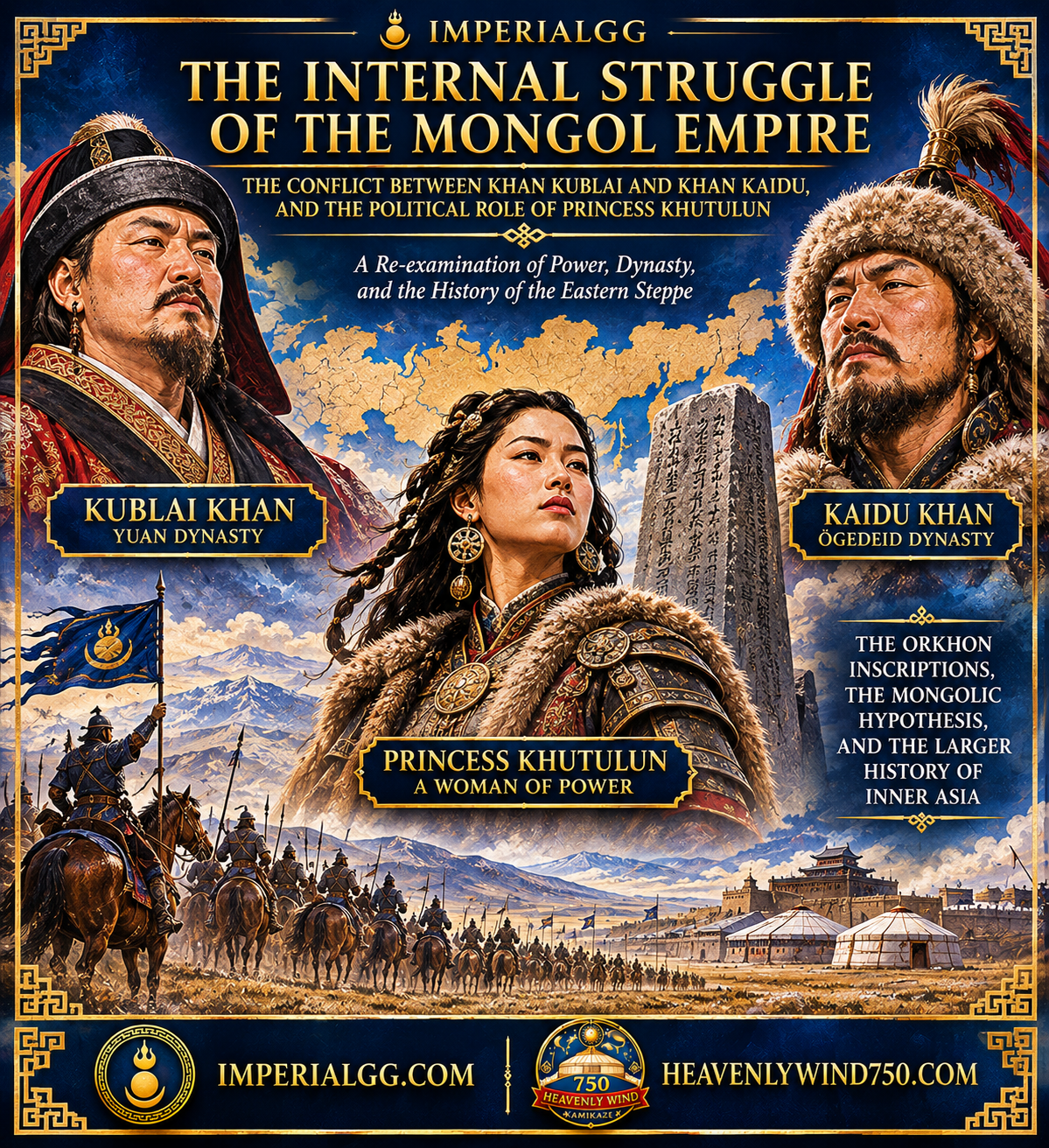
THE CONFLICT BETWEEN KHAN KUBLAI AND KHAN KAIDU, AND THE POLITICAL ROLE OF PRINCESS KHUTULUN
An examination of political power, the Ögedeid succession, and the traditions of nomadic governance in the Mongol Empire during the thirteenth century
ABSTRACT
During the second half of the thirteenth century, the Mongol Empire experienced a major internal political crisis. The struggle for the imperial throne that followed the death of Möngke Khan in 1259 initially unfolded between Kublai and Ariq Böke. It subsequently developed into a prolonged political and military confrontation in Central Asia when Kaidu, a descendant of Ögedei Khan, refused to recognize Kublai’s authority as Great Khan.
This conflict was not simply a personal rivalry between two rulers. It reflected deeper disagreements over the political unity of the empire founded by Chinggis Khan, the legitimacy of imperial succession, the autonomy of the various Chinggisid branches, and the relationship between traditional nomadic political institutions and the increasingly sedentary administrative system developed under Kublai.
This article examines the origins and development of the conflict between Kaidu and Kublai, its principal military episodes, its continuation after Kublai’s death in 1294, Kaidu’s death in 1301, and the general reconciliation of 1304. Particular attention is given to Princess Khutulun, daughter of Kaidu Khan. By comparing accounts associated with Rashid al-Din and Marco Polo, the article examines her military activities and political role within the broader context of women’s authority in the Mongol imperial world.
Keywords: Mongol Empire, Kublai Khan, Kaidu Khan, Ögedeid dynasty, Princess Khutulun, Rashid al-Din, Marco Polo, Yuan dynasty, Chagatai Khanate, Central Asia.
I. INTRODUCTION: THE INTERNAL CRISIS OF THE EMPIRE
In 1206, Chinggis Khan united numerous Mongol tribes and political groups, establishing the Great Mongol State. His achievement transformed the history of Eurasia. The political system he created rested not only on military conquest but also on dynastic succession, military organization, the distribution of territories, taxation, and the political relationships maintained within the imperial court.
Nevertheless, questions concerning the distribution of imperial authority, the selection of the Great Khan, and the degree of autonomy granted to different branches of the ruling dynasty continued to generate political tensions among Chinggis Khan’s descendants.
Following the death of Ögedei Khan in 1241, the regency of Töregene Khatun, the brief reign of Güyük Khan, and the accession of Möngke Khan in 1251, the political divisions within the empire became increasingly pronounced. During Möngke’s reign, the political influence of several Ögedeid princes declined, and their territorial holdings and authority were reduced. These developments formed part of the historical background to Kaidu’s later struggle.[1]
After Möngke Khan died in 1259, his younger brothers Kublai and Ariq Böke competed for the imperial throne. Kublai proclaimed himself Great Khan in 1260, but a significant section of the Mongol aristocracy supported Ariq Böke. Although Ariq Böke surrendered in 1264, the political forces that had supported him did not disappear entirely.
Among those forces, Kaidu, grandson of Ögedei Khan, emerged as a particularly important figure. He refused to recognize Kublai’s authority and sought to restore the political influence of the Ögedeid branch of the ruling dynasty. He gradually consolidated his own military and political power in Central Asia.[2]
From this point onward, the internal conflict of the Mongol Empire entered a new phase.
II. KHAN KAIDU: THE POLITICAL REVIVAL OF THE ÖGEDEID DYNASTY
Kaidu was a grandson of Ögedei Khan and a great-grandson of Chinggis Khan. His father was Qashi, a son of Ögedei. Kaidu became one of the few influential surviving members of the Ögedeid branch following the political purges of 1251.
During the struggle between Kublai and Ariq Böke after Möngke’s death, Kaidu supported Ariq Böke. Following Ariq Böke’s defeat, however, Kaidu continued to reject Kublai’s authority and sought to establish an independent political base in Central Asia.
Michal Biran interprets Kaidu’s rise not merely as an attempt to restore Ögedeid dynastic interests, but also as a political process shaped by alliances, conflicts, and negotiations with the Chagataid princes.[3]
Kaidu initially strengthened his position through territories associated with the Ögedeid branch. However, he soon had to adjust his relationships with the Chagataid rulers. Although he experienced conflicts with rulers such as Alghu and Baraq, he eventually formed an alliance with Baraq.
The great quriltai at Talas in 1269 represented an important turning point. Political leaders discussed territorial rights, pasturelands, and regional influence. The relationships among Kaidu, Baraq, and Möngke-Timur of the Jochid branch entered a new phase. This gathering reflected a political environment increasingly shaped by the interests of dynastic branches and regional rulers rather than by a single, universally recognized imperial authority.[4]
By 1271, Kaidu had proclaimed himself ruler of the Ögedeid branch and further consolidated his authority in Central Asia. His political sphere extended across areas associated with present-day southeastern Kazakhstan, Semirechye, the Ili River basin, the Altai region, and the approaches to the Tarim Basin.
These territories were not merely pastoral lands. They were strategically important spaces for trade along the Silk Roads, urban settlements, mountain passes, and military movements.
III. KUBLAI’S POLICIES AND KAIDU’S RESISTANCE
The reasons behind Kaidu’s opposition to Kublai cannot be adequately explained as a simple struggle for the imperial throne.
Kublai sought to restore centralized imperial authority, while Kaidu and his supporters sought to preserve the traditional political order of the nomadic world, dynastic territorial rights, and the relative autonomy of the Chinggisid branches.
Kublai increasingly concentrated his political activities in China. In 1271, he proclaimed the dynastic name Yuan and expanded the use of Chinese administrative institutions in governing his territories. Kaidu, by contrast, opposed this transformation, which he viewed as a departure from the traditional political practices of the Mongol Empire.
In his discussion of Mongol-period Chinese Turkestan in Encyclopaedia Iranica, Morris Rossabi describes Kaidu as a major representative of the political forces that resisted Kublai’s increasingly sedentary and China-centered government and sought to preserve traditional nomadic institutions.[5]
An important distinction must be made here. Kublai considered himself the legitimate holder of the authority of the Great Khan. Kaidu, meanwhile, sought to restore the political rights and influence of the Ögedeid dynasty. Their conflict therefore represented a struggle between centralized imperial authority and the practical autonomy of the empire’s dynastic branches.
IV. MILITARY CONFRONTATION: THE CAPTURE OF NOMUKHAN AND KUBLAI’S DIFFICULTIES
Kublai’s military campaigns against Kaidu encountered repeated difficulties.
In 1271, Kublai dispatched his son Nomukhan to lead an army against Kaidu. However, internal military divisions, the mobility of the opposing forces, and logistical difficulties prevented the campaign from achieving a decisive result.
In 1276, Kaidu succeeded in capturing Nomukhan, dealing a serious blow to Kublai’s political and military position. Accounts in the Yuan shi and Rashid al-Din’s historical writings record Nomukhan’s prolonged captivity, which lasted for nearly a decade.[6]
This episode demonstrates Kaidu’s military and political capabilities. Rather than confronting Kublai’s forces solely through direct engagement, he relied on the mobility of nomadic cavalry, attacks against exposed positions, and disruption of enemy supply routes.
During the 1280s, Kublai continued his military efforts. However, sources also record the capture of the Yuan commander Qi Gongzhi by Kaidu’s forces around 1285.[7]
Kublai’s armies made considerable efforts to establish lasting control over the Tarim Basin and the Dzungarian region. Nevertheless, long supply lines, military expenses, and the sudden movements of nomadic forces repeatedly limited the effectiveness of these campaigns.
Kaidu’s principal advantages included his knowledge of the terrain, the mobility of his cavalry, and his alliances with regional leaders. Kublai, on the other hand, possessed greater demographic, economic, industrial, and administrative resources. Yet these advantages alone were insufficient to guarantee lasting military control over the distant territories of Central Asia.
V. PRINCESS KHUTULUN: DAUGHTER OF KHAN KAIDU AND MILITARY LEADER
Princess Khutulun, daughter of Kaidu Khan, occupies a distinctive place in the history of the Mongol Empire during the thirteenth century.
Reducing her historical identity to that of a physically powerful woman famous for defeating men in wrestling contests would oversimplify her actual role. According to the Persian historian Rashid al-Din, Khutulun participated in her father’s military campaigns, entered enemy formations, captured enemy soldiers, and demonstrated considerable military ability.
In her study “Qutulun: The Warrior Princess of Central Asia,” published in The Mongols and the Islamic World, Michal Biran identifies Khutulun as one of the most prominent female warriors of Mongol Central Asia and emphasizes her unusual position as a military leader.[8]
5.1. Rashid al-Din’s Account
Rashid al-Din’s Jāmiʿ al-tawārīkh (Compendium of Chronicles), written in the early fourteenth century, is one of the most important Persian sources concerning Princess Khutulun.
According to Rashid al-Din, Khutulun regularly accompanied her father on military campaigns and dressed in the manner of a male warrior. She was said to have entered enemy ranks and captured mounted warriors, bringing them back as prisoners.
This account suggests that Khutulun was not simply a royal daughter. She possessed practical military experience and enjoyed her father’s confidence.[9]
Women of the Mongol aristocracy during Kublai’s era were not necessarily confined to domestic or ceremonial roles. They could possess their own households, property, livestock, dependents, and, in certain circumstances, military forces. Some exercised direct influence over political decisions and military affairs.
Khutulun’s distinction was her reported personal participation in her father’s campaigns and her ability to perform military leadership functions.
5.2. Marco Polo’s Account: Wrestling and Ten Thousand Horses
The Venetian traveler Marco Polo journeyed through Mongol-controlled territories between 1271 and 1291 and became familiar with the court of Kublai Khan. His work, The Description of the World, is an important source for the geography, politics, and society of Asia during the thirteenth century.[10]
Marco Polo refers to Kaidu’s daughter by the name “Aigiaruc.” Scholars generally identify this figure with Khutulun.
According to Marco Polo, Khutulun declared that she would marry only a man capable of defeating her in wrestling. Men who challenged her and lost were required to surrender horses to her.
Marco Polo describes her defeating numerous challengers and accumulating a substantial number of horses. In some versions of the account, the number is said to have reached ten thousand.[11]
However, this narrative should not be treated as entirely verified historical fact. Medieval travel accounts frequently combine observations, oral traditions, and literary embellishment. Michal Biran also cautions that certain elements of the wrestling narrative may have been romanticized.
Nevertheless, Marco Polo’s account provides valuable evidence of Khutulun’s reputation, physical ability, and social standing in the equestrian nomadic world.
5.3. Khutulun and Political Marriage
Marriage among members of the Mongol aristocracy was not always a purely private matter. In many cases, it served as an instrument for strengthening political alliances between dynastic princes, military commanders, and regional authorities.
Rashid al-Din records that Khutulun was interested in marrying Ghazan, who later became Ilkhan from 1295 to 1304. According to this account, she sent envoys and gifts to Ghazan. However, the proposed marriage did not take place.
Michal Biran suggests that this narrative may also have served to enhance Ghazan’s reputation, given Rashid al-Din’s close relationship with his patron. The account therefore requires careful source criticism.[12]
Rashid al-Din further records that Khutulun eventually married a tall and handsome man who had served as a cook in Kaidu’s household. The position of ba’urchi, or royal cook, could be an important and trusted office within the Mongol court, sometimes associated with responsibilities connected to the ruler’s household and personal security.
This episode demonstrates that Khutulun’s marriage cannot be understood exclusively as a political arrangement. Personal choice, family circumstances, and political considerations could all influence the decisions of members of the ruling dynasty.
5.4. Khutulun’s Political Position after Kaidu’s Death
The most politically significant period of Khutulun’s life began after the death of her father, Kaidu Khan.
Kaidu died in 1301 after being wounded during a military confrontation. Before his death, he reportedly designated his son Orus as his successor and advised his other sons to follow the counsel of Duwa, the Chagatai ruler. Michal Biran discusses this episode based on Rashid al-Din’s account.[13]
However, Duwa had different political objectives. Rather than supporting Orus, he sought to install Chapar, Kaidu’s eldest son, and bring the political influence of the Ögedeid branch under his own control.
Khutulun opposed this decision and supported Orus, seeking to defend her father’s final wishes. She recognized Duwa’s political ambitions and challenged his intervention in the succession.
This episode demonstrates that Khutulun was not merely a woman known for her physical strength or military ability. She was also a political participant capable of defending the dynastic interests of the Ögedeid family.
According to the historical accounts, Duwa expressed the view that a woman should not interfere in matters of succession and political authority. Yet the history of the Mongol Empire provides clear examples of women exercising substantial political power, including Töregene Khatun and Orghina Khatun, who held authority during periods of regency.
Khutulun herself did not become ruler. Nevertheless, her attempt to defend her father’s succession arrangements and the political interests of her dynasty reveals the extent of her influence.[14]
5.5. Khutulun’s Final Political Struggle
Following Kaidu’s death, the political position of the Ögedeid branch weakened, while Duwa’s influence increased.
Khutulun assumed responsibility for protecting her father’s tomb and memorial interests. According to accounts discussed by Michal Biran, she established her household in the region between the Ili and Chu rivers, south of the Tianshan Mountains.
However, Khutulun did not completely withdraw from political affairs. Around 1306, when Chapar attempted to mobilize the Ögedeid forces to defend his position, Khutulun reportedly arrived with her own military contingent.
One particularly important detail is that Khutulun is described as commanding her own mingghan—a military unit of approximately one thousand men—rather than merely accompanying her husband or another male commander. This is among the most significant pieces of evidence concerning her military authority.[15]
Nevertheless, Duwa’s forces, supported by the military power of the Yuan dynasty, inflicted a decisive defeat on Chapar’s side. The political position of Kaidu’s descendants deteriorated, and the independent political authority of the Ögedeid branch approached its end.
Around 1307, forces associated with Duwa reportedly attacked Khutulun’s household at night. According to the account attributed to Qashani, her husband and two sons were killed by being drowned in a river. The circumstances of Khutulun’s own death remain uncertain.[16]
Thus, the life of Princess Khutulun, daughter of Kaidu Khan, appears to have ended amid the collapse of her father’s political power and the struggle over the succession of the Ögedeid dynasty.
VI. THE DEATH OF KUBLAI AND THE CONTINUATION OF KAIDU’S STRUGGLE
Kublai Khan died in 1294. However, Kaidu’s resistance did not end with his death.
Kublai was succeeded by his grandson Temür Öljeytü Khan, who ruled from 1294 to 1307. Temür continued his grandfather’s policy in Central Asia and remained involved in military confrontations with Kaidu and Duwa of the Chagatai branch.
This chronological distinction is important: Kublai died in 1294, whereas Kaidu continued his struggle until 1301. Therefore, the conflict between Kaidu and Kublai did not simply end with Kublai’s death. Kaidu’s resistance continued during the reign of Kublai’s successor, Temür Khan.[17]
In 1301, Kaidu was wounded during a major battle against Yuan forces and subsequently died. His death altered the political balance of power in Central Asia.
Following Kaidu’s death, Duwa strengthened his own position and sought to influence the succession within the Ögedeid branch according to his political interests. As a result, Chapar’s position weakened, and between approximately 1306 and 1310 the independent political authority of the Ögedeid branch effectively came to an end.
In 1304, a general reconciliation was reached among several branches of the Mongol ruling dynasty. The recognition of Temür Öljeytü’s authority as Great Khan by other Chinggisid rulers represented a partial realization of a political objective that Kublai had been unable to achieve fully during his lifetime.[18]
However, the reconciliation of 1304 should not be interpreted as a complete restoration of the empire’s former unity. In political reality, the Yuan dynasty, Golden Horde, Ilkhanate, and Chagatai Khanate continued to develop their own administrations, military structures, and economic interests.
VII. THE FUNDAMENTAL CAUSES AND HISTORICAL CONSEQUENCES OF THE INTERNAL CONFLICT
The confrontation between Kaidu and Kublai can be understood through five principal issues.
First, the legitimacy of imperial succession. Kublai considered himself the legitimate successor to the authority of the Great Khan, while Kaidu sought to restore the political rights of the Ögedeid dynasty.
Second, centralized imperial authority versus dynastic autonomy. Kublai sought to strengthen the central authority of the empire, whereas Kaidu sought to preserve the territorial holdings and political independence of the dynastic branches in Central Asia.
Third, differences in political and administrative systems. Kublai’s Yuan dynasty increasingly relied on Chinese administrative institutions, a sedentary economy, and urban centers. Kaidu, by contrast, sought to preserve traditional nomadic political organization, military structures, and the strategic importance of pastoral territories.
Fourth, control over territory and trade routes. Central Asian territories, the Silk Roads, the Tarim Basin, and the Dzungarian region were of enormous economic, military, and diplomatic importance. The conflict was therefore not merely a dispute over the imperial throne, but also a struggle over control of important Eurasian trade and communication networks.
Fifth, dynastic succession within the Ögedeid branch. After Kaidu’s death, the question of succession among his descendants became increasingly contentious. Duwa exploited the situation to weaken the political influence of the Ögedeid dynasty. Princess Khutulun’s involvement reveals the complexity of this struggle.
The result was a further weakening of the Mongol Empire’s political unity and an acceleration of the independent development of its constituent states.
VIII. AUTHOR’S THESIS
The conflict between Kaidu and Kublai can correctly be described as an internal struggle within the Mongol Empire. However, it should not be reduced to a personal rivalry between two rulers.
It was a struggle over the future political model of the empire founded by Chinggis Khan.
Kublai sought to preserve centralized imperial authority under changing historical conditions and to establish a powerful state increasingly based on the administrative institutions of sedentary China. Kaidu, on the other hand, sought to restore the authority of the Ögedeid dynasty and defend the traditional nomadic political order, dynastic territorial rights, and regional autonomy.
Rather than reducing this conflict to a simple judgment about which ruler was right or wrong, it is more important to understand the two competing political tendencies that existed within the Mongol Empire during the thirteenth century.
The life of Princess Khutulun reveals another important dimension of this history. Women of the Mongol aristocracy were not merely instruments of dynastic marriage. They could possess their own military forces, property, households, and political authority. When necessary, they participated directly in military campaigns and struggles over dynastic succession.
Khutulun is a particularly important example of this phenomenon. She participated in her father’s military campaigns, commanded her own military contingent, and attempted to defend the political interests of the Ögedeid dynasty after Kaidu’s death. Her fate demonstrates that the internal conflicts of the Mongol Empire were not limited to rulers and princes. They affected entire dynasties, households, military groups, and political alliances.
The confrontation between Kaidu and Kublai was a struggle over political authority, state traditions, and dynastic succession within the Mongol Empire. The history of Princess Khutulun, meanwhile, demonstrates that women could occupy independent positions in military and political affairs within the Mongol imperial world.
FOOTNOTES
[1] Michal Biran, “Qutulun: The Warrior Princess of Central Asia,” in The Mongols and the Islamic World: From Conquest to Conversion, ed. Peter Jackson (New Haven: Yale University Press, 2017), discussion of Kaidu’s Ögedeid background and the political purges of 1251. See also The Cambridge History of the Mongol Empire, vol. I (Cambridge: Cambridge University Press, 2023), chapter “Mongol Central Asia: The Chaghadaids and the Ögödeids, 1260–1370.”
[2] Morris Rossabi, “Chinese Turkestan iv. In the Mongol Period,” Encyclopaedia Iranica, vol. V, fasc. 5 (1991), pp. 473–474; revised online edition, 2013. https://www.iranicaonline.org/articles/chinese-turkestan-iv/
[3] Michal Biran, “Qutulun: The Warrior Princess of Central Asia,” in The Mongols and the Islamic World, pp. 64–66. Discussion of Kaidu’s background, Ögedeid political interests, and alliances with the Chagataid branch.
[4] A. Porsin, “The Role of the Katwan and Talas Kurultai in the Military-Political Confrontation between Kaidu and Borak in the Second Half of the 60s of the 13th Century,” Kazhistorians.kz. Discussion of the Talas assembly, the Kaidu–Baraq alliance, and Central Asian political relations during the 1260s. https://kazhistorians.kz/index.php/home/article/view/21
[5] Morris Rossabi, “Chinese Turkestan iv. In the Mongol Period,” pp. 473–474. Discussion of Kaidu’s opposition to Kublai’s policies and the defense of traditional nomadic institutions.
[6] Yuan shi (元史), biography of Nomukhan and related records; Morris Rossabi, “Chinese Turkestan iv. In the Mongol Period,” p. 474; Rashīd al-Dīn, The Successors of Genghis Khan, trans. J. A. Boyle (New York: Columbia University Press, 1971), p. 266. Discussion of Nomukhan’s capture and captivity.
[7] Yuan shi (元史), record concerning Qi Gongzhi, cited by Rossabi at p. 6937; Morris Rossabi, “Chinese Turkestan iv. In the Mongol Period,” p. 474.
[8] Michal Biran, “Qutulun: The Warrior Princess of Central Asia,” in The Mongols and the Islamic World: From Conquest to Conversion (New Haven: Yale University Press, 2017), pp. 64–79. A principal modern study of Khutulun’s life, military activities, and political role.
[9] Rashīd al-Dīn, Jāmiʿ al-tawārīkh, ed. E. Blochet (Leiden and London, 1911), vol. II; Rashīd al-Dīn, Jāmiʿ al-tawārīkh (Tehran, 1994), vol. I, pp. 629–631; see also Biran, “Qutulun,” pp. 66–67. Discussion of Khutulun’s participation in military campaigns.
[10] Marco Polo, The Travels of Marco Polo, trans. A. C. Moule and Paul Pelliot (London: George Routledge & Sons, 1938), vol. I; Michele Bernardini, “Polo, Marco,” Encyclopaedia Iranica. https://www.iranicaonline.org/articles/polo-marco/
[11] Marco Polo, The Travels of Marco Polo, trans. A. C. Moule and Paul Pelliot (London: George Routledge & Sons, 1938), vol. I, pp. 453–456; Biran, “Qutulun,” pp. 67–69. Discussion of the name Aigiaruc, the wrestling contests, and the horses.
[12] Rashīd al-Dīn, Jāmiʿ al-tawārīkh (1994), vol. I, pp. 629–630; Biran, “Qutulun,” pp. 66–68. Discussion of the proposed marriage between Khutulun and Ghazan and the need for source criticism.
[13] Rashīd al-Dīn, Jāmiʿ al-tawārīkh (1994), vol. I, pp. 630–631; Biran, “Qutulun,” pp. 69–70. Discussion of Kaidu’s succession arrangements and the political struggle involving Orus, Chapar, and Duwa.
[14] Biran, “Qutulun,” pp. 69–71. Khutulun’s political involvement, her conflict with Duwa, and examples of women’s political authority in the Mongol Empire.
[15] Biran, “Qutulun,” pp. 71–72. Discussion of Khutulun’s participation with her own military contingent around 1306.
[16] Qāshānī, Tārīkh-i Ūljāytū (1969), pp. 39–40; Biran, “Qutulun,” p. 72. Account of the attack on Khutulun’s household. The circumstances of Khutulun’s own death remain uncertain and should not be presented as definitively established.
[17] Morris Rossabi, “Chinese Turkestan iv. In the Mongol Period,” p. 474; Peter Jackson, The Mongols and the Islamic World: From Conquest to Conversion (New Haven: Yale University Press, 2017). Discussion of the continuation of the conflict during Temür Öljeytü Khan’s reign.
[18] Peter Jackson, The Mongols and the Islamic World: From Conquest to Conversion (New Haven: Yale University Press, 2017); The Cambridge History of the Mongol Empire, vol. I (Cambridge: Cambridge University Press, 2023). Discussion of the general reconciliation of 1304 and relations among the Chinggisid branches.
BIBLIOGRAPHY
PRIMARY SOURCES
Yuan shi (元史). Beijing edition, 1976.
Rashīd al-Dīn. Jāmiʿ al-tawārīkh. Ed. E. Blochet. Leiden and London, 1911.
Rashīd al-Dīn. Jāmiʿ al-tawārīkh. Tehran edition, 1994.
Rashīd al-Dīn. The Successors of Genghis Khan. Translated by J. A. Boyle. New York: Columbia University Press, 1971.
Marco Polo. The Travels of Marco Polo. Translated by A. C. Moule and Paul Pelliot. London: George Routledge & Sons, 1938.
Qāshānī. Tārīkh-i Ūljāytū. 1969.
MODERN SCHOLARSHIP
Biran, Michal. “Qutulun: The Warrior Princess of Central Asia.” In The Mongols and the Islamic World: From Conquest to Conversion. New Haven: Yale University Press, 2017.
Jackson, Peter. The Mongols and the Islamic World: From Conquest to Conversion. New Haven: Yale University Press, 2017.
Rossabi, Morris. “Chinese Turkestan iv. In the Mongol Period.” Encyclopaedia Iranica, vol. V, fasc. 5, 1991, pp. 473–474.
The Cambridge History of the Mongol Empire. Edited by Michal Biran and Hodong Kim. Cambridge: Cambridge University Press, 2023.
Porsin, A. “The Role of the Katwan and Talas Kurultai in the Military-Political Confrontation between Kaidu and Borak in the Second Half of the 60s of the 13th Century.” Kazhistorians.kz.
IMPERIALGG.COM
The history of the Mongol Empire should not be confined to the victories and defeats of its rulers. It must also be examined through its internal politics, traditions of governance, dynastic relationships, and the actual participation of women in imperial affairs.