THE FIRST MONGOL-LED INVASION OF JAPAN IN 1274
By Altanbagana Baatar
DBA Candidate| Founder & Organizer
Heavenly Wind 750 International Conference
Heavenlywind750.com | Imperilagg.com
02 November 2026
GORYEO’S MILITARY MOBILIZATION, NAVAL CONTRIBUTION, AND THE REALITIES OF A MEDIEVAL MARITIME CAMPAIGN
A Goryeo-Centered Historical Reassessment Based on Korean Primary Sources
ABSTRACT
The first Mongol-led invasion of Japan in 1274 was not simply a military confrontation between the Mongol Empire and Japan. It was a multinational maritime expedition organized under the authority of Kublai Khan and dependent to a considerable extent on the military, naval, and logistical resources of the Goryeo kingdom.
This article examines the 1274 campaign primarily through Korean historical records, particularly the Goryeosa (高麗史), alongside modern Korean scholarship and selected Japanese and international studies. It investigates Goryeo’s political position under Yuan authority, the mobilization of labor and resources, the construction of approximately 900 warships, the organization of the expeditionary forces, and the campaign’s operations in the Tsushima, Iki, and Hakata regions.
The article argues that Goryeo was not merely a geographical passageway or a secondary participant. Its shipbuilding capacity, naval personnel, military commanders, and logistical infrastructure were essential to the expedition. At the same time, the campaign must be understood within the unequal political relationship between the Yuan Empire and Goryeo, rather than interpreted as a voluntary military partnership between two equal states.
Keywords: Mongol Empire, Yuan dynasty, Goryeo, Korea, Japan, Kublai Khan, Kim Bang-gyeong, 1274 invasion, medieval naval warfare, maritime logistics.
1. INTRODUCTION: A MARITIME CAMPAIGN BEYOND A BILATERAL WAR
The first Mongol-led invasion of Japan in 1274 is frequently presented in historical narratives as an attempted conquest by the Mongol Empire against Japan. However, such a description can obscure the multinational structure of the expedition and the considerable contribution of the Goryeo kingdom.
The campaign was organized under Kublai Khan (1215–1294), ruler of the Mongol Empire and founder of the Yuan dynasty. Its military resources included Mongol and Han Chinese troops, Goryeo soldiers, sailors, navigators, shipbuilders, and other personnel. The operation depended heavily on the Korean Peninsula as a logistical and naval staging ground.[1]
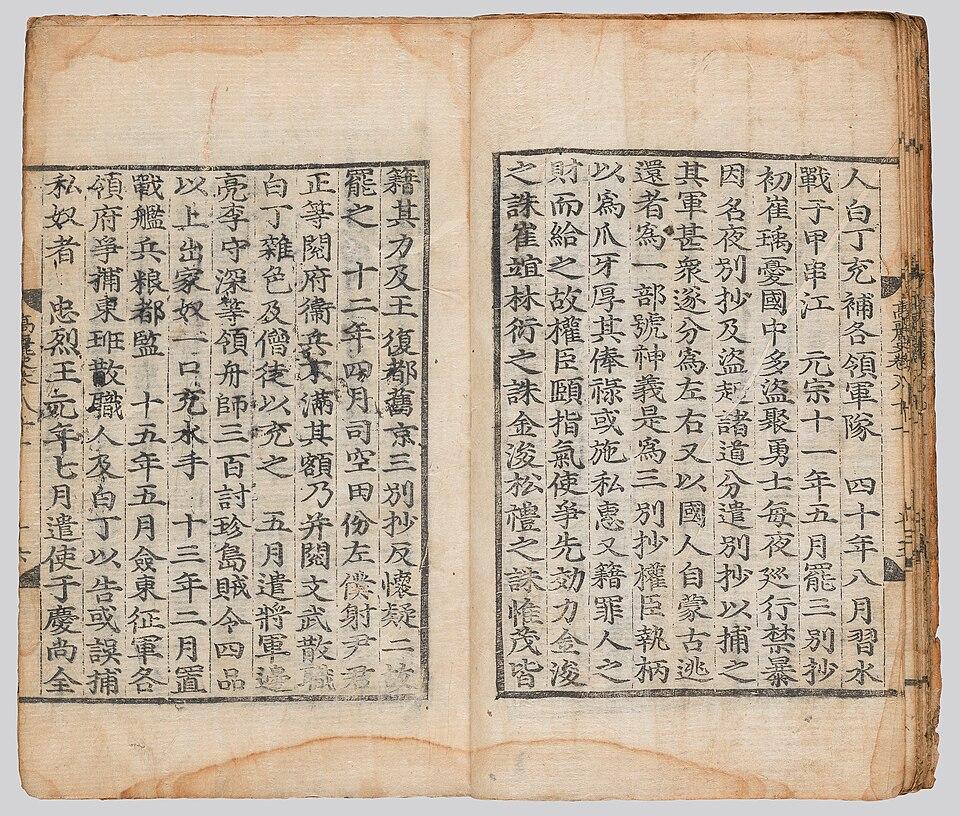
The Korean historical record provides an essential perspective. The Goryeosa (高麗史), particularly the biography of General Kim Bang-gyeong (金方慶), records the preparation of the expeditionary fleet, the appointment of military commanders, the concentration of troops at Happo (合浦), and the composition of the forces assembled for the campaign.[2]
This evidence allows the 1274 expedition to be examined not only as an episode in Japanese military history but also as a major event in Goryeo’s political, military, and maritime history.
This study focuses exclusively on the first expedition of 1274. The second expedition of 1281 is outside its scope.
2. HISTORICAL AND POLITICAL BACKGROUND: GORYEO UNDER YUAN PRESSURE
The relationship between Goryeo and the Mongol Empire had been shaped by decades of warfare and political negotiation.
Mongol invasions of the Korean Peninsula began in 1231. The conflict continued through successive campaigns until Goryeo’s royal court entered into negotiations with the Mongol leadership. In 1259, Crown Prince Wang Jeon, later King Wonjong, traveled to meet Kublai Khan. This diplomatic encounter helped establish a new political relationship between the two powers.
Goryeo retained its royal dynasty and a degree of internal governmental structure, but its foreign policy and military obligations became increasingly subject to Yuan demands.
By the 1260s, Kublai Khan had begun diplomatic initiatives directed toward Japan. The Yuan court sought to establish a formal relationship and demanded that Japan acknowledge its authority. Goryeo was repeatedly involved in these diplomatic efforts because of its geographical position and established maritime connections with the Japanese archipelago.[3]
The diplomatic negotiations did not produce the desired result. Japanese authorities did not accept the Yuan demands, and the Kamakura shogunate maintained its refusal to establish the relationship sought by Kublai Khan.
The failure of diplomacy was followed by military preparations.
The Korean historical record and modern scholarship indicate that preparations for the expedition were underway before 1274. Goryeo was required to provide ships, personnel, food supplies, and other military resources. The preparation was not simply a matter of assembling an army: it required a large-scale maritime mobilization involving shipbuilding, labor recruitment, transportation, and provisions.[4]
The distinction between political participation and political consent is important. Goryeo contributed substantially to the expedition, but this contribution occurred within an unequal relationship with the Yuan Empire.
3. SHIPBUILDING AND THE MOBILIZATION OF GORYEO’S RESOURCES
One of the most significant aspects of the 1274 expedition was the construction and assembly of its naval fleet.
According to the biography of Kim Bang-gyeong in the Goryeosa, Kublai Khan ordered the construction of warships and appointed Kim Bang-gyeong and Hong Tagu (洪茶丘) to supervise the work.
The account describes a disagreement over shipbuilding methods. The use of a southern Chinese construction method was considered expensive and potentially difficult to complete within the required time. Kim Bang-gyeong therefore consulted the relevant authorities and supervised construction using Goryeo’s established shipbuilding methods.[5]
This passage is important for two reasons.
First, it demonstrates that Goryeo possessed an established shipbuilding tradition that could be mobilized for a large international military operation.
Second, it indicates that the Yuan authorities depended on local technical knowledge rather than simply imposing a uniform shipbuilding system throughout the expedition.
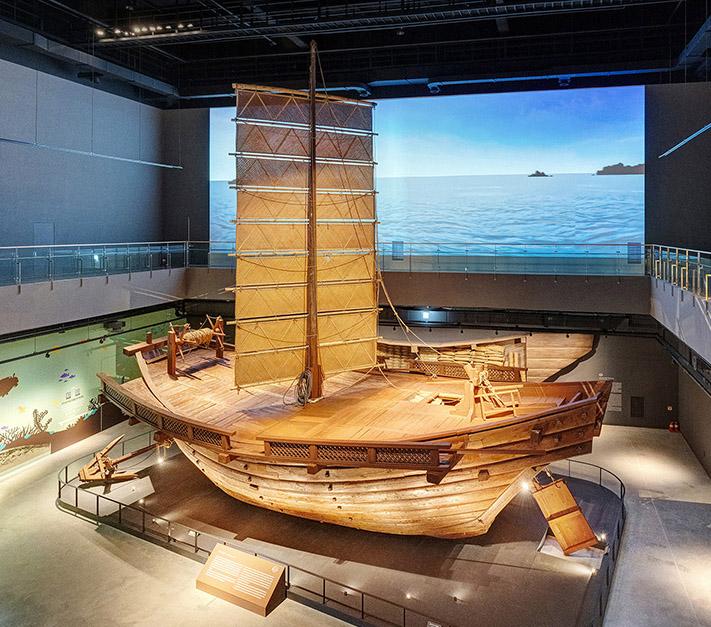
The Goryeosa records that approximately 900 warships were assembled at Happo. It also records a force of 25,000 Mongol and Han Chinese troops, 8,000 Goryeo soldiers, and 6,700 sailors, navigators, and other maritime personnel.[6]
These figures are among the most important pieces of evidence for understanding the scale of the first expedition.
However, they should be interpreted carefully. The figures represent the force recorded in the historical account, not necessarily a modern independently verified count of every individual who participated. The distinction between combat troops and maritime personnel must also be preserved.
The construction of approximately 900 vessels was not merely a technical achievement. It represented an enormous mobilization of labor, timber, shipbuilding expertise, transportation, and administrative coordination.
Modern Korean historian Yoon Yong-hyuk has examined the naval contribution of Goryeo in detail. His 2008 study argues that the ships used in the invasions of Japan were constructed in Goryeo and challenges interpretations that have treated the fleet primarily through a Japan-centered or South China-centered perspective.[7]
His research is particularly relevant because it places Goryeo’s shipbuilding industry at the center of the discussion rather than treating it as a peripheral logistical detail.
4. THE COMMAND STRUCTURE AND COMPOSITION OF THE EXPEDITIONARY FORCE
The Goryeosa biography of Kim Bang-gyeong provides a detailed account of the command structure assembled for the expedition.
The principal commanders included:
Kudun (忽敦) — identified in the record as the commander-in-chief, or Dawon-su (都元帥).
Hong Tagu (洪茶丘) — deputy commander.
Liu Fuheng (劉腹亨) — another deputy commander.
Kim Bang-gyeong (金方慶) — commander of the Goryeo central force.
The Goryeo army was organized into three principal divisions:
Central Division: Kim Bang-gyeong commanded the central force, with Park Ji-ryang (朴之亮), Kim Heun (金忻), and Im Gae (任愷) serving as subordinate officers.
Left Division: Kim Sin (金侁) commanded the left division, assisted by Wi Deuk-yu (韋得儒) and Son Se-jeong (孫世貞).
Right Division: Kim Mun-bi (金文庛) commanded the right division, with Na Yu (羅裕), Park Bo (朴保), and Ban Bu (潘阜) serving as subordinate officers.[8]
This structure illustrates that Goryeo did not simply provide a group of soldiers to be incorporated informally into the Yuan army. Its forces retained identifiable commanders and an internal military organization within the broader expeditionary command.
Nevertheless, the overall expedition remained under Yuan strategic authority. The distinction between Goryeo’s internal command structure and the Yuan-led operational command is essential to understanding the political and military arrangement.
The expedition was therefore a combined military operation, but not one conducted by equal sovereign partners.
5. DEPARTURE FROM HAPPO AND THE ROUTE TOWARD JAPAN
The assembly point of the expeditionary force was Happo (合浦), located in the area of present-day Masan, Changwon, in South Korea.
The Korean record identifies Happo as the place where the expeditionary fleet and troops gathered while awaiting additional forces, including Jurchen contingents.[9]
The route toward Japan passed through the islands situated between the Korean Peninsula and Kyushu.
The principal operational sequence was:
Departure from the Goryeo naval staging area.
Movement toward Tsushima Island (対馬).
Military operations on Tsushima.
Movement toward Iki Island (壱岐).
Arrival in the Hakata Bay region of northern Kyushu.
The Korean historical account provides evidence of the expedition’s military organization and preparation, while Japanese sources offer additional information about the fighting and the response of local defenders.
The Mōko Shūrai Ekotoba (蒙古襲来絵詞), an illustrated account associated with the Japanese warrior Takezaki Suenaga, is an important visual source for the battles of the Mongol invasions. It depicts Japanese warriors and scenes associated with the fighting in Kyushu.
However, the illustrated scroll should not be treated as a neutral photographic record. It was produced within a Japanese warrior context and reflects the perspective and interests of its patron and subject. Its images must therefore be compared with written sources and modern historical research.
6. THE CAMPAIGN IN 1274: TSUSHIMA, IKI, AND HAKATA
The expedition reached the islands between Korea and Japan before advancing toward Kyushu.
The Japanese historical tradition records attacks on Tsushima and Iki before the expedition reached the Hakata Bay region.
The Korean historical record is especially valuable for reconstructing the organization and composition of the invading force, while Japanese sources provide more detailed accounts of local military encounters.
The fighting in northern Kyushu involved a different military environment from the continental campaigns with which Mongol forces were more familiar. The expedition had to operate across the sea, land troops in unfamiliar territory, coordinate ships and soldiers, and confront Japanese mounted and infantry forces defending their local territories.
The campaign should therefore be understood as a complex maritime operation rather than simply an extension of Mongol land warfare.
The Japanese illustrated account of Takezaki Suenaga provides evidence of the fighting and the participation of Japanese warriors. Yet the interpretation of individual scenes, weapons, ships, and tactical movements requires careful comparison with other evidence.
The surviving records do not permit every detail of the battlefield sequence to be reconstructed with certainty.
7. THE WITHDRAWAL: WEATHER, NAVAL CONDITIONS, AND HISTORICAL INTERPRETATION
The first expedition ended with the withdrawal of the invading force from the Hakata region.
A common historical explanation attributes the withdrawal to a severe storm that damaged the fleet. This explanation has become closely associated with later Japanese narratives about divine protection.
However, the question requires careful treatment.
The existence of severe weather and the loss of vessels are important parts of the historical discussion, but the precise relationship between weather, military decisions, supply conditions, and the timing of the withdrawal remains a subject of scholarly interpretation.
Korean historian Yoon Yong-hyuk addressed the question of the campaign’s withdrawal and the role of the storm in his 2005 study, which specifically examines the first invasion of 1274. The article includes separate discussions of troop strength, ship construction, the course of the fighting, the storm question, and the reasons for the coalition’s early withdrawal.[10]
J. Neumann’s 1975 study also examined the meteorological dimension of the Mongol invasions of Japan, comparing historical accounts of the storms and their effects on the invading fleets.[11]
For an evidence-based account, it is therefore more appropriate to distinguish three questions:
Did severe weather affect the expedition? The historical tradition and later studies support the conclusion that weather was an important factor.
Did the weather cause the entire withdrawal? This requires a broader analysis of military and logistical circumstances.
Can the storm be described confidently as a typhoon in the modern meteorological sense? Such terminology should not be applied automatically without examining the historical and scientific evidence.
The withdrawal should consequently be studied as the outcome of a maritime military operation under difficult operational conditions, rather than explained through a single dramatic event alone.
8. GORYEO’S HISTORICAL POSITION: PARTICIPANT, LOGISTICAL BASE, AND POLITICAL SUBJECT
The 1274 expedition reveals the complex position of Goryeo within the Yuan imperial system.
Goryeo provided a substantial number of soldiers, a large naval fleet, sailors, navigators, shipbuilding labor, and logistical resources. Its commanders played identifiable roles in the expedition, and its ports served as essential staging areas.
At the same time, Goryeo’s participation must be understood in the context of its political subordination to the Yuan Empire.
The mobilization of resources was not simply an expression of an independent Goryeo foreign policy. It was also a consequence of the obligations and pressures imposed by the Yuan court.
This distinction matters because modern national histories sometimes present the campaign through the framework of contemporary national identities. Such an approach can obscure the complex political realities of the thirteenth century.
The people involved belonged to different political communities and military organizations. The expedition was organized under Yuan imperial authority, but its practical execution depended on the resources and expertise of several regions.
The campaign was therefore both an imperial military operation and a major episode in the history of Goryeo’s maritime and political experience.
9. AUTHOR’S THESIS
The first Mongol-led invasion of Japan in 1274 should be reconsidered as a multinational maritime expedition whose success or failure cannot be understood through the military actions of Mongol forces alone.
The Korean historical record demonstrates that Goryeo was central to the preparation and execution of the campaign. Its shipbuilding industry, military organization, sailors, navigators, and logistical infrastructure provided the material foundation for the expedition.
The approximately 900 warships recorded in the Goryeosa, together with the 8,000 Goryeo soldiers and 6,700 maritime personnel, reveal the scale of the kingdom’s contribution.
Yet this contribution should not be romanticized as an equal partnership. Goryeo operated within an unequal political relationship with the Yuan Empire, and its military resources were mobilized under imperial pressure.
The historical significance of 1274 therefore extends beyond the question of whether the expedition achieved its military objectives. It provides evidence of the relationship between imperial power, regional political structures, maritime technology, and the human and material costs of medieval warfare.
For the Heavenly Wind 750 research initiative, the Korean perspective is indispensable. It allows the 1274 campaign to be examined through the experience of a society that supplied much of the fleet and a substantial part of the expeditionary force.
The first invasion of Japan was not only a story of Mongol expansion. It was also a story of Goryeo’s ships, labor, soldiers, and maritime world.
FOOTNOTES
[1] National Institute of Korean History, “몽골제국의 일본 원정” [The Mongol Empire’s Expedition to Japan], 사료로 본 한국사 [Korean History through Historical Sources]. The overview describes the 1274 and 1281 expeditions as operations organized by the Mongol Empire using substantial Goryeo and Southern Song military resources.
https://contents.history.go.kr/front/hm/view.do?levelId=hm_052_0010
[2] Goryeosa (高麗史), vol. 104, Yeoljeon (列傳), biography of Kim Bang-gyeong (金方慶), “김방경이 합포에서 일본 정벌을 준비하다” [Kim Bang-gyeong prepares the expedition against Japan at Happo]. National Institute of Korean History, Korean History Database.
https://db.history.go.kr/id/kr_104r_0010_0010_0060
[3] Lina Nie, “Before the Storm: A Transrealm History of the Decades Leading Up to the First Mongol Invasion of Japan,” Monumenta Nipponica 78, no. 2 (2023): 157–187. The article examines the diplomatic negotiations involving Kublai Khan, Goryeo, the Kamakura shogunate, and the Japanese imperial court before the 1274 invasion.
https://dept.sophia.ac.jp/monumenta/article/before-the-storm-a-transrealm-history-of-the-decades-leading-up-to-the-first-mongol-invasion-of-japan/
[4] Yoon Yong-hyuk (윤용혁), “여원군의 일본침입을 둘러싼 몇 문제 — 1274년 1차 침입을 중심으로 —” [Some Issues Concerning the Goryeo–Yuan Invasion of Japan: Focusing on the First Invasion of 1274], 島嶼文化 [Island Culture], no. 25 (June 2005): 65–98. The National Institute of Korean History catalog identifies the article’s sections on troop strength, naval construction, the course of the fighting, the storm question, and the reasons for the early withdrawal.
https://db.history.go.kr/id/hb_129_02_000851
[5] Goryeosa, vol. 104, biography of Kim Bang-gyeong. The account describes the order to supervise warship construction and Kim Bang-gyeong’s decision to employ Goryeo shipbuilding methods. See footnote [2].
[6] Goryeosa, vol. 104, biography of Kim Bang-gyeong. The account records 25,000 Mongol and Han Chinese troops, 8,000 Goryeo troops, 6,700 sailors, navigators, and other maritime personnel, and approximately 900 warships assembled at Happo. See footnote [2]. These are figures transmitted by the historical source and should not be confused with independently verified modern counts.
[7] Yoon Yong-hyuk, “여원 연합군의 일본 침입과 고려 軍船” [The Goryeo and Mongol Combined Forces Invasion against Japan and Military Ships of the Goryeo Dynasty], Military History, no. 69 (2008): 69–114. DOI: 10.29212/mh.2008..69.69. The article examines Goryeo naval construction and challenges the assumption that the fleet should be understood primarily through a South Chinese shipbuilding framework.
https://www.kci.go.kr/kciportal/ci/sereArticleSearch/ciSereArtiView.kci?sereArticleSearchBean.artiId=ART001297115
[8] Goryeosa, vol. 104, biography of Kim Bang-gyeong. The account identifies the commanders and subordinate officers of the central, left, and right divisions. See footnote [2].
[9] Goryeosa, vol. 104, biography of Kim Bang-gyeong. The passage identifies Happo as the assembly point and records that the expeditionary force awaited Jurchen troops. See footnote [2].
[10] Yoon Yong-hyuk, “여원군의 일본침입을 둘러싼 몇 문제,” 65–98. The article’s table of contents identifies a dedicated section on the progress of the fighting and the question of the storm, followed by a section on the causes of the coalition’s early withdrawal. See footnote [4].
[11] J. Neumann, “Great Historical Events That Were Significantly Affected by the Weather: I. The Mongol Invasions of Japan,” Bulletin of the American Meteorological Society 56, no. 11 (November 1975): 1167–1171. DOI: 10.1175/1520-0477(1975)056<1167>2.0.CO;2.
https://journals.ametsoc.org/doi/10.1175/1520-0477(1975)056%3C1167:GHETWS%3E2.0.CO;2
SELECTED BIBLIOGRAPHY
PRIMARY SOURCES
Goryeosa (高麗史). Vol. 104, Yeoljeon (列傳), biography of Kim Bang-gyeong (金方慶). National Institute of Korean History, Korean History Database.
Goryeosa (高麗史). Relevant entries for the reign of King Wonjong and the first Japanese expedition, 1274. National Institute of Korean History, Korean History Database.
Takezaki Suenaga Emaki (竹崎季長絵巻), also known as Mōko Shūrai Ekotoba (蒙古襲来絵詞). Illustrated Japanese account associated with the 1274 and 1281 invasions.
MODERN SCHOLARSHIP
Nie, Lina. “Before the Storm: A Transrealm History of the Decades Leading Up to the First Mongol Invasion of Japan.” Monumenta Nipponica 78, no. 2 (2023): 157–187.
Neumann, J. “Great Historical Events That Were Significantly Affected by the Weather: I. The Mongol Invasions of Japan.” Bulletin of the American Meteorological Society 56, no. 11 (1975): 1167–1171.
Yoon, Yong-hyuk (윤용혁). “여원군의 일본침입을 둘러싼 몇 문제 — 1274년 1차 침입을 중심으로 —.” 島嶼文化, no. 25 (2005): 65–98.
Yoon, Yong-hyuk (윤용혁). “여원 연합군의 일본 침입과 고려 軍船.” Military History, no. 69 (2008): 69–114. DOI: 10.29212/mh.2008..69.69.
IMPERIALGG.COM
HEAVENLYWIND750.COM