
THE FIVE YUAN ENVOYS EXECUTED IN JAPAN, 1275
By Altanbagana Baatar
DBA Candidate| Founder & Organizer
Heavenly Wind 750 International Conference
Heavenlywind750.com | Imperilagg.com
31 October 2026
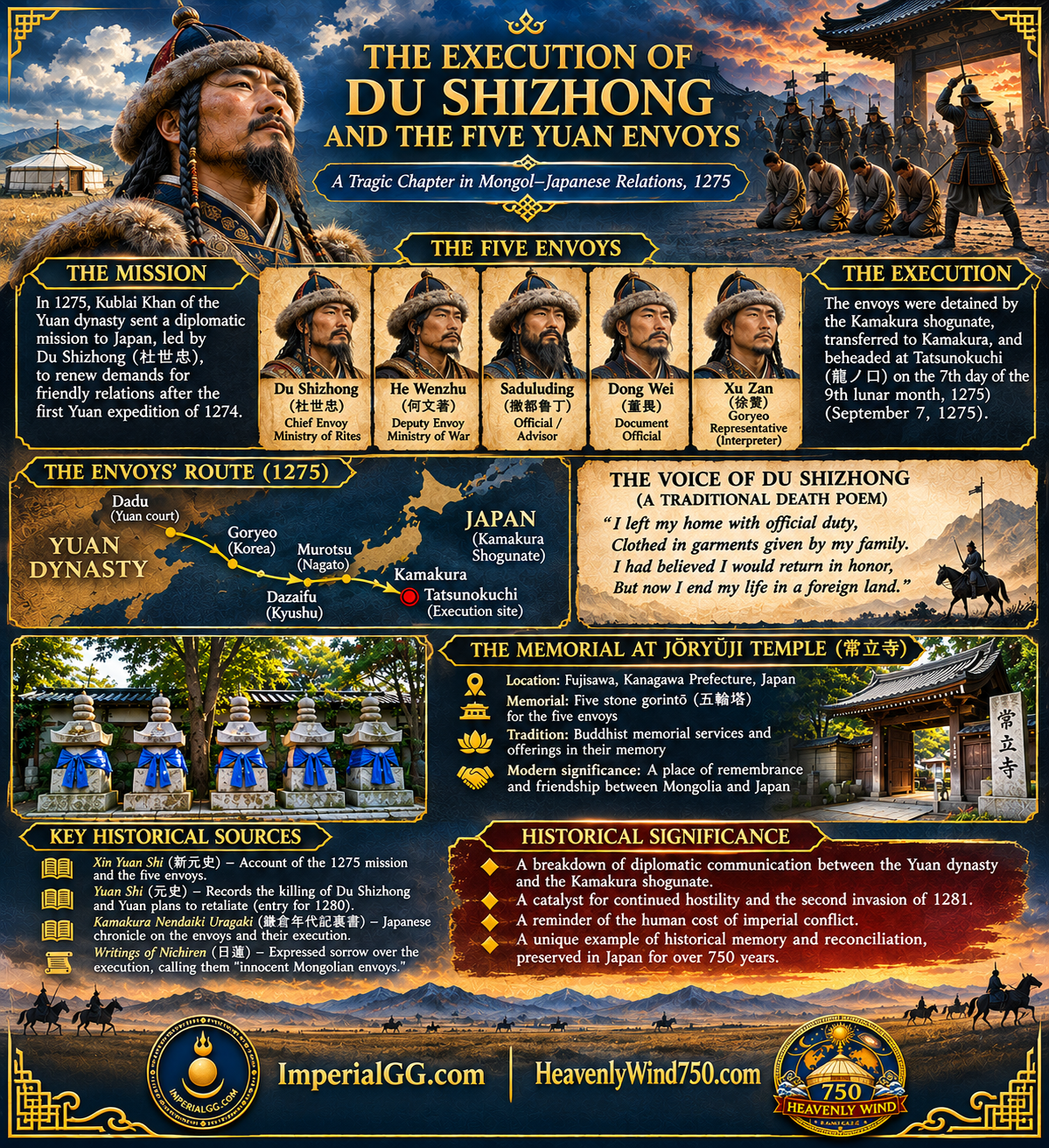
Du Shizhong, (Туушчин) the Diplomatic Mission of Kublai Khan, and the Memorial Tradition at Jōryūji Temple
ABSTRACT
In 1275, five diplomatic representatives sent by the Yuan dynasty of Kublai Khan were executed by the Kamakura military government in Japan. The mission, led by Du Shizhong (杜世忠), arrived in Japan less than a year after the first Yuan expedition of 1274. Rather than being received as diplomatic representatives, the envoys were detained, transferred to Kamakura, and ultimately beheaded at the execution ground of Tatsunokuchi.
Their deaths constitute an important episode in the diplomatic history of medieval East Asia. The event reveals the increasingly hostile relationship between the Yuan court and the Kamakura shogunate, the political consequences of the first invasion, and the precarious position of diplomatic representatives operating between competing states.
The five envoys are commemorated at Jōryūji Temple (常立寺) in Fujisawa, Kanagawa Prefecture, where five memorial stone monuments are associated with their burial and remembrance. The temple continues to preserve the memory of the envoys through Buddhist memorial observances. In September 2025, a major memorial service marked the 750th anniversary of their deaths, with participation from representatives of Mongolia.
This article examines the mission through Yuan historical records, Japanese chronicle traditions, modern scholarship, and evidence of the continuing memorial practice. It argues that the execution of the five envoys was not merely an isolated act of wartime violence. It became a lasting symbol of the destruction of diplomatic communication, the human consequences of imperial conflict, and the possibility of historical reconciliation through remembrance.
Keywords: Du Shizhong; Yuan dynasty; Kublai Khan; Mongol Empire; diplomatic history; Goryeo; Kamakura shogunate; Hōjō Tokimune; Jōryūji Temple; Tatsunokuchi; 1275.
1. INTRODUCTION: WHEN DIPLOMACY ENDED IN EXECUTION
The first Yuan expedition against Japan in 1274 did not end the diplomatic confrontation between Kublai Khan and the Japanese military government. Instead, the campaign was followed by another attempt to establish communication.
In 1275, a diplomatic mission carrying an imperial communication from the Yuan court arrived in Japan. Its principal representative was Du Shizhong, an official of the Yuan Ministry of Rites. The mission included other officials and a Goryeo representative who assisted with communication and navigation.
The Japanese authorities did not accept the mission as an opportunity to reopen diplomatic relations. The envoys were detained, transferred through Japanese administrative authorities, and eventually brought to Kamakura.
In the ninth month of 1275, five members of the mission were executed at Tatsunokuchi, in present-day Fujisawa, Kanagawa Prefecture. The incident became one of the most tragic episodes in the diplomatic relationship between the Yuan dynasty and Japan.
The significance of this event extends beyond the fate of five individuals. Their execution illustrates the transformation of diplomatic communication into a matter of military security and political confrontation.
The historical memory of the five envoys has survived in an unusual way. At Jōryūji Temple, their memorial is preserved through five stone monuments, Buddhist observances, and visits by Mongolian representatives and sumo wrestlers.
This article investigates both the thirteenth-century event and its later commemoration.
2. THE POLITICAL CONTEXT: AFTER THE FIRST INVASION OF 1274
The execution of the envoys must be understood within the political circumstances following the first Yuan expedition against Japan.
In October 1274, a Yuan-led force involving personnel from the Yuan state and Goryeo attacked Tsushima, Iki, and the Hakata Bay region of northern Kyushu.
The expedition withdrew without establishing permanent control over Japan. The reasons for its withdrawal remain a subject of historical debate, involving Japanese resistance, operational difficulties, maritime conditions, and the condition of the expeditionary fleet.
Kublai Khan did not abandon the objective of establishing relations with Japan.
The National Archives of Japan documents the diplomatic exchanges that preceded the invasions. Kublai’s earlier communications had requested friendly relations while also indicating the possibility of military force if Japan refused. The Japanese authorities did not provide the response expected by the Yuan court.
Our History through Archival Records+1
The mission of 1275 therefore arrived in a political environment shaped by:
The failure of earlier diplomatic initiatives.
The military confrontation of 1274.
Japanese fears of another invasion.
The Yuan court’s continuing demand for a response.
The Kamakura government’s determination to maintain its military position.
It is important not to assume that the 1275 mission had only one purpose. Some modern interpretations emphasize the possibility of renewed military pressure, while others consider diplomatic recognition, political submission, and the establishment of relations. The original letter carried by the mission is not preserved in its complete original form, which limits certainty about its precise wording.
3. THE FIVE ENVOYS: IDENTITIES AND HISTORICAL RECORDS
The mission was led by Du Shizhong (杜世忠), an official of the Yuan Ministry of Rites.
The New Yuan History (Xin Yuan Shi, 新元史), compiled by Ke Shaomin in the early twentieth century, gives a detailed account of the mission. It identifies the five executed representatives as follows:
Name | Chinese characters | Position or function |
|---|---|---|
Du Shizhong | 杜世忠 | Chief envoy; Ministry of Rites |
He Wenzhu | 何文著 | Deputy envoy; Ministry of War |
Saduluding | 撒都鲁丁 | Planning or advisory official |
Dong Wei | 董畏 | Letter and document official |
Xu Zan | 徐贊 | Goryeo representative and interpreter |
The spellings of several names vary across Chinese, Japanese, Korean, and modern transliteration traditions. The names above follow the forms found in the cited historical text.
Chinese Text Project+1
3.1 A multinational diplomatic mission
The composition of the mission is particularly important.
It was not made up exclusively of ethnic Mongols. It represented the administrative and diplomatic world of the Yuan dynasty, which governed a vast and culturally diverse territory.
Du Shizhong represented the Yuan imperial administration. He Wenzhu was associated with the former Southern Song administrative world, while the mission also included a Goryeo representative.
This composition reflects the wider character of the Yuan state. Its diplomatic activities relied on officials and intermediaries from different regions and political backgrounds.
The execution of the five therefore affected more than a single ethnic or national group. It involved representatives of the multinational imperial system established under Kublai Khan.
3.2 The historical significance of their names
The names of the five envoys should be preserved carefully rather than replaced with a general description such as “five Mongolian ambassadors.”
Their individual identities demonstrate the diversity of the mission. The inclusion of Xu Zan, a Goryeo official, is particularly important because it shows that the diplomatic relationship between Japan and the Yuan state continued to involve the Korean Peninsula.
The mission was therefore a diplomatic operation crossing several political and cultural boundaries.
4. THE JOURNEY TO JAPAN AND THE DETENTION OF THE MISSION
According to the account preserved in the New Yuan History, the mission departed in the second lunar month of 1275. It traveled through Goryeo and reached the coast of Nagato Province in the fourth lunar month.
The Japanese and later Chinese historical traditions describe the envoys arriving at Murotsu, in present-day Yamaguchi Prefecture. They were subsequently transferred to Dazaifu, the major administrative and military center responsible for Kyushu.
In the eighth lunar month, the mission was transferred toward Kamakura.
The sequence can be summarized as follows:
The diplomatic mission, 1275
Second lunar month — Yuan court
Kublai Khan dispatches the diplomatic mission led by Du Shizhong.
Third lunar month — Goryeo
The mission reaches Goryeo and receives assistance from local officials and maritime personnel.
Fourth lunar month — Nagato
The envoys arrive at Murotsu, in present-day Yamaguchi Prefecture.
Following months — Dazaifu
Japanese authorities detain the mission and transfer it to the administrative center in Kyushu.
Eighth lunar month — Kamakura
The five principal representatives are transferred to the seat of the Kamakura military government.
Ninth lunar month — Tatsunokuchi
The five envoys are executed.
Chronology reconstructed from the New Yuan History and Japanese chronicle traditions. Lunar dates are retained where precise conversion has not been independently established.
The route demonstrates that the mission did not immediately proceed to the Japanese capital. Instead, it passed through a series of military and administrative authorities.
This process is significant because the envoys were no longer treated as ordinary diplomatic visitors. Their movements were controlled by the Japanese military government.
The surviving records do not establish every detail of the negotiations or interrogations that took place during their detention. Such details should not be invented to fill gaps in the historical narrative.
5. THE EXECUTION AT TATSUNOKUCHI
In the ninth lunar month of 1275, the five envoys were beheaded at Tatsunokuchi (龍ノ口), a place associated with executions during the Kamakura period.
The event is traditionally dated to the seventh day of the ninth month. The Japanese memorial tradition recognizes September 7 as the anniversary date.
The execution was ordered under the authority of the Kamakura military government, headed by the regent Hōjō Tokimune (北条時宗).
This was not an ordinary battlefield death. The five men had arrived as representatives of a foreign government carrying an official communication.
Their execution raises an important question in the history of diplomacy: what happens when a state treats diplomatic representatives not as channels of communication but as instruments of an enemy’s military and political strategy?
5.1 The political decision of Hōjō Tokimune
The decision to execute the envoys must be examined in the context of the Kamakura government’s security concerns.
Japan had experienced a major military attack only months earlier. The possibility of another expedition was real, and the shogunate had reason to regard Yuan diplomatic pressure with suspicion.
The mission’s communication may have been interpreted as a demand for submission or as a warning of renewed military action.
However, the surviving evidence does not permit us to reconstruct the private deliberations of Hōjō Tokimune with certainty.
It is therefore more accurate to state that the execution reflected the Kamakura government’s refusal to accept the Yuan diplomatic initiative and its decision to respond through coercive military authority.
5.2 Diplomatic consequences
The execution removed the possibility of a negotiated response through this particular mission.
The Yuan Shi contains a later record, under the year 1280, stating that Japanese authorities had killed Du Shizhong and that Yuan commanders sought permission to punish Japan. This is an important example of how the Yuan court’s historical record preserves the event from a different chronological perspective.
History Database+1
The Japanese tradition, by contrast, places the execution in 1275.
This difference requires careful attention. It may reflect the date of the event in one tradition and the date when the Yuan court recorded or acted upon the news in another. It should not be used to shift the execution itself to 1280 without further evidence.
6. THE VOICE OF THE EXECUTED: POEMS AND THE MEMORY OF DU SHIZHONG
One of the most moving elements of the memorial tradition is the death poem attributed to Du Shizhong.
According to the account published by Nippon.com, a stone inscription at Jōryūji preserves a poem associated with the final moments of the chief envoy.
The poem refers to his departure from home, the clothing given to him by his family, and the expectation that he would return after completing his diplomatic mission.
Its central image is that of a man who leaves his family expecting to return with the honor of a successful diplomatic assignment.
Instead, he died in a foreign country.
The poem is significant because it changes the historical perspective. The envoys are no longer simply representatives of an imperial government. They become individuals with families, expectations, responsibilities, and lives interrupted by political conflict.
Nippon+1
6.1 The poem as a historical source
The poem should nevertheless be treated with source criticism.
The surviving memorial inscription and modern accounts preserve a tradition attributed to Du Shizhong. The exact textual transmission, original manuscript form, and wording should be checked against the earliest available documentary evidence before treating every modern translation as definitive.
This distinction does not diminish its historical value. It identifies the difference between the historical event and the later memorial tradition through which the event has been remembered.
7. NICHIREN AND THE MORAL QUESTION OF EXECUTING ENVOYS
An important Japanese religious voice associated with the event was Nichiren (日蓮, 1222–1282), the Buddhist teacher and founder of Nichiren Buddhism.
According to the account discussed by Nippon.com, Nichiren expressed sorrow over the execution of the Yuan envoys and referred to them as innocent Mongolian messengers.
The phrase cited in the article is:
「科なき蒙古の使の首をはねられ候ける事こそ不憫に候へ」
The meaning is approximately:
“How pitiable it is that the heads of innocent Mongolian envoys were cut off.”
This statement is important because it demonstrates that opposition to the execution existed within Japan itself.
Nichiren was not a representative of the Yuan court. He was a Japanese religious figure who had repeatedly criticized the Kamakura government. His position therefore offers an internal Japanese perspective on the moral consequences of the execution.
Nippon
The episode also demonstrates that medieval political and religious perspectives were not necessarily identical. Even during a period of intense military fear, some voices recognized the distinction between an enemy state and the individual people sent to communicate with it.
8. JŌRYŪJI TEMPLE: THE FIVE MEMORIAL TOWERS
The five envoys are commemorated at Jōryūji Temple (常立寺), a Nichiren Buddhist temple in Katase, Fujisawa City, Kanagawa Prefecture.
The memorial is known as the Genshi Gonin-zuka (元使五人塚), meaning the memorial mound or monument of the five Yuan envoys.
The temple’s memorial tradition associates the five men with burial at this site after their execution at Tatsunokuchi.
The five monuments are constructed in the form of gorintō (五輪塔), traditional Japanese Buddhist five-element memorial stupas.
Each structure consists of five symbolic forms representing:
Earth (地) — the material foundation.
Water (水) — fluidity and life.
Fire (火) — transformation.
Wind (風) — movement and breath.
Void or space (空) — the immaterial or transcendent dimension.
These five elements are part of Japanese Buddhist memorial symbolism. They should not be interpreted as a direct representation of the five envoys’ ethnic or political identities.
8.1 The blue cloth
One visually striking feature of the memorial is the blue cloth wrapped around the stone monuments.
According to Nippon.com, the practice became associated with the visit of former Mongolian sumo champion Hakuhō, who asked that blue cloth be placed on the memorial as a symbol of respect and honor.
Blue has a special place in Mongolian cultural symbolism, particularly in associations with the eternal blue sky. The cloth therefore provides a visible connection between contemporary Mongolian remembrance and a historical event that took place more than seven centuries ago.
The meaning of the blue cloth in this specific memorial should be distinguished from the much older Buddhist symbolism of the five-element towers. The former is part of a modern commemorative practice; the latter belongs to the traditional religious form of the monuments.
Nippon
9. THE MEMORIAL TRADITION: FROM HISTORICAL GRIEF TO INTERNATIONAL RECONCILIATION
The memorial at Jōryūji is not simply an archaeological or historical marker. It is an active place of remembrance.
A major documented event took place on April 12, 2024, when thirteen Mongolian-born sumo wrestlers, including Yokozuna Terunofuji, as well as other prominent wrestlers and Mongolia’s ambassador to Japan, visited the temple and participated in memorial observances.
The event demonstrated the continuing connection between the historical memory of the five envoys and contemporary Mongolian-Japanese relations.
Nippon+1
9.1 The 750th anniversary in 2025
On September 7, 2025, the 750th anniversary of the envoys’ execution was commemorated at Jōryūji.
The memorial service was attended by members of the Mongolian diplomatic community in Japan and representatives of the temple. Prayers were offered for the five envoys, for friendship between Mongolia and Japan, and for world peace.
This event is documented in a report published by Web Fujisawabito on September 7, 2025.
WEBふじさわびと
The 2024 and 2025 events establish that memorial observances continue in the present day. However, the available documentation does not by itself prove that an identical public ceremony has taken place every single year since the thirteenth century. It is more accurate to describe this as an ongoing memorial tradition, with documented contemporary commemorations.
9.2 A place beyond national hostility
The significance of Jōryūji is particularly evident in the words attributed to its current head priest, Kōji Hattori.
In the 2024 Nippon.com report, the priest describes the five envoys as messengers caught between the political authorities of two states.
This interpretation shifts attention away from national rivalry and toward the human consequences of political decisions.
The temple has become a place where the memory of people once treated as representatives of an enemy state can be honored across national boundaries.
Nippon+1
10. THE MEMORIAL’S HISTORY IN THE TWENTIETH CENTURY
The present memorial tradition also has a modern history.
According to Nippon.com, a major memorial monument was erected at Jōryūji in 1925 by the temple’s twenty-third head priest, Nisshō.
This was a complicated historical period. Japan had entered an era of growing militarism, and the memory of a former enemy was not always easy to commemorate publicly.
The report notes that the memorial tradition may have encountered social difficulties in a climate in which public sympathy toward people from a former enemy country could be viewed unfavorably. The current priest emphasizes the importance of recognizing the five men as human beings rather than simply as representatives of a hostile state.
Nippon
This twentieth-century development is important because it demonstrates that historical memory is not static. It changes according to the political and cultural conditions of each generation.
The memorial at Jōryūji therefore preserves two histories:
The thirteenth-century history of the five envoys and their execution.
The modern history of remembrance, religious observance, and reconciliation.
11. HISTORICAL INTERPRETATION: WHAT DOES THE EXECUTION TELL US?
The execution of the five envoys raises several important historical questions.
11.1 Was the mission diplomatic or coercive?
The Yuan mission carried an official communication from Kublai Khan. The precise contents of the original letter are not fully preserved.
Some modern interpretations suggest that the mission was intended to pressure Japan into accepting Yuan authority. Others emphasize the possibility that Kublai sought political recognition, regional stability, or the establishment of commercial and diplomatic relations.
The evidence does not justify reducing the mission to a single purpose.
The most defensible conclusion is that it was an official Yuan diplomatic initiative conducted in an atmosphere of military confrontation.
11.2 Did the execution contribute to the second invasion?
The execution intensified the political hostility between the Yuan court and Japan.
The Yuan historical record later refers to the killing of Du Shizhong and the desire of Yuan commanders to retaliate. The execution therefore became part of the diplomatic and military context leading toward the second invasion of 1281.
History Database+1
However, it would be inaccurate to claim that the execution alone caused the second invasion. The Yuan court’s strategic objectives, the unfinished conquest of Southern Song, regional political calculations, and the continuing dispute with Japan were all relevant.
11.3 Why does the event matter today?
The historical significance of the five envoys lies in the intersection of diplomacy, warfare, and human experience.
Their deaths demonstrate that diplomatic representatives could become victims of conflicts beyond their control. Their later commemoration shows that the memory of such events can also become a foundation for reconciliation.
The history of the five envoys is therefore relevant not only to Mongolian and Japanese history but also to the wider history of diplomacy and international relations.
12. CONCLUSION: FIVE ENVOYS, SEVEN AND A HALF CENTURIES OF MEMORY
The execution of Du Shizhong and the four other members of the Yuan diplomatic mission in 1275 was a tragic consequence of the confrontation between the Yuan dynasty and the Kamakura shogunate.
The mission had been sent after the first Yuan expedition of 1274, when Kublai Khan continued to seek a response from Japan. Instead of achieving a diplomatic settlement, the five representatives were detained and executed at Tatsunokuchi.
Their story reveals the complex character of medieval East Asian diplomacy. The mission was multinational, the political authorities were divided, and the diplomatic process operated under the pressure of military conflict.
The memorial at Jōryūji Temple preserves the memory of these five individuals beyond the political boundaries that once separated their governments.
The five gorintō monuments, the blue cloth, the memorial poems, and the continuing Buddhist observances connect the thirteenth-century event with contemporary Mongolia-Japan relations.
The 750th anniversary commemoration in 2025 demonstrated that the historical memory of the envoys remains meaningful today.
For Mongolian historical research, this episode deserves particular attention. It provides an opportunity to examine the lives of Yuan officials, the diplomatic institutions of Kublai Khan’s government, the role of Goryeo intermediaries, and the ways in which Mongolian historical memory is preserved outside Mongolia.
Ultimately, the five envoys should not be remembered only as victims of a political confrontation. They should also be studied as individuals who carried the responsibility of communication between two states during a period when diplomacy was increasingly overshadowed by war.
Seven and a half centuries later, their memorial reminds us that political conflicts may divide nations, but historical remembrance can create a place for mutual respect and reconciliation.
AUTHOR’S THESIS
The execution of the five Yuan envoys in 1275 represents a critical moment in the diplomatic history of the Mongol-Yuan relationship with Japan. It demonstrates how diplomatic communication became subordinated to military security and political confrontation in medieval East Asia.
The continuing memorial at Jōryūji Temple offers a second historical dimension: the transformation of a tragedy into a tradition of remembrance.
The five envoys were sent by an empire, detained by a military government, and executed in a foreign land. Today, their memory is preserved through religious observance and international friendship.
The history of the five envoys is not only a story of diplomatic failure. It is also a history of how societies remember the human cost of conflict.
REFERENCES AND PRIMARY SOURCES
Primary and historical records
1. Yuan Shi (元史), Volume 208, biographies and foreign relations. The Yuan dynasty’s historical account of the Japanese killing of Du Shizhong and the subsequent response of Yuan commanders.
Korean History Database – Yuan Shi, Volume 208
2. Xin Yuan Shi (新元史), Volume 250, biography concerning Japan. Compiled by Ke Shaomin (柯劭忞). Contains the detailed account of the 1275 mission, its route, and the five executions.
Chinese Text Project – New Yuan History, Volume 250
3. Kamakura Nendaiki Uragaki (鎌倉年代記裏書), completed in 1332. A Japanese chronicle tradition cited in modern research for the mission’s arrival and the execution date. See the discussion in Morris, below.
4. Nichiren (日蓮), writings concerning the Mongol envoys. The statement mourning the execution of innocent Mongolian messengers is discussed in the modern historical report cited below.
5. National Archives of Japan. “Japan and Mongolia: A History of Exchanges.”
National Archives of Japan – Historical Documents
Modern scholarship and research
6. Morris, James. “Some Reflections on the First Muslim Visitor to Japan.” American Journal of Islamic Social Sciences 35, no. 3. The study compares Yuan and Japanese historical traditions concerning the 1275 mission and discusses the identities and chronology of the envoys.
7. “The Tragedy of the Yuan Envoys: The Temple Where Mongolian Sumo Wrestlers Visit to Pay Their Respects.” Nippon.com, April 12, 2024.
Read the illustrated historical report
8. Web Fujisawabito. “Remembering the Yuan Envoys Executed in a Foreign Land: Memorial Service at Jōryūji and Reflections on World Peace.” September 7, 2025.
Read the 750th-anniversary memorial report
9. Web Fujisawabito. “Jōryūji Temple: Its Priest and Community.” September 6, 2025.
Read the temple and memorial background
10. Town News Fujisawa. “Mongolian Sumo Wrestlers Visit the Five Envoys’ Memorial at Jōryūji.” March 1, 2024.
11. Town News Fujisawa. “Mongolian Wrestlers Visit Jōryūji: Seven Years Since the Previous Memorial Visit.” April 10, 2015.
PHOTOGRAPHIC AND HISTORICAL IMAGE COLLECTION
These images are particularly suitable for placing directly into the ImperialGG article, with their original source credits.
1. The Five Envoys’ Memorial at Jōryūji
Photographic documentation of the five stone memorial towers.
2. Mongolian Sumo Wrestlers Paying Their Respects, 2024
A contemporary photograph documenting the memorial visit.
3. The 750th Anniversary Memorial, 2025
Photographic documentation of the anniversary observance.
4. The Mōko Shūrai Ekotoba
A thirteenth-century visual source for the military and political context of the envoys’ mission.
5. Tatsunokuchi Historical Site
The execution site associated with the five envoys, distinct from their memorial at Jōryūji.
Image-use note: The image previews above are visual references. Before publication, confirm each original image’s photographer, institution, reproduction rights, and exact caption. The Nippon.com and Web Fujisawabito photographs should be credited to their respective photographers or publishers, not presented as ImperialGG photographs.
FINAL SOURCE-CRITICAL NOTES
There are three issues that should remain explicit in the final publication:
1. The 1275 versus 1280 dating discrepancy: Japanese chronicle traditions and the New Yuan History place the execution in 1275, while the Yuan Shi contains a 1280 entry reporting the killing. The date of the execution and the date of its later reporting must not be confused.
2. The five names: Transliteration varies. The identities and titles should be checked against the Chinese text and Japanese records before printing a definitive biographical list. The New Yuan History is a later compilation, not a contemporary eyewitness account.
3. The annual memorial claim: Contemporary reports establish ongoing memorial observances, including the 2024 visit and the September 2025 750th-anniversary service. They do not establish an uninterrupted annual public ceremony dating back to 1275. The article therefore describes a continuing memorial tradition, not an unbroken annual ritual.
ImperialGG.com | Heavenly Wind 750 International Conference
Research direction: The next valuable step is to obtain the full original Chinese text of the relevant Yuan records and the earliest Japanese chronicle passage, then prepare a parallel-text appendix with Chinese characters, transliteration, English translation, and exact source references.