
THE HISTORICAL IMAGINATION, NATIONAL CONSCIOUSNESS, AND LITERARY MODERNITY OF NINETEENTH-CENTURY MONGOLIA
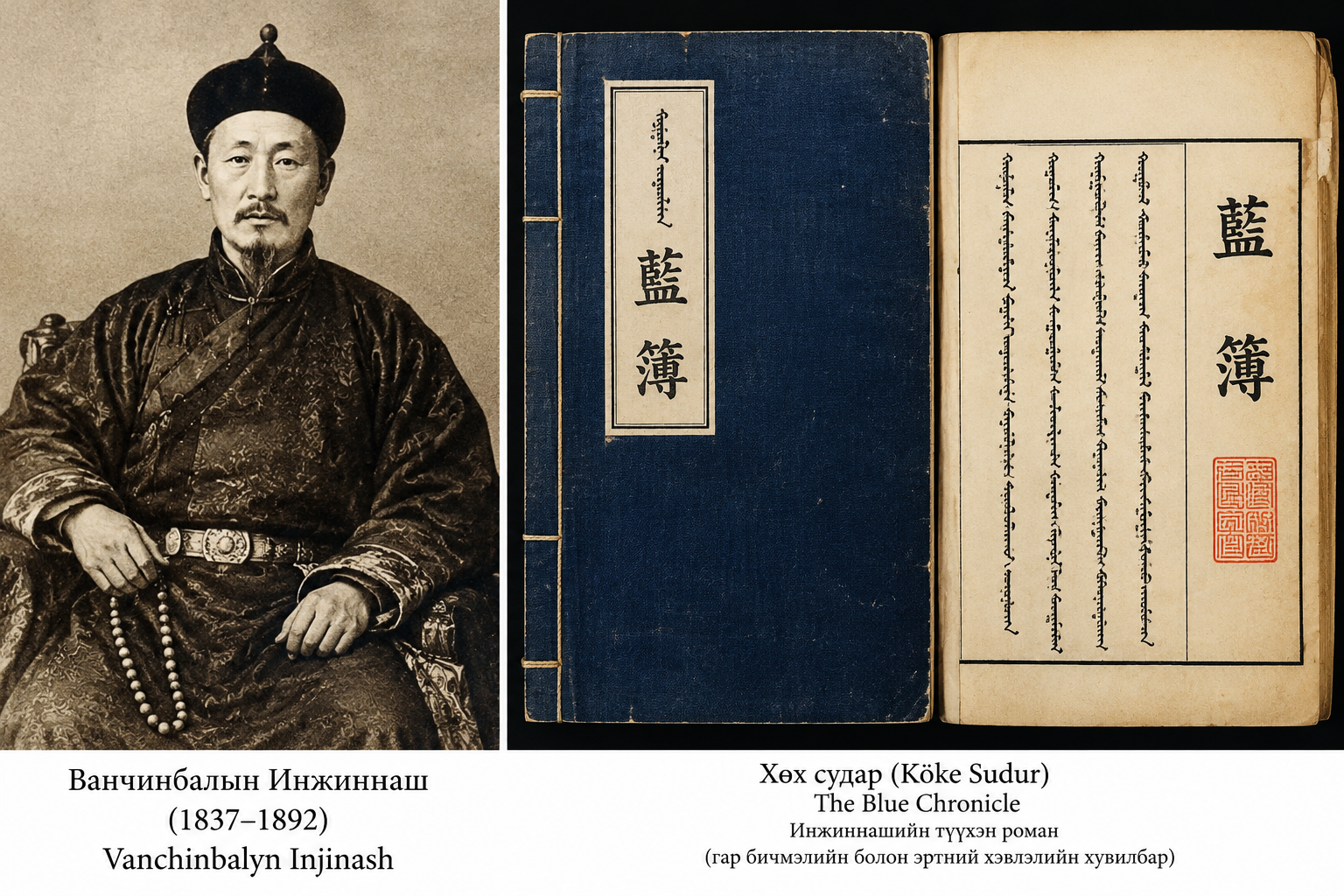
VANCHINBALYN INJINASH
ABSTRACT
Vanchinbalyn Injinash (1837–1892) occupies a significant place in the history of Mongolian literature as a novelist, poet, and intellectual whose works connected historical memory, literary creativity, and reflections on society. Writing in the nineteenth century in the Mongolian communities of southern Manchuria, Injinash developed a literary vision shaped by Mongolian historical traditions and the wider East Asian written-literary environment. His best-known work, Köke Sudur (The Blue Chronicle), is a major historical narrative associated with the rise and rule of the Mongol Empire. His other important novels, Nigen Dabqur Asar (The One-Storey Pavilion) and Ulaɣan-a Ukilaqu Tingkim (The Chamber of Red Tears), explore human relationships, social conventions, personal suffering, and moral questions.
This article examines Injinash’s historical imagination, his literary relationship with earlier Mongolian traditions, the influence of Chinese narrative literature, and his significance for the development of Mongolian prose. It argues that his contribution should be understood not simply through the historical subjects he selected, but also through the way he transformed inherited traditions into an instrument of literary and historical reflection.
Keywords: Vanchinbalyn Injinash, Köke Sudur, Mongolian literature, historical novel, Chinggis Khan, Mongolian historical consciousness, Inner Mongolia, literary exchange.
I. INTRODUCTION
The nineteenth century was a consequential period in the intellectual and literary history of the Mongolian world. Mongolian writers and scholars continued to preserve historical narratives, genealogical knowledge, religious literature, poetry, and oral traditions while also participating in a multilingual literary environment shaped by Mongolian, Chinese, and Manchu cultural institutions.
Within this context, Vanchinbalyn Injinash emerged as one of the most important Mongolian literary figures of his generation. His works combined historical subject matter with sustained attention to human character, ethical conduct, social relationships, and the meaning of collective memory.
Injinash is especially important because his literary production demonstrates that Mongolian intellectual life in the nineteenth century cannot be understood exclusively through religious scholarship, administrative writing, or the preservation of older chronicles. Literary fiction also became a means of interpreting the past and examining contemporary society.
His historical novel Köke Sudur, often translated as The Blue Chronicle or The Blue Book of the Yuan Empire, represents this development particularly clearly. Its narrative engages with the historical world of the Mongol Empire and the legacy of Chinggis Khan. His social novels, meanwhile, demonstrate his interest in the relationship between individual experience and the social structures within which people lived.
The central question of this article is therefore: How did Injinash transform Mongolian historical traditions and literary resources into a distinctive form of nineteenth-century historical and social consciousness?
II. HISTORICAL AND INTELLECTUAL BACKGROUND
2.1. Family and literary environment
Vanchinbalyn Injinash was born in 1837 into a Mongolian noble family in the Tümed Right Banner region of what is now Liaoning Province, northeastern China. His father, Vanchinbal (1795–1847), was a Mongolian nobleman and literary figure who wrote poetry and began the historical narrative subsequently continued by his son.
The family’s intellectual environment was multilingual. Knowledge of Mongolian and engagement with Chinese and Manchu written traditions formed part of the broader cultural circumstances in which elite Mongolian literary production developed.
This background matters because Injinash’s writing cannot be adequately classified as either an isolated continuation of indigenous Mongolian literature or a simple imitation of Chinese fiction. His works emerged through interaction among different literary traditions, while retaining distinctly Mongolian historical subjects and cultural references.
According to the bibliographic and literary scholarship on Injinash, his father’s contribution to Köke Sudur is particularly important: the first eight chapters are attributed to Vanchinbal, while Injinash continued and substantially developed the work.
The novel should consequently be approached as a multigenerational literary undertaking rather than as an entirely independent creation by a single author.
2.2. Mongolian society under the Qing dynasty
Injinash lived during the Qing dynasty, when Mongolian communities were incorporated into an imperial administrative order that governed extensive territories across Inner Asia.
Mongolian noble families, Buddhist institutions, literary networks, and local communities operated within this political framework. Their experiences were not uniform, and the circumstances of Mongolian society differed by region, status, and economic position.
For a writer such as Injinash, historical memory could provide a way to reflect on questions of political authority, social organization, cultural continuity, and the relationship between the past and the present.
His interest in the Mongol Empire should not automatically be interpreted as evidence of a modern nationalist ideology in the twentieth-century sense. Rather, his writing can be examined as an expression of historical consciousness within the intellectual and political conditions of nineteenth-century Mongolian society.
This distinction is essential to a historically responsible interpretation of his work.
III. KÖKE SUDUR: THE MONGOL EMPIRE AS A LITERARY SUBJECT
3.1. The historical novel
Köke Sudur is Injinash’s best-known literary work and one of the major historical narratives in the Mongolian written tradition.
The work takes the Mongol Empire and the age associated with Chinggis Khan as its central historical horizon. Through its narrative, the imperial past becomes a subject of literary reconstruction rather than merely a sequence of events recorded in a chronicle.
Its importance lies in the relationship it establishes between historical events, political leadership, human character, and the moral interpretation of power.
The novel belongs to a wider tradition of historical writing in which the past is used to examine questions relevant to the author’s own time. However, its literary form distinguishes it from conventional annalistic chronicles: characterization, descriptive passages, figurative language, and narrative organization become important instruments for presenting historical experience.
The work’s title is commonly rendered in English as The Blue Chronicle or The Blue Book of the Yuan Empire. These translations reflect different approaches to conveying the Mongolian title and should not be mistaken for evidence that the work was originally composed as a modern historical textbook.
3.2. Historical memory and political authority
The figure of Chinggis Khan occupies a central place in the broader historical imagination associated with Köke Sudur. Yet the significance of the novel extends beyond the representation of a single ruler.
The Mongol imperial past provides a framework for considering political leadership, collective action, the ordering of society, and the relationship between personal conduct and public responsibility.
In this respect, the novel can be read as an attempt to make historical experience intelligible through narrative. The past becomes a field in which the conduct of leaders and communities can be represented, compared, and evaluated.
Nevertheless, a careful analysis must distinguish the historical Mongol Empire from its literary representation. A nineteenth-century novel written centuries after the events it describes cannot be treated as an independent eyewitness source for the thirteenth century.
Its historical value operates on two levels: it contributes to the study of Mongolian literary representations of the imperial past, and it provides evidence for how that past was interpreted in the nineteenth century.
This distinction does not diminish the novel’s importance. Instead, it clarifies the different questions historians and literary scholars can ask of it.
3.3. A multigenerational literary project
The role of Vanchinbal in the origins of Köke Sudur requires particular attention. If the first eight chapters were written by Injinash’s father, as reported in the literary scholarship, the novel embodies a process of transmission and transformation across generations.
Injinash inherited an unfinished literary undertaking and developed it within his own intellectual and artistic framework.
This relationship illustrates how historical narratives can preserve continuity while undergoing reinterpretation. The work is neither simply a relic inherited from the past nor an entirely new construction detached from earlier writing. It represents the interaction between inherited material and a later author’s creative decisions.
The relationship between father and son is therefore part of the literary history of the novel itself.
IV. LITERARY FORM AND THE DEVELOPMENT OF MONGOLIAN PROSE
4.1. Narrative description and characterization
Research on the literary language of Köke Sudur identifies descriptive narration, character portraits, metaphors, comparisons, and epithets as important features of Injinash’s prose. Natural scenery is also connected with the emotional atmosphere of characters and events.¹
These techniques help create a narrative world in which historical action is accompanied by reflection on human experience.
Rather than presenting people solely through their political positions or public deeds, descriptive writing can give attention to their appearance, emotional states, relationships, and responses to circumstances.
This approach strengthens the connection between historical narrative and literary characterization. Historical figures become participants in a structured narrative rather than names appearing only in a sequence of events.
The use of natural imagery also deserves attention. Landscape can function not merely as a geographical setting but as a means of establishing mood, emphasizing contrasts, and connecting human experience with the surrounding world.
4.2. Literary language and cultural continuity
Injinash’s prose demonstrates the creative potential of written Mongolian in a period when Mongolian writers also encountered established Chinese literary forms.
His achievement should therefore be examined through the specific qualities of his language, the organization of his narrative, and his adaptation of inherited literary conventions.
It is important not to assume that the development of Mongolian prose simply followed a linear progression from oral storytelling to modern fiction. Mongolian literary culture already possessed rich written, poetic, historical, religious, and oral traditions. Injinash’s work emerged from their interaction.
His writing provides an important case for studying how these resources could be reorganized into extended prose narratives that addressed historical and social subjects.
V. CHINESE LITERARY INFLUENCE AND MONGOLIAN CREATIVE AGENCY
5.1. Literary exchange in nineteenth-century Inner Asia
Injinash’s novels developed within a literary environment in which Chinese fiction circulated widely and provided narrative models, themes, and techniques.
Scholars have identified relationships between Nigen Dabqur Asar and the Chinese novel Honglou meng (Dream of the Red Chamber), as well as connections between Köke Sudur and Chinese historical fiction, including Sanguo yanyi (Romance of the Three Kingdoms).²
These relationships are important for understanding the transregional character of literary culture in nineteenth-century Inner Asia.
Literary exchange did not necessarily mean direct translation in every instance. Authors could borrow narrative structures, adapt episodes, rework familiar themes, or transform elements of another literary tradition for a different audience.
The precise nature of these relationships must be established through textual comparison rather than inferred from general cultural proximity.
5.2. Influence is not the same as imitation
The identification of Chinese literary influence raises a methodological question: how should scholars evaluate a Mongolian work that draws on a foreign literary model?
The answer requires distinguishing between literary dependence and creative adaptation.
A work may employ recognizable narrative conventions while changing their language, cultural setting, social implications, and intended readership. The existence of a source relationship does not by itself establish that the resulting work lacks originality.
At the same time, cultural pride cannot substitute for textual evidence. If particular episodes or passages are closely derived from Chinese works, that relationship should be acknowledged and examined directly.
A rigorous assessment of Injinash should therefore consider both the evidence of literary borrowing and the transformations introduced in his Mongolian texts.
This approach avoids two opposite errors: treating Mongolian literature as merely derivative of Chinese literature, and denying documented cultural exchange in order to claim complete independence.
5.3. Mongolian folklore and literary tradition
Injinash’s novels also incorporate elements associated with Mongolian literary and cultural traditions. Research on Nigen Dabqur Asar and Ulaɣan-a Ukilaqu Tingkim discusses the use of riddles, proverbs, traditional customs, symbolic meanings, and motifs associated with Mongolian folklore.³
These elements are significant because they demonstrate how written fiction can draw upon cultural resources that extend beyond the printed literary text.
Proverbs and riddles can establish a recognizable cultural voice, while ritual practices and symbolic conventions can situate characters within a particular social world.
Such features also complicate any simple division between an indigenous Mongolian tradition and an imported Chinese literary form. Injinash’s writing can be understood as a site of interaction in which different resources coexist, compete, and acquire new meanings.
VI. NIGEN DABQUR ASAR AND ULAGɣAN-A UKILAQU TINGKIM: SOCIAL EXPERIENCE AND HUMAN DIGNITY
6.1. The social novel
Injinash’s other major novels, Nigen Dabqur Asar (The One-Storey Pavilion) and Ulaɣan-a Ukilaqu Tingkim (The Chamber of Red Tears), extend the scope of his literary work beyond imperial history.
These narratives focus on social relationships, personal suffering, convention, and the circumstances shaping individual lives. They reveal a writer interested not only in the political past but also in the moral and emotional dimensions of society.
Their literary significance lies partly in their ability to place private experience within a wider social framework. Individual suffering is not presented as an entirely isolated phenomenon; it can be understood in relation to family expectations, customs, social position, and the conduct of other people.
This emphasis provides a useful basis for studying the relationship between literature and social criticism in nineteenth-century Mongolian writing.
6.2. Individual experience and social convention
The social world represented in these novels raises questions about the relationship between individual desires and established expectations.
Marriage customs, interpersonal obligations, status, and the authority exercised by families and communities can shape the opportunities available to characters. Literary narratives allow these relationships to be examined through their consequences for particular human lives.
However, the novels should not be treated as straightforward documentary descriptions of all Mongolian social conditions. Fiction selects, organizes, and transforms experience according to artistic purposes.
Their value lies in the questions they raise and the social relationships they represent, which can then be studied alongside historical, ethnographic, and other literary evidence.
6.3. The relationship between the two social novels
The study of Nigen Dabqur Asar and Ulaɣan-a Ukilaqu Tingkim benefits from comparative analysis.
Both works belong to a literary environment influenced by Chinese fiction, yet they must also be examined within the development of Mongolian prose and its representations of social life.
Comparing their narrative structures, character relationships, use of cultural motifs, and treatment of suffering can help clarify Injinash’s literary methods.
Such comparison is more productive than classifying the novels solely by their sources. It enables scholars to investigate what the author retained, altered, emphasized, or reinterpreted in adapting literary material for Mongolian readers.
VII. INJINASH AND THE DEVELOPMENT OF MONGOLIAN HISTORICAL CONSCIOUSNESS
7.1. The past as an object of interpretation
Injinash’s literary achievement provides an opportunity to reconsider the relationship between historical memory and literature.
His historical novel engages with the legacy of the Mongol Empire, while his social novels address the tensions and experiences of human life. Taken together, these works reveal the breadth of his interests as a writer.
The imperial past and contemporary society are not identical subjects, but both can be examined through questions of authority, conduct, obligation, and the relationship between individuals and larger communities.
This connection is an interpretive framework rather than a claim that every part of Injinash’s writing expresses a single political program.
His historical consciousness should be reconstructed through close reading, attention to literary form, and consideration of the historical circumstances in which his works were written.
7.2. Historical memory and modern nationalism
Modern readers may interpret Köke Sudur through the later development of Mongolian national consciousness. Such readings can be meaningful, but they must be distinguished from claims about the author’s own political intentions.
The nineteenth-century Mongolian world differed from the national-state frameworks that developed in the twentieth century. Political identity, historical belonging, and cultural affiliation operated within different institutional and intellectual conditions.
Consequently, it would be anachronistic to assume that Injinash articulated modern nationalism in precisely the same terms as later Mongolian intellectuals or political movements.
A more defensible interpretation is that his work preserved and reworked Mongolian historical memory, providing later generations with a substantial literary representation of the imperial past.
The subsequent reception of that work is a separate historical subject that deserves its own investigation.
VIII. THE PUBLICATION AND RECEPTION OF INJINASH’S WORKS
Injinash’s literary legacy was not fully established through printed publication during his lifetime. His works circulated in manuscript form, and their wider publication and reception developed later.⁴
This circumstance has implications for the history of Mongolian literature.
Manuscript transmission can preserve texts while also creating challenges for establishing authoritative versions, determining textual relationships, and tracing the circulation of individual works.
The publication history of Injinash’s writings should therefore be studied alongside the history of their composition. Questions of manuscript provenance, editorial decisions, variant readings, and the chronology of publication are important for any critical edition.
His later reputation also illustrates how literary canons are formed. The recognition of a writer depends not only on the original act of composition but also on the work of editors, scholars, translators, publishers, and institutions that preserve and interpret the texts.
A comprehensive history of Injinash’s reception should examine Mongolian scholarship as well as international research, including the development of literary studies in Mongolia and Inner Asia.
IX. AUTHOR’S THESIS
Injinash’s lasting importance lies in his transformation of Mongolian historical memory and inherited literary resources into a sustained form of historical and social reflection.
Three propositions support this thesis.
First, Köke Sudur should be studied as a literary interpretation of the Mongol imperial past, not simply as a chronicle or a substitute for contemporary historical documentation. Its significance includes what it reveals about the nineteenth-century representation of Chinggis Khan and the Mongol Empire.
Second, Injinash’s engagement with Chinese fiction should be understood through a method of comparative literary analysis. Documented textual borrowing and adaptation do not automatically negate Mongolian literary agency. They make it necessary to investigate how narrative material was transformed within a Mongolian linguistic and cultural framework.
Third, his historical and social novels should be considered together. The imperial narrative and the novels of social experience represent different dimensions of his literary work, connecting questions of collective memory with questions of human conduct, social convention, and individual suffering.
On this basis, Injinash can be understood as a major figure in the development of Mongolian prose and historical imagination. His work illustrates how literary creativity can preserve cultural memory while simultaneously reinterpreting it.
X. CONCLUSION
Vanchinbalyn Injinash occupies an important position in the literary history of nineteenth-century Mongolia. Through Köke Sudur, he contributed to the literary representation of the Mongol imperial past. Through Nigen Dabqur Asar and Ulaɣan-a Ukilaqu Tingkim, he explored social relationships and the human consequences of established conventions.
His writing emerged from an intellectually complex environment shaped by Mongolian historical traditions, oral culture, written literature, and engagement with Chinese narrative forms.
The most productive interpretation of his achievement avoids reducing his work either to an exclusively national literary tradition isolated from external influences or to a derivative branch of Chinese fiction. Instead, it examines the specific ways in which literary resources were adapted and transformed in Mongolian writing.
Further research should prioritize critical editions, manuscript comparison, close textual analysis, and systematic comparison with Chinese literary sources. It should also investigate the historical reception of Injinash’s works and the ways successive generations have interpreted their significance.
Injinash’s legacy ultimately demonstrates that the history of a people’s literature is also a history of how that people remembers, interprets, and reimagines its past.
FOOTNOTES
V. Yanjindulam, “В. Инжаннашийн ‘Хөх судар’ романы уран дүрийн хэлний асуудалд” [Issues in the Literary Language of Injinash’s The Blue Chronicle], Mongolian Studies, vol. 39, no. 433 (2015), pp. 175–184. The article examines descriptive methods, character portraits, nature imagery, metaphors, comparisons, and epithets.
Boris Riftin, “Mongolian Translations of Old Chinese Novels and Stories: A Tentative Bibliographic Survey,” in Literary Migrations: Traditional Chinese Fiction in Asia, pp. 130–160. Singapore: ISEAS–Yusof Ishak Institute, 2013. This study provides context for the circulation and adaptation of Chinese fiction in Mongolian literary culture.
Kh. Nandin-Erdene, “Инжаннашийн ‘Нэгэн давхар асар’, ‘Улаанаа ухилах танхим’ хоймсон роман дахь монголын уран зохиолын уламжлалыг тодруулах нь” [Mongolian Literary Traditions in Injinash’s The One-Storey Pavilion and The Chamber of Red Tears], Mongolian Studies, vol. 46, no. 587 (2022), pp. 165–173. DOI: https://doi.org/10.22353/ms20224619.
“В. Инжинаш,” Цахим ном (E-Nom), author and literary overview. The entry discusses Injinash’s life, major works, and manuscript-based transmission. https://www.e-nom.mn/author?aid=43.
SELECTED BIBLIOGRAPHY
Primary and literary sources
Injinash, Vanchinbalyn. Köke Sudur [The Blue Chronicle / The Blue Book of the Yuan Empire]. Mongolian historical novel, begun by Vanchinbal and continued by Injinash.
Injinash, Vanchinbalyn. Nigen Dabqur Asar [The One-Storey Pavilion]. Mongolian social novel.
Injinash, Vanchinbalyn. Ulaɣan-a Ukilaqu Tingkim [The Chamber of Red Tears]. Mongolian social novel.
Secondary scholarship
Hangin, John Gombojab. Köke Sudur (The Blue Chronicle): A Study of the First Mongolian Historical Novel by Injannasi. Wiesbaden: Otto Harrassowitz, 1973.
Kh. Nandin-Erdene. “Mongolian Literary Traditions in Injinash’s The One-Storey Pavilion and The Chamber of Red Tears.” Mongolian Studies 46, no. 587 (2022): 165–173. https://doi.org/10.22353/ms20224619.
Riftin, Boris. “Mongolian Translations of Old Chinese Novels and Stories: A Tentative Bibliographic Survey.” In Literary Migrations: Traditional Chinese Fiction in Asia, 130–160. Singapore: ISEAS–Yusof Ishak Institute, 2013.
Yanjindulam, V. “Issues in the Literary Language of Injinash’s The Blue Chronicle.” Mongolian Studies 39, no. 433 (2015): 175–184.
Online research resources
National University of Mongolia, Mongolian Studies journal: https://journal.num.edu.mn/ms/
E-Nom, V. Injinash author entry: https://www.e-nom.mn/author?aid=43
UNESCO, History of Civilizations of Central Asia, volume VI, section on Mongolian literature: https://en.unesco.org/silkroad/sites/default/files/knowledge-bank-article/vol_VI%20silk%20road_literature%20in%20turkic%20and%20mongolian.pdf