
THE SECRET HISTORY OF THE MONGOLS IN INTERNATIONAL SCHOLARSHIP
PALLADIUS KAFAROV, ERICH HAENISCH, AND THE RECOVERY OF A MEDIEVAL MONGOLIAN TEXT
The Secret History of the Mongols (Mongγol-un niγuca tobčiyan) is one of the most important surviving sources for the history of the Mongol Empire. Its accounts of Chinggis Khaan, the formation of Mongol political authority, and the reign of Ögedei Khaan make it indispensable to the study of medieval Mongolia. Yet the text’s survival and introduction to international scholarship involved a complex history of Chinese transcription, translation, manuscript transmission, and philological reconstruction.
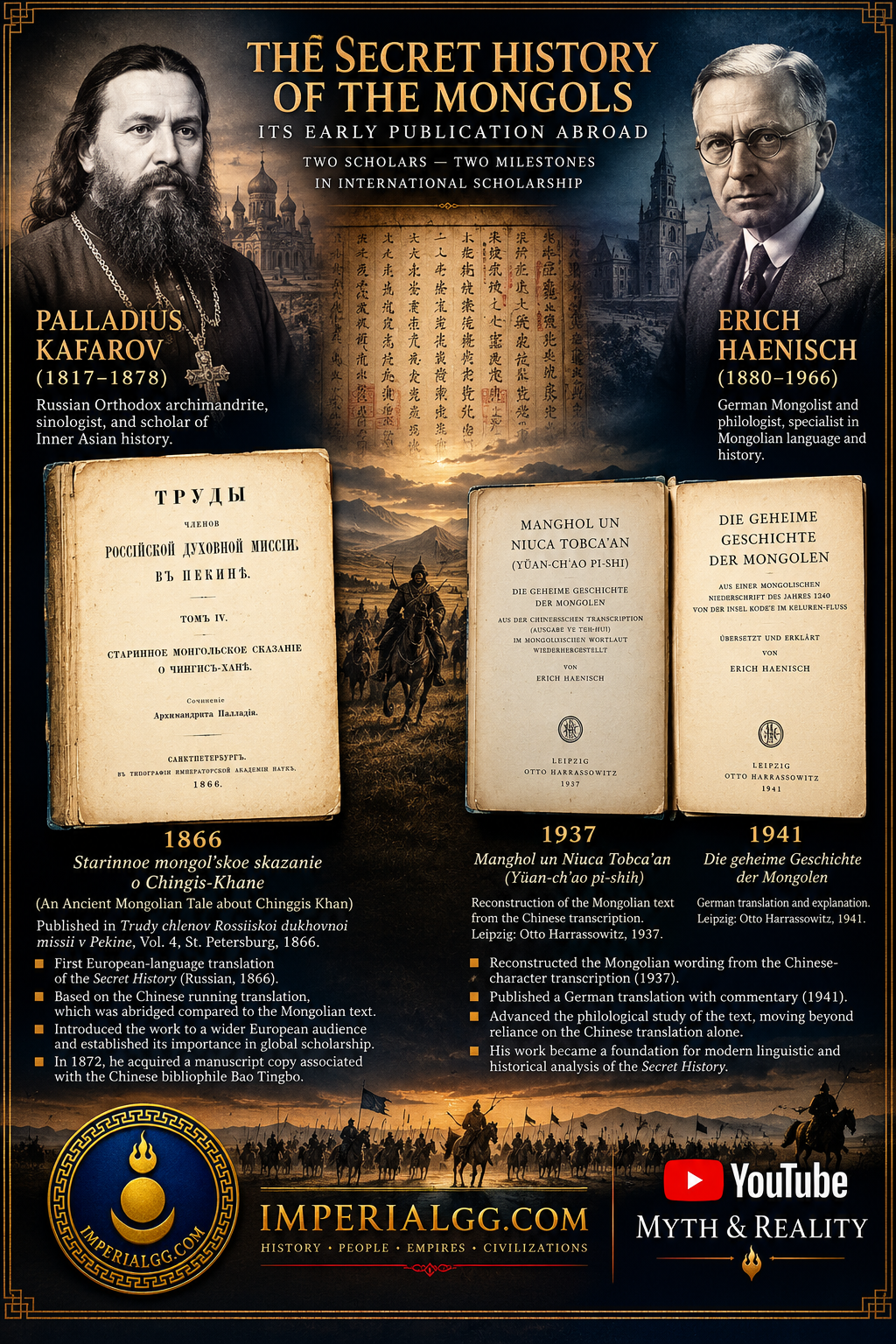
Two scholars occupy particularly important places in this history: Palladius Kafarov (1817–1878), the Russian Orthodox cleric and sinologist who published an early Russian translation in 1866, and Erich Haenisch (1880–1966), the German Mongolist who reconstructed the Mongolian wording from the Chinese-character transcription and published a critical edition in 1937, followed by a German translation in 1941.[1]
Their contributions were different. Kafarov introduced the work to a wider European scholarly audience through a Russian translation of the Chinese version. Haenisch subsequently advanced the philological reconstruction of the Mongolian text. Neither scholar discovered the work in the sense of finding a previously unknown book in its original thirteenth-century manuscript form. Their achievements belong to distinct stages in the modern scholarly recovery of a text preserved through an unusual and complicated transmission.
THE TEXT BEFORE ITS EUROPEAN PUBLICATION
The original Mongolian manuscript of the Secret History has not survived in an identified thirteenth-century copy. The principal textual tradition available to modern scholarship was preserved through a Chinese documentary form in which Mongolian words were represented phonetically with Chinese characters. The transcription was accompanied by interlinear Chinese glosses and a Chinese translation of the narrative.
This arrangement made the text accessible to readers working in the Chinese documentary tradition, but it also created substantial linguistic difficulties. Chinese characters represented Mongolian sounds rather than simply translating every Mongolian word into Chinese. Consequently, the text had to be approached through the comparison of phonetic transcription, glosses, Chinese translation, and the grammar and vocabulary of medieval Mongolian.[2]
The work became known in Chinese bibliographic tradition as Yuan chao bi shi (元朝秘史), usually translated as The Secret History of the Yuan Dynasty. Its transmission is associated with the textual and scholarly institutions of China during the Ming and Qing periods. The surviving witnesses, however, do not provide a completely transparent record of the original composition, and scholars continue to examine the relationship between the medieval text and its later Chinese transmission.
This distinction is essential. The Secret History is a Mongolian historical work, not a Chinese composition. Chinese transcription and translation provided the means through which its Mongolian content survived in the principal textual tradition available to modern scholars.
PALLADIUS KAFAROV AND THE RUSSIAN PUBLICATION OF 1866
Palladius Kafarov, born Pyotr Ivanovich Kafarov in 1817, was a Russian Orthodox archimandrite and scholar of Chinese and Inner Asian history. His work in Beijing placed him in contact with Chinese manuscripts and scholarly traditions that were important to the study of the Mongol Empire.
In 1866, Kafarov published Starinnoe mongol’skoe skazanie o Chingis-Khane (Старинное монгольское сказание о Чингис-хане), a title that may be translated as An Ancient Mongolian Tale about Chinggis Khan. The work appeared in the fourth volume of Trudy chlenov Rossiiskoi dukhovnoi missii v Pekine (Works of Members of the Russian Ecclesiastical Mission in Beijing), published in St. Petersburg.[3]
This publication was a major milestone in the international history of the Secret History. It introduced a Russian-language version of the narrative to readers beyond the Chinese scholarly environment and helped establish the text as a subject of European academic inquiry.
Nevertheless, the 1866 publication must be described precisely. Kafarov’s translation was based on the Chinese running translation, which was abridged in relation to the Mongolian narrative represented in the phonetic transcription. It was therefore not a complete critical translation directly from a reconstructed Mongolian text.
The distinction matters because the Russian publication gave European scholars access to the historical narrative, but it did not resolve all the linguistic and textual problems associated with the work. A translation based on an abridged Chinese rendering necessarily reflects the choices and limitations of that intermediary text.
Kafarov’s contribution was thus both important and limited in a clearly definable way. He brought the work into European-language scholarship, but the fuller reconstruction of the Mongolian wording required further philological research.
A second event associated with Kafarov occurred in 1872, when he acquired a manuscript copy connected with the Chinese bibliophile Bao Tingbo (鮑廷博, 1728–1814). This copy contained the Mongolian text represented in Chinese characters together with its Chinese glosses and translation. Its importance lay in the more substantial evidence it provided for studying the Mongolian wording.[4]
The years 1866 and 1872 therefore refer to different developments: the publication of Kafarov’s Russian translation and his acquisition of an important manuscript witness. They should not be conflated into a claim that the Secret History was first discovered in a single event in Beijing.
ERICH HAENISCH AND THE RECONSTRUCTION OF THE MONGOLIAN TEXT
Erich Haenisch was a German scholar whose research made a major contribution to Mongolian linguistics and historical philology. His work on the Secret History addressed a fundamental problem left unresolved by earlier translations: how to reconstruct the Mongolian text from its Chinese-character transcription.
In 1937, Haenisch published Manghol un Niuca Tobca’an (Yüan-ch’ao pi-shih): Die geheime Geschichte der Mongolen aus der chinesischen Transcription (Ausgabe Ye Teh-hui) im mongolischen Wortlaut wiederhergestellt. The title indicates the central aim of the publication: the Mongolian wording of the Secret History was reconstructed from the Chinese transcription in the edition associated with Ye Dehui (葉德輝).[5]
This was a different scholarly undertaking from Kafarov’s 1866 translation. Rather than relying primarily on the Chinese running translation, Haenisch worked to recover the Mongolian text represented by the phonetic transcription. His approach required close attention to the sounds encoded by Chinese characters, the accompanying glosses, Mongolian grammar, vocabulary, and the internal coherence of the narrative.
The 1937 publication is consequently a major landmark in the philological history of the Secret History. It made a reconstructed Mongolian text available for systematic linguistic and historical analysis. It also provided a basis for subsequent work on the text’s vocabulary, syntax, names, chronology, and literary structure.
The reconstruction was necessarily scholarly rather than mechanical. Chinese characters do not map perfectly onto Mongolian phonology, and the interpretation of a transcription can involve competing readings. Haenisch’s edition therefore represents an important scholarly reconstruction, not the rediscovery of an untouched original manuscript.
His work helped move research beyond translations mediated by Chinese and toward sustained examination of the Mongolian text itself.
THE GERMAN TRANSLATION OF 1941
Haenisch followed his 1937 reconstruction with a German translation published in Leipzig in 1941 by Otto Harrassowitz. Its full title was Die geheime Geschichte der Mongolen: aus einer mongolischen Niederschrift des Jahres 1240 von der Insel Kode’e im Keluren-Fluss. The title presents the work as deriving from a Mongolian record associated with the year 1240, a traditional dating that should be distinguished from the continuing scholarly discussion of the text’s composition and transmission.[6]
The 1941 volume belonged to the series Das Mongolische Weltreich: Quellen und Forschungen, a scholarly series devoted to sources and research on the Mongol Empire. Haenisch’s publication included a German translation and explanatory material, making the reconstructed text more accessible to scholars who did not read Mongolian.
The relationship between the two editions is important. The 1937 work concentrated on reconstructing the Mongolian wording from the Chinese transcription. The 1941 volume presented the narrative in German, with explanatory apparatus. The latter was not the first publication of the Secret History in a European language; Kafarov’s Russian translation had appeared decades earlier. Rather, Haenisch’s work represented a more advanced stage in the scholarly reconstruction and interpretation of the Mongolian text.
The book was subsequently reissued in a revised second edition in Leipzig in 1948. Library catalogues and bibliographies identify the 1941 edition and the revised 1948 edition as separate publications.[7]
HAENISCH IN THE CONTEXT OF INTERNATIONAL SCHOLARSHIP
Haenisch was not the only scholar working on the reconstruction of the Secret History during this period. Sergei A. Kozin published a separate Russian scholarly edition and translation in 1941, while Paul Pelliot developed a French reconstruction and translation that was published posthumously in 1949.[8]
These parallel efforts demonstrate that the scholarly recovery of the Secret History was an international enterprise. Russian, German, French, Chinese, Japanese, and later English-language scholarship contributed to the comparison of textual witnesses and the interpretation of the Mongolian narrative.
The differences among these editions are historically significant. Scholars did not simply reproduce one agreed text. They made different decisions about phonetic reconstruction, the interpretation of difficult passages, the division of the narrative, and the relationship between the Mongolian wording and the Chinese translation.
William Hung’s article, “The Transmission of the Book Known as ‘The Secret History of the Mongols,’” published in 1951, remains an important study of the text’s transmission history.[9] Later scholarship, particularly Igor de Rachewiltz’s critical edition and translation published in 2004, further developed the philological and historical analysis of the work.
These studies show why the history of the Secret History cannot be reduced to a story about a single foreign scholar. Its survival depended on Chinese textual transmission, while its modern scholarly interpretation emerged through the cumulative work of researchers in several countries.
WHY THESE PUBLICATIONS MATTER
Kafarov and Haenisch occupy distinct but complementary positions in the history of Mongolian studies.
Kafarov’s 1866 Russian publication introduced the narrative to a wider European scholarly audience. It demonstrated that a major historical account of the Mongols survived within a Chinese documentary tradition and made that account accessible to readers who could not consult the Chinese sources directly.
Haenisch’s 1937 reconstruction and 1941 German translation advanced the study of the text by concentrating on the Mongolian wording rather than treating the Chinese translation as the sole basis for interpretation. His work contributed to the development of a more rigorous philological approach to the Secret History.
Their contributions also demonstrate the importance of distinguishing among different kinds of scholarly publication. A translation of a Chinese rendering, a reconstruction of the Mongolian text from Chinese characters, and a translation based on that reconstructed text are related but not equivalent achievements.
For historians of Mongolia, this distinction is particularly important because the Secret History remains one of the principal sources for reconstructing the political world of Chinggis Khaan and his successors. Its language, narrative structure, and historical claims must be evaluated with attention to the form in which the text has survived.
AUTHOR’S THESIS
The international publication history of the Secret History of the Mongols reveals a process of scholarly recovery rather than a single act of discovery.
Palladius Kafarov’s Russian translation of 1866 marked an early introduction of the work to European scholarship, but it relied on the abridged Chinese running translation. Erich Haenisch’s 1937 reconstruction and 1941 German translation represented a subsequent stage in the recovery of the Mongolian wording from the Chinese-character transcription.
The distinction between these achievements is essential to an accurate history of Mongolian studies. Kafarov helped make the narrative internationally known; Haenisch helped make its Mongolian textual form more accessible to systematic philological research. Neither contribution can be understood fully without recognizing the Chinese scholars, manuscript traditions, and documentary institutions through which the work survived.
The Secret History of the Mongols is therefore not only a foundational source for Mongolian history. Its own transmission provides an example of how historical knowledge crosses linguistic and political boundaries, and how successive generations of scholars reconstruct the past through incomplete but complementary evidence.
FOOTNOTES
[1] Palladius Kafarov, “Старинное монгольское сказание о Чингис-хане,” in Труды членов Российской духовной миссии в Пекине, vol. 4 (St. Petersburg, 1866); Erich Haenisch, Manghol un Niuca Tobca’an (Yüan-ch’ao pi-shih): Die geheime Geschichte der Mongolen aus der chinesischen Transcription … im mongolischen Wortlaut wiederhergestellt (Leipzig: Otto Harrassowitz, 1937); Erich Haenisch, Die geheime Geschichte der Mongolen: aus einer mongolischen Niederschrift des Jahres 1240 von der Insel Kode’e im Keluren-Fluss (Leipzig: Otto Harrassowitz, 1941).
[2] William Hung, “The Transmission of the Book Known as ‘The Secret History of the Mongols,’” Harvard Journal of Asiatic Studies 14, nos. 3–4 (1951): 433–492, https://doi.org/10.2307/2718184.
[3] Kafarov, “Старинное монгольское сказание о Чингис-хане,” Труды членов Российской духовной миссии в Пекине, vol. 4 (1866). See also the bibliographic record in the specialist bibliography Monumenta Altaica, “Publications of the Text and Translations of the Secret History of the Mongols,” https://www.altaica.ru/SecretH.php.
[4] Hung, “The Transmission of the Book Known as ‘The Secret History of the Mongols,’” 433–492. The manuscript history and Kafarov’s role should be distinguished from the earlier Chinese transmission of the text.
[5] Erich Haenisch, Manghol un Niuca Tobca’an (Yüan-ch’ao pi-shih): Die geheime Geschichte der Mongolen aus der chinesischen Transcription (Ausgabe Ye Têh-hui) im mongolischen Wortlaut wiederhergestellt (Leipzig: Otto Harrassowitz, 1937). See also Georges Cœdès, review of Haenisch’s edition, Bulletin de l’École française d’Extrême-Orient 37 (1937): 545.
[6] Haenisch, Die geheime Geschichte der Mongolen (Leipzig: Otto Harrassowitz, 1941). The title page identifies the work as translated and explained by Haenisch.
[7] See the catalogue records for the 1941 edition in the University of Indiana’s IUCAT catalogue, https://iucat.iu.edu/iub/1098769, and for the revised 1948 edition in the CiNii Books catalogue, https://ci.nii.ac.jp/ncid/BA05700819.
[8] Sergei A. Kozin, Sokrovennoe skazanie: Mongol’skaia khronika 1240 g. pod nazvaniem Monggol-un Niguca Tobcian, Iuan’ Chai Bi Shi, vol. 1 (Moscow and Leningrad: Izdatel’stvo Akademii Nauk SSSR, 1941); Paul Pelliot, Histoire secrète des Mongols: restitution du texte mongol et traduction française des chapitres I à VI (Paris, 1949).
[9] Hung, “The Transmission of the Book Known as ‘The Secret History of the Mongols,’” 433–492.
SELECTED BIBLIOGRAPHY
Cœdès, Georges. Review of Erich Haenisch, Manghol un Niuca Tobca’an (Yüan-ch’ao pi-shih). Bulletin de l’École française d’Extrême-Orient 37 (1937): 545.
Haenisch, Erich. Manghol un Niuca Tobca’an (Yüan-ch’ao pi-shih): Die geheime Geschichte der Mongolen aus der chinesischen Transcription … im mongolischen Wortlaut wiederhergestellt. Leipzig: Otto Harrassowitz, 1937.
Haenisch, Erich. Die geheime Geschichte der Mongolen: aus einer mongolischen Niederschrift des Jahres 1240 von der Insel Kode’e im Keluren-Fluss. Leipzig: Otto Harrassowitz, 1941.
Hung, William. “The Transmission of the Book Known as ‘The Secret History of the Mongols.’” Harvard Journal of Asiatic Studies 14, nos. 3–4 (1951): 433–492. https://doi.org/10.2307/2718184.
Kafarov, Palladius. “Старинное монгольское сказание о Чингис-хане.” In Труды членов Российской духовной миссии в Пекине, vol. 4. St. Petersburg, 1866.
Kozin, Sergei A. Sokrovennoe skazanie: Mongol’skaia khronika 1240 g. pod nazvaniem Monggol-un Niguca Tobcian, Iuan’ Chai Bi Shi. Vol. 1. Moscow and Leningrad: Izdatel’stvo Akademii Nauk SSSR, 1941.
Pelliot, Paul. Histoire secrète des Mongols: restitution du texte mongol et traduction française des chapitres I à VI. Paris, 1949.
Rachewiltz, Igor de. The Secret History of the Mongols: A Mongolian Epic Chronicle of the Thirteenth Century. 2 vols. Leiden: Brill, 2004.
Digital Research Resources
Monumenta Altaica, bibliography and editions of the Secret History of the Mongols: https://www.altaica.ru/SecretH.php
University of Indiana, IUCAT catalogue, Haenisch’s 1941 edition: https://iucat.iu.edu/iub/1098769
CiNii Books, Haenisch’s revised 1948 edition: https://ci.nii.ac.jp/ncid/BA05700819
William Hung, “The Transmission of the Book Known as ‘The Secret History of the Mongols,’” JSTOR: https://www.jstor.org/stable/2718184