
BAVUUDAI TSEND (1875–1932)
A PIONEERING MONGOLIAN TRANSLATOR, STATESMAN, AND THE REVIVAL OF THE SECRET HISTORY OF THE MONGOLS
Abstract
Bavuudai Tsend (1875–1932), known by his title Bodlogot Baatar Gün, was a Mongolian statesman, diplomat, and pioneering translator whose contribution to Mongolian historical scholarship merits wider international recognition. In 1916–1917, he translated The Secret History of the Mongols from its Chinese-script textual tradition into written Mongolian, preceding the influential translation by Tsendiin Damdinsüren, published in 1947. Although Tsend’s manuscript did not initially achieve wide circulation, recent scholarly editions and digitization projects have renewed interest in its historical and philological significance. This article outlines Tsend’s public career, his translation project, and the importance of comparing his work with later translations. It also examines the role of the Bodlogot Baatar Tsend Gün Foundation in preserving and disseminating his legacy through annotated publications, manuscript digitization, scholarly initiatives, and cultural outreach. Tsend’s contribution should be understood not only as a milestone in Mongolian translation history but also as an important resource for the study of historical language, textual transmission, and the interpretation of Mongolia’s literary heritage.
Keywords: Bavuudai Tsend; The Secret History of the Mongols; Mongolian history; diplomacy; translation history; textual scholarship; cultural heritage.
1. Introduction
The Secret History of the Mongols is a foundational source for understanding the political history, social relationships, and cultural world of the early Mongol Empire. Its value extends to historical linguistics and literary studies because it preserves medieval Mongolian vocabulary, political terminology, oral-literary conventions, and cultural practices. The transmission of its Mongolian text through Chinese-script phonetic transcription and an accompanying Chinese rendering, however, has created significant challenges for reconstructing and interpreting the original language.
Bavuudai Tsend, commonly known as Tsend Gün, undertook a pioneering effort to restore the text into written Mongolian in the early twentieth century. His translation, completed in 1916–1917, preceded the widely circulated version by Tsendiin Damdinsüren, published in 1947. Tsend’s manuscript remained relatively inaccessible for decades, but later scholarly editions have made it possible to reassess his contribution to Mongolian philology and translation history. <Cite refs={[“turn216974search0″,”turn216974search1”]}/>
2. Statesman and Diplomat
Born in 1875 in Hulunbuir, Bavuudai Tsend grew up in a multilingual environment and acquired knowledge relevant to the political and administrative life of the region. In 1912, he entered the service of the government of the Bogd Khanate of Mongolia and served in its foreign-affairs administration, reportedly at the level of deputy minister. His public career placed him within a period of major political transformation, when Mongolia was consolidating its institutions and renewing attention to its historical and cultural heritage.
Tsend’s diplomatic experience and linguistic education provide important context for his translation project. Reconstructing Mongolian expressions from a Chinese-script transcription required not only language skills but also careful interpretation of historical vocabulary, grammatical structures, personal names, titles, and narrative context. His work therefore reflects an intersection between public service and the scholarly recovery of Mongolia’s written heritage. <Cite refs={[“turn216974search1″,”turn216974search9”]}/>
3. The Translation of The Secret History of the Mongols
Commissioned by the Buryat scholar Jamsrangiin Tseveen, Tsend undertook the translation of The Secret History of the Mongols in 1916 and completed it in 1917. The work involved reconstructing Mongolian wording from a textual tradition in which Mongolian speech had been recorded phonetically using Chinese characters and accompanied by a Chinese rendering. This was not a straightforward transcription exercise: the translator had to interpret the relationship between recorded sounds, grammatical structures, and historical meanings.
Tsend’s translation did not enter wide circulation when it was completed. The manuscript was subsequently preserved in a Russian manuscript collection associated with the Institute of Oriental Studies. Its limited accessibility meant that it did not become the principal version read by the Mongolian public.
Damdinsüren’s translation, published in 1947, eventually became the most influential modern Mongolian version. Damdinsüren emphasized literary readability and sought to communicate the aesthetic force of the work, particularly its poetic passages. Tsend’s version and Damdinsüren’s translation should therefore be understood in their distinct historical and literary contexts. <Cite refs={[“turn216974search1″,”turn216974search3”]}/>
A systematic comparison is essential to determine how the two translations differ in wording, syntax, repetition, imagery, and interpretation. Literal translation does not automatically guarantee accuracy, just as literary adaptation does not necessarily imply distortion. Comparing specific passages with the transmitted text and other scholarly editions can clarify whether differences arise from the source tradition, linguistic interpretation, or editorial choices.
4. The Bodlogot Baatar Tsend Gün Foundation and the Preservation of His Legacy
The Bodlogot Baatar Tsend Gün Foundation, officially registered as a Mongolian nongovernmental organization, works to research and promote Tsend’s historical achievements, intellectual contributions, and cultural legacy. Its activities connect scholarly research with publication, digitization, public education, and international cultural outreach.
A major achievement has been the publication of The Secret History of the Mongols Translated by Tsend Gün: An Annotated Edition in three volumes in 2022. Prepared by scholars G. Bilgüüdüi and D. Bolormaa, the edition presented Tsend’s translation with extensive explanations and a modern Cyrillic-based transcription. In 2023, the publication The Open History of the Secret History of the Mongols Translated by Tsend Gün further advanced this work by digitally presenting the manuscript, providing a scholarly transcription, and supplying a Cyrillic rendering with explanatory notes. These projects have made Tsend’s translation more accessible to researchers and readers. <Cite refs={[“turn216974search0”]}/>
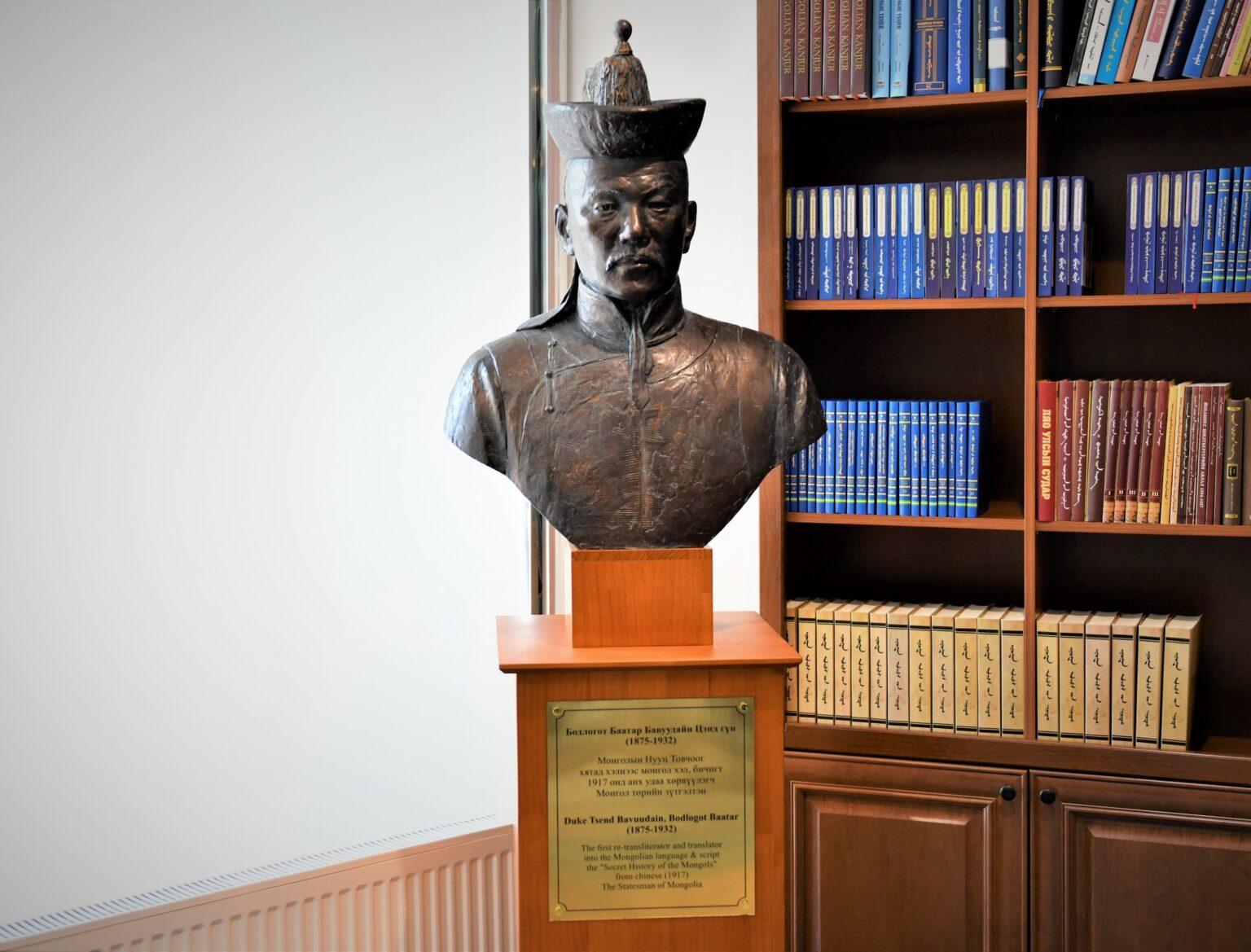
The foundation has also supported scholarly publications and public recognition of Tsend’s legacy. In 2025, marking the 150th anniversary of his birth, a Mongolian-English study by Dr. and Professor G. Myagmarsambuu, The Wise Minister of the Mongol State: Bodlogot Baatar Gün Bavuudai Tsend (1875–1932), was introduced to the public. In collaboration with the Chinggis Khaan National Museum, the foundation also participated in placing a bust of Tsend in the museum’s research library. <Cite refs={[“turn216974search9”]}/>
Other reported activities include a memorial award established in Tsend’s name to recognize contributions to Mongolian history, The Secret History of the Mongols, and cultural heritage, as well as book donations and cultural cooperation with Mongolian institutions abroad. Together, these initiatives demonstrate how family commitment, scholarly expertise, and institutional collaboration can help preserve a historical figure’s legacy and bring it to international audiences.
5. Scholarly Significance and Future Research
Tsend’s translation is important not simply because it preceded Damdinsüren’s version, but because it provides a separate historical witness to the modern reconstruction of a foundational Mongolian text. Its study can contribute to research on medieval Mongolian vocabulary, historical grammar, names and titles, political terminology, and the interpretation of particular passages.
Future research should compare Tsend’s manuscript with Damdinsüren’s translation and other established scholarly editions, passage by passage. Such work should distinguish the wording of the manuscript from modern transcription, editorial correction, and explanatory interpretation. This method would help establish where the translations differ and whether those differences affect historical meaning.
The foundation’s publication and digitization initiatives provide an important basis for this work. Their long-term value will depend on continued scholarly scrutiny, transparent editorial practices, and access to the manuscript and its supporting documentation.
6. Conclusion
Bavuudai Tsend (1875–1932), the Mongolian statesman and diplomat known as Bodlogot Baatar Gün, made a pioneering contribution to the modern history of The Secret History of the Mongols through his 1916–1917 translation from the Chinese-script textual tradition into written Mongolian. Although his manuscript did not initially achieve broad circulation, its preservation and subsequent publication have created new opportunities for historical, linguistic, and textual research.
The Bodlogot Baatar Tsend Gün Foundation has played a significant role in renewing attention to this legacy through annotated editions, digitization, bilingual scholarship, public commemoration, and cultural outreach. These efforts help place Tsend’s work within both Mongolian national scholarship and international discussions of textual transmission and cultural preservation.
A careful comparison of Tsend’s translation with later versions, especially Damdinsüren’s influential 1947 translation, offers the most productive path toward evaluating their respective contributions. By grounding judgments in direct textual evidence, scholars can better understand the relationship between philological reconstruction, literary interpretation, and historical meaning.
References
Chuluun, S., general editor, and D. Bolormaa, editor. Mongolyn Nuuts Tovchoon: Tsend Güngiin Orchuulsan, Tailbart Ekh [The Secret History of the Mongols Translated by Tsend Gün: An Annotated Edition]. Ulaanbaatar, 2022.
Damdinsüren, Tsendiin. Mongolyn Nuuts Tovchoon [The Secret History of the Mongols]. Ulaanbaatar, 1947.
Mongolian Academy of Sciences, Institute of History. “G. Bilgüüdüi: The Translation History of The Secret History of the Mongols.” Institutional interview and historical discussion.
Mongolian Academy of Sciences, Institute of Language and Literature. “The Open History of The Secret History of the Mongols Translated by Tsend Gün Published.” 2023.
Chinggis Khaan National Museum. “The Bust of Duke Tsend Bavuudain, ‘Bodlogot Baatar,’ Donated to the Museum Research Library.” 27 September 2025.
Myagmarsambuu, G. Mongol Töriin Mergen Said, Bodlogot Baatar Gün Bavuudai Tsend: 1875–1932 [The Wise Minister of the Mongol State: 1875–1932]. Mongolian-English edition, 2025