
THE SECRET HISTORY OF THE MONGOLS: ITS PRESERVATION IN BEIJING AND REDISCOVERY BY MODERN SCHOLARSHIP
The Secret History of the Mongols (Mongγol-un niγuca tobčiyan) is one of the most important surviving sources for the history of the Mongol Empire. It preserves accounts of the origins of Chinggis Khaan, his early life and rise to power, the unification of the Mongol tribes, the establishment of imperial rule, and the reign of his successor Ögedei Khaan. Its historical importance extends beyond political and military events: the work also provides evidence for Mongolian traditions, kinship, political legitimacy, social organization, and the language of the medieval Mongols.
Yet the text did not survive through a simple, uninterrupted tradition of Mongolian manuscripts. The version that became accessible to modern scholars was transmitted through a complex textual history involving the Mongol Yuan dynasty, the Ming imperial court, Chinese transcription and translation, manuscript copying, and nineteenth-century European scholarship. Beijing played a crucial role in this history, but the familiar story that the Secret History was simply “discovered” there in the nineteenth century requires clarification.
The Mongol Text and Its Chinese Transmission
The Secret History of the Mongols was composed in medieval Mongolian, probably during the thirteenth century, although its precise date, authorship, and stages of composition remain subjects of scholarly discussion. The surviving text is not an autograph manuscript from the age of Chinggis Khaan. The original Mongolian manuscript in its presumed original script has not been identified.
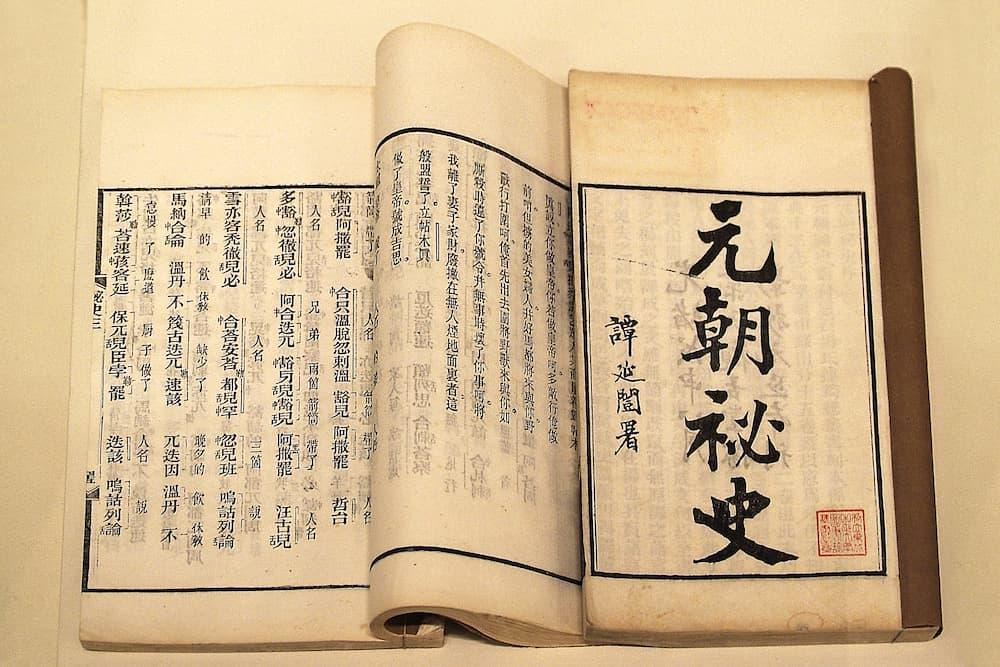
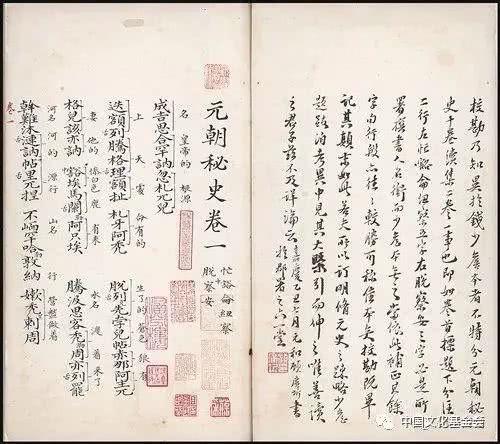
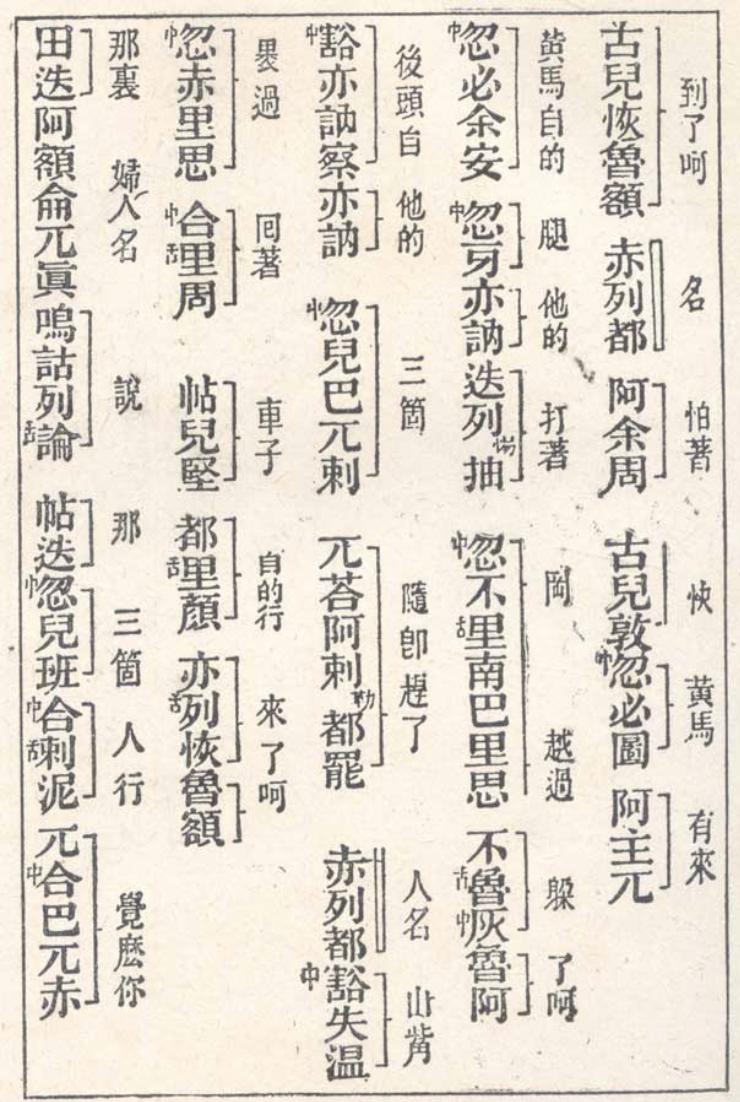
The principal textual tradition known to modern scholarship survives in a form that combines Mongolian words transcribed into Chinese characters, Chinese glosses explaining the Mongolian vocabulary, and a more continuous Chinese translation. These elements served different purposes. The Chinese characters represented the sounds of Mongolian words; the interlinear glosses helped explain their meanings; and the Chinese translation conveyed the narrative in a form accessible to Chinese readers.
This arrangement is particularly important for historical linguistics. Chinese characters were being used primarily to record Mongolian pronunciation rather than simply to translate Mongolian words into Chinese. Consequently, scholars cannot treat the Chinese-character transcription as ordinary Chinese prose. Recovering the Mongolian text requires careful analysis of the transcription, the glosses, the Chinese translation, and the linguistic characteristics of medieval Mongolian.
The surviving Chinese form is therefore both a preservation mechanism and a source of interpretive difficulty. It enabled the Mongolian narrative to survive in a textual tradition outside its original linguistic setting, but it also introduced questions concerning pronunciation, orthography, textual divisions, translation, and the relationship between surviving copies and earlier versions.
T. H. Barrett emphasizes that the circumstances and date of the Chinese transcription are not entirely clear. The text’s transmission cannot be reconstructed with certainty in every detail. Nevertheless, the available evidence allows historians to identify several important stages in its preservation. <Cite refs={[“turn919319search2″,”turn919319search24”]}/>
From the Yuan Dynasty to the Ming Imperial Court
The history of the text is closely connected to the political transformation that followed the fall of the Yuan dynasty in China.
In 1368, the Ming dynasty displaced the Yuan government from its capital, Dadu, the city that developed into modern Beijing. The Ming court inherited and collected documentary materials associated with the preceding Mongol-ruled dynasty. The preservation and transmission of Mongolian historical and linguistic materials subsequently took place within the institutional world of the Chinese imperial state.
The work became known in Chinese bibliographic tradition as Yuan chao bi shi (元朝秘史), commonly translated as The Secret History of the Yuan Dynasty. This title reflects the text’s transmission through Chinese scholarship and imperial literary institutions; it should not be mistaken for evidence that the work originated as a Chinese composition.
During the early Ming period, the Mongolian text was incorporated into a Chinese documentary framework. Its Mongolian wording was transcribed in Chinese characters, supplied with explanatory glosses, and accompanied by a Chinese translation. The resulting textual form made it possible for Chinese scholars and officials to preserve and study a work written in a language different from their own.
The text was also associated with the Yongle Encyclopedia, a monumental compilation commissioned by the Yongle Emperor and completed in 1408. The subsequent history of the work involved more than one textual form, including versions with different divisions and arrangements. These differences are important because the surviving tradition does not represent a single, perfectly preserved manuscript passed unchanged from the thirteenth century to modern times.
The early Ming period was therefore decisive in the survival of the Secret History. Its preservation depended on the reproduction and organization of Mongolian material within Chinese textual institutions. This process did not make the work originally Chinese; rather, it created the principal documentary form through which its Mongolian content became accessible to later generations.
Gu Guangqi and the 1805 Copy
A major landmark in the later history of the text was the manuscript copy completed in 1805 by the Qing-period scholar Gu Guangqi (顾广圻, 1766–1835).
Gu’s copy is important because it represents a significant stage in the transmission of the Chinese-character version of the Secret History. It was based on an earlier printed text and became one of the principal witnesses used in subsequent scholarship. The Chinese National Library holds the manuscript traditionally known as Gu Guangqi’s certified text.
The year 1805 should not, however, be described as the date when the Secret History was first discovered. The text had already been transmitted through earlier Chinese editions and documentary collections. Gu’s achievement belongs to the history of copying, verification, and textual preservation rather than the initial recovery of a previously unknown work.
Other copies also circulated among Chinese scholars and collectors. One important manuscript was associated with Bao Tingbo (鮑廷博, 1728–1814), a prominent bibliophile. This copy later became closely connected with the work of the Russian scholar Palladius Kafarov.
The existence of several textual witnesses allowed later scholars to compare readings and investigate variations. Such comparison is essential in textual criticism: differences between copies may reveal copying errors, editorial decisions, changes in textual arrangement, or relationships between earlier and later versions.
Research on the manuscripts preserved in the Chinese National Library confirms the importance of Gu Guangqi’s copy and the wider network of Chinese manuscript transmission. <Cite refs={[“turn919319search8″,”turn919319search26”]}/>
Palladius Kafarov and the Nineteenth-Century Introduction to European Scholarship
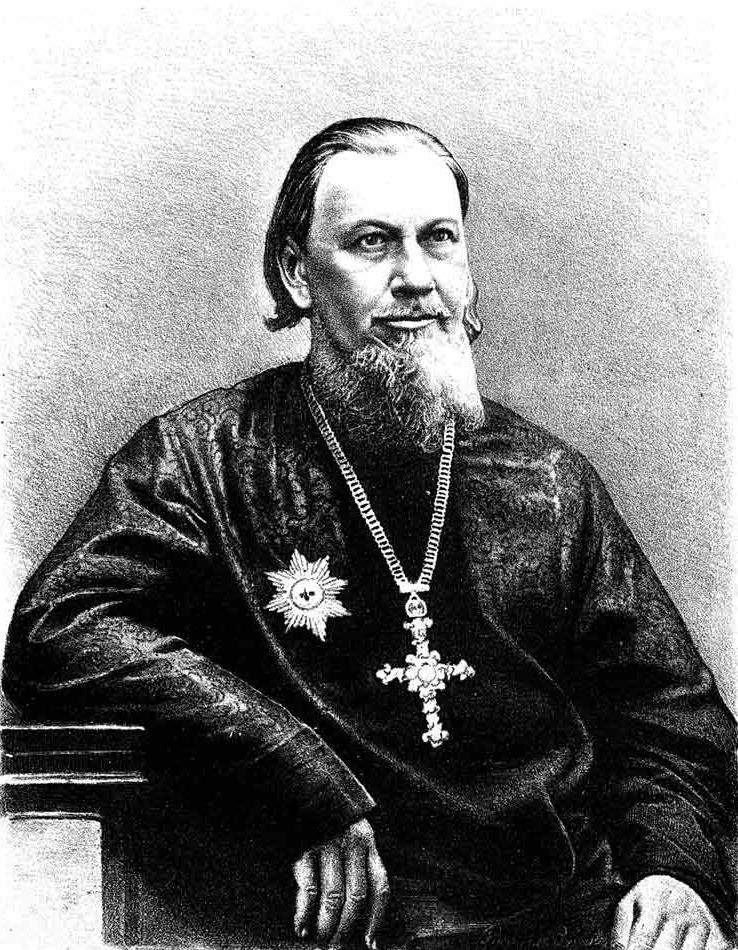
Palladius Kafarov, whose Russian name was Pyotr Ivanovich Kafarov (1817–1878), was a Russian Orthodox archimandrite and scholar of Chinese and Inner Asian history. Through his work in Beijing, he became one of the key figures in the introduction of the Secret History of the Mongols to European scholarship.
Two events associated with Kafarov are frequently confused: his publication of a Russian translation in 1866 and his acquisition of an important manuscript copy in 1872.
In 1866, Kafarov published a Russian translation under the title Starinnoe mongol’skoe skazanie o Chingis-Khane, conventionally rendered in English as An Ancient Mongolian Tale about Chinggis Khan. This publication made the work known to a wider scholarly audience beyond the Chinese-language tradition.
The 1866 translation, however, was based on the Chinese translation of the text, which presented only an abridged version of the Mongolian narrative. It was not equivalent to a complete scholarly translation made directly from the Mongolian wording transcribed in Chinese characters.
In 1872, Kafarov acquired the manuscript associated with Bao Tingbo. This manuscript contained the Mongolian text represented in Chinese characters, together with the Chinese glosses and translation. It provided a much more substantial basis for studying the Mongolian text itself.
The distinction is fundamental. Kafarov did not create the Secret History, nor did he recover a manuscript that had been entirely unknown to Chinese scholars. His importance lies in making the text available to European scholarship through translation and in obtaining a manuscript that enabled further investigation of its Mongolian wording.
The two dates mark different stages in this process: 1866, the publication of Kafarov’s Russian translation; and 1872, his acquisition of an important manuscript copy. They should not be combined into a single claim that the entire work was first discovered in one event.
Francis Woodman Cleaves discusses Kafarov’s early publication in the introduction to his English translation, while Igor de Rachewiltz provides a detailed account of the manuscript tradition and the relationships among the surviving textual witnesses. <Cite refs={[“turn919319search25″,”turn919319search26″,”turn919319search10”]}/>
Why the Manuscript Matters
The manuscript tradition associated with Beijing is central to the modern study of the Secret History of the Mongols for three principal reasons.
First, it preserves Mongolian wording that would otherwise be inaccessible through the surviving manuscript record. The Chinese-character transcription provides evidence for the language of the text, although scholars must account for the phonological and orthographic conventions of the transcription.
Second, the accompanying Chinese glosses and translation provide additional evidence for interpreting difficult passages. They cannot always be accepted as definitive explanations of Mongolian words, but they are valuable witnesses to how earlier readers understood the text.
Third, the survival of multiple manuscript copies allows scholars to reconstruct the history of the text itself. By comparing differences in wording, arrangement, and translation, researchers can investigate how the work was copied, edited, and transmitted.
These features make the Secret History both a historical narrative and a complex textual object. Its value lies not only in what it says about Chinggis Khaan and the Mongol Empire, but also in what its transmission reveals about the preservation of Mongolian historical literature across political and linguistic boundaries.
The Continuing Work of Textual Scholarship
Kafarov’s publications were an important beginning, but they did not resolve all the problems associated with the text. Subsequent scholars compared Chinese editions, manuscript copies, Mongolian linguistic evidence, and the work’s internal structure.
William Hung’s major article, “The Transmission of the Book Known as ‘The Secret History of the Mongols’,” published in the Harvard Journal of Asiatic Studies in 1951, remains an important study of the text’s transmission. Hung examined the Chinese documentary evidence and reconstructed significant parts of the work’s later history.
Francis Woodman Cleaves’s English translation, published by Harvard University Press in 1982, provided a major scholarly translation based on the Mongolian text as reconstructed from the Chinese-character transcription. Igor de Rachewiltz’s two-volume critical edition and translation, The Secret History of the Mongols, published in 2004, offered an extensive treatment of the text, its linguistic features, historical context, and transmission.
Modern research continues to investigate the date of composition, the structure of the narrative, the relationship between its different textual divisions, and the extent to which the surviving text reflects an earlier Mongolian original. These questions remain important because the Secret History is a foundational source, but not one whose textual history is entirely transparent.
Conclusion
The history of the Secret History of the Mongols is not simply a story of a lost book discovered by a foreign scholar in Beijing. It is a longer history of preservation, transcription, translation, copying, and scholarly reconstruction.
The text survived through a Chinese-character transcription of Mongolian, accompanied by glosses and a Chinese translation. Its transmission through the early Ming period, its preservation in later Chinese editions and manuscript copies, Gu Guangqi’s 1805 copy, and Palladius Kafarov’s publications and manuscript acquisition all contributed to its eventual international study.
Beijing was central to this process because it served as a major center of imperial administration, documentary preservation, and scholarly activity. Chinese scholars and textual traditions were indispensable to the survival of the work. Kafarov’s role was not to discover the text in an absolute sense, but to introduce it to a wider European scholarly audience and to help make a fuller study of its Mongolian wording possible.
The Secret History of the Mongols thus stands as an important example of how historical texts survive through the interaction of different languages, political institutions, scholarly traditions, and manuscript cultures. Its preservation is itself part of the history of Mongolia and of the wider Eurasian world.
Selected References
Barrett, T. H. “The Secret History of the Mongols: Some Fresh Revelations.” Bulletin of the School of Oriental and African Studies 55, no. 1 (1992): 115–119. https://doi.org/10.1017/S0041977X00002706.
Cleaves, Francis Woodman, trans. The Secret History of the Mongols: For the First Time Done into English out of the Original Tongue and Provided with an Exegetical Commentary. Cambridge, MA: Harvard University Press, 1982.
Hung, William. “The Transmission of the Book Known as ‘The Secret History of the Mongols.’” Harvard Journal of Asiatic Studies 14, nos. 3–4 (1951): 433–492. https://doi.org/10.2307/2718184.
Kafarov, Palladius. Starinnoe mongol’skoe skazanie o Chingis-Khane [An Ancient Mongolian Tale about Chinggis Khan]. Published in Trudy chlenov Rossiiskoi dukhovnoi missii v Pekine, vol. 4. St. Petersburg, 1866.
Rachewiltz, Igor de. The Secret History of the Mongols: A Mongolian Epic Chronicle of the Thirteenth Century. 2 vols. Leiden: Brill, 2004.
Ulaan, Borjigijin. “On Some Manuscript Copies of the Secret History of the Mongols Collected in the Chinese National Library.” Paper presented at the 53rd Annual Meeting of the Permanent International Altaistic Conference, St. Petersburg, 2010.
Further Research Resources
Institute of Asian and Oriental Studies, scholarly bibliographies and studies of the Secret History of the Mongols.
The Chinese National Library, collections of manuscript copies associated with Gu Guangqi and other Qing-period scholars.
The Harvard Journal of Asiatic Studies, for William Hung’s study of textual transmission.
Brill’s edition of Igor de Rachewiltz’s critical translation and commentary.