
THE WEAPONS OF THE YUAN EXPEDITIONS TO JAPAN, 1274–1281
By Altanbagana Baatar
DBA Candidate| Founder & Organizer
Heavenly Wind 750 International Conference
Heavenlywind750.com | Imperilagg.com
29 October 2026
Composite Bows, Arrows, Explosive Projectiles, and the Transformation of Medieval Warfare
ABSTRACT
The Yuan expeditions against Japan in 1274 and 1281 brought together military forces, technologies, and tactical traditions from across the Mongol Empire. Their weapons included composite bows, arrows, swords, spears, protective armor, and gunpowder-based explosive projectiles. These expeditions are particularly significant because they reveal how warfare developed when steppe military traditions encountered Japan’s established warrior culture and coastal defensive systems.
This article examines the weapons and military practices associated with the invasions through a comparative reading of historical records, illustrated war scrolls, archaeological evidence, and modern scholarship. It argues that the military significance of the expeditions cannot be explained by the supposed superiority of one weapon alone. Rather, the effectiveness of the Yuan forces depended on the interaction of projectile weapons, coordinated formations, communications, naval transport, and the diverse capabilities of a multinational army.
A critical distinction is necessary: the forces dispatched by the Yuan dynasty under Kublai Khan were not ethnically Mongol in their entirety. They included Korean personnel and troops and sailors drawn from territories under Yuan control. Consequently, the weapons used during the invasions should be studied within the broader technological and military system of the Yuan state, rather than attributed indiscriminately to Mongols alone.
Keywords: Mongol Empire; Yuan dynasty; Japan; composite bow; archery; gunpowder weapons; medieval warfare; Takashima; Mongol invasion scrolls.
1. INTRODUCTION: TWO INVASIONS, MULTIPLE MILITARY TRADITIONS
In 1274 and 1281, the Yuan dynasty launched major expeditions against the Japanese archipelago. These campaigns are often remembered through the later Japanese concept of kamikaze, or “divine wind.” Yet concentrating exclusively on storms and their religious interpretation can obscure the military history of the invasions themselves.
The expeditions brought together different military traditions. The Yuan state inherited and adapted the mobile warfare associated with the Mongol steppe while incorporating personnel, equipment, naval resources, and technologies from its wider territories. On the Japanese side, mounted archery, individual warrior reputation, local military organization, and defensive preparations shaped the response.
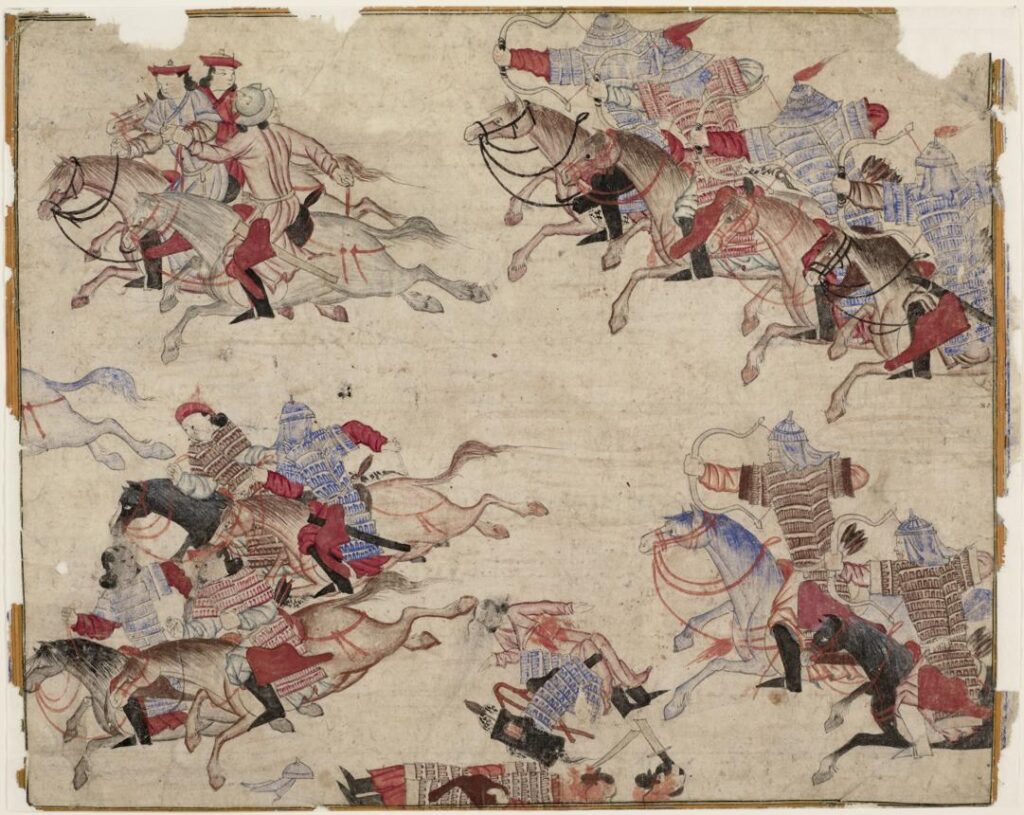
The surviving Mōko shūrai ekotoba (蒙古襲来絵詞), commonly translated as the Scrolls of the Mongol Invasions, is especially valuable. Associated with the warrior Takezaki Suenaga, who fought in both campaigns, the scrolls offer visual and textual evidence of combat. However, the surviving manuscripts have undergone damage, restoration, rearrangement, and later additions. Their illustrations must therefore be evaluated critically rather than treated as untouched photographic records of thirteenth-century events.
marbas.princeton.edu+1
The central research question is not simply which weapons the Yuan forces possessed, but how those weapons functioned within the conditions of a maritime invasion and how reliably their use can be reconstructed from the surviving evidence.
2. THE COMPOSITE BOW: TECHNOLOGY AND MILITARY FUNCTION
The composite bow was one of the most important weapons associated with Mongol military traditions. Unlike a simple wooden bow made from a single piece of timber, a composite bow combined several materials whose different mechanical properties contributed to its performance.
Typical construction could involve:
Wood: the structural core of the bow.
Horn: placed on the side facing the archer to resist compression.
Animal sinew: applied to the opposite side to help the bow store and release elastic energy.
Adhesives and protective coverings: used to join and protect the assembled layers.
The precise materials and construction varied by region, period, and bow-making tradition. It would therefore be misleading to assume that every bow carried by every soldier in the Yuan expedition was identical to a surviving Mongolian composite bow from another period. Nevertheless, the composite-bow tradition provides an important technological context for understanding the military capabilities of the steppe-derived forces.
Royal Armouries+1
2.1 Why the bow mattered
The composite bow offered several military advantages. Its relatively compact form was suitable for use on horseback, while its layered construction could store considerable energy in a comparatively short bow. A trained archer could employ it in mobile engagements, during advances or withdrawals, and in coordinated shooting.
The bow’s effectiveness, however, depended on much more than its construction. It required training, physical conditioning, suitable arrows, maintenance, and the ability to judge distance and timing. In a military formation, the bow could be used not only to strike an individual opponent but also to disrupt movement, pressure defensive positions, and expose opponents to follow-up attacks.
These advantages should not be confused with proof that Yuan archers always outranged Japanese archers. Actual performance depended on the bow, arrow, draw length, archer, target, weather, and tactical circumstances. No single maximum-range figure can establish how effectively a particular bow performed during the invasions.
2.2 Mounted archery and the Japanese battlefield
Mongol military traditions are strongly associated with mounted archery, but the Japanese expeditions were amphibious operations. Troops had to cross the sea, disembark, protect transport vessels, and fight on unfamiliar islands and coastal terrain.
The availability of horses and the ability to maneuver them were therefore not constant across every stage of the campaigns. Mounted archery remained relevant, but the invading forces could not simply reproduce the conditions of an open steppe battlefield.
This distinction is fundamental: a weapon’s effectiveness is determined not only by its design, but also by the environment in which it is used.
3. ARROWS: PROJECTILE WEAPONS AND TACTICAL COORDINATION
Arrows were not a uniform category of weapon. Their heads, shafts, dimensions, and intended uses could vary according to available materials and military requirements. Different arrowhead forms could serve different purposes, but identifying the exact function of a particular type requires archaeological or textual evidence rather than visual guesswork.
The distinction between a weapon’s general capabilities and its documented use in Japan is especially important. Historical accounts associated with the invasions describe arrow attacks and, in some traditions, arrows treated with poison. The National Archives of Japan’s historical presentation discusses such accounts alongside descriptions of Yuan troops using drums, gongs, and gunpowder projectiles. These reports should be evaluated in relation to their sources and transmission, rather than treated as proof that every unit used every reported weapon.
Our History through Archival Records+1
3.1 Arrows as part of a larger system
Projectile weapons could serve several tactical purposes:
Inflicting casualties: striking exposed opponents or exploiting weaknesses in protective equipment.
Disrupting formations: compelling defenders to seek cover, alter their positions, or break coordination.
Supporting advances: providing covering fire while other troops moved.
Creating pressure: forcing defenders to respond to attacks arriving from several directions or at different moments.
These are general functions of organized archery, not a claim that every tactic can be demonstrated for every engagement in Japan. The surviving evidence supports the importance of archery in the campaigns, but reconstructing precise firing sequences or ammunition distributions requires more specific documentation.
3.2 The significance of sound and coordination
The invasion accounts also describe the use of drums, gongs, shouting, and coordinated action. Such practices matter because a weapon system operates within a communication system. Signals can help units coordinate movement, maintain formation, and time their attacks.
It is tempting to portray the Japanese warriors as unfamiliar with organized combat simply because some historical narratives contrast individual challenges with collective Yuan tactics. That interpretation is too broad. Japan had its own military organization and battlefield practices. The more defensible conclusion is that the invasions brought different tactical conventions into direct confrontation, with the outcome shaped by the specific circumstances of each encounter.
4. EXPLOSIVE PROJECTILES: GUNPOWDER TECHNOLOGY IN THE EAST ASIAN THEATER
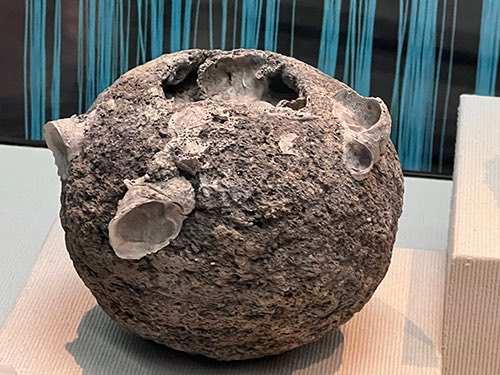
Among the most significant weapons associated with the invasions were gunpowder-based explosive projectiles, commonly referred to in Japanese discussions as tetsuhō (てつはう). These objects are important to the history of warfare because they demonstrate the use of explosive technology in a major maritime campaign well before the widespread adoption of later firearms.
4.1 Archaeological evidence from Takashima
One of the most important discoveries came from the underwater archaeological site off Takashima, in present-day Nagasaki Prefecture. A ceramic sphere associated with the 1281 invasion measures approximately 13 centimeters in diameter. Researchers used computed tomography (CT) to examine the object, revealing metal and ceramic fragments inside. These components suggest that the projectile could have produced both an explosive effect and dangerous fragments at close range.
Nippon+1
This discovery is particularly valuable because it provides material evidence independent of the later visual tradition surrounding the invasions.
Nevertheless, the archaeological interpretation must remain precise. The object’s construction and internal contents support its identification as an explosive projectile, but the exact composition of its filling, the explosive force it produced, and the way each projectile was deployed require careful examination of the relevant archaeological and technical studies.
It is also important to distinguish an explosive projectile from a modern firearm. The existence of gunpowder-based bombs does not mean that the Yuan expedition possessed modern guns or that Japanese defenders faced the same type of ballistic warfare that characterized later centuries.
4.2 How might the projectiles have been used?
Historical and archaeological discussions associate these projectiles with the Yuan forces’ use of gunpowder weapons. Catapult-launched explosive projectiles are a plausible and documented part of the broader technological context. Their military value could have included:
producing a loud explosion that disrupted concentration;
scattering fragments among nearby combatants;
creating confusion during close engagements;
placing additional psychological pressure on defenders unfamiliar with the particular weapon.
The exact tactical effect of each projectile in the Japanese campaigns cannot be measured from the surviving evidence. Its sound, blast, and fragments may have been important, but claims about casualties or battlefield outcomes need direct support from historical records or archaeological findings.
4.3 A critical correction concerning the invasion scrolls
One of the most widely reproduced images of the invasions depicts an explosive projectile bursting near Japanese warriors in the Mōko shūrai ekotoba. However, the authenticity of that particular image is disputed.
Research on the scroll’s transmission indicates that the explosive-projectile scene and some depictions of Yuan soldiers were later additions. The image should therefore not be used as unqualified contemporary evidence that a particular bomb exploded in the exact scene portrayed. The archaeological finds at Takashima provide a separate and important line of evidence for the use of explosive projectiles during the invasions.
Department of History+3
This distinction illustrates a broader principle of historical method: an artifact may establish that a technology existed, while a later illustration may not reliably establish the precise circumstances in which it was used.
5. ARMOR, SWORDS, AND CLOSE-COMBAT WEAPONS
Archery and explosive projectiles were only part of the Yuan military arsenal. Soldiers also required weapons and protective equipment for fighting at close quarters.
5.1 Lamellar armor
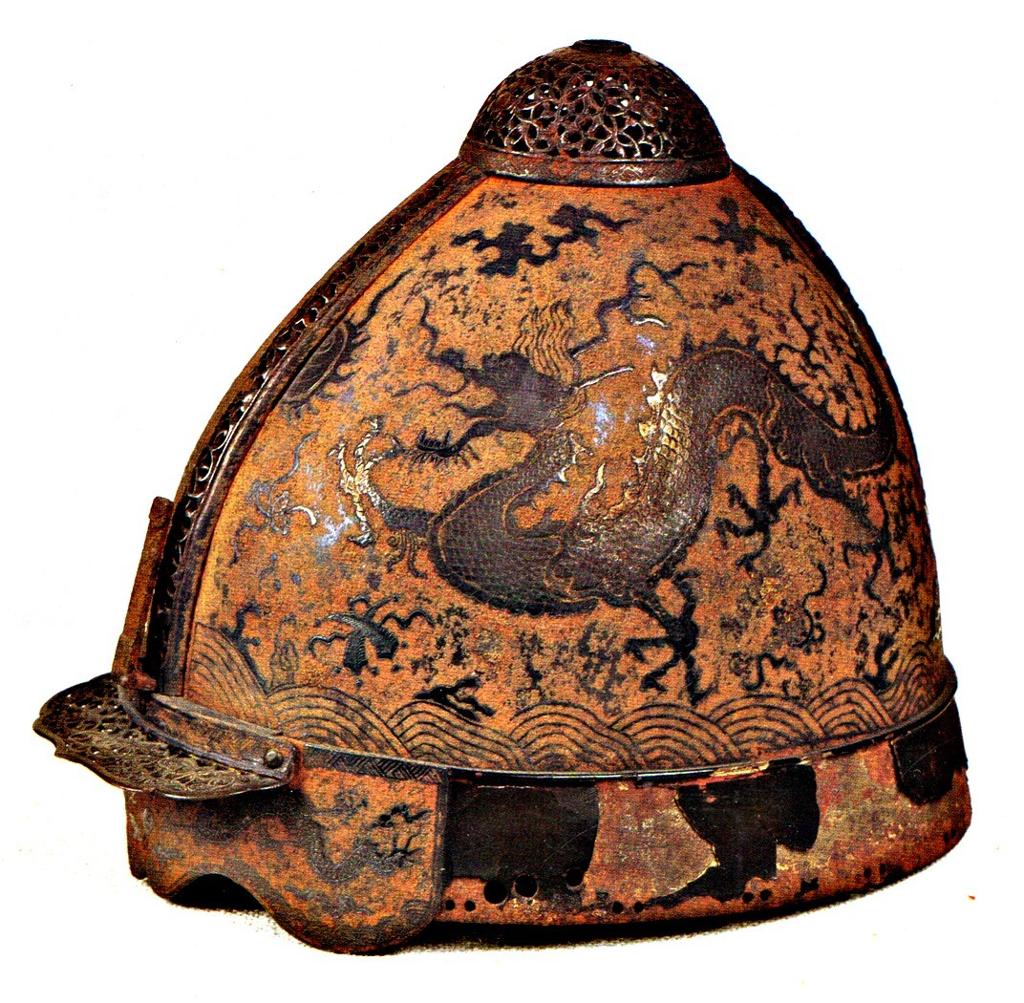
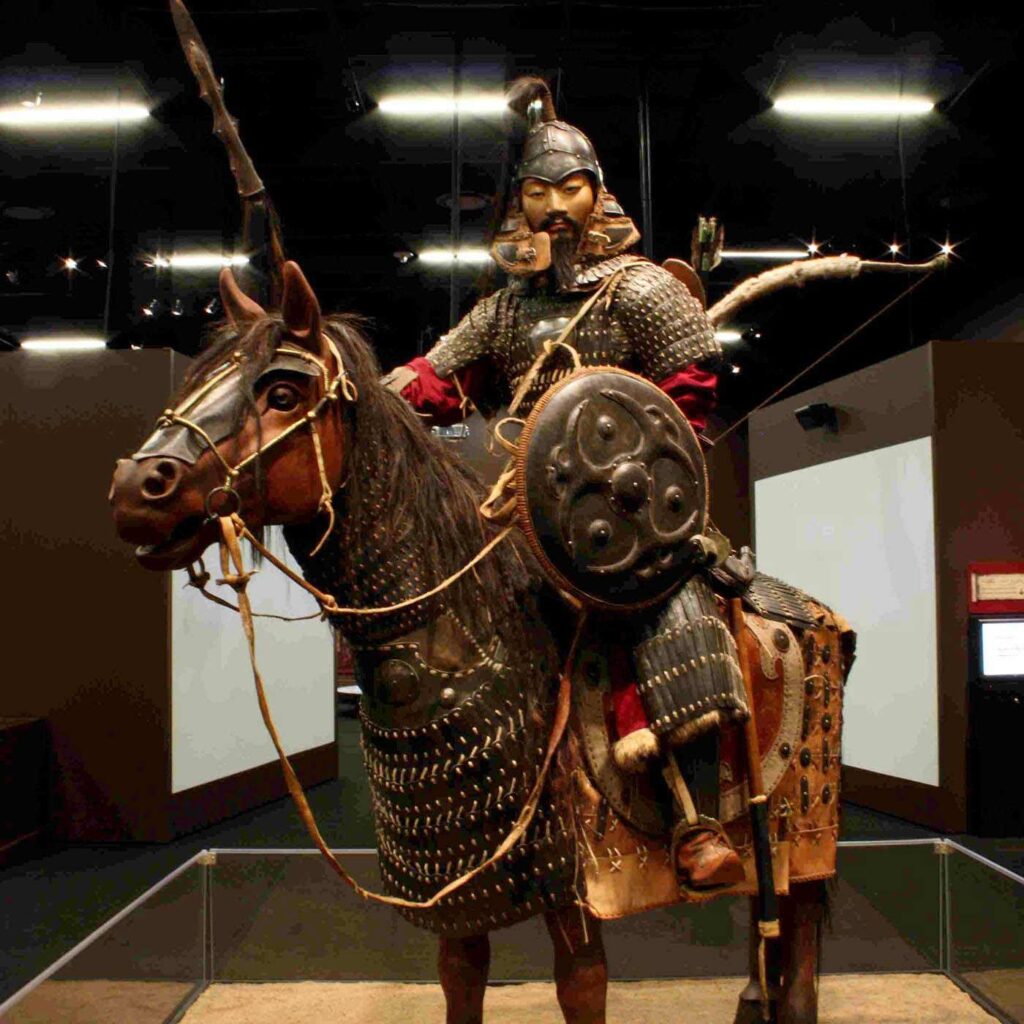
Lamellar armor was constructed from small plates of hardened leather, iron, or other suitable materials, laced together to form overlapping rows. Depending on the design, it could protect the torso and other parts of the body while allowing greater flexibility than a rigid shell.
This form of armor was well suited to many mounted military traditions across Inner Asia. Its construction and use, however, were not exclusive to Mongols. Related armor systems existed in other Asian military cultures, and Yuan forces drew on a broad range of equipment and manufacturing traditions.
Royal Armouries+1
The presence of lamellar armor in the wider Mongol military tradition does not establish that every soldier in the Japanese expeditions wore it. The Yuan army was a composite force, and equipment likely varied with military role, origin, resources, and status.
Armor also had limitations. Its effectiveness depended on its material, thickness, coverage, condition, and the type and angle of an incoming strike. It would be incorrect to claim that lamellar armor made a warrior invulnerable to arrows or other weapons.
5.2 Swords, spears, and other weapons
The Mongol military tradition included swords, spears or lances, and mace-like weapons. These served different purposes from the bow: they were particularly relevant when opposing forces came into direct contact.
A spear could be used to thrust at an opponent, while a sword offered a versatile close-combat weapon. A mace could deliver a forceful impact against a combatant, including one wearing protective equipment.
Yet the presence of a weapon in the broader Mongol arsenal does not prove that it was widely used in every engagement in Japan. For the two invasions, the strongest reconstruction combines the surviving Japanese visual and textual evidence with broader knowledge of Yuan military organization. It avoids treating general descriptions of Mongol warfare as a complete inventory of the equipment carried by the expeditionary forces.
6. THE YUAN BOW AND THE JAPANESE YUMI: A COMPARATIVE PERSPECTIVE
The contrast between the shorter bows associated with Yuan forces and the Japanese yumi is frequently used to explain the early stages of the invasions. The Japanese longbow was asymmetrical, with its grip positioned below the midpoint. This design allowed it to be used on horseback as well as on foot, although its handling and tactical advantages differed from those of a shorter composite bow.
The Yuan forces’ bows were described in modern accounts as compact weapons suitable for use on foot or on horseback. Their practical advantages may have included maneuverability and adaptability in changing combat conditions. However, a comparison based only on bow length would be incomplete: draw weight, arrow design, training, shooting position, and battlefield conditions also affected performance.
Nippon+1
6.1 Different tactical conventions
The invasions have often been portrayed as a confrontation between Japanese individual combat and Mongol collective tactics. Some Japanese accounts describe warriors announcing their identities or seeking recognition for individual deeds, while narratives of the Yuan forces emphasize coordinated formations and concentrated attacks.
These differences are historically significant, but they should not be exaggerated into a claim that Japanese warfare was entirely individualistic or that Yuan soldiers acted according to one uniform doctrine. Both sides possessed organized military structures. The campaigns instead reveal the difficulties of adapting established practices to a new opponent operating under different logistical and tactical conditions.
The Mōko shūrai ekotoba is useful for examining these interactions, but its illustrations should be compared with the accompanying text, administrative documents, archaeological evidence, and modern scholarship before drawing conclusions about particular weapons or engagements.
Department of History+1
7. WEAPONS AND THE MARITIME LOGISTICS OF INVASION
A weapon’s effectiveness depends on whether an army can transport it, maintain it, supply its users, and deploy it under battlefield conditions. This issue was especially important for the Yuan expeditions.
The invading forces had to move personnel, horses, provisions, weapons, and other equipment across the sea. Naval transport was therefore not simply a means of reaching Japan; it was part of the military system that determined what could be brought to the battlefield and how long an expedition could remain operational.
The 1281 expedition was particularly large and complex. Its forces came from different parts of the Yuan state and relied on maritime transport and coordination. The archaeological material recovered from Takashima—including weapons and other military objects—helps demonstrate the material scale of the campaign. The composition of the recovered assemblage also cautions against imagining the expedition as an exclusively Mongol force: the Yuan military system drew heavily on resources and personnel from its wider territories.
Nippon+2
7.1 Why the maritime environment mattered
The same weapons could perform differently depending on whether soldiers were fighting on land, aboard ships, during disembarkation, or along a defended shoreline.
Archery required suitable positions, clear lines of sight, and the ability to handle and protect equipment.
Explosive projectiles needed appropriate means of transport and deployment, and their effects could vary according to the distance and circumstances of use.
Armor and close-combat weapons affected mobility, endurance, and the outcome of engagements after opposing forces closed distance.
Naval transport and supply influenced the ability to reinforce troops, replenish equipment, and maintain a campaign.
These factors help explain why it is inadequate to describe the invasions simply as a contest between superior and inferior weapons. Military technology operated within a wider system of organization, logistics, terrain, and weather.
8. 1274 AND 1281: WHAT THE EVIDENCE ALLOWS US TO CONCLUDE
The two invasions should be treated as related but distinct campaigns.
Feature | First invasion, 1274 | Second invasion, 1281 |
|---|---|---|
Strategic context | Initial major Yuan expedition against Japan | Renewed and larger expedition after the first campaign |
Military environment | Island landings and coastal engagements | More extensive maritime operation involving multiple forces |
Weapons evidence | Historical accounts describe archery and coordinated combat | Archaeological evidence includes explosive projectiles associated with the campaign |
Main interpretive issue | Reconstructing the tactics and encounters from limited sources | Integrating archaeological finds with historical accounts and later visual traditions |
The evidence does not justify reducing either campaign to a single weapon or a single environmental event. Nor should the outcome be attributed exclusively to Japanese defensive skill, Yuan military weakness, or storms. Each explanation captures only part of a complex historical process.
Thomas Conlan’s study of Takezaki Suenaga’s scrolls and administrative records is particularly important because it challenges overly simple accounts of Japan’s survival through divine intervention alone. It places Japanese resistance and the historical record of the fighting at the center of the analysis.
Department of History+1
The archaeological record complements this documentary approach. The Takashima finds establish a material basis for discussing the weapons carried by the Yuan expedition, while manuscript scholarship helps determine which images can be used reliably to reconstruct the events.
9. CONCLUSION: TECHNOLOGY, ORGANIZATION, AND HISTORICAL MEMORY
The weapons associated with the Yuan invasions of Japan reveal a military system built from several interacting traditions. Composite bows supported mobile archery; arrows provided a versatile means of attack; swords, spears, and other weapons served in close combat; armor protected at least some combatants; and gunpowder-based explosive projectiles introduced a further dimension to the battlefield.
The most important conclusion is not that one weapon guaranteed Yuan victory. Rather, the invasions demonstrate the importance of combining technology with tactical coordination, personnel, logistics, and the ability to operate across different environments. The Yuan expeditions were products of a large, multiethnic state whose military resources extended beyond the Mongol steppe.
The evidence also illustrates the need for source criticism. The Mōko shūrai ekotoba remains a remarkable historical record, but its transmission history complicates the interpretation of some famous images. Archaeological discoveries from Takashima provide independent evidence for explosive projectiles, while the scrolls, written records, and modern scholarship offer complementary perspectives on the campaigns.
Studying these weapons in context moves the discussion beyond the familiar narrative of “Mongols versus samurai.” It reveals a more complex encounter involving military adaptation, technological exchange, maritime power, and competing historical memories.
For the history of East Asian warfare, the invasions of 1274 and 1281 are significant not because they can be explained by a single technological advantage, but because they show how different military systems met, adapted, and struggled under the demanding conditions of a transoceanic campaign.
REFERENCES AND FURTHER READING
1. Bennett, Natasha. “Arms and Armour of the Mongol Empire.” Royal Armouries.
https://royalarmouries.org/objects-and-stories/stories/the-mongols/arms-and-armour-of-the-mongol-empire
2. Conlan, Thomas D. In Little Need of Divine Intervention: Takezaki Suenaga’s Scrolls of the Mongol Invasions of Japan. Honolulu: University of Hawai‘i Press, 2001/2002.
https://history.princeton.edu/about/publications/little-need-divine-intervention-takezaki-suenagas-scrolls-mongol-invasions-japan
3. Imperial Household Agency, Museum of the Imperial Collections, Sannomaru Shōzōkan. “Illustrated Scrolls of the Mongol Invasions.”
https://collection.shozokan.nich.go.jp/en/object/SZK002942
4. National Archives of Japan. “Japan and Mongolia: A History of Exchanges.”
https://www.archives.go.jp/about/activity/international/jp_mn50/english/ch01.html
5. Mochida, Jōji. “The Battle of Bun’ei: The First Mongol Invasion of Japan.” Nippon.com, September 20, 2024.
https://www.nippon.com/en/japan-topics/c13702/
6. Testa, Giuseppina Aurora. “Mōko Shūrai Ekotoba (Illustrated Account of the Mongol Invasions): A Case Study of Encounter with the Other in Japan.” Eikón Imago 9 (2020): 35–57.
https://doi.org/10.5209/eiko.73275
7. “The Evolution of Warfare and Weapons in Japan, 792–1392.” Religions 4, no. 1.
https://www.mdpi.com/2409-9252/4/1/2
8. Princeton University, Manuscript, Rare Book and Archive Studies. “Scrolls of the Mongol Invasion: Annotated Version.”
https://marbas.princeton.edu/resource-links/scrolls-mongol-invasion-annotated-version
9. Hatanaka, Shūji. “元寇の陶製火薬兵器『てつはう』の再現(第1報)” [Reconstruction of the Ceramic Gunpowder Weapon Tetsuhō from the Mongol Invasions, Report 1]. Explosion 30, no. 3 (2020): 172–177.
https://jglobal.jst.go.jp/detail?JGLOBAL_ID=202102214764522290
AUTHOR
Altanbagana Baatar
DBA Candidate | Founder & Organizer
Heavenly Wind 750 International Conference
ImperialGG.com | October 29, 2026