
WHEN DIPLOMACY ENDED IN EXECUTION
By Altanbagana Baatar
DBA Candidate| Founder & Organizer
Heavenly Wind 750 International Conference
Heavenlywind750.com | Imperilagg.com
27 October 2026
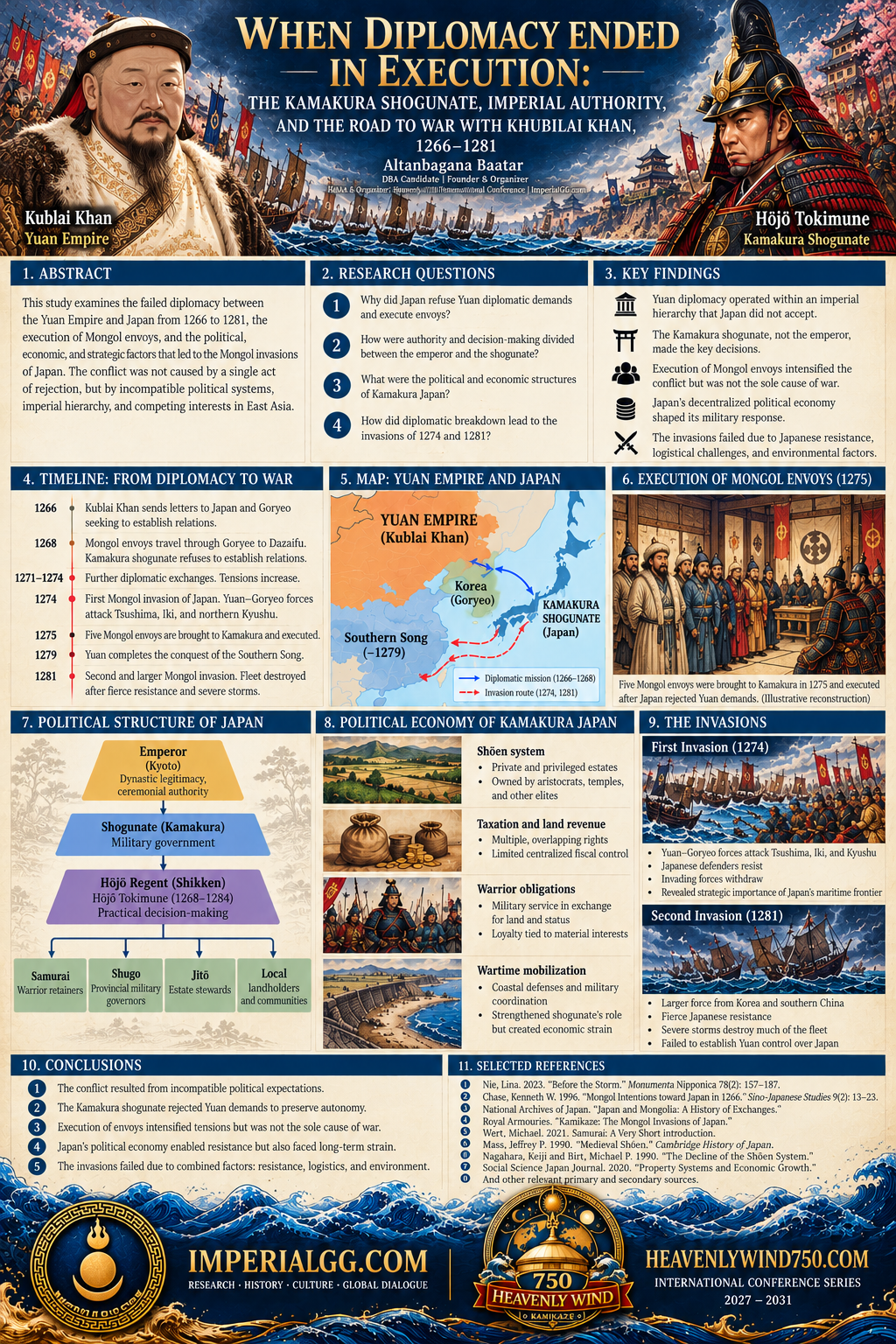
THE JAPANESE SHOGUNATE, IMPERIAL AUTHORITY, AND THE ROAD TO WAR WITH KHUBILAI KHAN, 1266–1281
Abstract
The Mongol invasions of Japan in 1274 and 1281 were preceded by nearly a decade of diplomatic exchanges, competing claims to political authority, and repeated failures to establish an accepted relationship between the Yuan Empire and the Japanese government. Although Kublai Khan presented his initial approach as an invitation to establish friendly relations, his correspondence also reflected the hierarchical assumptions of Mongol imperial diplomacy and the possibility of military coercion. Japan’s response emerged from a political system in which the emperor retained traditional dynastic legitimacy while the Kamakura shogunate exercised substantial military and administrative power. This article examines the refusal of Mongol diplomatic demands, the execution of Yuan envoys, the authority of the Hōjō regency, and the political-economic structure that supported Japan’s military response. Using Japanese archival materials, contemporary and later historical records, and modern scholarship, it argues that the movement from diplomacy to war cannot be explained by a single act of rejection. Rather, it reflected a conflict between incompatible political expectations, concerns over Japanese autonomy, and the strategic calculations of the Yuan court.
Keywords: Kublai Khan, Yuan dynasty, Kamakura shogunate, Hōjō Tokimune, Mongol invasions of Japan, diplomatic history, imperial authority, medieval Japanese political economy.
1. Introduction: Diplomacy Before Invasion
The Mongol invasions of Japan are often remembered through the military campaigns of 1274 and 1281, as well as the storms later celebrated in Japanese historical memory as kamikaze, or “divine winds.” Yet the conflict began well before Mongol troops landed on Japanese shores. During the 1260s, Kublai Khan’s government sought diplomatic contact with Japan, attempting to establish a relationship that would acknowledge the authority of the expanding Mongol Empire.[1]
The first documented approach to Japan in 1266 preceded the final defeat of the Southern Song dynasty in 1279. This chronology matters: the initial diplomatic initiative cannot be explained simply as an effort to redirect surplus Song soldiers toward Japan. The Yuan court’s objectives must instead be examined in the broader context of imperial expansion, regional diplomacy, and its relations with Goryeo Korea and the Japanese political establishment.[2]
The Japanese response was shaped by an institutional structure unlike that of the Yuan Empire. The Japanese emperor retained dynastic and ceremonial legitimacy, but the Kamakura shogunate exercised much of the country’s effective military authority. The Hōjō regents, who governed the shogunate, had to evaluate foreign demands not only in diplomatic terms but also in relation to the security of their regime and the obligations connecting the warrior class to the government.
The execution of Yuan envoys became one of the most consequential episodes in this deteriorating relationship. Nevertheless, it is important to distinguish the documented events from later interpretations that portray Japanese refusal as a single, decisive cause of war. Diplomatic rejection, imperial hierarchy, military preparations, and regional strategy must be examined together.
2. Kublai Khan’s Diplomatic Initiative, 1266–1268
In 1266, Kublai Khan’s government prepared a letter addressed to the ruler of Japan. The communication sought to establish relations while placing the proposed relationship within a political vocabulary shaped by Mongol imperial authority. The message referred to the established connections between Japan and the Chinese world and questioned why Japan had not sent envoys to the Mongol court.
The letter was neither an unambiguous declaration of peace nor an explicit announcement of immediate invasion. It combined an invitation to establish relations with language suggesting that continued refusal could have serious consequences. Its diplomatic ambiguity is central to understanding why the two governments interpreted the exchange differently.[3]
The Japanese National Archives records that the Mongol government dispatched two letters in 1266: one to the king of Goryeo, instructing him to facilitate contact with Japan, and another addressed to the Japanese ruler. The Korean mission carrying the Japanese letter reached Dazaifu in 1268.[4]
The involvement of Goryeo demonstrates that the negotiations were not simply a bilateral dispute. The Yuan court used its relationship with Korea to facilitate diplomatic contact, making the Korean kingdom an intermediary between continental imperial power and the Japanese archipelago.
For Kublai’s government, the establishment of formal relations could serve several purposes. It could clarify Japan’s political position, reduce uncertainty on the empire’s maritime frontier, and potentially secure Japanese acknowledgment of the Yuan emperor’s authority. Yet these possible objectives should not be treated as interchangeable, nor should any one of them be identified as the emperor’s exclusive motive without additional evidence.
Japan faced a different question: whether accepting the proposed relationship would expose the country to demands inconsistent with its political autonomy. The disagreement therefore concerned not only communication but also the meaning of diplomatic recognition itself.
3. Who Governed Japan? Emperor, Shogunate, and Regent
To understand the Japanese response, it is necessary to distinguish the emperor, the shogunate, and the regent.
The Japanese emperor occupied the traditional dynastic center of political legitimacy. The imperial court in Kyoto retained important ceremonial, aristocratic, and institutional functions. However, by the thirteenth century, military government had developed in Kamakura under the bakufu, the warrior administration established by the Minamoto regime.
The Kamakura government exercised substantial authority through its relationships with warrior retainers, landholders, military officials, and provincial institutions. The shogunate’s political strength depended on its capacity to protect the interests of its followers and coordinate military obligations across the country.[5]
Hōjō Tokimune, who served as shikken—regent of the Kamakura shogunate—from 1268 to 1284, became the principal political figure associated with Japan’s response to the Mongol threat. He was not the shogun. Rather, he exercised authority within the Hōjō regency that dominated the military government.
This distinction matters because the foreign-policy response cannot be reduced to a personal decision by the emperor or the shogun. The imperial court and the Kamakura government operated within overlapping structures of authority, and their approaches to the Mongol demands were not necessarily identical.
The shogunate had strong reasons to resist an external relationship that might undermine its control over Japan’s military and political affairs. Accepting a foreign ruler’s claim to superior authority could create consequences beyond the immediate diplomatic exchange. It could raise questions about who represented Japan, who controlled relations with foreign powers, and whether the military government could continue to protect the autonomy of the institutions on which its power rested.
The conflict therefore exposed a fundamental tension: the Yuan court expected Japan to respond within an imperial hierarchy, while Japanese authorities sought to preserve a political order that did not recognize Kublai Khan as its superior.
4. The Refusal of Diplomatic Demands and the Execution of Envoys
The diplomatic exchanges became increasingly confrontational after the initial approaches. Japanese authorities did not establish the relationship Kublai Khan sought, and the Yuan government continued to send missions demanding a response.
According to the Japanese National Archives, the Mongol government’s efforts to establish relations were repeatedly rejected by the Kamakura shogunate. The refusal preceded the invasions of 1274 and 1281.[4]
The treatment of Yuan envoys became especially significant. Japanese historical accounts record that a group of five Yuan envoys arriving in 1275 was executed. The Royal Armouries’ historical account also describes the execution of envoys during the later diplomatic efforts between 1275 and 1281.[6]
These executions were more than isolated acts of punishment. In diplomatic terms, they demonstrated that the Japanese military government was unwilling to comply with the Yuan court’s demands and was prepared to impose severe consequences on representatives of the opposing power.
However, the historical meaning of the executions requires careful interpretation. It is tempting to describe them as the direct cause of the invasions, but such a conclusion oversimplifies the chronology. Kublai Khan had already initiated diplomatic pressure years earlier, and the Yuan government possessed strategic interests extending beyond the treatment of its envoys.
The executions intensified the confrontation and narrowed the space for negotiation. They also reinforced the possibility that the Yuan court would regard Japan’s refusal as a challenge to imperial authority. Yet they should be understood as part of an escalating series of diplomatic and strategic decisions rather than as a sufficient explanation for the wars.
The distinction between documented action and inferred motive is particularly important here. The execution of envoys can be established through historical accounts; the precise calculations behind each decision require further comparison of Japanese, Korean, and Yuan records.
5. The Political Economy of the Kamakura Shogunate
Japan’s response to the Mongol threat was shaped by its economic and social structure. The Kamakura government was not a centralized fiscal state operating through a uniform national taxation system. Its authority depended substantially on relationships among landholding institutions, warrior families, and local administrators.
A central institution was the shōen, a private or privileged estate associated with aristocratic families, religious institutions, and other powerful proprietors. The medieval Japanese land system also included public-domain lands, commonly discussed in relation to kokugaryō. These arrangements created overlapping rights over land, revenue, administration, and the people who worked the land.[7]
The Kamakura shogunate developed its own mechanisms of control through offices such as the jitō, or estate stewards, and the shugo, or military governors. These officials helped connect the military government to local society and enabled it to exercise authority across different provinces. Their roles did not simply eliminate the rights of traditional proprietors; instead, military and estate-based authority frequently overlapped.[8]
Warrior loyalty was consequently linked to material interests and political obligations. The shogunate’s capacity to mobilize military forces depended on its relationships with its retainers, while those retainers expected the government to protect their rights and status.
The Mongol threat placed considerable pressure on this system. Defending coastal regions required military mobilization, the construction and maintenance of defenses, coordination among local authorities, and the provision of resources over an extended period. The invasion therefore became a test of the shogunate’s capacity to organize a decentralized political order for external defense.
Research on medieval Japanese property systems suggests that the Mongol invasions strengthened the Kamakura government’s role in national defense and increased its influence over estate holders, including aristocratic and religious proprietors.[9] This development, however, did not mean that the military government gained unlimited resources or that every warrior benefited equally from the conflict.
Unlike a campaign that yielded new territories and distributable spoils, the defense of Japan offered no straightforward mechanism for rewarding all the warriors who had performed military service. The costs of mobilization and the difficulty of distributing rewards became important structural problems for the shogunate. These problems contributed to wider tensions in the later Kamakura period, although they should not be treated as the sole cause of the regime’s eventual collapse.
The political economy of medieval Japan therefore helps explain why the Mongol invasions mattered beyond the battlefield. They tested not only Japan’s military capabilities but also the institutional relationships that sustained its government.
6. The First Invasion, 1274
In 1274, Yuan and allied forces from Goryeo launched the first major invasion of Japan. The campaign demonstrated that the diplomatic conflict had developed into an armed confrontation.
The expedition crossed the sea and attacked Japanese positions in northern Kyushu, including areas around Tsushima and Iki before reaching the mainland. Japanese defenders confronted an invading force that combined continental military experience with maritime transport and logistical support.
The campaign ended with the invading forces withdrawing. Its precise operational sequence and the relative importance of combat, weather, transport, and command decisions remain subjects of historical investigation. It would be inaccurate to attribute the withdrawal solely to a storm or to treat the later kamikaze tradition as a complete explanation of the campaign.
The first invasion also revealed the geographical significance of Japan’s maritime frontier. The Japanese government’s defensive problem was not confined to a single battlefield: it involved the protection of islands, coastal settlements, landing points, and sea routes.
For the Yuan government, the campaign failed to produce Japan’s submission. For the Kamakura shogunate, it confirmed the need to prepare for another attack.
The invasion thus transformed a diplomatic dispute into a sustained military and administrative challenge.
7. The Second Invasion, 1281
The second invasion in 1281 was substantially larger and involved forces assembled from different parts of the Yuan Empire. Its preparations took place in a changed political environment: the Yuan dynasty had completed the conquest of the Southern Song in 1279, expanding its control over China’s resources and population.
The expedition included a force assembled in Korea and a much larger force organized in southern China. The intended coordination of these fleets created considerable logistical demands. Transporting troops, horses, weapons, provisions, and other supplies across the sea required planning on a scale that exceeded the first invasion.[6]
The Japanese government had also had years to prepare. Coastal defenses and military mobilization reflected lessons drawn from the 1274 campaign. The resulting confrontation was therefore not simply a repetition of the first invasion but a second contest shaped by different military resources and defensive preparations.
The invading forces encountered determined Japanese resistance. The campaign ultimately failed to establish Yuan control over Japan. Severe weather contributed to the destruction and dispersal of portions of the invading fleets, but the military outcome should be understood through the combined effects of resistance, logistics, operational coordination, and environmental conditions.
The second invasion illustrates the relationship between imperial ambition and practical limitations. The Yuan government could mobilize substantial resources across East Asia, yet the capacity to assemble a large expedition did not guarantee the ability to sustain it and secure its political objectives.
8. Was the Conflict Inevitable?
The progression from diplomatic exchanges to invasion can appear inevitable when viewed retrospectively. Yet the evidence suggests a sequence of decisions made under conditions of uncertainty.
Kublai Khan’s government sought a relationship with Japan that was compatible with its assumptions about imperial hierarchy. Japanese authorities resisted the demands because the proposed relationship threatened to compromise their political autonomy. The Kamakura government’s refusal and the execution of envoys further aggravated the conflict.
Nevertheless, neither diplomacy nor warfare should be explained solely through the intentions of one ruler. The Yuan court operated within a wider regional system involving Goryeo, the former Southern Song territories, maritime routes, and the strategic priorities of the empire. Japan’s response emerged from a political system in which the imperial court and the military government exercised different forms of authority.
The economic structure of the Kamakura regime also influenced the consequences of war. Military defense strengthened the shogunate’s national role but imposed burdens on a political order built around landholding rights and warrior obligations. These tensions help explain why the invasions were consequential even though Japan remained unconquered.
The historical record does not support a simplistic narrative in which the execution of envoys alone caused the Mongol invasions. Rather, the conflict developed through the interaction of imperial diplomacy, incompatible claims to political authority, strategic calculation, and the practical requirements of military mobilization.
9. Conclusion
The confrontation between Kublai Khan’s Yuan Empire and Japan was more than a clash between an expanding continental empire and an island polity. It was a conflict over the terms on which political relationships could be established and the authority under which those relationships would operate.
The Yuan government’s diplomatic initiatives sought to bring Japan into a relationship consistent with Mongol imperial expectations. The Japanese response, led in practice by the Kamakura shogunate and the Hōjō regency, rejected those demands and ultimately included the execution of envoys. These actions intensified the confrontation but did not, by themselves, explain the subsequent invasions.
Japan’s political structure is essential to understanding its resistance. The emperor retained dynastic legitimacy, while the Kamakura government exercised substantial military authority through a decentralized network of warrior retainers and land-based institutions. Defending the country required the shogunate to mobilize this system on a larger scale than before, exposing both its strengths and its economic limitations.
The invasions of 1274 and 1281 ultimately failed to bring Japan under Yuan rule. Their legacy extended beyond the immediate military outcome, influencing the authority of the Kamakura government, the obligations of the warrior class, and later Japanese historical memory.
The road to war was not simply the consequence of a rejected letter or an executed envoy. It emerged from a deeper conflict between imperial hierarchy and political autonomy, shaped by the institutions, resources, and strategic calculations of both sides.
Footnotes
1. Lina Nie, “Before the Storm: A Transrealm History of the Decades Leading Up to the First Mongol Invasion of Japan,” Monumenta Nipponica 78, no. 2 (2023): 157–187. Nie examines the negotiations preceding the invasion and argues for a regional approach that integrates Mongol, Korean, and Japanese perspectives. https://dept.sophia.ac.jp/monumenta/article/before-the-storm-a-transrealm-history-of-the-decades-leading-up-to-the-first-mongol-invasion-of-japan/
2. Kenneth W. Chase, “Mongol Intentions toward Japan in 1266: Evidence from a Mongol Letter to the Sung,” Sino-Japanese Studies 9, no. 2 (1996): 13–23. The article compares the 1266 diplomatic initiative with a 1260 letter to the Southern Song and provides a basis for distinguishing the initial approach to Japan from later military developments. https://www.chinajapan.org/articles/09.2/09.2chase13-23.pdf
3. Chase, “Mongol Intentions toward Japan in 1266,” 13–23. For the documentary context and the surviving Japanese record of the Mongol letter, see the National Archives of Japan, “Japan and Mongolia: A History of Exchanges,” section on thirteenth-century relations and the Mōko kokuchōjō (Mongol diplomatic letter). https://www.archives.go.jp/about/activity/international/jp_mn50/ch01.html
4. National Archives of Japan, “Japan and Mongolia: A History of Exchanges,” section I, “Thirteenth-Century Relations.” The archive explains the 1266 letters, the arrival of the Korean mission at Dazaifu in 1268, and the refusal of the Kamakura shogunate to establish the requested relationship. https://www.archives.go.jp/about/activity/international/jp_mn50/ch01.html
5. Michael Wert, Samurai: A Very Short Introduction (Oxford: Oxford University Press, 2021), chapter 2, “Early Warrior Authority.” This provides an overview of the development of warrior government and the political role of the Hōjō. https://doi.org/10.1093/actrade/9780190685072.003.0003
6. Royal Armouries, “Kamikaze: The Mongol Invasions of Japan.” This institutional overview summarizes the diplomatic missions, the execution of envoys, and the organization of the 1274 and 1281 expeditions. It should be used for orientation and cross-checked against specialist scholarship for precise military details. https://royalarmouries.org/objects-and-stories/stories/the-mongols/kamikaze-the-mongol-invasions-of-japan
7. Jeffrey P. Mass, “Medieval Shōen,” in The Cambridge History of Japan, vol. 3, Medieval Japan, ed. Kozo Yamamura (Cambridge: Cambridge University Press, 1990), 89–127. https://doi.org/10.1017/CHOL9780521223546.004
8. Nagahara Keiji and Michael P. Birt, “The Decline of the Shōen System,” in The Cambridge History of Japan, vol. 3, Medieval Japan, ed. Kozo Yamamura (Cambridge: Cambridge University Press, 1990), 260–300. https://doi.org/10.1017/CHOL9780521223546.008
9. “Property Systems and Economic Growth in Japan, 730–1874,” Social Science Japan Journal 23, no. 2 (2020): 147 onward. The study discusses the relationship between decentralized governance, the samurai class, and the Kamakura shogunate’s mobilization of resources for national defense during the Mongol invasions. https://academic.oup.com/ssjj/article/23/2/147/5912248
Selected Bibliography
Chase, Kenneth W. “Mongol Intentions toward Japan in 1266: Evidence from a Mongol Letter to the Sung.” Sino-Japanese Studies 9, no. 2 (1996): 13–23. https://www.chinajapan.org/articles/09.2/09.2chase13-23.pdf.
Mass, Jeffrey P. “Medieval Shōen.” In The Cambridge History of Japan, vol. 3, Medieval Japan, edited by Kozo Yamamura, 89–127. Cambridge: Cambridge University Press, 1990. https://doi.org/10.1017/CHOL9780521223546.004.
Nagahara, Keiji, and Michael P. Birt. “The Decline of the Shōen System.” In The Cambridge History of Japan, vol. 3, Medieval Japan, edited by Kozo Yamamura, 260–300. Cambridge: Cambridge University Press, 1990. https://doi.org/10.1017/CHOL9780521223546.008.
National Archives of Japan. “Japan and Mongolia: A History of Exchanges.” Section I, “Thirteenth-Century Relations.” https://www.archives.go.jp/about/activity/international/jp_mn50/ch01.html.
Nie, Lina. “Before the Storm: A Transrealm History of the Decades Leading Up to the First Mongol Invasion of Japan.” Monumenta Nipponica 78, no. 2 (2023): 157–187. https://dept.sophia.ac.jp/monumenta/article/before-the-storm-a-transrealm-history-of-the-decades-leading-up-to-the-first-mongol-invasion-of-japan/.
Wert, Michael. Samurai: A Very Short Introduction. Oxford: Oxford University Press, 2021. https://doi.org/10.1093/actrade/9780190685072.003.0003.
Methodological Note
This article distinguishes documented events from interpretations of political motive. The 1266 diplomatic initiative, the arrival of a Korean mission in 1268, the refusal of Yuan diplomatic demands, and the invasions of 1274 and 1281 are grounded in published historical records and institutional summaries. The interpretation of the conflict as a collision between imperial hierarchy and Japanese political autonomy is an analytical argument that should be tested against the original Japanese, Chinese, and Korean texts.
For publication in a peer-reviewed journal, the next stage should verify the exact wording and folio or page references for the envoys’ executions in Japanese chronicles, compare those passages with the Yuanshi (元史) and Goryeosa (高麗史), and consult the relevant primary-source editions directly. Where exact primary-text references have not been verified, this article does not invent them.