
GUSTAVE FLAUBERT — THE NOVELIST WHO PERFECTED REALISM
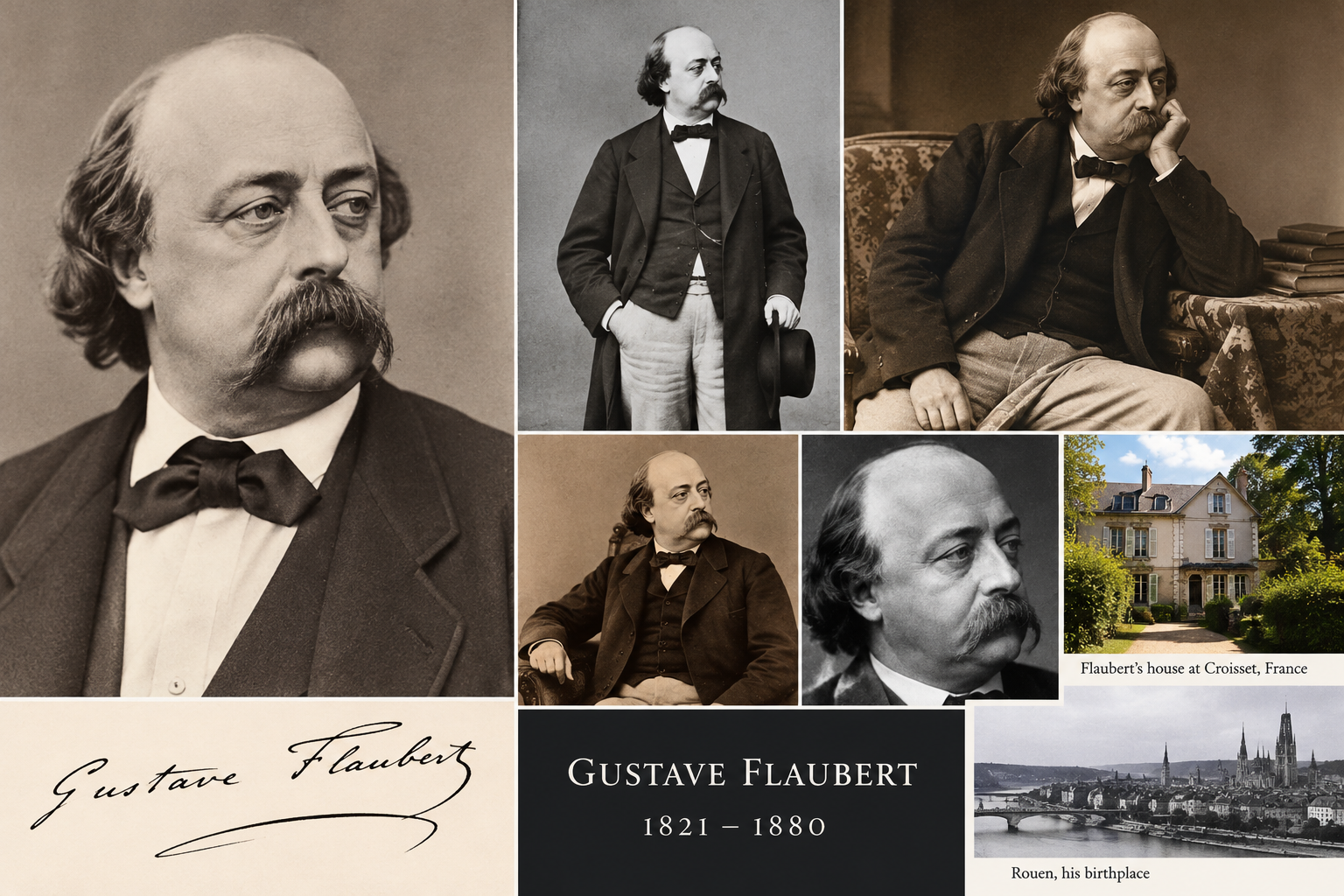
Gustave Flaubert (1821–1880) was one of the most influential French novelists of the nineteenth century. Renowned for his precise language, psychological insight, and relentless pursuit of literary perfection, he helped shape the development of modern realism. His works continue to be read, translated, published, and studied internationally.
Born on December 12, 1821, in Rouen, France, Flaubert grew up in a family connected to medicine. His father was a surgeon at the Hôtel-Dieu hospital. Although Flaubert studied law in Paris, his deepest interest was literature. He gradually devoted himself to writing, developing a disciplined approach that made every sentence an object of careful revision.
His best-known novel, Madame Bovary, was first published in book form in 1857. The story follows Emma Bovary, a woman whose romantic expectations clash with the limitations of provincial life. Through her experiences, Flaubert examined desire, dissatisfaction, social convention, and the distance between fantasy and reality. The novel provoked controversy and led to a trial on charges involving public morality. Flaubert was acquitted, and the controversy helped bring the book wider attention.
Flaubert continued to explore different historical and psychological worlds. Salammbô (1862) drew on ancient Carthage, while Sentimental Education (1869) portrayed personal ambitions and political upheaval in nineteenth-century France. His short fiction, including Three Tales (1877), further demonstrated his range as a writer.
Flaubert’s influence extended far beyond France. His works entered international literary circulation through translations and successive editions, inspiring generations of novelists, critics, and scholars. His insistence on finding le mot juste—the precisely fitting word—became emblematic of his artistic philosophy.
For readers in Mongolia and elsewhere, Flaubert remains a writer worth returning to: not simply because of his place in literary history, but because his characters reveal enduring tensions between personal desire, social expectations, and the realities of human life.
Flaubert died on May 8, 1880, at Croisset, near Rouen. His legacy endures in world literature, where his pursuit of precision and his unsparing examination of human behavior continue to invite new readers and interpretations.
BIOGRAPHY
Full name: Gustave Flaubert
Born: December 12, 1821 — Rouen, France
Died: May 8, 1880 — Croisset, France
Nationality: French
Profession: Novelist
Literary movement: Realism
Major works: Madame Bovary, Salammbô, Sentimental Education, Three Tales
Known for: Precise prose, psychological realism, and the ideal of le mot juste
SOURCES
Bibliothèque nationale de France (BnF), biographical overview of Gustave Flaubert.
BnF, Patrimoines Partagés, “Gustave Flaubert (1821–1880).”
Bibliothèque nationale de France, catalogue and manuscript records for Flaubert’s works.