TAKEZAKI SUENAGA: THE FEAR OF DEFEAT, THE PURSUIT OF REWARD, AND THE MAKING OF A WARRIOR’S FALSE LEGACY
By Altanbagana Baatar
DBA Candidate| Independent Historian
ImperialGG Historical Research Seriers
25 October 2026
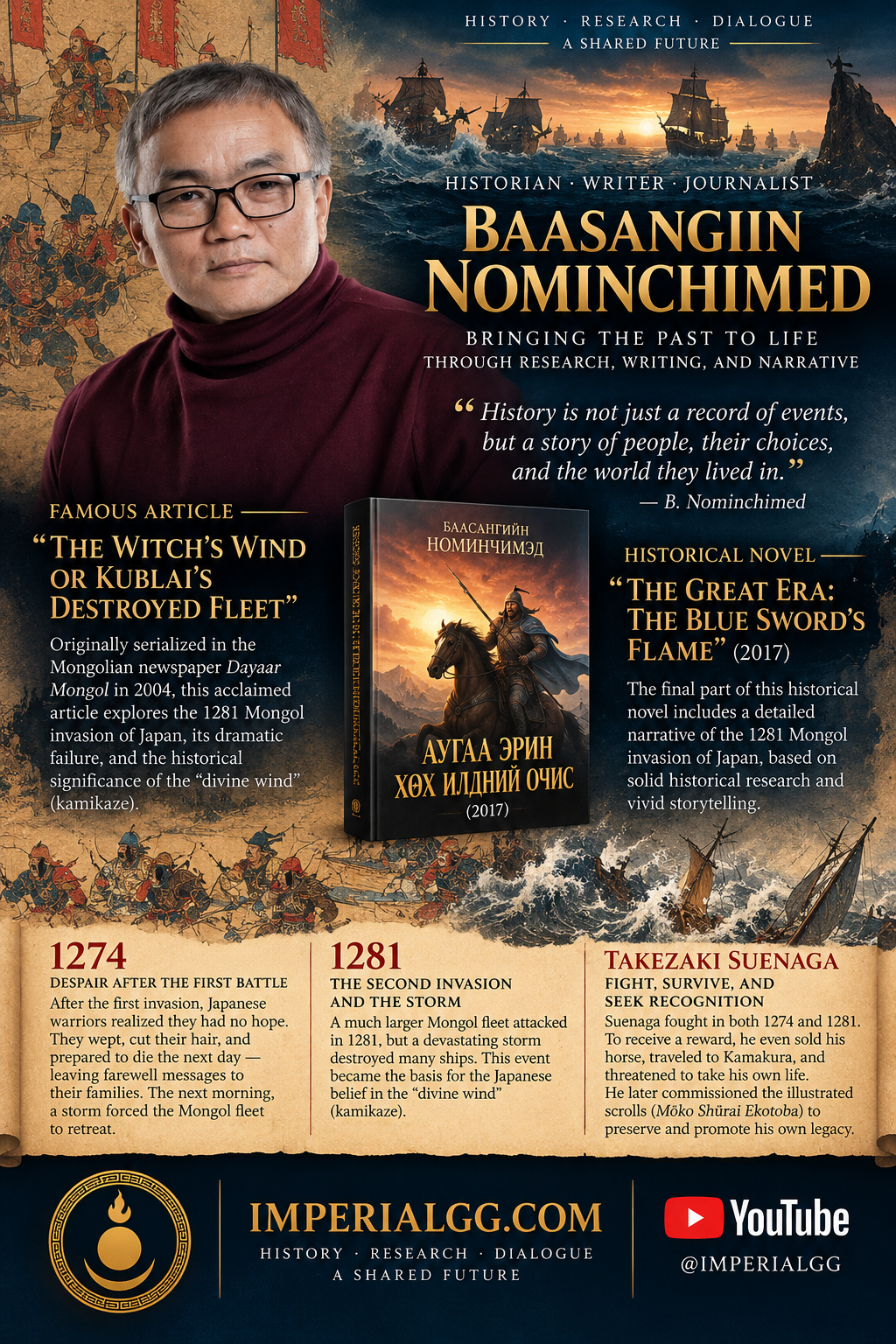
The Invasion of 1274 and the Illustrated Record of the Mongol Wars
The Mongol invasion of Japan in 1274 was not simply a confrontation between two military powers. It was also an experience of fear, uncertainty, and the struggle to preserve personal honor under conditions that Japanese warriors had never encountered on such a scale. The experience of Takezaki Suenaga, a warrior from Higo Province who participated in both the 1274 and 1281 campaigns, offers a particularly revealing perspective on this conflict.
Suenaga is known principally through the Mōko Shūrai Ekotoba, or Illustrated Account of the Mongol Invasions. The work combines paintings and written passages to describe his military experiences and his subsequent efforts to obtain recognition and reward from the Kamakura military government. It is one of the most important surviving sources for the invasions, but it must also be read critically: the work was commissioned to preserve Suenaga’s own record of valor, not to provide a comprehensive and impartial history of the war.
1274: A Warrior Confronts the Possibility of Death
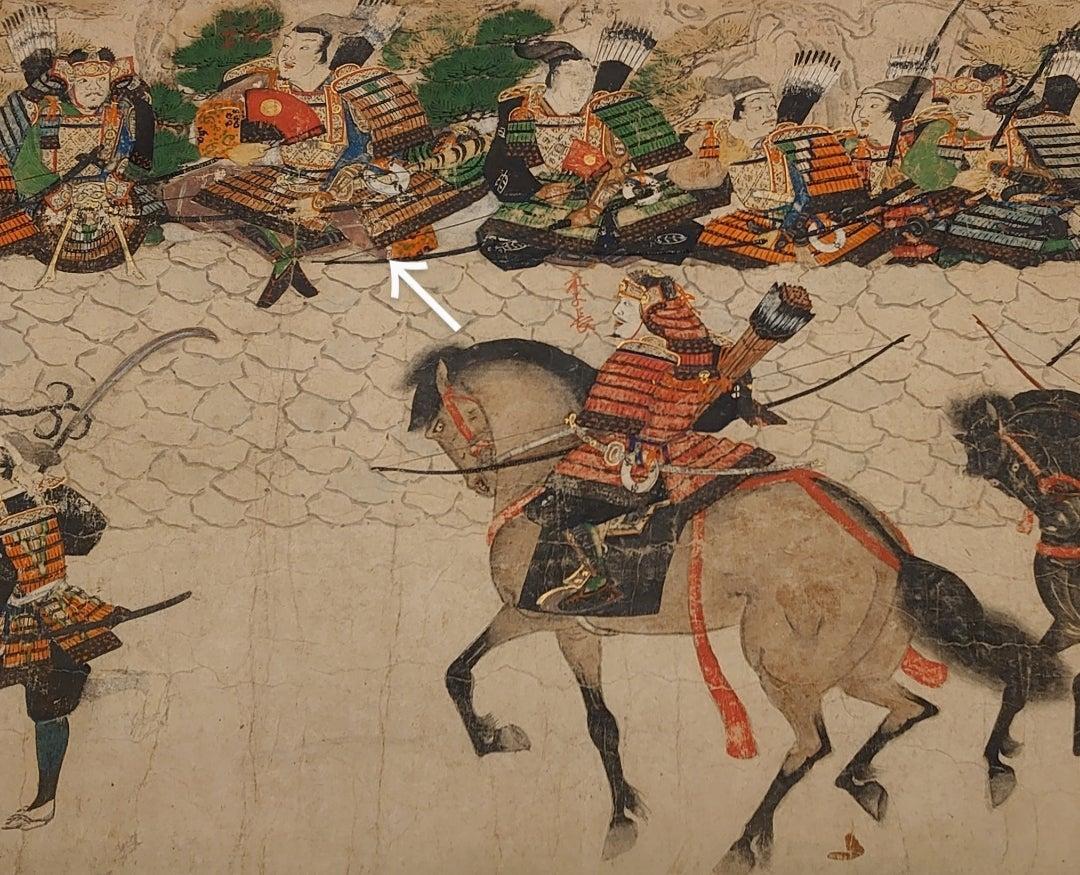
During the first invasion, Suenaga advanced toward the fighting with only a small group of companions. His account describes his determination to reach the enemy before other warriors could claim precedence in battle. Despite warnings to wait for the proper moment, he insisted on advancing, wishing to establish his courage through direct combat.
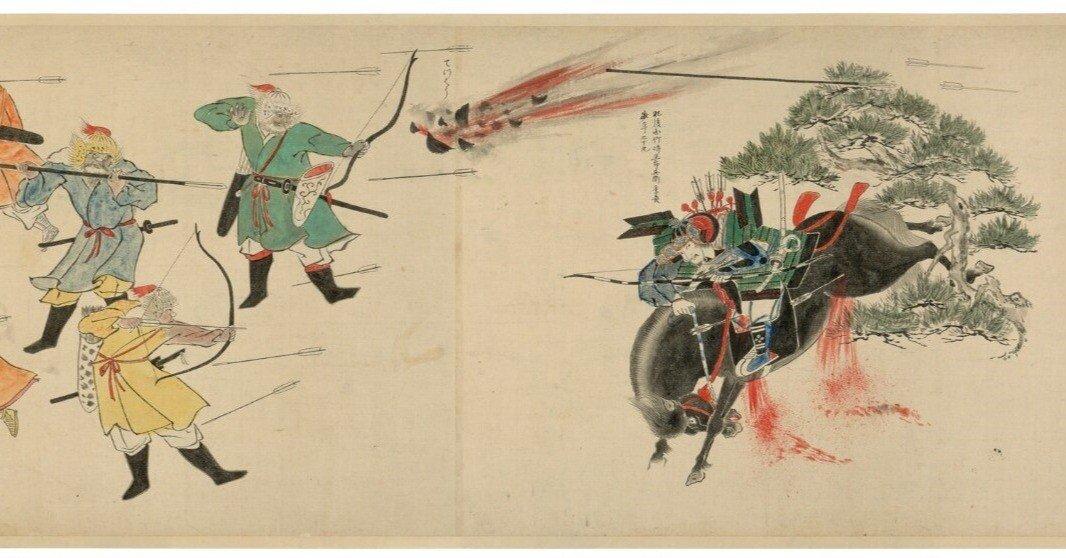
The encounter proved dangerous. Suenaga’s horse was struck by arrows, and he himself was wounded. His advance placed him in a perilous position, and he depended on the intervention of other Japanese warriors to survive. His experience reveals the vulnerability of an individual mounted warrior when confronted by a coordinated force employing massed archery and unfamiliar battlefield methods.
The Mongol-led forces’ initial success created a wider atmosphere of uncertainty among Japanese defenders. The scale of the invasion, the effectiveness of the attackers’ weapons, and the rapid movement of the expedition challenged assumptions about how a warrior could demonstrate valor and survive combat.
The Mongolian writer and historian Baasangiin Nominchimed, in his account commonly known as The Witch’s Wind, or Kublai’s Destroyed Fleet, presents a vivid narrative of the Japanese defenders’ despair after the first encounter. In this account, warriors recognize the possibility that they may not survive the following day; some are described as weeping, cutting their hair, and preparing to leave their families behind before what they believe may be their final battle.
This episode should be understood as a reported narrative of the emotional atmosphere surrounding the invasion. Its exact wording and relationship to the surviving Japanese source tradition require separate verification before it can be quoted as a direct statement by Suenaga. Nevertheless, the episode raises an important historical question: how did warriors understand courage when the outcome of battle appeared beyond their control?
The narrative also highlights a distinction between individual valor and collective military survival. A warrior could demonstrate extraordinary courage and still face defeat. The fear expressed in such accounts does not negate bravery; rather, it reveals the human reality behind the idealized image of the fearless samurai.
From the Battlefield to Kamakura: The Pursuit of Recognition
Suenaga’s struggle did not end when he survived the fighting. For a warrior of his standing, battlefield courage had to be recognized through an established system of rewards and service. Personal testimony alone might not be sufficient. Evidence of military achievement, witnesses, and the ability to present a persuasive claim could determine whether a warrior received land or official recognition.
After the 1274 campaign, Suenaga traveled to Kamakura to seek acknowledgment of his service. The journey was costly, and the surviving narrative emphasizes his determination to pursue his claim despite financial and institutional obstacles. He sought to demonstrate that he had advanced against the enemy and risked his life in battle.
His experience illustrates the importance of reputation in medieval Japanese military society. A warrior’s standing depended not only on what he believed he had accomplished but also on whether his actions could be recognized by those who controlled rewards and appointments.
Suenaga eventually received recognition, including a horse and an appointment connected with landholding. His success was not merely the result of fighting. It also reflected his persistence in presenting his case and obtaining official acknowledgment of his service.
This is one of the most revealing aspects of his story. Suenaga was both a combatant and an advocate for his own reputation. He understood that the memory of military service could influence his material position and the standing of his descendants.
1281: Returning to Battle
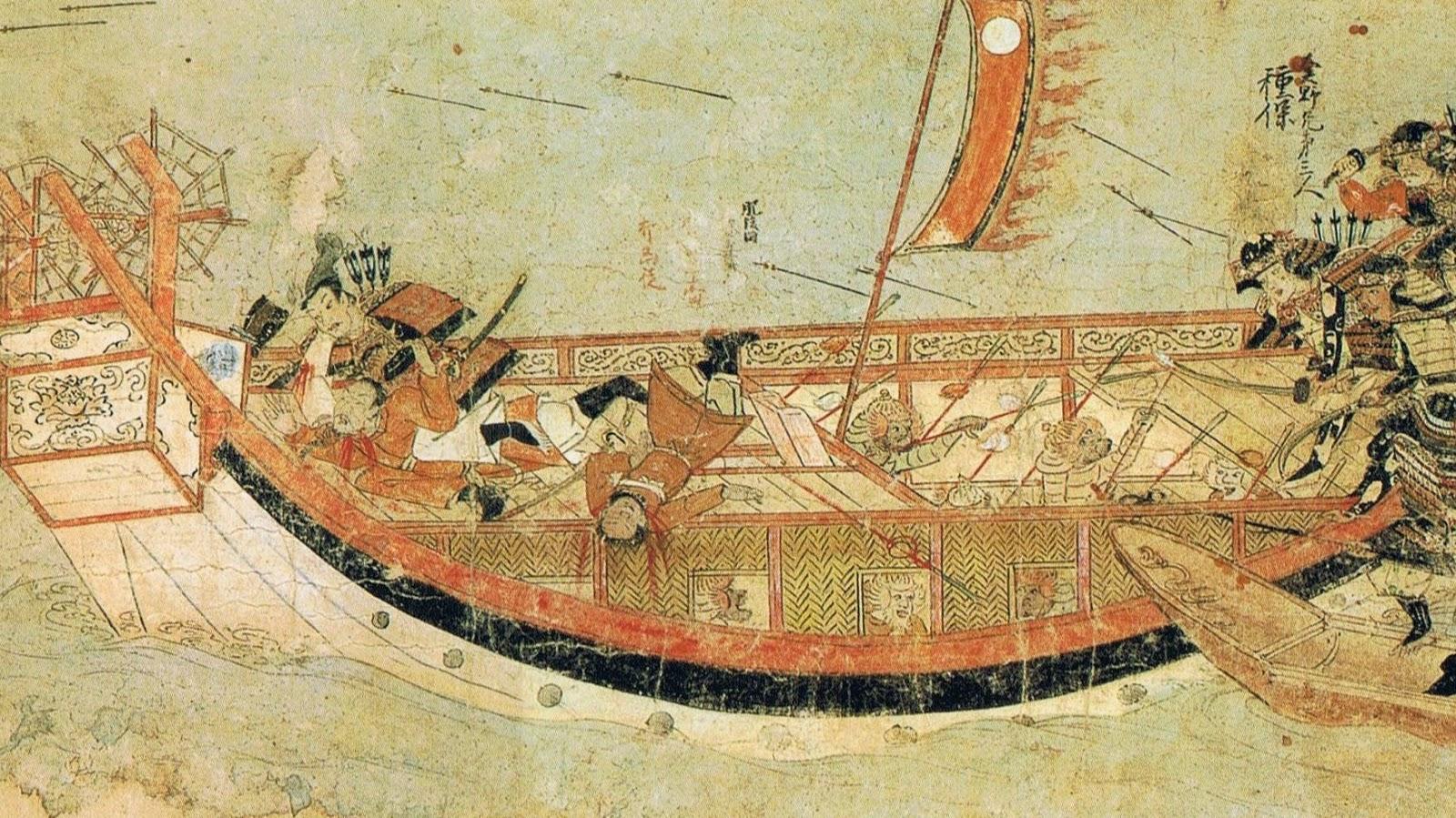
When the second Mongol-led expedition arrived in 1281, Suenaga again participated in the defense of Japan. The later sections of the Mōko Shūrai Ekotoba depict close combat involving enemy vessels and Japanese warriors attempting to board them. Suenaga’s narrative emphasizes his own participation and the military achievements through which he hoped to demonstrate his continuing valor.
The second invasion ended in disaster for the invading forces, with severe weather contributing to the loss of ships and the failure of the expedition. The subsequent cultural memory of the “divine wind,” or kamikaze, became one of the most enduring interpretations of the invasions.
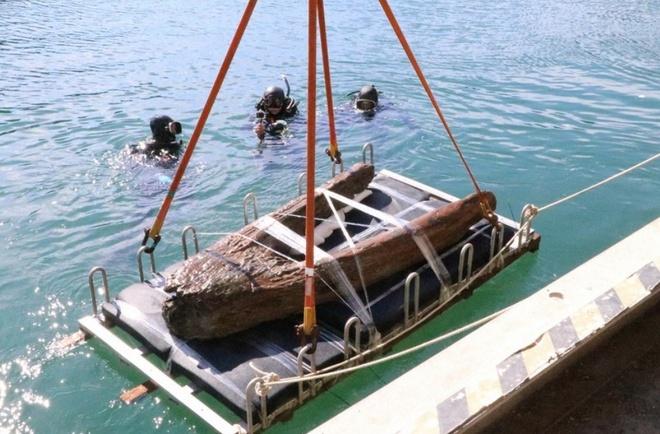
Yet the historical outcome should not be reduced to a single meteorological event. Japanese defenses, the difficulty of coordinating the fleets, logistical challenges, the timing of the campaign, and the maritime environment all require consideration. Archaeological investigations around Takashima Island provide material evidence for studying the ships and equipment associated with the second invasion.
Suenaga’s own story occupies a different but complementary level of analysis. While the archaeology investigates the material remains of the fleet, his illustrated account shows how one warrior sought to preserve his place within the memory of the conflict.
The Illustrated Scrolls: Historical Testimony and Self-Presentation
The Mōko Shūrai Ekotoba is frequently treated as a visual record of the Mongol invasions. Its depictions of warriors, horses, armor, weapons, and encounters with the invading forces are invaluable for the study of thirteenth-century Japanese military culture.
However, the scrolls should not be understood as equivalent to modern documentary photography. They were commissioned in connection with Suenaga’s desire to preserve and validate his military service. Their focus is therefore selective. They emphasize particular actions and individuals rather than presenting the complete strategic history of the invasion.
The surviving work also has a complex transmission history. Its physical condition deteriorated, and the images and textual sections were preserved, copied, rearranged, and interpreted over subsequent centuries. Modern scholars have identified reasons to distinguish the original medieval work from later alterations and reconstructions.
Thomas D. Conlan’s study, In Little Need of Divine Intervention: Takezaki Suenaga’s Scrolls of the Mongol Invasions of Japan, provides an important scholarly translation and interpretation of the scrolls and related documents. His research demonstrates why the source must be examined not only for what it depicts but also for the purposes it served and the ways in which it was transmitted.
The scrolls are therefore both historical testimony and an act of self-presentation. Suenaga sought to ensure that his courage would be remembered, his service recognized, and his place in the history of the invasions preserved.
This does not mean that the entire work is fictional. It means that its statements and images must be evaluated in relation to their context, purpose, and later history.
Conclusion: The Making of a Warrior’s Legacy
Takezaki Suenaga’s story connects three dimensions of the Mongol invasions of Japan: the danger experienced by warriors in battle, the institutional struggle to obtain recognition for military service, and the deliberate construction of historical memory.
The account of Japanese defenders who feared that they might die the following day reminds us that the invasion was experienced by human beings facing genuine uncertainty. Suenaga’s subsequent journey to claim a reward demonstrates that military reputation was not secured by courage alone. His illustrated scrolls reveal how the memory of a warrior’s actions could be shaped and preserved for future generations.
The historical importance of the Mōko Shūrai Ekotoba lies precisely in this combination. It provides rare evidence for the appearance and conduct of warriors during the invasions, while also showing how one participant attempted to control the narrative of his own achievements.
For the Heavenly Wind 750 research program, Suenaga’s story offers an important methodological lesson. Historical sources are not merely containers of facts. They are also products of particular circumstances, created by individuals with purposes, expectations, and interests. To understand them fully, historians must investigate both the events they describe and the processes through which those events became historical memory.
References
Conlan, Thomas D. 2001. In Little Need of Divine Intervention: Takezaki Suenaga’s Scrolls of the Mongol Invasions of Japan. Cornell East Asia Series 113. Ithaca, NY: Cornell University East Asia Program.
Conlan, Thomas D. “Myth, Memory, and the Scrolls of the Mongol Invasions of Japan.” Princeton University. https://tconlan.scholar.princeton.edu/sites/g/files/toruqf3991/files/tconlan/files/conlan_myth_memory_.pdf
Japan Tourism Agency. “Illustrated Account of the Mongol Invasions, Volume 2, Sections 5–8.” https://www.mlit.go.jp/tagengo-db/en/R5-00737.html
Nominchimed, Baasan. Shulmiin salhi buyu Khubilain süidsen flot [The Witch’s Wind, or Kublai’s Destroyed Fleet]. Originally reported as serialized in Dayaar Mongol newspaper in 2004. The exact edition and relevant page numbers should be verified against the original publication.
About the Author
Altanbagana Baatar is an independent researcher and Doctor of Business Administration (DBA) candidate whose research interests include Mongolian history, Inner Asian civilizations, historical sources, and cultural heritage. He is the founder and organizer of the Heavenly Wind 750 International Conference.
Date of Publication: October 25, 2026