
THE COOK AS A FIGURE OF TRUST IN MONGOLIAN STATE TRADITION
By Altanbagana Baatar
DBA Candidate| Independent Historian
ImperialGG Historical Research Seriers
23 October 2026
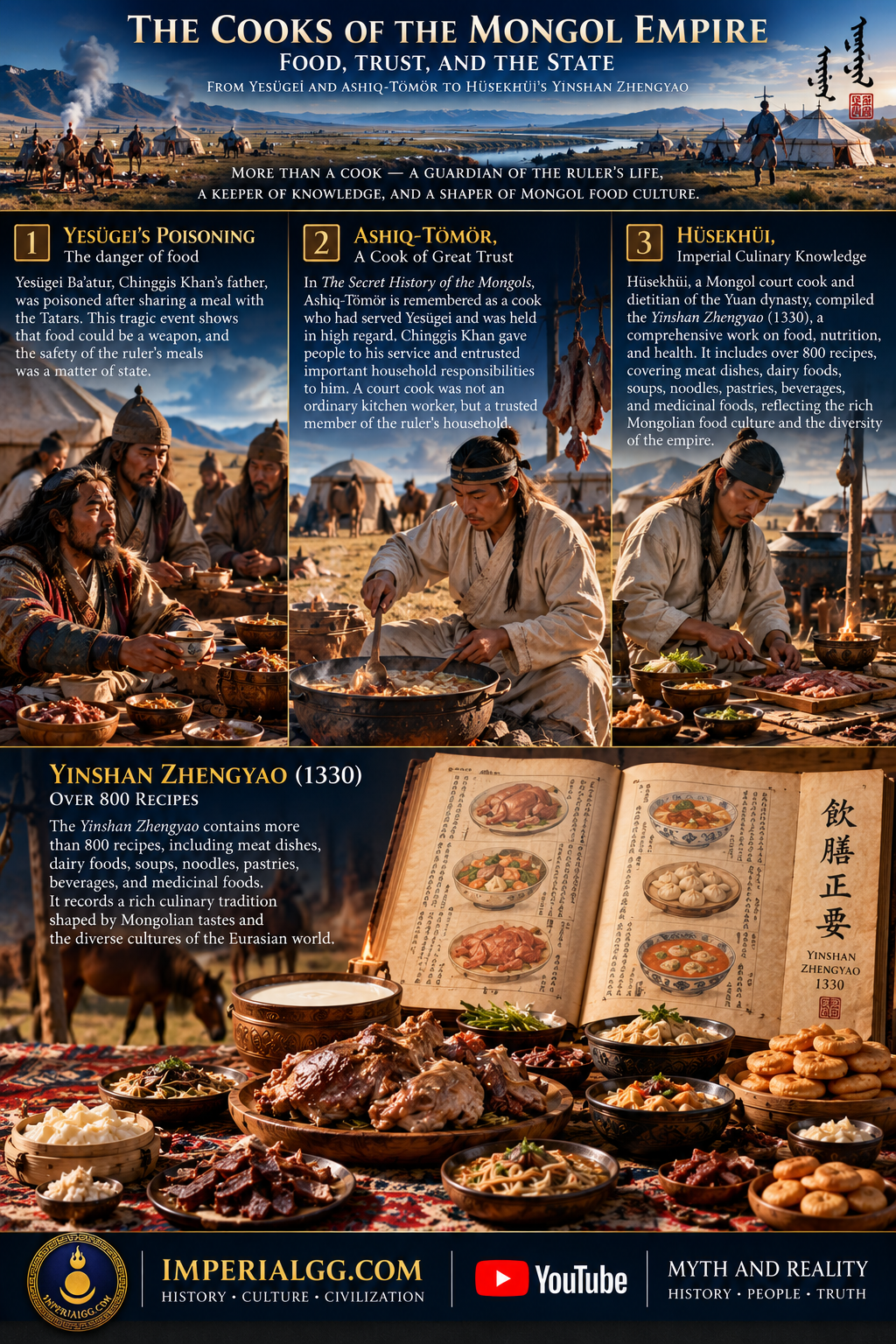
COURT SERVICE, FOOD SECURITY, AND CULINARY KNOWLEDGE FROM THE STEPPE EMPIRES TO THE YUAN DYNASTY
Abstract
The historical role of the cook in Mongolian political culture deserves closer examination than it has generally received. Often understood primarily as a provider of food, the court cook occupied a position at the intersection of household administration, personal service, food security, and political trust. This article examines the status of the cook in the Mongolian historical tradition through three bodies of evidence: the account of Yesügei Ba’atur’s poisoning in The Secret History of the Mongols; the representation of Ashiq-Tömör as a cook trusted by Chinggis Khan; and the development of specialized culinary and dietary knowledge under the Mongol Yuan dynasty, particularly in Hüsekhüi’s Yinshan Zhengyao (1330). Drawing on Thomas T. Allsen’s study of cuisine and imperial administration, alongside scholarship on Yuan dietary medicine, the article argues that cooking at the Mongol court cannot be understood as merely domestic labor. The cook’s proximity to the ruler made the position relevant to the administration of food, the maintenance of court life, and the reproduction of political trust. The article also proposes a comparative research agenda extending to the Xiongnu and earlier steppe polities. However, it distinguishes the long-term historical importance of food provision from the stronger claim that an identical institution of court cooks existed continuously from the Xiongnu to the Mongol Empire. The evidence supports a significant connection between culinary service and imperial governance, while the question of institutional continuity requires further investigation.
Keywords: Mongolian history; court cooks; ba’urchi; Chinggis Khan; Yesügei Ba’atur; Ashiq-Tömör; Hüsekhüi; Yinshan Zhengyao; Xiongnu; food security; Mongol Empire.
1. Introduction: Beyond the Preparation of Food
Food occupies a central place in the political and social life of pastoral societies. In a mobile society dependent on livestock, dairy products, meat, seasonal resources, and the management of herds, food provision involves more than cooking. It requires knowledge of animals and their products, preservation and preparation techniques, the coordination of supplies, and the ability to maintain the well-being of a household or community under changing environmental conditions.
These considerations become especially important when the household in question belongs to a ruler. A ruler’s household is not simply a private domestic unit. In the Mongolian imperial tradition, it was closely connected to the exercise of authority, the organization of personal service, the distribution of resources, and the administration of the political community.
The cook therefore deserves attention as a historical figure situated within this relationship between household and government.
The Mongolian historical record offers several points of departure for investigating this role. The Secret History of the Mongols preserves accounts of poisoning, trusted household personnel, and the organization of service around Chinggis Khan. Later evidence from the Mongol Empire demonstrates that the office of ba’urchi, conventionally translated as “cook” but sometimes understood more broadly as a steward or commissary, could be associated with considerable status and responsibility. Thomas T. Allsen has shown that the office was connected to the imperial guard and that some individuals who held it subsequently occupied important military or political positions.¹
The Yuan-period culinary tradition provides a further dimension. Hüsekhüi’s Yinshan Zhengyao, presented to the imperial court in 1330, demonstrates the development of specialized knowledge concerning food preparation, ingredients, dietary practices, and medicinal nourishment. It records a courtly culinary world shaped by Mongolian preferences and by the wider Eurasian connections of the empire.²
This article brings these sources together to advance three arguments. First, the cook’s role should be examined as a position of trust rather than defined exclusively by the physical preparation of meals. Second, the relationship between food provision and political authority became particularly visible in the institutional organization of the Mongol imperial court. Third, the development of Mongolian culinary knowledge provides evidence of a sophisticated food culture that included practical expertise, dietary knowledge, and the adaptation of culinary traditions across Eurasia.
The article also considers the possibility of deeper historical continuities reaching back to the Xiongnu. This is proposed as a comparative research question rather than as an established institutional genealogy.
2. Food, Trust, and Political Vulnerability in The Secret History of the Mongols
One of the most consequential food-related episodes in The Secret History of the Mongols is the death of Yesügei Ba’atur. According to the narrative, Yesügei encountered Tatars while traveling and was invited to share a meal. Recognized as an enemy, he was poisoned and subsequently died after returning home.³
This episode is not an account of misconduct by a court cook. Its significance lies elsewhere: it illustrates the vulnerability of a political leader when food is received and consumed in circumstances where its safety cannot be assured.
The episode demonstrates that eating could have political consequences. A meal offered in a social setting could create an expectation of hospitality and trust while concealing a threat. The danger arose not from cooking itself but from the inability to guarantee the integrity of the food and the intentions of those providing it.
This distinction is important. The story does not establish that Mongolian rulers systematically assigned food preparation to a particular office because of the danger of poisoning. Nor does it demonstrate that the office of ba’urchi originated in response to Yesügei’s death. Those claims would require evidence beyond the episode.
Nevertheless, the account helps establish the historical significance of food security in political life. Where a ruler’s survival depended partly on the food and drink offered to him, the people who controlled their preparation, handling, and delivery could occupy positions of considerable responsibility.
The issue was not simply culinary competence. It was also the reliability of those entrusted with access to the ruler.
This perspective provides a useful framework for examining the status of court cooks in the subsequent Mongolian imperial tradition. Their importance should be considered in relation to the ruler’s household, the organization of service, and the personal relationships through which political authority was exercised.
3. Ashiq-Tömör and the Status of the Court Cook
The account of Ashiq-Tömör in The Secret History of the Mongols offers a more direct starting point for examining the social standing of a cook.
In the passage supplied for this study, Chinggis Khan recalls people who had served his father, Yesügei Ba’atur. Ashiq-Tömör is identified as a cook, and the narrative describes the assignment of people in connection with his service. The surrounding passage also records Chinggis Khan’s decisions concerning Ibaqa Khatun and Jorchidai.
The significance of Ashiq-Tömör lies in the way the text identifies him by his role within the household tradition of the ruling family. He is not introduced simply as an anonymous person who prepares meals. He is named within a narrative concerning established relationships of service and the distribution of people and responsibilities.
This does not mean that every cook possessed the same status or enjoyed the same degree of access to the ruler. The text does not provide a comprehensive hierarchy of cooks, nor does it establish a universal rule that cooks were rewarded through promotion to a particular office.
It does, however, invite a more careful interpretation of the term cook in a Mongolian courtly context.
In modern usage, the word often refers to a specialist whose responsibilities are limited to preparing food. In a royal or imperial household, however, cooking could be part of a larger service structure involving the coordination of supplies, the preparation and delivery of meals, and the maintenance of the ruler’s household.
Ashiq-Tömör’s appearance in the narrative should therefore be read as evidence that the identity of a court cook could be socially and politically meaningful. The precise extent of his authority remains a question for textual comparison, but his named presence is itself significant.
The passage also suggests a connection between established service and the reproduction of trust across generations. Chinggis Khan’s reference to people who had served his father places the memory of earlier household relationships within the organization of his own rule.
This is a particularly important feature of Mongolian political culture. The ruler’s household was a setting in which personal relationships, service, loyalty, and political authority could intersect. A person’s position within that household might therefore have implications beyond the technical duties of an occupation.
4. The Ba’urchi: Court Service and Imperial Administration
The broader historical evidence makes it possible to move beyond a single named individual.
In his study of cuisine in the Mongol Empire, Thomas T. Allsen examines the office of ba’urchi, usually translated as “cook” and sometimes rendered as “steward” or “commissary.” He emphasizes that the position had an unexpectedly important place within the imperial system. The Mongol conception of government was closely connected to the ruler’s household establishment, and the title of ba’urchi indicated proximity to the ruler and the ability to act within his service structure.⁴
Allsen also notes that cooks served within the imperial guard, or keshig. One component, the kebte’ül, had responsibilities that included the provision and preparation of food and drink. Individuals holding the title could also perform functions beyond the preparation of meals, including military command.
The example of Ked Buqa, who held the title of ba’urchi while leading a major Mongol military expedition in the thirteenth century, illustrates the point. The title did not necessarily confine its holder to a narrowly defined culinary occupation.
This evidence requires a distinction between the technical meaning of the office and the broader responsibilities of its holders. A person identified as a cook might participate in an institutional structure whose duties extended to the administration and protection of the ruler’s household. The office could also form part of a career in imperial service.
It would therefore be misleading to assume that the historical importance of the ba’urchi resulted solely from the preparation of elaborate dishes. Its significance also derived from its place within the ruler’s household and the organization of trusted personnel.
The court cook occupied a position where several functions could converge:
Food provision: ensuring that food and drink were prepared and supplied for the ruler and his household.
Household service: participating in the daily organization of the imperial establishment.
Trust and access: performing duties in proximity to the ruler, where reliability was essential.
Administrative and military service: in some cases, holding responsibilities beyond culinary work.
These functions should not be assumed to have applied identically to every individual who held the title. The evidence nevertheless demonstrates that the office could carry a significance that extended well beyond ordinary domestic labor.
The Mongol imperial example thus supports a central argument of this article: the court cook should be studied as a participant in the political and administrative life of the ruling household.
5. Food Security and the Protection of the Ruler
The connection between food and political security provides a useful interpretive framework for understanding the status of trusted culinary personnel.
A ruler’s food passed through a chain of preparation, handling, storage, and delivery. Each stage involved practical responsibilities and the possibility of failure, contamination, or deliberate interference. The closer a person was to these processes, the more important reliability could become.
Yesügei Ba’atur’s poisoning illustrates the political consequences of unsafe food in a particular historical episode. The later organization of the Mongol court, as documented in the evidence concerning the ba’urchi, demonstrates that food preparation and provision could be incorporated into a structured system of household service.
The two bodies of evidence are related analytically, but they should not be treated as direct proof of a single institutional development. The poisoning of Yesügei does not establish the origins of the ba’urchi office. Rather, the episode helps explain why food provision could carry implications for personal security and political trust.
The court cook’s importance should consequently be understood in terms of the relationship between specialized knowledge and access to the ruler. Culinary skill was necessary, but skill alone does not explain the position’s potential social significance. The ability to perform a sensitive household function reliably was also important.
This interpretation does not require the assumption that every cook was a bodyguard or that every court cook had responsibility for detecting poison. It recognizes that food security formed part of the wider environment in which trusted household personnel operated.
The evidence therefore supports a cautious but meaningful conclusion: in the Mongol imperial household, the preparation and provision of food were not politically neutral activities. They belonged to a system of service in which reliability, proximity, and responsibility could carry consequences for the ruler and the state.
6. Hüsekhüi and the Development of Mongolian Culinary Knowledge
The historical role of the cook becomes even more significant when examined alongside the development of specialized culinary knowledge.
Hüsekhüi, also known in Chinese as Hu Sihui, compiled Yinshan Zhengyao (飲膳正要), conventionally translated as Proper and Essential Things for the Emperor’s Food and Drink or Essentials of the Emperor’s Food and Drink. The work was presented to the Yuan imperial court in 1330 and is associated with Hüsekhüi’s position as a court dietitian.⁵
The work is not simply a collection of recipes. It brings together information about ingredients, culinary preparations, dietary practices, beverages, and the relationship between food and health. It also reflects the multicultural setting of the Yuan court, where Mongolian ruling traditions intersected with Chinese, Turkic, Persian, and other Eurasian culinary and medical knowledge.
The significance of this compilation lies partly in its systematic character. Culinary knowledge appears as something that could be recorded, classified, transmitted, and applied within an imperial setting. Food preparation was therefore connected to a broader intellectual tradition involving the properties of ingredients, dietary prescriptions, and the management of nourishment.
Françoise Sabban’s study of the Yinshan Zhengyao emphasizes the relationship between court cuisine and the cultural environment of the Yuan dynasty. She notes the importance of mutton in the work and examines the presence of ingredients and culinary terminology reflecting contacts among different regions and traditions.⁶
The text is particularly important because it complicates any simple opposition between nomadic food and sedentary cuisine. The Yuan court’s food culture incorporated Mongolian preferences while also drawing on knowledge and ingredients from the wider Eurasian world.
The resulting culinary tradition should not be described as an unchanged survival of an ancient nomadic diet. It was a developing body of knowledge shaped by imperial expansion, cultural exchange, medical ideas, and the needs of a court that brought together people from different regions.
Hüsekhüi’s work therefore provides evidence of culinary expertise at a level extending beyond the immediate act of cooking. It demonstrates the existence of a written tradition in which food preparation, dietary knowledge, and health were treated as subjects worthy of systematic attention.
7. Culinary Knowledge as an Element of Imperial Culture
The Yinshan Zhengyao also offers a way to reconsider the relationship between Mongolian food culture and imperial administration.
The expansion of the Mongol Empire brought together regions with different agricultural systems, pastoral traditions, spices, ingredients, medical practices, and methods of food preparation. The imperial court became a setting in which some of these traditions could be combined and adapted.
The culinary world recorded by Hüsekhüi was therefore not exclusively Mongolian in the narrow sense. Its significance lies in the interaction between a Mongol ruling environment and a wider body of Eurasian knowledge.
This does not diminish its value as evidence for Mongolian history. On the contrary, it illustrates how imperial culture could develop through the incorporation and adaptation of knowledge from different regions.
The court’s culinary practices also suggest that food could be approached as a subject requiring professional expertise. The preparation of meals and the selection of ingredients were connected to questions of nourishment and health. Such knowledge could be recorded and transmitted beyond the immediate experience of individual cooks.
The existence of a text such as the Yinshan Zhengyao thus supports a broader understanding of Mongolian culinary culture. Food was not merely a necessity of pastoral life. Within the imperial court, it could become a specialized field of practical and written knowledge.
The number of recipes attributed to the work requires care. Modern descriptions of the Yinshan Zhengyao report different totals depending on what is counted as a recipe, beverage, medicinal preparation, or other food-related entry. One scholarly reference describes 236 recipes and more than two hundred illustrations, while other summaries divide the material into distinct categories.⁷
For this reason, claims that Hüsekhüi documented “more than 800 recipes” should not be repeated as a settled fact without identifying the specific edition, translation, or counting method supporting that number. The importance of the work does not depend on a single total. Its organization and range of culinary and dietary knowledge already demonstrate the sophistication of the Yuan court’s food culture.
8. The Xiongnu and the Question of Historical Continuity
The possibility that the special position of cooks in Mongolian political culture originated in the Xiongnu period is an important research question. It should, however, be approached through comparative historical analysis rather than assumed continuity.
The Xiongnu and the Mongol Empire both developed political systems in which the ruler’s household, the distribution of resources, and the management of people and livestock were central to the organization of power. Food provision would necessarily have been important in maintaining a ruler’s household and supporting the movement and activities of elite groups.
These broad similarities provide a reasonable basis for investigating the historical importance of culinary and provisioning personnel in successive steppe polities. Yet similarities in social requirements do not, by themselves, establish the continuous transmission of a specific office.
To demonstrate institutional continuity from the Xiongnu to the Mongol Empire, researchers would need to identify evidence concerning the terminology, duties, social status, and organization of culinary personnel in the earlier period and compare it with the better-documented Mongol ba’urchi.
At present, the available evidence considered in this article is stronger for the Mongol imperial period than for a direct institutional genealogy reaching back to the Xiongnu.
The appropriate conclusion is therefore not that the Mongol court cook’s office has been definitively traced to the Xiongnu. Rather, the Xiongnu provide an earlier comparative setting in which to investigate how food provision and household service contributed to the political organization of steppe empires.
Such a study could help distinguish between two forms of continuity: the enduring importance of food provision in steppe political life, and the transmission of a specific office or administrative institution. The first is a plausible broad historical proposition; the second requires more direct evidence.
9. Conclusion
The evidence examined here demonstrates that the cook in Mongolian imperial history should not be understood merely as a person responsible for preparing meals.
The account of Yesügei Ba’atur’s poisoning in The Secret History of the Mongols illustrates the potential political consequences of food offered under conditions of deception. The account of Ashiq-Tömör situates a named cook within the remembered network of service associated with Chinggis Khan’s family. Evidence concerning the ba’urchi demonstrates that culinary service could be integrated into the imperial household and, in some cases, associated with wider military and administrative responsibilities.
The Yuan-period Yinshan Zhengyao adds a further dimension by demonstrating the development of specialized culinary and dietary knowledge. Hüsekhüi’s work records a courtly tradition in which food preparation, ingredients, nourishment, and health were brought together in a systematic written compilation.
Taken together, these sources support the interpretation of the court cook as a figure situated at the intersection of practical expertise, household organization, political trust, and imperial culture. The importance of the position arose not simply from the preparation of food but also from its place within the ruler’s household and the organization of reliable service.
The proposed connection with the Xiongnu remains a promising avenue for further research. Establishing a direct institutional lineage, however, requires evidence beyond the general observation that food provision was important to successive steppe empires.
The broader historical conclusion is clear: culinary service was an essential part of the material life of the Mongol imperial court, while the surviving evidence shows that its organization and intellectual foundations could extend well beyond the kitchen itself.
Footnotes
Thomas T. Allsen, Culture and Conquest in Mongol Eurasia (Cambridge: Cambridge University Press, 2001), chapter 15, “Cuisine,” pp. 127–140. Allsen discusses the office of ba’urchi, its connection with the ruler’s household, and the responsibilities of some officeholders beyond cooking. See also the chapter’s later online publication by Cambridge University Press.
Hüsekhüi (Hu Sihui), Yinshan Zhengyao (飲膳正要), presented to the Yuan court in 1330. For a scholarly analysis of the work’s culinary and cultural dimensions, see Françoise Sabban, “Cuisine à la cour de l’empereur de Chine au XIVe siècle: Les aspects culinaires du Yinshan zhengyao de Hu Sihui,” Médiévales 5 (1983): 32–56, https://doi.org/10.3406/medi.1983.934.
The Secret History of the Mongols, account of Yesügei Ba’atur’s encounter with the Tatars and subsequent death. The precise section number and wording should be cited according to the edition used in the final publication.
Allsen, Culture and Conquest in Mongol Eurasia, 127–140. Allsen explains that ba’urchi is commonly translated as “cook,” though “steward” or “commissary” may better reflect some of its institutional functions. His discussion cautions against equating the historical office with a narrowly defined modern occupation.
Sabban, “Cuisine à la cour de l’empereur de Chine,” 32–56. The work is associated with Hüsekhüi’s service as a court dietitian during the Yuan dynasty and was presented to the emperor in 1330.
Sabban, “Cuisine à la cour de l’empereur de Chine,” especially the discussion of mutton, foreign ingredients, culinary vocabulary, and the multicultural character of the Yuan court’s food practices.
Yinshan Zhengyao, as summarized by the Chinese Text Project and other reference resources. Recipe totals vary according to classification and counting method; claims concerning “800 or more recipes” require a specific edition or catalogue to substantiate them.
References
Allsen, Thomas T. Culture and Conquest in Mongol Eurasia. Cambridge: Cambridge University Press, 2001.
The Secret History of the Mongols. Mongolian text and translation, with the edition and section numbering to be specified in the final version.
Sabban, Françoise. “Cuisine à la cour de l’empereur de Chine au XIVe siècle: Les aspects culinaires du Yinshan zhengyao de Hu Sihui.” Médiévales 5 (1983): 32–56. https://doi.org/10.3406/medi.1983.934.
Hüsekhüi (Hu Sihui). Yinshan Zhengyao (飲膳正要). Yuan dynasty, 1330.