WHY DID KHUBILAI KHAN TURN TOWARD JAPAN?
By Altanbagana Baatar
DBA Candidate| Founder & Organizer
Heavenly Wind 750 International Conference
Heavenlywind750.com | Imperilagg.com
26 October 2026
Diplomacy, the Southern Song Conquest, Maritime Security, and the Political Uses of Military Expansion, 1265–1281
Lorem ipsum dolor sit amet, consectetur adipiscing elit. Ut elit tellus, luctus nec ullamcorper mattis, pulvinar dapibus leo.
Abstract
The Mongol-led invasions of Japan in 1274 and 1281 raise a fundamental historical question: why did Khubilai Khan turn toward Japan, and what political and strategic objectives did he seek to achieve? Interpretations have emphasized imperial expansion, the diplomatic subordination of Japan, the disruption of Japanese connections with the Southern Song dynasty, and the possible use of military resources made available by the conquest of southern China. The history of Japanese maritime raiding against Goryeo Korea provides an additional regional context, although its direct influence on Khubilai’s decision remains to be demonstrated.
This article examines these explanations through Kenneth W. Chase’s study, “Mongol Intentions toward Japan in 1266: Evidence from a Mongol Letter to the Sung” (1996), alongside the Yuanshi (元史, History of Yuan) and other relevant historical evidence. Chase compares Khubilai’s 1266 letter to Japan with a letter sent to the Southern Song court in 1260. His analysis reveals a diplomatic strategy that combined professed peaceful intentions, demands for an exchange of envoys, an expectation of hierarchical political relations, and the implicit threat of military force.
The chronology is decisive. Khubilai’s diplomatic initiative toward Japan began before the Southern Song was conquered in 1279. Consequently, the proposition that Japan was initially targeted simply to redirect troops made redundant by the conquest of the Southern Song cannot explain the origins of the policy. Nevertheless, the conquest of southern China may have altered the military and logistical resources available for the second expedition in 1281. The article argues that the invasions should be understood as the outcome of an unresolved diplomatic confrontation that developed within the broader strategic transformation of East Asia.
Keywords: Khubilai Khan; Mongol Empire; Yuan dynasty; Japan; Southern Song; Goryeo; Japanese maritime raiding; diplomatic history; 1274 invasion; 1281 invasion.
I. Introduction: The Problem of Mongol Intentions
The invasions of Japan by the Mongol-led Yuan forces in 1274 and 1281 have often been interpreted through the dramatic outcome of the campaigns. The first expedition failed to establish Yuan control over Japan; the second ended in catastrophic maritime losses. In later historical memory, particularly in Japan, the storms associated with the invasions became inseparable from the concept of kamikaze, or “divine wind.”
Yet the outcome of a military expedition does not automatically explain why it was launched.
To understand Khubilai Khan’s decision, it is necessary to reconstruct the diplomatic and political circumstances that preceded the invasions. Japan was not an entirely unknown destination suddenly selected after the conquest of the Southern Song. The Yuan court had begun attempting to establish diplomatic communication with Japan in 1265, and a letter dispatched in 1266 reached Japanese authorities in 1268. Several subsequent missions failed to establish the relationship Khubilai sought. The first invasion followed in 1274.
This sequence raises several distinct questions.
Was Khubilai primarily seeking diplomatic recognition of his imperial authority? Did he hope to weaken the relationship between Japan and the Southern Song? Did the refusal of Japanese authorities to respond to his envoys make military intervention more likely? Did earlier Japanese maritime raids against Goryeo contribute to the political context? Finally, did the conquest of the Southern Song transform the military resources available for the second invasion?
These questions must not be collapsed into a single explanation.
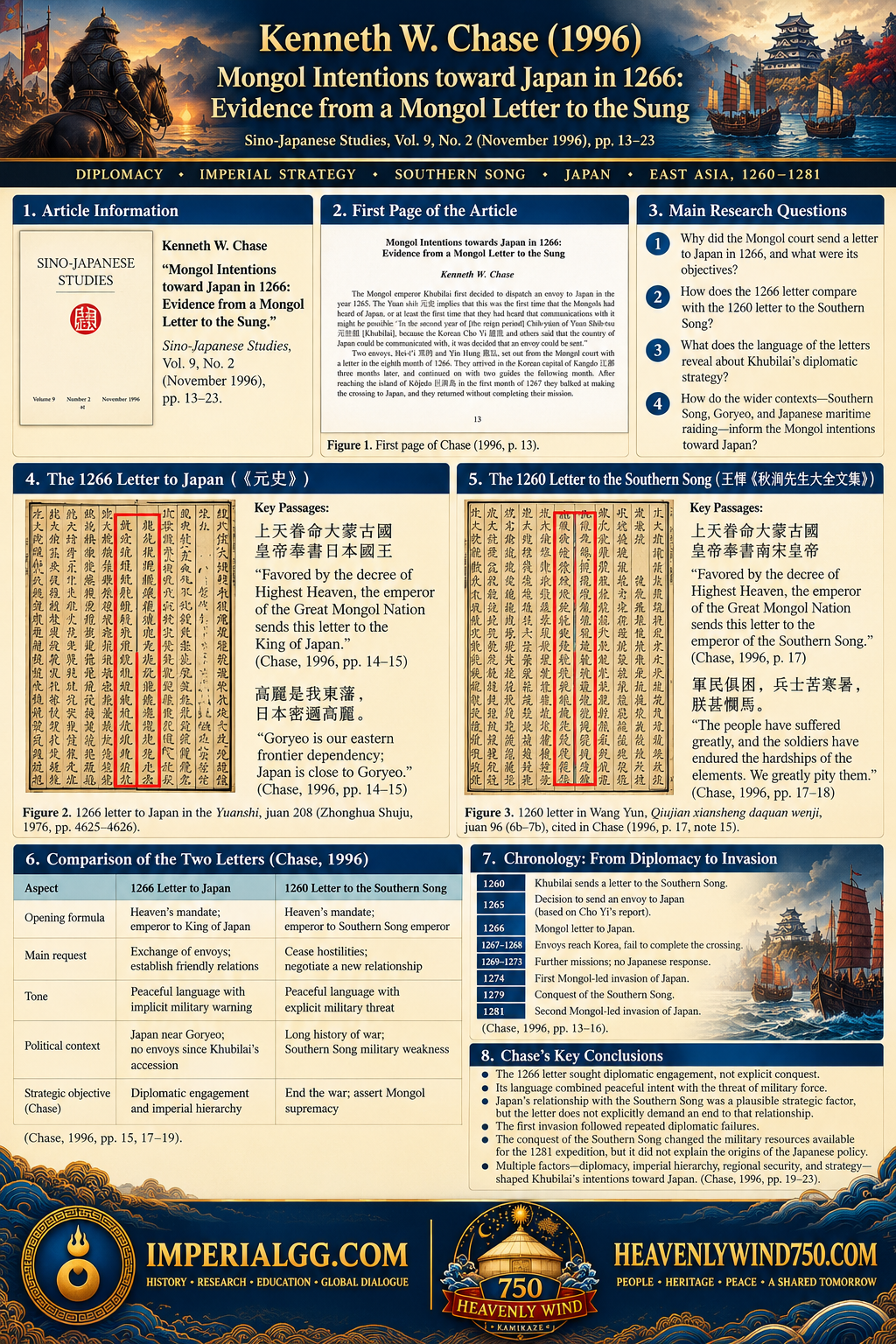
The most important starting point is Kenneth W. Chase’s article, “Mongol Intentions toward Japan in 1266: Evidence from a Mongol Letter to the Sung,” published in Sino-Japanese Studies, volume 9, issue 2, in November 1996, pages 13–23. Chase compares the wording and structure of Khubilai’s 1266 letter to Japan with a letter sent to the Southern Song in 1260.
His approach is particularly valuable because it begins with surviving diplomatic evidence rather than assuming that the subsequent invasions reveal the emperor’s intentions from the beginning.
II. The Chronology: Japan Before the Conquest of the Southern Song
The chronology immediately challenges one explanation sometimes proposed for the invasions: that Khubilai directed redundant Southern Song troops toward Japan after the conquest of southern China.
The relevant events occurred in the following order.
| Date | Event | Historical significance |
|---|---|---|
| 1260 | Khubilai sends a diplomatic letter to the Southern Song court after his accession. | Establishes an early example of his diplomatic language toward an independent neighboring regime. |
| 1265 | The Yuan court decides to send an envoy to Japan after Korean official Cho Yi reports that communication is possible. | Demonstrates that Japan had entered Yuan diplomatic calculations before the Southern Song conquest. |
| 1266 | The Mongol court dispatches a letter to Japan. | The principal document examined by Chase. |
| 1267–1268 | The initial mission fails to complete its crossing; the letter eventually reaches Japanese authorities through Korean intermediaries. | Diplomatic communication remains unresolved. |
| 1269–1273 | Further missions attempt to obtain a Japanese response. | Demonstrates that the Yuan court continued diplomatic efforts before resorting to invasion. |
| 1274 | The first Mongol-led expedition attacks Japan. | Military action follows repeated unsuccessful diplomatic initiatives. |
| 1279 | The Southern Song is finally conquered. | The strategic and military resources of the Yuan state change substantially. |
| 1281 | The second expedition attacks Japan. | The campaign takes place after the conquest of the Southern Song. |
The dates of the early missions and the sequence leading to the first invasion are discussed in Chase’s article, especially pages 13–16. The chronology establishes that the original diplomatic initiative preceded the Southern Song’s final defeat by thirteen years.
This does not mean that the Southern Song played no role in Khubilai’s calculations. It means that the hypothesis must be formulated more precisely.
The conquest of the Southern Song cannot explain why Khubilai first began approaching Japan in 1265–1266. It may, however, help explain the scale, composition, and logistical resources of the second expedition in 1281.
The distinction between the origins of a policy and the later resources used to implement it is essential.
III. The 1266 Letter to Japan: A Primary-Source Examination
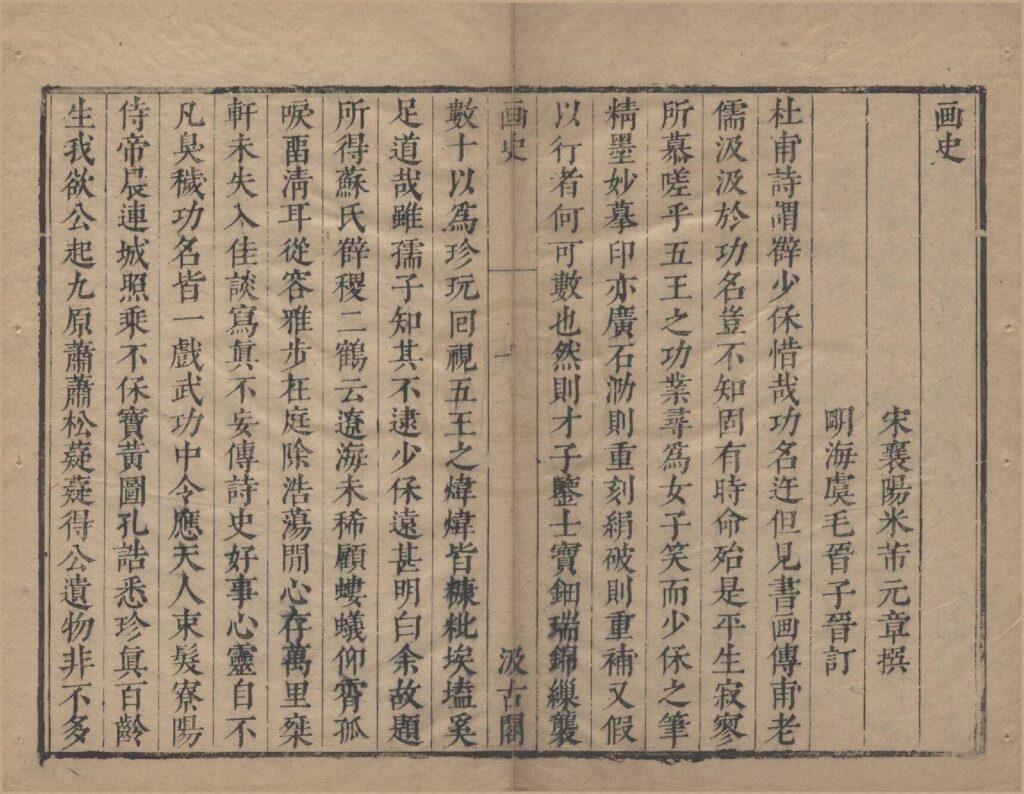
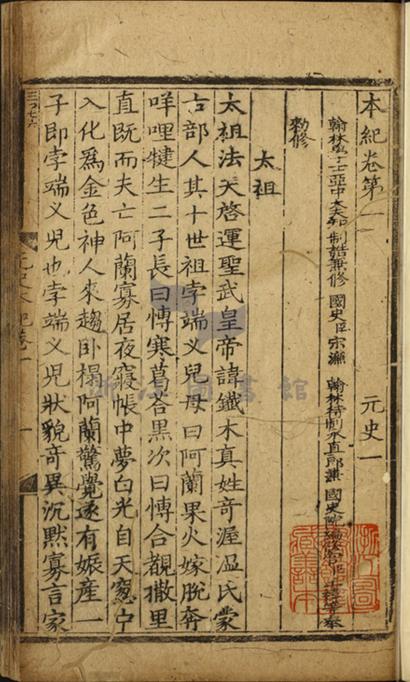
Chase identifies a copy of Khubilai’s 1266 letter preserved in the Tōdaiji library in Japan. He notes that this version is virtually identical to the text in chapter 208 of the Yuanshi. His published discussion reproduces an English translation of the letter and analyzes its wording in detail (Chase 1996, pp. 14–15).
The following Chinese text is the opening of the letter as transmitted in the historical tradition:
上天眷命大蒙古國皇帝奉書日本國王
Translation:
“Favored by the decree of Highest Heaven, the emperor of the Great Mongol Nation sends this letter to the King of Japan.”
Source: Yuanshi 元史, chapter 208, pp. 4625–4626 in the Zhonghua Shuju edition cited by Chase; compare the thirteenth-century copy discussed in Chase, p. 14 and note 5, p. 15.
The opening identifies the sender through the political and cosmological language of imperial authority. However, the phrase invoking Heaven’s mandate should not be interpreted as uniquely Mongol rhetoric. Chase notes that this expression derives from the classical Chinese literary tradition and appears in the 1260 letter to the Southern Song as well (Chase 1996, p. 15, note 6).
This is an important warning against interpreting every formal phrase as evidence of an exceptional Mongol attitude.
The letter continues by invoking the expectation that neighboring rulers should establish peaceful relations. It then turns to Korea:
高麗是我東藩,日本密邇高麗。
Translation:
“Goryeo is our eastern frontier dependency; Japan is close to Goryeo.”
Source: The wording is quoted here from the transmitted text of the 1266 letter; compare Chase’s translation in Sino-Japanese Studies 9, no. 2 (1996), pp. 14–15.
This passage is particularly significant. Japan is introduced in relation to Goryeo, a state already incorporated into the Mongol imperial political order. The geographical relationship is therefore also a political one.
The letter subsequently notes that Japan had maintained contacts with China in earlier times but had not sent an envoy to Khubilai to establish friendly relations. It asks Japan to exchange diplomatic messages and concludes with a warning about the possibility of war.
Chase translates the concluding portion as follows:
“As for using soldiers and weapons, who would want that? King, consider this.”
(Chase 1996, p. 15.)
The passage combines an expressed preference for peaceful relations with an unmistakable implication of coercion.
Two observations follow.
First, the letter does not explicitly demand the complete surrender of Japan or the immediate termination of Japanese trade with the Southern Song. Chase emphasizes that neither demand appears in the surviving text (1996, p. 15).
Second, the letter is not simply a friendly invitation. Its political context, imperial language, and reference to military force indicate that Khubilai expected Japan to respond within a diplomatic framework acceptable to the Yuan court.
The document therefore supports a more nuanced interpretation than either “Khubilai wanted only peace” or “Khubilai had already decided to conquer Japan.”
It establishes a demand for diplomatic engagement under conditions of imperial pressure. It does not, by itself, establish the precise military decision-making process that later led to invasion.
IV. The 1260 Letter to the Southern Song: A Controlled Comparison
Chase’s principal methodological contribution is his comparison of the 1266 Japanese letter with a letter Khubilai sent to the Southern Song emperor in 1260, shortly after his accession.
The 1260 letter survives in the literary collection of Wang Yun (王恽), Qiujian xiansheng daquan wenji 秋澗先生大全文集, juan 96, folios 6b–7b, as cited by Chase (1996, p. 17, note 15).
The letter opens with wording closely parallel to that of the 1266 document:
上天眷命大蒙古國皇帝奉書南宋皇帝
Translation:
“Favored by the decree of August Heaven, the emperor of the Great Mongol Nation sends this letter to the emperor of the Southern Song.”
Source: Wang Yun, Qiujian xiansheng daquan wenji, juan 96, fols. 6b–7b; English translation in Chase 1996, p. 17.
The parallel is important. Both communications present Khubilai as a ruler whose authority is grounded in Heaven’s mandate. Both address political entities outside the Mongol empire. Both combine diplomatic language with expectations about how the recipient should respond.
The Southern Song letter, however, is substantially longer and more explicit about military threats.
Khubilai refers to decades of warfare and the suffering of ordinary people:
軍民俱困,兵士苦寒暑,朕甚憫焉。
The exact wording of the surviving text varies across transmitted versions; the relevant passage in Chase’s English translation states that the people had suffered and the soldiers had endured the hardships of the elements.
Translation of the passage as rendered by Chase:
“The people have experienced the bitterness of suffering, while the warriors have experienced the rigors of the elements. We greatly pity them.”
(Chase 1996, p. 17.)
The letter then proposes a cessation of hostilities, but it also emphasizes the military weakness of the Southern Song and the Mongol capacity to continue the war.
Chase’s analysis demonstrates that the language of peaceful intent did not preclude a deliberate threat of military action. In the Southern Song case, the letter explicitly described the forces that could be deployed and warned that refusal to negotiate would bring devastating consequences (Chase 1996, pp. 17–19).
This comparison has direct implications for the interpretation of the 1266 letter to Japan.
The existence of peaceful language does not prove that Khubilai lacked coercive objectives. Conversely, the presence of a military warning does not establish that a full-scale invasion had already been irrevocably decided upon.
The two letters must be interpreted as diplomatic instruments within their respective political circumstances.
V. What Did Khubilai Actually Want from Japan?
Chase’s comparison leads to a crucial conclusion: neither the 1266 letter to Japan nor the 1260 letter to the Southern Song explicitly demanded more than the exchange of envoys. Yet the diplomatic exchange would have involved different degrees of political subordination for the two recipients (Chase 1996, pp. 19–21).
This distinction matters because medieval East Asian diplomacy operated through hierarchical forms of recognition. The titles assigned to rulers, the presentation of envoys, and the ceremonial protocols accompanying diplomatic contact could express political relationships without necessarily implying direct annexation.
The 1266 letter addresses the Japanese ruler as “King of Japan” rather than emperor. Within the Chinese-language diplomatic tradition, this designation placed the recipient below the emperor in formal status. However, Chase cautions that the title alone did not necessarily mean that Japan had surrendered its political independence. Japanese rulers had previously accepted similar designations in relations with Chinese dynasties without losing their independent political institutions (Chase 1996, pp. 19–20).
This point prevents an overly simple reading of the letter.
Khubilai’s objective may have included securing recognition of his imperial position and establishing a formal relationship in which Japanese envoys acknowledged the appropriate diplomatic hierarchy. Such an arrangement would have been politically significant even without direct territorial conquest.
At the same time, the Yuan court’s expectation of a response was not detached from its military power. Continued refusal could be interpreted as rejection of the relationship Khubilai sought to establish.
The surviving evidence therefore supports three connected but distinct objectives:
Diplomatic communication: securing the exchange of envoys and formal acknowledgment of the Yuan court.
Imperial hierarchy: placing Japan within a diplomatic order in which Khubilai’s superior status was recognized.
Coercive enforcement: retaining the option of military action if diplomacy failed.
These objectives were compatible. The historical question is how their relative importance changed between 1265 and 1281.
VI. The Southern Song Connection: A Strategic Hypothesis, Not a Proven Sole Cause
One interpretation discussed by Chase is that Khubilai wished to bring Japan into his political orbit partly because of its economic and cultural connections with the Southern Song. Japanese trade with the Southern Song was significant, and the Southern Song was still a major independent power when the Yuan court initiated diplomatic communication with Japan.
Chase presents this as an interpretation advanced in earlier scholarship, including the view that Khubilai may have sought to weaken Japan’s connections with the Southern Song and encourage Japan to align itself with the Mongols (1996, p. 13).
This hypothesis is plausible, but the evidentiary distinction must remain clear.
The 1266 letter does not explicitly demand that Japan terminate its trade with the Southern Song. Chase specifically notes the absence of such a demand (1996, p. 15). The letter therefore cannot be cited as direct proof that severing Japanese-Southern Song connections was Khubilai’s principal objective.
Nevertheless, the geopolitical context makes the question important. Japan’s commercial and cultural relationship with the Southern Song meant that Japanese neutrality was not necessarily irrelevant to the Yuan court’s strategic calculations.
A cautious formulation is therefore preferable: Khubilai may have regarded Japan’s relationship with the Southern Song as a factor in his diplomatic strategy, but the surviving letter does not establish that severing this relationship was the decisive reason for his approach.
The distinction between a plausible strategic consideration and a documented primary motive is central to responsible historical interpretation.
VII. Did the Conquest of the Southern Song Release Troops for the Invasion of Japan?
The hypothesis that Khubilai redirected former Southern Song troops toward Japan deserves examination, particularly in relation to the second expedition of 1281.
The chronology, however, rules out the idea that the conquest of the Southern Song initiated the Japanese policy. The Yuan court had already begun its diplomatic approach to Japan in 1265, sent the 1266 letter, and pursued additional missions before the first invasion in 1274.
The conquest of the Southern Song in 1279 occurred after the first expedition and before the second. It transformed the Yuan state’s access to military personnel, maritime expertise, shipbuilding resources, and the infrastructure of southern China.
This makes it reasonable to investigate whether former Southern Song military personnel and maritime resources contributed to the second expedition.
However, three propositions must not be confused:
That the conquest of the Southern Song increased the Yuan state’s available military and maritime resources.
That former Southern Song personnel and resources were incorporated into the forces used against Japan.
That the original decision to attack Japan was made specifically to redirect surplus Southern Song troops.
The first proposition follows from the broad political and military consequences of the conquest. The second requires evidence about the composition and organization of the 1281 forces. The third is not supported by the chronology of the initial diplomatic initiative.
The hypothesis should therefore be revised rather than discarded entirely. The conquest of the Southern Song may help explain the capabilities and composition of the second expedition, but it cannot explain the beginning of Khubilai’s diplomatic policy toward Japan.
Further research should examine the Yuan records concerning the Jiangnan Army, the commanders responsible for maritime operations, shipbuilding and provisioning orders, and the recruitment or reassignment of former Southern Song personnel. Such evidence would allow the question to be addressed through administrative and military documentation rather than inference alone.
VIII. Japanese Maritime Raiding and Goryeo: A Regional Context
Japanese maritime raiding against the Korean peninsula is another possible factor in the history of Khubilai’s policy toward Japan.
Goryeo had experienced maritime attacks associated with raiding groups operating from the Japanese archipelago. Such attacks affected coastal security, trade, and the political relationship between Goryeo and its neighbors.
The Yuan court’s 1266 letter explicitly identifies Goryeo as its eastern frontier and emphasizes Japan’s geographical proximity to it. This passage makes the Korean dimension particularly relevant to the investigation.
However, geographical proximity is not equivalent to proof of causation.
The 1266 letter, as analyzed by Chase, does not identify Japanese raiding as the principal reason for Khubilai’s diplomatic initiative. It emphasizes the absence of diplomatic communication and the desire to establish friendly relations. Consequently, the letter cannot be used as direct evidence that the invasion was primarily retaliation for maritime attacks against Goryeo.
To establish such a connection, the investigation must compare the Goryeosa 高麗史 (History of Goryeo) with the Yuanshi and other records. The relevant questions include whether Goryeo officials reported maritime raids directly to Khubilai, whether the Yuan court explicitly connected those raids to its policy toward Japan, and whether surviving orders indicate that the expeditions were intended to punish raiders or secure maritime routes.
Without such evidence, the most defensible conclusion is that maritime raiding formed part of the wider regional security environment but cannot yet be established as the decisive cause of the invasions.
This approach does not diminish the significance of the raids. It places them within a broader analysis of the relationship between Goryeo’s security, Yuan imperial strategy, and the unresolved diplomatic relationship with Japan.
IX. From Diplomacy to War, 1266–1274
The diplomatic history between 1266 and 1274 strengthens the argument that the first invasion followed a prolonged attempt to obtain a response from Japan.
Chase records that the initial envoys failed to complete their crossing, that the letter eventually reached Japanese authorities through Korean intermediaries, and that additional missions followed in 1268, 1269, 1271, and 1273. The Japanese authorities did not provide the response sought by Khubilai (Chase 1996, pp. 13–16).
This sequence is significant because it reveals that the Yuan court did not move directly from the first letter to immediate military invasion.
Instead, diplomacy continued over several years. The failure of the missions to establish the desired relationship contributed to the deterioration of relations.
Chase concludes that the Mongols attempted to achieve their aims through diplomacy if possible and that the invasion followed after this option had been exhausted (1996, p. 16). This is his interpretation of the surviving diplomatic sequence, not direct evidence of every deliberation within Khubilai’s court.
The distinction is important. We can establish that several missions occurred and that the first invasion followed them. We cannot reconstruct every internal discussion or determine the precise moment when Khubilai decided that military action was unavoidable.
Nevertheless, the documented chronology strongly supports the conclusion that the first expedition emerged from a prolonged diplomatic confrontation rather than from a sudden decision made after the conquest of the Southern Song.
X. Conclusion: A Multi-Causal Explanation
Why did Khubilai Khan turn toward Japan?
The surviving evidence does not support a single-cause explanation. Instead, the history points toward a combination of imperial diplomacy, political hierarchy, regional security, strategic competition, and military capability.
Chase’s comparison of the 1266 letter to Japan with the 1260 letter to the Southern Song provides the strongest starting point. The letters show that Khubilai combined language of peace with demands for diplomatic engagement and warnings of military consequences. His approach to Japan should therefore be understood as an attempt to establish a political relationship within the Yuan court’s imperial framework, backed by the possibility of force.
The Southern Song connection remains relevant because Japan’s commercial and cultural relationships with the Southern Song formed part of the wider strategic environment. Yet the surviving Japanese letter does not explicitly demand that those relationships end. The hypothesis that Khubilai sought to weaken Japan’s connections with the Southern Song remains plausible but unproven as the principal motive.
The conquest of the Southern Song in 1279 must be treated separately. It could have transformed the Yuan state’s access to troops, ships, and maritime expertise before the second expedition in 1281. But it cannot explain the original decision to establish diplomatic contact with Japan, which had begun in 1265.
Finally, Japanese maritime raiding against Goryeo provides an important regional context. Establishing whether it directly influenced Khubilai’s decision requires closer examination of Korean and Yuan administrative records. The available evidence does not justify presenting it as the sole or decisive cause.
The most defensible interpretation is therefore that Khubilai’s policy toward Japan began as a diplomatic initiative intended to establish a recognized relationship under Yuan imperial authority. The refusal of Japanese authorities to respond, the broader geopolitical relationship with the Southern Song, and the Yuan court’s growing willingness to use military force contributed to the transition from diplomacy to war. The conquest of the Southern Song subsequently altered the resources available for the second expedition.
The invasions of 1274 and 1281 were thus connected episodes, but they were not identical operations and should not be explained through the same immediate causes.
A rigorous history must distinguish what the documents explicitly state from what historians infer from their context. In this case, that distinction reveals a more complex and historically persuasive explanation than the claim that Khubilai simply redirected surplus troops toward Japan after conquering the Southern Song.
Notes and Primary-Source References
1. Kenneth W. Chase, 1996. “Mongol Intentions toward Japan in 1266: Evidence from a Mongol Letter to the Sung.” Sino-Japanese Studies 9, no. 2 (November): 13–23. The full article is available at: https://www.chinajapan.org/articles/09.2/09.2chase13-23.pdf
Relevant pages:
pp. 13–14: Initial missions and competing interpretations of Khubilai’s intentions.
pp. 14–15: The 1266 letter to Japan and its surviving versions.
pp. 16–19: The 1260 letter to the Southern Song and comparison of diplomatic language.
pp. 19–21: Comparative interpretation and conclusions.
2. Yuanshi 元史, chapter 208, “Lie zhuan di jiu shi wu: Waiyi yi” 列傳第九十五·外夷一. Zhonghua Shuju edition, 1976, pp. 4625–4626, as cited by Chase. This is the principal dynastic-history text for the 1266 letter and the Yuan account of Japan. The chapter should be checked against the Chinese edition when preparing page-specific quotations for publication.
3. Wang Yun 王恽, Qiujian xiansheng daquan wenji 秋澗先生大全文集, juan 96, fols. 6b–7b. This collection preserves the 1260 letter to the Southern Song discussed by Chase (1996, p. 17, note 15). The quoted English translation above follows Chase’s published rendering.
4. Yuanshi 元史, chapter 7, “Shizu si” 世祖四. The chronological annals provide context for the Yuan court’s military and diplomatic activity during the 1260s. The relevant entries should be examined alongside chapter 208 rather than treated as substitutes for the diplomatic letter.
5. Goryeosa 高麗史 (History of Goryeo). The relevant annals and biographies should be examined for maritime raiding, coastal security, Korean participation in the expeditions, and reports transmitted to the Yuan court. Exact volume and page references should be added only after the relevant entries have been verified against a reliable edition.
6. National Archives of Japan. “Japan and Mongolia—Our History through Archival Records: Relations in the Thirteenth Century.” https://www.archives.go.jp/about/activity/international/jp_mn50/english/ch01.html
Source-Critical Note
The article distinguishes direct quotations from paraphrases and interpretations. The English translations of the 1266 and 1260 letters follow Chase’s published translations. Chinese wording is included where it can be identified in the transmitted texts, but the complete letters should be checked against the relevant Chinese editions before any expanded verbatim transcription is published. The argument concerning former Southern Song troops and maritime raiding is presented as a research question requiring additional primary-source evidence, not as an established